Least Privilege and Permission Scoping for AI Agents in Production
Four linked controls keep autonomous agents from holding more authority than their tasks need.
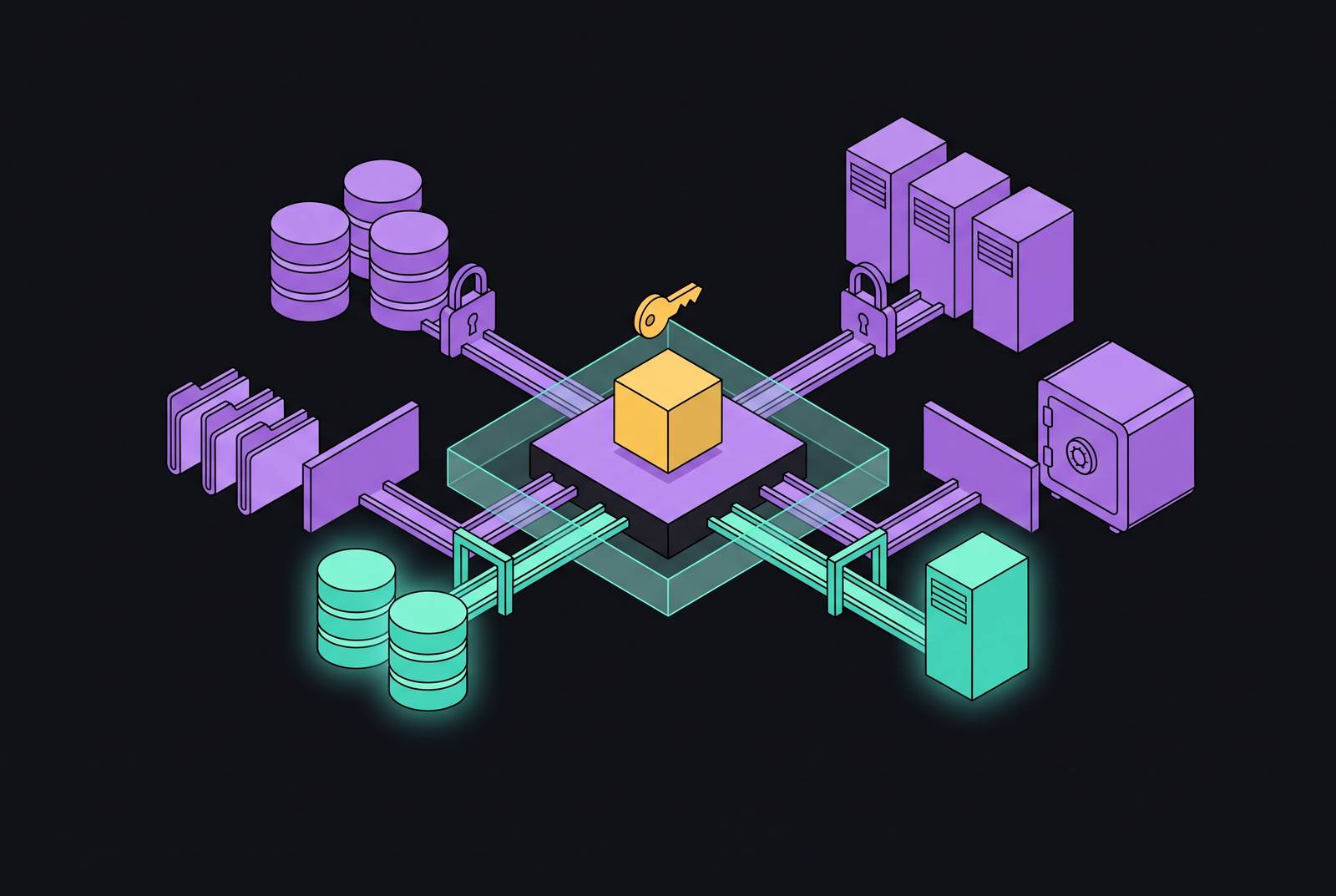
Least privilege for AI agents in production is a design discipline. Human-style access controls leave autonomous agents with authority that can outlive or exceed their tasks. Limiting the damage requires four controls working together, which are dedicated identities, just-in-time permissions, task-bound tool access, and end-to-end auditability.
Why human-style IAM structurally fails for AI agents
Human identity and access management assumes that agents work the way people do. An identity belongs to a persistent person, access changes slowly enough for periodic review, and a human authorizes delegated actions. Agents can instead appear for a task, act autonomously, and disappear. Static service accounts offer no escape from this mismatch when their standing permissions are reused for workflows whose purpose and scope keep changing.
Microsoft's security guidance describes how this happens quietly. A team gives an agent a broad “Reader” role, then expands its workflow to include remediation. Rather than redesign the role, the team grants more access. The workflow now has authority beyond its original purpose, without a corresponding decision about where that authority should stop. Each change looks like a small change to how the work gets done.
The risk grows when one agent connects several systems. It may hold credentials for email, files, a ticketing system, and a code repository at once. Each integration can look harmless on its own. Together, they let the agent correlate information and take actions that nobody explicitly authorized as a whole. In multi-agent deployments, new credentials issued at each delegation hop can also give downstream agents permissions the original user never approved.
Quarterly or semi-annual reviews are a poor match for an agent that can execute thousands of privileged actions in a day. More importantly, a tool-call log may show what ran while leaving gaps in the chain of authority concerning who authorized it, under which role, and whether it stayed within the intended scope.
What privilege drift and over-permissioned agents look like in production
Privilege drift begins with decisions made to keep workflows running. Development teams over-provision OAuth scopes, reuse service accounts across deployments, and add permissions without tracking their combined reach. Access accumulates faster than anyone reassesses its purpose. When an agent processes untrusted input, the authority it has built up can be misused, even if it had been sitting idle in a configuration file.
The Supabase/Cursor MCP privilege escalation shows the consequence. Excessive MCP access allowed integration tokens to be exfiltrated to a public thread after an over-permissioned agent processed untrusted input. The failure joined two conditions that need separate attention. Permission scoping would constrain what the agent could expose.
The state-sponsored campaign GTG-1002 demonstrates a different scale of abuse. It used manipulated, jailbroken coding agents to execute the large majority of an espionage operation against multiple targets. This was not simply an unwanted answer from a model. Compromised agents substituted for human operators in a sustained campaign, showing why operational authority changes the consequences of manipulation.
SkillScope, accepted at ACM CCS 2026, analyzed tens of thousands of real-world agent Skills and validated that roughly one in ten exhibited over-privileged behaviors. Yet permission scope is only part of the boundary. If the data environment has not itself been classified, restricting access to that environment can leave sensitive information exposed within it. A narrow permission still needs a well-defined target.
How the security and standards community has named and classified the problem
OWASP calls unnecessary operational authority “excessive agency.” The OWASP LLM Top 10 2026 moved it from sixth to third place, reflecting increased attention to what models can do. OWASP's “Least-Agency” principle extends least privilege to autonomy itself. An agent should have only the autonomy its defined task needs, with limits on its freedom to use a broad set of credentials.
The OWASP Agentic Top 10 names the related identity failure as ASI03, Identity and Privilege Abuse. It covers agents inheriting, escalating, or sharing high-privilege credentials. Its mitigation connects identity directly to permission duration and purpose. Agents should have managed non-human identities and use short-lived, task-scoped just-in-time credentials. Naming an agent is therefore not enough without controlling the authority attached to it.
Singapore's IMDA Model AI Governance Framework for Agentic AI approaches the same boundary through tool access. It calls on developers to limit the tools available to each agent under the principle of least privilege. The Cybersecurity Agency of Singapore's Addendum likewise advises organizations to scope execution privileges strictly to what is necessary. These are different entry points into the same problem.
The 2026 Singapore Consensus on Global AI Safety Research Priorities brings those concerns together. Its Companion Report on Agentic Risk Management starts with Least Privilege, Traceable Identity, and Auditability as its first three design principles. NIST's AI Agent Standards Initiative, launched in February 2026, is also developing governance language for this area. The convergence is the useful signal. Application security, government governance, and international safety research are treating constrained authority, attributable actors, and usable evidence as foundations.
The four primitives that together constitute a least-privilege design for agents
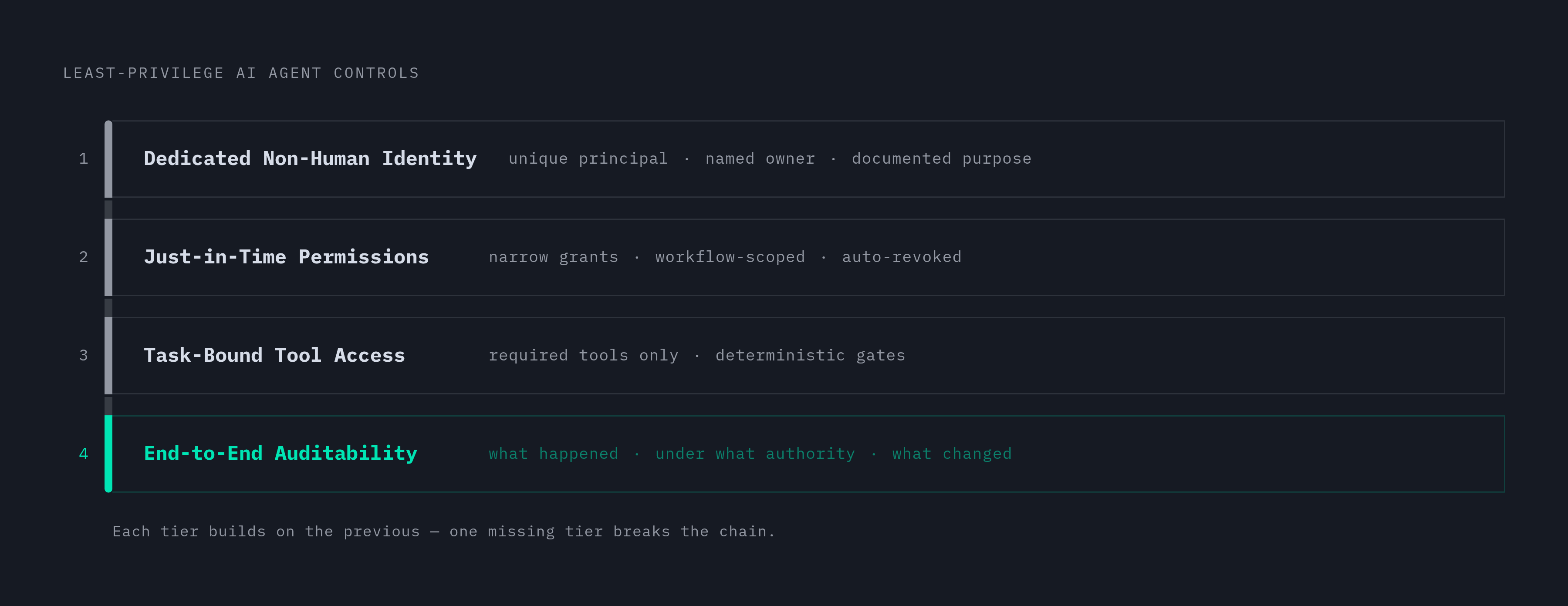
Dedicated non-human identity is the first primitive. Every agent needs a unique principal, a documented purpose, and a named human owner responsible for approvals and incident response. Do not substitute a shared secret or reused service account. Microsoft's guidance describes the agent as a “first-class principal,” with onboarding, credential rotation, suspension, decommissioning, and a shutdown mechanism that invalidates credentials and tokens. The ISACA white paper places acceptable use and prohibited actions within governance and risk ownership, so the identity has an explicit mandate as well as a technical name.
Just-in-time scoped permissions turn that mandate into temporary authority. Keep the agent's managed identity stable, but grant narrowly scoped privileges only for a particular workflow and revoke them automatically afterward. Build roles for specific tasks such as read-only knowledge retrieval, summarizing labeled documents, or creating a draft ticket. When a workflow gathers evidence and carries out remediation, use different roles or tools for read and write duties, and require step-up approvals for high-impact actions.
Task-bound tool access enforces the boundary at execution. Allow only the tools the defined task needs, instead of giving the agent a broad set with a few tools blocked. A research assistant does not need permission to send email. Split reasoning, retrieval, and action execution into stages, with controls that give each stage the access it needs. External sharing, permission changes, payments, and record deletion require explicit human approval through a deterministic gate.
The task itself must shape that enforcement. An action can be legitimate for one user prompt and over-privileged for another, even when the agent's provisioned permissions have not changed. SkillScope modeled instruction-level procedures and code-level operations as action nodes and reduced triggered over-privileged action instances by 88.56% while preserving legitimate task completion. Its 2026 findings show that fine-grained, task-conditioned enforcement can work at real-world scale. The ISACA paper calls tool integrations the “actuator surface,” where model mistakes become operational incidents.
End-to-end auditability makes the other controls testable. Records need to establish what happened, under what authority, and what changed. The companion report distinguishes Auditability from Legibility, which concerns whether a human can interpret agent behavior from the record. That distinction has practical force during an incident. A coherent identity anchors the record, temporary grants explain the authority, and tool boundaries show what execution was allowed. Detailed telemetry and planned response workflows then make the evidence useful for detection and response.
Applying the four primitives incrementally in a real SaaS engineering environment
For a SaaS engineering team, the starting point is a current inventory. Include agents, models, tools, plugins, vector stores, memory stores, data sources, and external providers. The ISACA checklist puts inventory first in its governance controls, before technical permission scoping. Without that map, the team cannot determine what data an agent can reach or whether its permissions still fit its role. Even a careful access review will miss dependencies that are hidden.
Next, threat-model each workflow before deployment, including user input, retrieval, memory, inference, tool calls, API integrations, approval interfaces, and output delivery. The happy path is not the whole workflow. Start the agent with the minimum permissions for one defined task, validate its behavior, and expand access only when there is clear evidence that the expansion is needed and safe.
Build lifecycle controls for credential rotation, suspension, decommissioning, and effective token invalidation into that first deployment. Put deterministic approval in front of high-impact, irreversible actions even if the full just-in-time architecture is not yet ready. This order of work limits how much damage an agent can do while the team builds the broader permission system.
Require regular security and risk reviews before adding to what an agent can do. Continuous pull-request scanning can check for new tool integrations or permission expansions introduced by agent-adjacent code. This brings ongoing assurance into the engineering workflow. It does not replace a review of the deployed configuration, because the agent's real authority depends on code, IAM policies, and cloud configuration together.
Trace's AI-native pen tests are one option for that whitebox review, using access to those layers to compare real permissions with the agent's declared role. An exploit-proven finding reviewed by a certified engineer can show whether privilege drift has opened an unintended access path.
The strongest objection to this approach is operational friction. Narrow roles and temporary grants take more design work than broad standing credentials, particularly when a workflow is still changing. The incidents already described show that standing privilege defers the cost until misuse, when the consequences can extend across systems. Incremental rollout makes the design work manageable without pretending it can be skipped.
Why least-privilege agent design is now a security audit and compliance matter, not only an engineering choice
The ISACA white paper, published in September 2026, presents its controls as a foundation for compliance and explicitly connects poor agent governance to compliance failures. Singapore's frameworks likewise position least privilege as a baseline for agentic security. These signals go beyond engineering preference. They point toward reviews in which an organization must explain not only that an agent works, but why it has its particular authority.
NIST's initiative is developing governance language expected to inform security frameworks referenced by SOC 2, HIPAA, and ISO 27001 auditors. That indicates a direction of travel, with the agent-specific requirements of individual frameworks still unsettled. Microsoft's guidance also identifies auditability gaps as a source of complexity in regulatory inquiries. If the identity model cannot establish who authorized an action and under what role, the organization has an evidence problem as well as a security problem.
For SaaS companies in fintech, anti-fraud, and financial services, that evidence is becoming part of more customer security reviews. Enterprise customers ask how agents are permissioned and audited. Reusing a service account does not adequately answer either question. A pen test limited to the application layer also leaves agent permission architecture unexamined, so a rigorous whitebox engagement should include tool access, credential handling, and delegation chains within its scope.
The security case does not depend on compliance. Limiting authority reduces what a compromised or misbehaving agent can damage, while traceable identity and interpretable records make investigation possible. Those same controls give a reviewer evidence to check, with a clear scope, working exploits, and traceable findings. The design that constrains an agent's reach is also the design that lets the business prove where that reach ends.