ReDoS Vulnerabilities in SaaS Input Validation and Regex Libraries
Regex validators can stall servers, and this guide covers fixes.

ReDoS vulnerabilities turn ordinary SaaS input validation and regex libraries into availability risks. Validation can consume the server’s CPU when rejecting a malicious value. Eliminating that risk means treating regex runtime as a security concern, choosing predictable engines where possible, and testing both failure paths and accepted inputs.
What ReDoS actually is and why it belongs in the same threat model as injection attacks
The security code meant to protect an application can itself be the attack surface. A validator can reject an attacker’s input correctly while taking so long that legitimate users cannot get service. No stolen record is needed for this attack. Unlike injection, ReDoS needs no data exfiltration path or privilege escalation because it targets the work done during validation.
MITRE catalogs this algorithmic weakness as CWE-1333, “Inefficient Regular Expression Complexity”. OWASP describes its attack vector as a regex that hangs a program for a very long time. Availability is a security property. That puts ReDoS in the same threat model as injection, even though the attacker’s goal and mechanism differ.
How a backtracking regex engine turns a failed match into an exponential-time problem
Consider ^(\w+\s?)*$, a regex used to validate display names. Its repeated group contains another repetition, so a run of letters can be divided among groups in many ways. A backtracking engine tries one arrangement, then rewinds when it cannot complete the match. PCRE/PCRE2, Python’s re, JavaScript’s RegExp, java.util.regex, Ruby’s Regexp, and.NET in its default mode use backtracking.
For this display-name pattern, letters followed by ! create the expensive case. The letters fit, but the final character does not, forcing the engine to revisit the possible partitions before reporting failure. The number of paths grows exponentially with input length.
Nested quantifiers such as (a+)+ create this ambiguity directly. Overlapping alternatives inside repetition, such as (a|aa)+, also give the engine more than one way to split the same characters. Adjacent unbounded wildcards can create excessive backtracking when they overlap and depend on an ending match. These shapes deserve scrutiny, though not every one has the same growth rate.
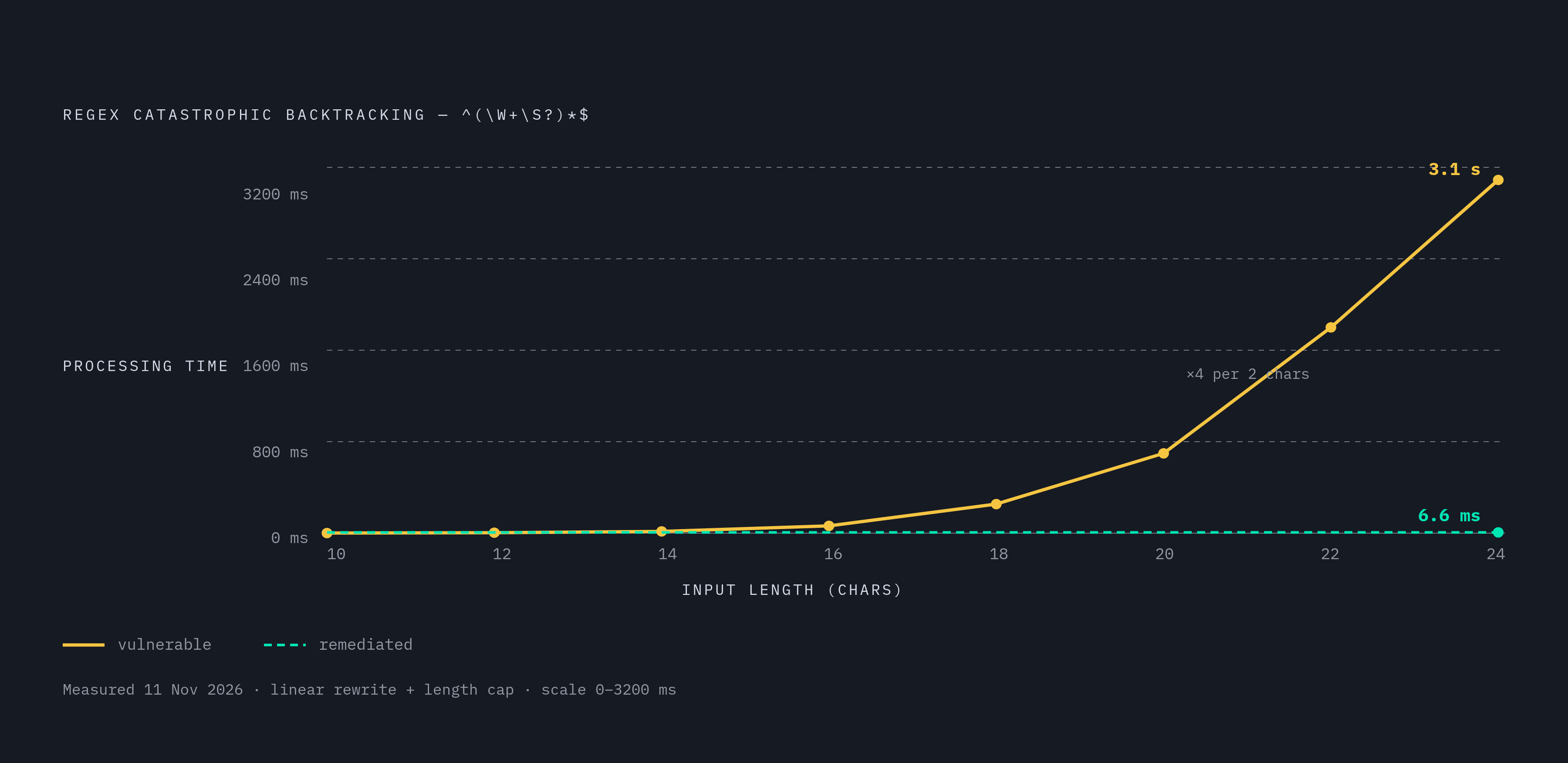
A reproducible Python experiment recorded on 11 November 2026 tested letters followed by !. Each addition of two letters multiplied processing time by between 3.9 and 4.2. The rejected input held the server for over three seconds. Valid names would not expose that failure path. A validator can pass ordinary functional tests while remaining vulnerable.
Where in a SaaS codebase these patterns routinely appear
Email and username validators are familiar hiding places because attempts to enforce detailed formats often produce nested quantifiers. Phone-number and postal-code formatters can wrap broad character classes in unbounded repetition, creating similar ambiguity. Routing code has its own version of the problem. Alternatives over overlapping path segments can leave a backtracking engine with too many ways to interpret a request.
Elsewhere, log parsing and search filters use adjacent wildcards on long strings that users can influence. API request validation puts regex inside JSON field checks and schema checkers, while authentication and authorization checks place it in code teams may trust most. That trust can discourage adversarial testing. Third-party validation libraries widen the surface further, because applications inherit patterns without necessarily inspecting their internals.
AI coding assistants add another route into the codebase. Generated regex can reproduce the same vulnerable shapes found throughout community code unless it receives adversarial scrutiny. PUFFERDOS research from June 2026 ranks ReDoS as the fourth most prevalent vulnerability in the JavaScript npm ecosystem and the sixth in Python’s PyPI ecosystem. This is not confined to obscure validation helpers. The same pattern appears from individual fields to shared infrastructure.
What ReDoS looks like at production scale: Cloudflare, Stack Overflow, and the library supply chain
Cloudflare’s July 2019 outage began with a WAF regex rule that backtracked catastrophically on certain request bodies. Because the rule ran on the request-processing path for all traffic, CPU utilization spiked across the global edge fleet almost immediately. The outage lasted 27 minutes and hit customers around the world. The placement of the pattern determined its reach.
Stack Overflow’s July 2016 disruption came from a whitespace-trimming pattern, ^[\s\u200c]+|[\s\u200c]+$. An edge case set off excessive backtracking and disrupted the service for 34-minute peak-traffic periods. In both cases, code with a simple job could bring down the whole service.
Moment.js had a vulnerable regex that left thousands of applications that used it open to denial-of-service conditions, while inefficient patterns in validator.js affected functions for string sanitization and validation. Django’s django.utils.text.Truncator was also vulnerable when used with html=True, as documented in CVE-2023-43665 and CVE-2024-27351.
Recent CVEs show the breadth of affected features. CVE-2024-9277 covers inefficient regex complexity in Langflow versions up to and including 1.0.18, while CVE-2024-5552 concerns Kubeflow’s email validation system. Another CVE identifies super-linear runtime in a web framework’s ng-srcset directive. The exposure widens again through transitive dependencies. CVE-2024-21538 in cross-spawn and CVE-2024-4067 in micromatch affected packages downloaded hundreds of millions of times per week, both of which were used indirectly in a large share of Node.js projects.
Why teams keep shipping vulnerable patterns despite the documented history
Knowing regex syntax does not mean knowing its worst-case runtime. Mahassadi et al.’s September 2026 empirical analysis found that developers asked whether they knew about ReDoS were overwhelmingly unaware of it. The study also found that these vulnerabilities were becoming more prevalent and were much more likely to be exploited than non-ReDoS vulnerabilities. Awareness has not matched the documented risk.
Standard tests reinforce that blind spot. Typical valid and invalid examples can all return quickly, while an input that is long enough and almost matches can trigger catastrophic backtracking. Load tests usually use data like that from real users rather than strings built to allow as many possible partitions as possible.
Detection tools help, but they do not agree reliably. The same study evaluated five publicly available tools on the same regex datasets and found substantial disagreement over which patterns were vulnerable. Silence from one analyzer is insufficient evidence of safety. Partial defenses in mainstream engines also leave gaps wherever backtracking remains the default without supplementary protection.
Eliminating catastrophic backtracking: engine choice, pattern rewriting, and runtime guards
The most durable response is to remove backtracking from untrusted-input matching where practical. Engines built on Thompson NFA simulation offer linear-time evaluation. Google’s RE2 makes that guarantee in more than one language. Rust’s regex crate is linear-time by construction, and Go’s standard regexp package uses RE2 semantics.
RE2 and equivalent engines omit features including backreferences and lookaround, so a swap is not automatically suitable for every parsing task. Most input validators do not need those features. Validation is thus a practical place to get predictable runtime while leaving other regex engines in an application as they are.
Where an engine switch is not feasible, runtime guards provide another defense..NET offers a per-match timeout and a non-backtracking mode, recent Ruby added a global regex timeout, and PCRE2 exposes match and backtracking depth limits. Caps on input length also limit the work before matching starts. A 64-character display-name cap bounds the possible input, but a bound alone is not proof that an exponential pattern is fast enough.
Pattern rewriting addresses the ambiguity itself. Replace nested quantifiers with unambiguous alternatives, avoid overlapping branches inside repeated groups, and narrow character classes to what the field actually requires. Anchors such as ^ and $ can restrict the search space. They are not a cure by themselves, as the already anchored display-name example shows.
The November experiment combined a linear rewrite with a character-length cap. The same attack input took 6.6 ms, down from over 3.1 seconds, and controls checked how the code handled valid input. Two deliberate behavior changes remained. Tab-separated names and names over the cap were now rejected, so the fix required product sign-off rather than being treated as a purely technical cleanup.
Catching ReDoS before it reaches production: static analysis, test strategy, and CI integration
Detection should combine static pattern analysis with runtime performance tests in CI. The disagreement between tools makes that combination necessary, while runtime tests show whether suspicious structure becomes a real slowdown. JavaScript teams can use eslint-plugin-redos for dedicated linting. eslint-plugin-security flags user-controlled RegExp construction among other unsafe patterns, while regexp-tree, recheck, rxxr, and ReScue cover different subsets of regex weaknesses.
A structural warning is a starting point. An upstream length cap may make a flagged pattern safe in context, while an analyzer may miss a vulnerable shape outside its coverage. The input must also reach the regex. PUFFERDOS generated attack strings validated at the program level and found exploitable cases that earlier tools missed because their strings did not follow real data-flow paths.
To test that path, add near-matching inputs that get longer with each test for every regex that handles untrusted input. Assert that response time does not grow super-linearly, rather than checking only whether validation returns the expected answer. Failure speed is part of correctness here. After remediation, the before-and-after comparison supplies evidence that the change worked and becomes a regression test against reintroducing the weakness.
Dependency scanning must cover the full dependency tree as well. Pattern analysis of first-party code alone cannot find every ReDoS CVE in libraries brought in indirectly, so software composition analysis is needed to check those libraries. Download popularity does not remove that need. For findings that reach a penetration test report, a working exploit demonstrating CPU impact should distinguish a verified vulnerability from a structural warning.
What a ReDoS finding in a pen test report should look like, and what to do with it
An actionable finding names the exact pattern, its code location, and the path by which attacker-controlled input reaches it. It also includes a concrete attack string that reproduces the slowdown in the target environment. Timing evidence must show the growth. Testing a series of longer inputs helps show whether a slowdown comes from algorithmic blowup or a request that just happens to be slow.
Severity then depends on the deployment context. A vulnerable pattern in a single-threaded Node.js process that serves authenticated API traffic poses a different risk from the same pattern behind a load balancer with per-request timeouts. A pattern alone cannot establish that distinction.
After a rewrite or engine swap, retest the same attack string against the fixed code. A retest limited to functional correctness cannot establish that the runtime weakness is gone. The report should document the result with enough detail for the engineering team to reproduce both the original finding and the fix.
For SOC 2 and HIPAA purposes, availability vulnerabilities fall within the penetration-test scope auditors expect to see addressed. A report limited to injection and authentication findings can leave that gap open. The standard for a security vendor should therefore be concrete. Every ReDoS finding should include a working exploit, measured impact, and a remediation retest, rather than stopping at a list of patterns that look dangerous.
Sources
- An Empirical Analysis of ReDoS Vulnerabilities and ReDoS Detection Tools
- PUFFERDOS: Efficient and Effective Attack String Generation for Regular Expression Denial of Service Vulnerabilities
- [2609.10294] An Empirical Analysis of ReDoS Vulnerabilities and ReDoS Detection Tools
- Regexes are Hard: Decision-making, Difficulties, and Risks in Programming Regular Expressions
- SoK: A Literature and Engineering Review of Regular Expression Denial of Service (ReDoS)
- SoK: A Literature and Engineering Review of Regular Expression Denial of Service (ReDoS)