SAST vs SCA for Catching Vulnerabilities Before Deployment
SAST scans code you write; SCA checks code you import.
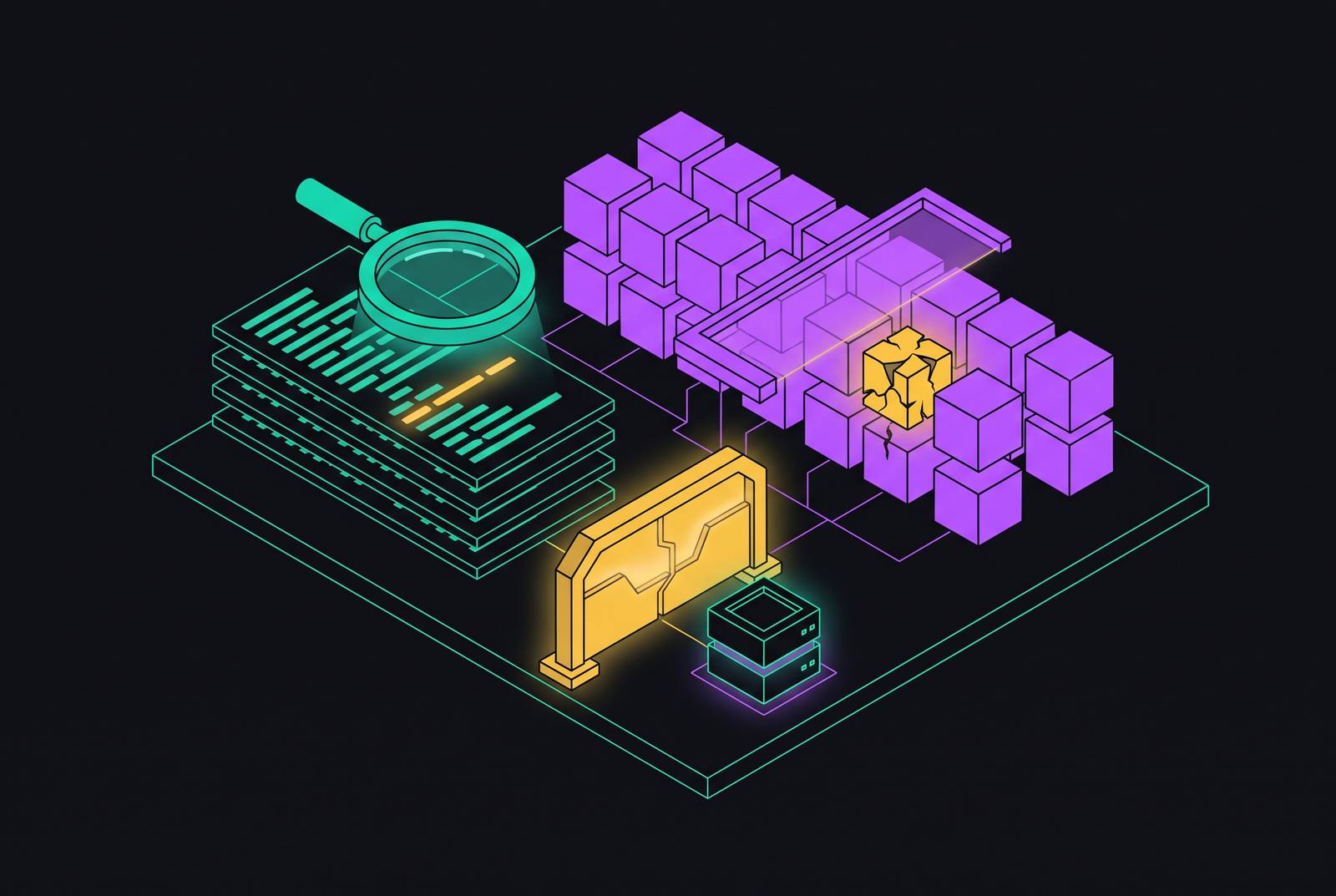
SAST and SCA catch different kinds of vulnerabilities before deployment. SAST examines the code a team writes, while SCA checks the dependencies it imports. Effective coverage requires both. The harder task is understanding their limits, setting gates developers can work with, and testing the attack paths that neither scanner can prove.
Why SAST and SCA divide the attack surface the way they do
Roughly 77–90% of a codebase by volume is open-source and third-party code, with first-party logic making up only a fraction. That composition creates two separate sources of risk. A team can introduce a flaw in its own code, or import one inside a dependency without changing that dependency at all.
Those risks need different kinds of inspection. Static application security testing, or SAST, follows the logic and the flow of data through source code. Software composition analysis, or SCA, matches component identifiers against known-vulnerability databases. A source-code parser does not, by itself, know that a vulnerability has been recorded against a library version. A dependency scanner, in turn, cannot tell how first-party code handles user input.
What SAST actually does to your source code and what it reliably finds
SAST analyzes source code without running the application. It parses the code into an abstract syntax tree or another intermediate representation, then applies rules that look for insecure patterns. The depth of that inspection varies considerably. Pattern matching, as used in Semgrep CE, checks the code’s tree structure for user-defined patterns. It is fast and transparent, but it can find only what those patterns express.
Intra-procedural taint tracking follows data that may be unsafe within a single function, but goes no further. Inter-procedural analysis follows those flows from one function or file to another. That broader view catches more, but requires significantly more compute. The distinction is important when a dangerous operation sits several function calls away from the input that feeds it.
Within those limits, SAST finds SQL injection patterns, cross-site scripting baked into templates, hardcoded credentials, insecure cryptographic calls, unsafe API usage, input validation flaws, and information leakage through error handling. Unsafe Python deserialization using the pickle module is a textbook source-level catch. CVE-2025-29783 represents that class of flaw in vLLM’s Mooncake integration, where network bytes reach pickle deserialization. A rule can flag the unsafe operation before execution. It can detect only part of this particular vulnerability, however, because exploitability also depends on network exposure.
SAST can return an exact file and line number. That makes findings actionable inside an IDE or at a CI/CD gate, while the code is still being written or reviewed. Known vulnerabilities in imported components, runtime and infrastructure configuration, and business rules that cannot be expressed as code patterns fall outside its core coverage. Finding an unsafe operation is not the same as knowing whether a particular user should be allowed to perform it.
What SCA actually does to your dependency tree and what it reliably finds
SCA starts with the components an application imports. It parses dependency manifests and lockfiles, including package.json, pom.xml, requirements.txt, go.sum, and Gemfile.lock, to build an inventory called a software bill of materials, or SBOM. It then matches those components against records in databases such as NVD and the GitHub Advisory Database. Its central question is different from SAST’s. Rather than inspecting how first-party logic works, it asks whether the application includes a component with a known vulnerability.
An XSS vulnerability in the nice-select2 npm package illustrates the distinction. A team may import the package without reading its source, yet SCA can find the affected dependency by checking known vulnerability records. Scanning only the team’s own code would not uncover that internal package flaw. Dependency-tree analysis also reaches transitive dependencies, which are dependencies brought in by other dependencies. The vulnerable component need not be one the team selected directly.
The inventory supports more than vulnerability detection. SCA also surfaces license compliance risks, outdated or unmaintained components, and deprecated packages. SBOM output in CycloneDX or SPDX formats supports teams working under supply-chain regulations. For known vulnerabilities, remediation is usually clearer than a first-party code fix because it typically means updating a dependency version. That clarity does not mean every flagged version creates an exploitable path.
Without reachability analysis, SCA cannot tell whether the application calls the vulnerable function. It also cannot find first-party flaws or dependency zero-days that are missing from its vulnerability records. Malicious packages present a separate problem. A freshly injected backdoor introduced through typosquatting or account compromise can pass a CVE check because no CVE entry exists. Matching known defects and detecting deliberately malicious code are related tasks, but they are not interchangeable.
Where SAST and SCA genuinely overlap and why that overlap is not redundancy
The two tools look similar in a development workflow. Both can run without executing the application, fit into build-stage checks, and produce findings for developers to triage before deployment. There is some genuine overlap in findings, too. SAST can find hardcoded credentials in first-party source files, while some SCA tools surface credentials exposed in manifests or package metadata. The issue class is shared, but the inspected material differs.
Some commercial SAST tools include lightweight dependency checks, and some SCA platforms flag insecure patterns when they can inspect source. Those additions do not replace either core technique. Agreement between different detection paths can strengthen the evidence for a problem, while a finding from only one path can expose a coverage difference. Teams should check that a product with both labels does both kinds of analysis.
The false-positive problem that makes both tools harder to operate than they appear
Coverage on paper is not the same as useful detection. The EASE 2024 academic benchmark tested four SAST tools against 170 manually curated commits containing known vulnerabilities in production Java code. With default rule sets, all four tools together found under forty percent of the known vulnerabilities. Most of those known vulnerabilities went undetected. That result concerns missed findings and exposes why a quiet scanner cannot be treated as proof that code is safe.
Developers must sort findings that may point to an exploitable weakness from alerts that do not. SCA has substantially lower false-positive rates than SAST in absolute terms, yet even an accurate dependency match can be operationally irrelevant. The vulnerable function may never be called. Without reachability analysis, many findings can point to vulnerable code in the dependency tree without showing an attack path that works.
These two problems put teams under competing pressures. Checks that look for more flaws can leave more findings to review, while default rules can still miss real flaws. Alert fatigue makes that tension harder to manage because developers who keep seeing low-value findings learn to ignore the gate itself. The remedy is configuration discipline: severity thresholds, reachability analysis where available, and a clear separation between blocking findings and informational annotations give each alert a more useful role.
How to integrate SAST and SCA into a CI/CD pipeline without creating gates that developers route around
To put that discipline into practice, teams should place each check where its inputs are ready. SAST can provide IDE and pre-commit feedback because it examines code as it is written. SCA fits at the build stage, when a resolved dependency manifest or lockfile is available. Neither requires a running application. Build-stage scanning usually adds 1–5 minutes depending on the size of the codebase, so teams can expect a fairly small and predictable increase in build time.
The useful sequence is SAST at commit, then SCA at build. This gives developers feedback on their own code before the dependency check evaluates the resolved component tree. The reason for sequencing is not that one tool depends on the other’s results. Each needs a different input at a different point. Placing them accordingly avoids treating two distinct checks as interchangeable gates that must run together.
For SAST, a practical starting point is to block critical and high-severity findings. Medium and low findings can appear as pull-request annotations without blocking the merge. Blocking every informational finding floods the pipeline and weakens the gate’s credibility. The distinction also makes clear which findings need action before the pipeline can proceed.
For SCA, the equivalent choice is whether a dependency upgrade is required or advisory. Reachability analysis, where supported, can narrow the blocking set to dependencies whose vulnerable code paths the application actually calls. That keeps an accurate version match from automatically receiving the same treatment as a reachable flaw. The gate should reflect that difference. A scanner’s ability to generate a finding is not, by itself, a reason to stop a merge.
What neither SAST nor SCA can find, and why that matters before deployment
Even a well-tuned pipeline leaves an exploitability question unanswered. Neither tool validates a finding in the live environment as an attacker would exploit it. They find possible weaknesses or known vulnerable components, but leave the attack path through the deployed application unproven. Runtime configuration also lies outside their scope. Environment variables, cloud IAM policies, and server settings can change the security picture without being resolved by source rules or dependency records.
Business logic needs a different kind of context. Broken access control is the clearest example because code alone cannot tell whether a given user should be able to reach a given resource. The scanner may see an operation without knowing the application’s intended permission rules. An SSRF finding and exposed credentials may combine into a critical exploit chain, but these scans do not automatically assemble and validate that chain.
AI coding assistants bring a new blind spot with package hallucinations. They can generate references to packages that do not exist. When those references never resolve through a lockfile, manifest-based SCA has no corresponding component in the SBOM to flag. The missing inventory entry is the problem. This remains an unresolved challenge, separate from matching an installed package against an existing vulnerability record.
These limits do not make the scanners ineffective. A clean result says nothing conclusive about intended permissions, combined attack paths, or the effect of runtime settings. Treating it as deployment approval would ask the tools to certify conditions they never tested. Those conditions need a layer that can examine the application in context.
Why the gaps that remain after SAST and SCA are exactly what penetration testing is designed to close
Penetration testing is built to test those remaining conditions. With whitebox access to source code, cloud configurations, and documentation, a test can examine the code together with its runtime environment and intended behavior. With that context, a test can look into access control, infrastructure settings, and links between findings that otherwise stand alone. It starts where automated inspection runs out of evidence. The task is to determine what an attacker can actually do.
A working exploit demonstrates an attack path, providing evidence beyond a pattern match or the severity a CVSS score assigns to a suspected weakness. Point-in-time tests still have a timing limit, however, because code changes after the test. An integrated security layer that runs continuous pull-request scanning keeps up with those changes. The logical next layer for a SAST/SCA pipeline is exploitability validation on the same cadence, rather than leaving that question solely to occasional tests.
That distinction also changes the evidence a security program produces. For teams pursuing SOC 2, HIPAA, or ISO 27001, scanner records show that checks ran. Auditors and enterprise buyers increasingly want evidence that real attack paths were tested and either closed or knowingly accepted. Once source flaws and known dependency vulnerabilities are being checked, the remaining task is to establish whether the application, in its actual context, can be exploited.