SAST Tools With Cross-File Taint Analysis Capabilities
Single-file scanners miss the real vulnerabilities; cross-file analysis catches them.
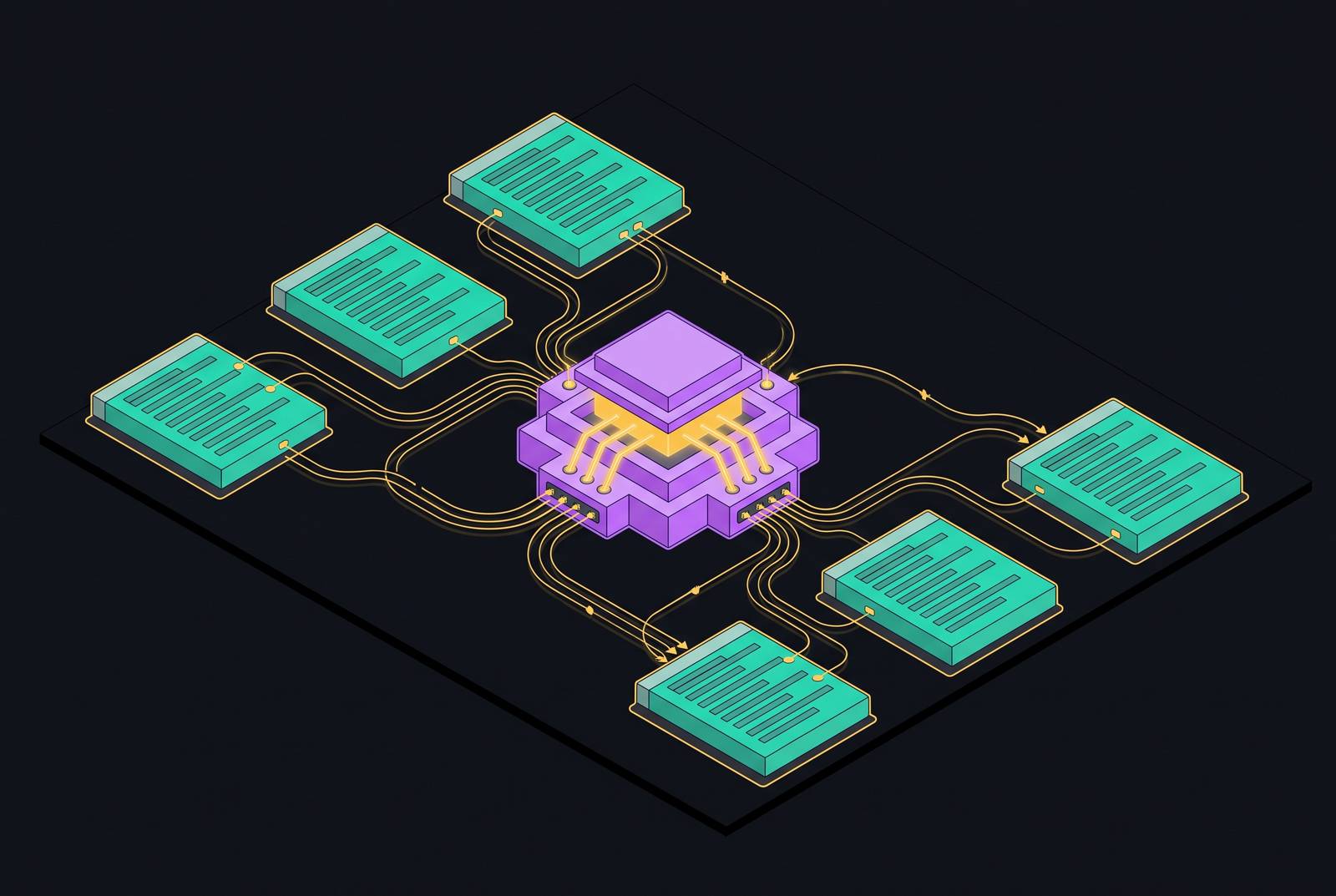
Most SAST scanners read one file at a time, and that habit is why they miss the vulnerabilities attackers actually use. Untrusted input lands in one file, and the dangerous sink is three files away. If your scanner can't follow that path, it isn't catching the bugs worth catching. What follows is how cross-file taint analysis actually works, and a hard look at which tools do it versus which ones just print the phrase in their marketing copy.
Why single-file SAST misses the vulnerabilities that get exploited
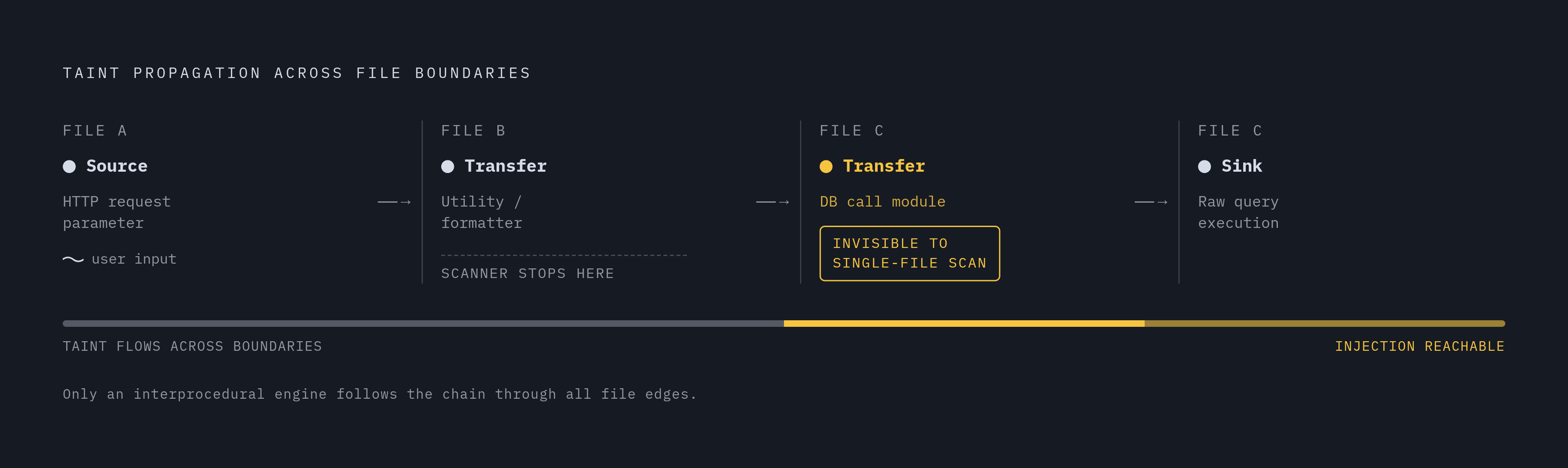
Taint analysis is the core trick behind most static scanners. It follows untrusted input, an HTTP request parameter or a piece of a SQL query, from wherever it enters the app (the source) to wherever it does something risky (the sink), like a database call or a shell command. That one mechanism covers a huge share of the OWASP Top 10: SQL injection, cross-site scripting, path traversal, insecure deserialization. Each maps to a CWE number, and each follows the same shape: data moves from an untrusted place to a sensitive one without getting checked along the way.
A single-file scanner can't see this. An API handler grabs the request, hands it to a shared utility function for formatting, and that utility function passes the value into a database call defined in a completely different module. The handler looks fine on its own. The utility function looks fine on its own. The database call might even look parameterized and safe. Trace the actual path the data takes, though, and there's an injection point sitting in the middle of it, invisible to any tool that stops looking at the edge of a file.
Authentication bugs follow the same pattern, and arguably they're worse, because the failure is relational rather than local. A permission check might live in one module and work exactly as intended, while a decorator or piece of middleware defined somewhere else quietly overrides it. Neither file is broken by itself. The vulnerability lives only in the relationship between them, and a single-file scanner has no way to model a relationship it can't even see both halves of.
How cross-file taint analysis works under the hood
The distinction that matters is intraprocedural versus interprocedural analysis. Intraprocedural analysis stays inside one function or file. Interprocedural analysis follows the call graph outward, tracking data as it moves between functions and across module boundaries, no matter how many files it crosses on the way.
Building that kind of engine takes a few concrete steps. Every source file gets parsed into an abstract syntax tree first. From there, the engine builds a control flow graph and a call graph spanning the whole program, linking function calls across files instead of stopping at each file's edge. Once that structure exists, taint propagates along it: a tainted value passed as an argument into a function defined elsewhere hands its taint to the receiving parameter, and the engine keeps tracking it through assignments, return values, and further transformations until it hits a sink or gets cleaned by a sanitizer.
None of this is easy to pull off well. Scale is one problem: a codebase of any real size has millions of possible paths data could take, and walking all of them costs real time and real compute. Precision is the harder problem, and it's the one that actually kills adoption. Propagate taint too aggressively and every team using the tool drowns in false positives inside a week. Path sensitivity adds a third layer, since a serious analysis has to know which branch of an if-statement actually got taken at runtime, not just that a branch exists somewhere in the source.
Reachability filtering is what separates tools people keep running from tools that get muted after month one. A vulnerable pattern sitting in a function nothing ever calls is noise, full stop. Filtering that out is the single biggest lever for turning raw scanner output into something a team will actually act on, and it's the detail most vendors gloss over in their pitch decks.
Which tools genuinely deliver cross-file taint analysis
"Cross-file taint analysis" gets used as a sales line more often than it gets earned, and most teams find that out the hard way, months into a deployment. The honest comparison here is an audit of what each tool does under the hood. It's an audit of what each tool does under the hood: which languages get full interprocedural treatment, how deep the path sensitivity actually goes, and how much taint survives contact with a real data structure like a dictionary or a hash map.
That last detail matters more than it sounds like it should. A tool can advertise cross-file analysis for JavaScript and still lose track of a tainted value the moment it gets stuffed into an object and pulled back out under a different key. So the four tools below get judged on what breaks once the codebase gets messy and real.
Checkmarx One: deepest enterprise coverage and compliance reporting
Checkmarx One runs interprocedural data flow analysis with taint tracking across more than 35 languages, backed by coverage for over 200 CWE categories https://expertinsights.com/application-security/the-top-static-application-security-testing-sast-tools. Depth isn't even across the board: it's strongest in Java, C#, JavaScript, and Python, and the on-premises version reaches into COBOL and ABAP, which counts for a lot if you're a bank or an insurer still running mainframe code next to modern services. Framework coverage runs past 80.
CxQL lets a security team define its own sources, sinks, and sanitizers, which matters enormously once the app runs on an internal framework the vendor has never heard of. Vendr data puts Checkmarx pricing at around $59,000 a year and up https://expertinsights.com/application-security/the-top-static-application-security-testing-sast-tools.
CodeQL: querying code as a database for the most expressive taint tracking
CodeQL takes a genuinely different approach, and it's the one built for teams that want to write their own rules rather than rent someone else's. Instead of scanning source text directly, it compiles the whole codebase into a relational database holding the full AST, the data flow graph, and the control flow graph, then runs queries against that database. Security rules aren't pattern templates here, they're queries written in QL, a language built specifically for asking questions about code structure. That gives QL the ability to define custom sources, sinks, and sanitizers, and to trace taint across file and module boundaries with a level of precision hard to match with template-based rule systems.
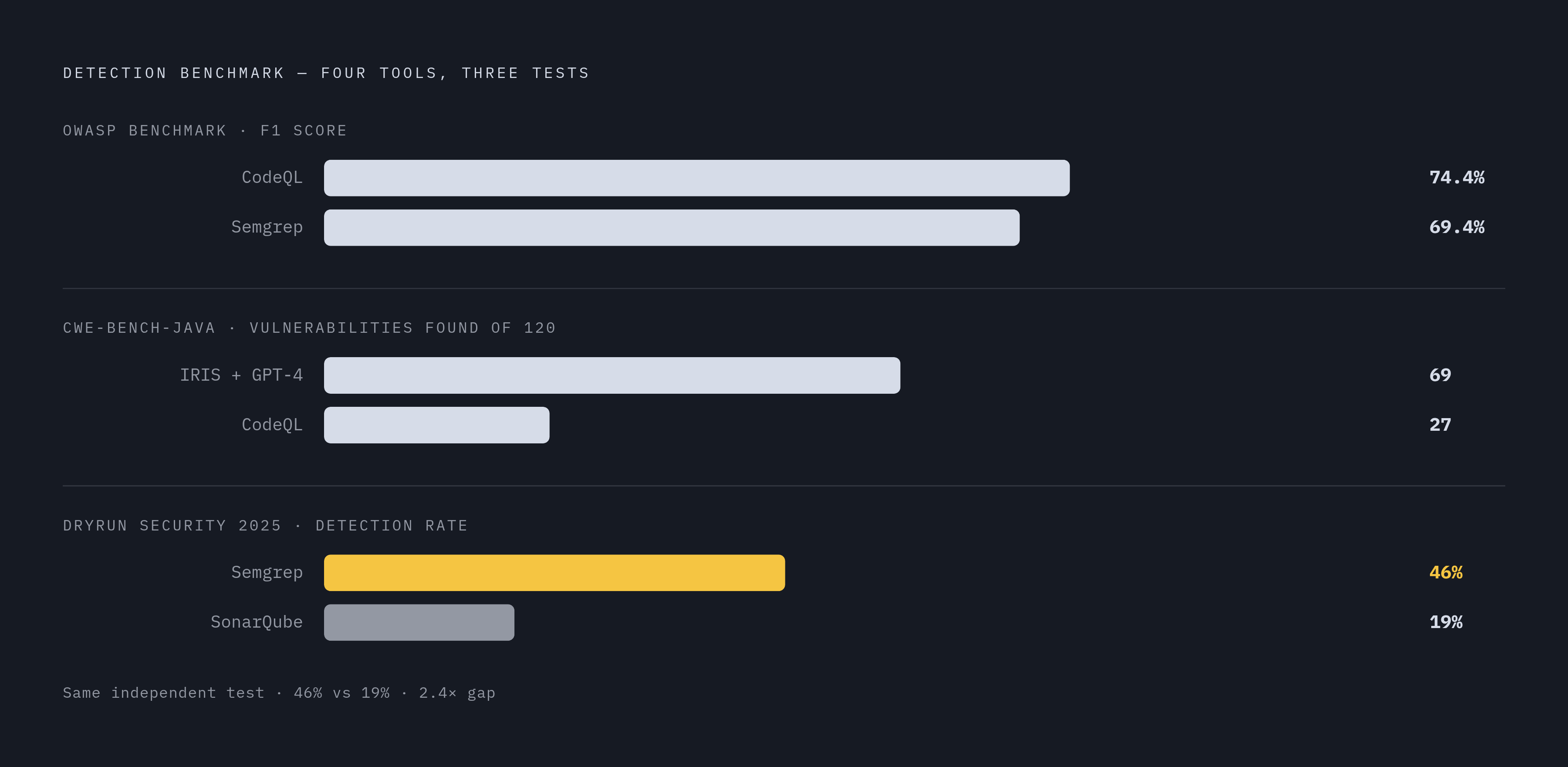
On raw scale, CodeQL 2.24.0 ships 491 security queries in its Default suite, covering 166 distinct CWE categories, and the Extended suite adds another 135 queries covering 35 more https://codeql.github.com/docs/codeql-overview/codeql-changelog/codeql-cli-2.24.0/. On the OWASP Benchmark, CodeQL scores 74.4% F1, ahead of Semgrep's 69.4% https://konvu.com/compare/semgrep-vs-codeql.
Real-world benchmarks tell a messier story, and the numbers themselves matter more than the headline score. On CWE-Bench-Java, a set of 120 known vulnerabilities, stock CodeQL caught 27 https://www.emergentmind.com/topics/codeql. On a separate 62-vulnerability benchmark called JavaTest, the official CodeQL ruleset found 24, while a tool called QLPro built on top of CodeQL found 41 https://www.emergentmind.com/topics/codeql. CodeQL still supports build modes for compiled languages (none, autobuild, and manual), which matters directly for anyone planning CI integration.
Semgrep Pro and the Opengrep fork: pattern-based SAST extended to cross-file analysis
Semgrep's whole pitch starts from simplicity. Rules are written in syntax that mirrors the actual code pattern being targeted, so a security engineer can write a working custom rule in minutes instead of days, and the open-source engine runs fast. The Pro tier builds enterprise-grade taint analysis on top of that same foundation.
Cross-file support in the Pro Engine splits into two tiers. Cross-function interprocedural analysis is available, currently marked experimental, across all 30-plus supported languages https://konvu.com/compare/semgrep-vs-codeql. On DryRun Security's independent 2025 benchmark, Semgrep posted a 46% detection rate under default settings, well ahead of SonarQube's 19% in the same test https://weavai.app/blog/en/2026/04/30/semgrep-2026-review-is-the-35-mo-sast-plan-worth-it/.
Semgrep Assistant adds AI-powered triage, and its Memories feature learns from past triage calls to cut down repeat noise. Opengrep, the fork, is backed by a consortium of 10+ AppSec organizations https://github.com/opengrep/opengrep. A year into life as an independent project, Opengrep had shipped 43 releases and clocked scan speeds 25% to 74% faster than Semgrep, with taint analysis running up to twice as fast https://daily.dev/posts/opengrep-sast-after-one-year-faster-deterministic-static-analysis-icreckgwy. That speed gap decides which tool actually stays in the CI pipeline once build times start mattering.
Snyk Code: AI-trained dataflow analysis with strong multi-hop injection detection
Snyk Code runs on DeepCode AI, an engine trained on millions of open-source commits that pairs machine learning models with a traditional dataflow analysis backbone. Its interfile dataflow analysis follows vulnerability paths across multiple function calls and multiple files, and in testing against JavaScript and Java codebases it caught injection vulnerabilities traveling through three or four layers of abstraction, starting at an HTTP request handler, passing through a service layer, and landing in a raw query execution call.
The AI layer isn't only there for detection. It does triage work too. Rather than flag every pattern match, it weighs whether a given match is exploitable given the surrounding context, a direct, by-design attempt at cutting the alert fatigue that plagues pattern-based scanners. Snyk Code sits inside a wider platform that also covers software composition analysis, secrets scanning, container scanning, and infrastructure-as-code, with IDE integration reaching into JetBrains products, VS Code, and Eclipse.
Whitebox penetration testing exists to close that gap, with testers who have full codebase access tracing the same multi-file chains a scanner flags, then confirming they actually hold up under real conditions. Trace works from that starting point, treating a scanner's cross-file finding as the beginning of an investigation. IRIS with GPT-4 detected 69 of 120 vulnerabilities on CWE-Bench-Java https://www.emergentmind.com/topics/codeql. Biome runs 35x faster than Prettier https://dev.to/moksh/top-static-code-analysis-tools-every-developer-should-know-in-2026-hi8.