SQL Injection in SaaS Applications Beyond the OWASP Basics
Modern SaaS apps hide SQL injection in ORMs, analytics pipelines, and second-order flows.
SQL injection is supposed to be a solved problem. The data says otherwise: CWE-89 ranked among the top entries on MITRE's CWE Top 25 for 2024, with 1,467 CVEs logged against it that year alone, and open-source SQLi CVEs are on pace to climb past 2,400, up from 2,264 in 2023.
The share of vulnerable projects is shrinking, down 14% in open-source code and 17% in closed-source code. Fine, but that's not the number worth staring at, and here's the one that should bother you: when a closed-source project runs security tooling for the first time, over 20% turn out vulnerable, and the average affected codebase carries close to 30 separate injection sites. One guy forgetting to sanitize a form field wouldn't produce numbers like that. This is a pattern baked into how the team ships code, week after week. The FBI and CISA said basically this in a 2024 warning: SQLi is a persistent defect in commercial software, everyone knows the fix, and most teams don't bother until after they've already been breached.
I've spent enough time inside real SaaS codebases to know where this actually goes wrong. ORMs create a false sense of coverage. They handle standard reads and writes fine, but every large product accumulates legacy modules, reporting tools, and third-party integrations where parameterization gets sloppy. Throw in multi-tenant data models, analytics pipelines, and GraphQL, and you've got a surface way bigger than the login-form example everyone learned from in the OWASP docs. Developers lock down the obvious stuff and walk right past the structural gaps sitting underneath. This piece is about those gaps.
Second-order injection and why it bypasses both developer intuition and automated scanners
Second-order injection, sometimes called stored injection, works in two stages. First, a bad string gets written to the database through a safe, parameterized insert. No error, no red flag, nothing to catch. Then later, some other part of the app pulls that string back out and drops it into a new query, unparameterized, because whoever wrote that retrieval code figured the data was already clean, since it came from the database, not from some stranger typing into a box.
That assumption is what gets SaaS products hurt. Think about how much user-controlled text these products store and reuse downstream: usernames, display names, organization names, webhook URLs, custom field labels. All of it eventually resurfaces somewhere, in a report, an admin dashboard, a billing summary, an audit log export. The team that built the signup form usually isn't the same team that built the reporting module six months later, and neither one has the full picture of where that data actually travels.
I've watched this play out almost exactly the same way more than once. A user sets their organization name to a crafted string, and nothing happens at signup, since the insert is parameterized and everything looks clean. Weeks pass, then the billing module runs a scheduled job to build an invoice summary, constructs a query using that organization name, and the injection fires. Nobody touched that code path in between, and nobody was watching for it, because nobody ever flagged "organization name" as untrusted input by that point in its life.
Scanners miss this almost by design. They fire a payload and check for something immediate: an error message, a reflection, a shift in the response. They don't follow a value from where it gets written to wherever it might resurface in a query, and that gap can span different endpoints, background jobs, even a report that only runs once a week. Catching this takes someone who maps the app's data flows end to end and knows which stored fields eventually feed back into query construction. Usually that means code access, and fuzzing alone won't get you there, not even close.
How ORM misuse reintroduces injection into codebases developers consider safe
The whole point of an ORM is to stop developers from hand-building SQL strings, and for standard CRUD it does exactly that. The trouble shows up at the edges, in the spots ORMs were never built to fully cover.
Almost every ORM ships a raw query escape hatch, something like .raw() or execute(), for the complex queries the abstraction layer can't express on its own. Search features, reporting dashboards, analytics filters: these lean on raw queries constantly, and that's exactly where things slip. Dynamic sorting is another common trap. ORMs will happily parameterize a value inside a WHERE clause, but they generally can't parameterize a column name or a sort direction, so a developer takes a sort field the frontend sends over and interpolates it straight into the query, because there's no clean parameterized way to do it otherwise.
Then there's the string-formatting trap: someone writes an f-string or a template literal to build a raw query instead of using bind parameters, and just like that, whatever protection the ORM was supposed to give is gone. Third-party ORM plugins for full-text search or geospatial queries add their own layer of query building too, often with parameterization that doesn't match the core library's standards.
A scenario I run into constantly: a sortable admin table, five or six columns. Frontend sends a column name and a direction, backend interpolates both into a raw ORM query because there's no other way to parameterize a column name. That sort field just became a live injection point, sitting quietly inside a feature nobody ever thinks twice about.
A code-level review finds this fast. Search every .raw() call, then trace whether user input reaches it. Someone testing from the outside only, with no code, can only find the ones they stumble into by luck, and that gap is widest around internal admin panels and API endpoints that never show up on the app's public surface at all.
Blind injection through analytics pipelines and background data processing
Blind injection is what happens when the app hands you nothing to look at. No error, no data, just behavior. You infer things one bit at a time: does the response come back true or false, does it take longer than it should. A classic move is injecting a database sleep call and timing the response. If the app pauses exactly as long as you told it to, you've confirmed the injection point without a single visible error on screen.
SaaS analytics features make this worse. Plenty of products build custom queries straight from user-supplied filters: date ranges, grouping fields, export columns. These queries often run asynchronously, results land in a dashboard later or get emailed out, so a time-based payload produces zero signal a developer would ever notice in the moment. Sometimes the output goes straight into a data warehouse or an S3 bucket and never comes back through an HTTP response at all, which means there's nothing for an automated scanner to even inspect.
This matters more than a garden-variety blind injection bug, because analytics pipelines usually run with elevated database privileges. They're built to aggregate across the whole dataset, every tenant at once, since that's the entire point of analytics. A successful injection here doesn't hand over one account's records; it can hand over the entire tenant dataset in a single shot.
Catching this requires understanding the data flow well enough to know which user-facing parameters eventually shape a query running somewhere in the background, and that usually means code access just to figure out what's worth testing. Tools like SQLMap are genuinely good at catching synchronous injection, but they're built around the request-response cycle. Asynchronous pipelines need a person forming a hypothesis and testing it by hand, one guess at a time.
Multi-tenant SQL injection and the cross-tenant data isolation failure it enables
Most growth-stage SaaS companies run multi-tenancy the same way: one shared database, one shared schema, a tenant_id column bolted onto every table that matters. It's cheap to run and simple to operate. The catch is that isolation between tenants depends entirely on every single query remembering to filter by that column. Nothing enforces it at the database layer; it's discipline, all the time, across every developer who ever touches a query.
SQL injection breaks that discipline instantly. A UNION-based injection can append a SELECT that skips the tenant_id filter entirely, pulling rows from other tenants straight into the response. Blind injection can enumerate tenant IDs one at a time and then extract data from any of them systematically. And you don't even need a full compromise: one single endpoint that forgot the tenant filter is enough to walk right across the boundary.
Where does that missing filter usually hide? Internal admin and support tools built fast, where tenant context gets assumed instead of checked. API endpoints bolted on later for partner integrations, where the filter lived in the UI layer but never made it into the actual service logic. Reporting and export features, where a developer believed they were only returning aggregate summaries and never thought tenant isolation even applied there.
The fallout isn't limited to one customer's breach; it spreads to every customer at once. That means SOC 2 audit findings, contractual notification obligations, and in tightly regulated markets like fintech, it can end an enterprise deal outright, full stop. Verizon's 2024 Data Breach Investigations Report put web app attacks, SQL injection included, at 26% of all breaches. Multi-tenant SaaS sits right in the middle of that category as a concentrated, high-value target.
GraphQL endpoints and HTTP header injection as overlooked entry points
GraphQL's flexibility is exactly what makes it risky. Clients can request nearly any combination of fields, filters, and arguments, so the backend often ends up building dynamic queries to keep up. Developers writing resolvers for complicated filter logic reach for raw SQL or ORM escape hatches constantly, the same patterns that cause trouble in REST APIs, except now the input surface is harder to map from the outside looking in. If introspection is left on in production, a tester gets handed the full schema, every field and argument laid bare, which actually speeds up finding injection candidates once you know where to look.
HTTP headers are a quieter problem, and scanners almost never touch them. Plenty of apps log request metadata (User-Agent, X-Forwarded-For, Referer, custom headers) and store it for analytics, audit trails, or fraud detection. If the logging code builds its INSERT statement using the raw header value without parameterizing it, every inbound request becomes a potential carrier. This logging code usually gets written once, early, and never gets a second look afterward, sitting far from the app's core business logic, and further still from anyone doing a code review.
API-first products have a third blind spot: deeply nested JSON fields mapped to database filters. Automated tools tend to test the surface-level parameters and stop there, leaving the nested ones completely untouched. Batch endpoints, bulk update, bulk delete, are another common source, since they often build IN clauses or multi-row queries straight from array inputs.
What ties all of this together is simple: none of these inputs look like "a user typed something into a form." That's the mental shortcut developers use to decide what needs parameterizing, and not one of these paths ever triggers it.
Why shallow pen tests don't find these vulnerabilities and what finding them actually requires
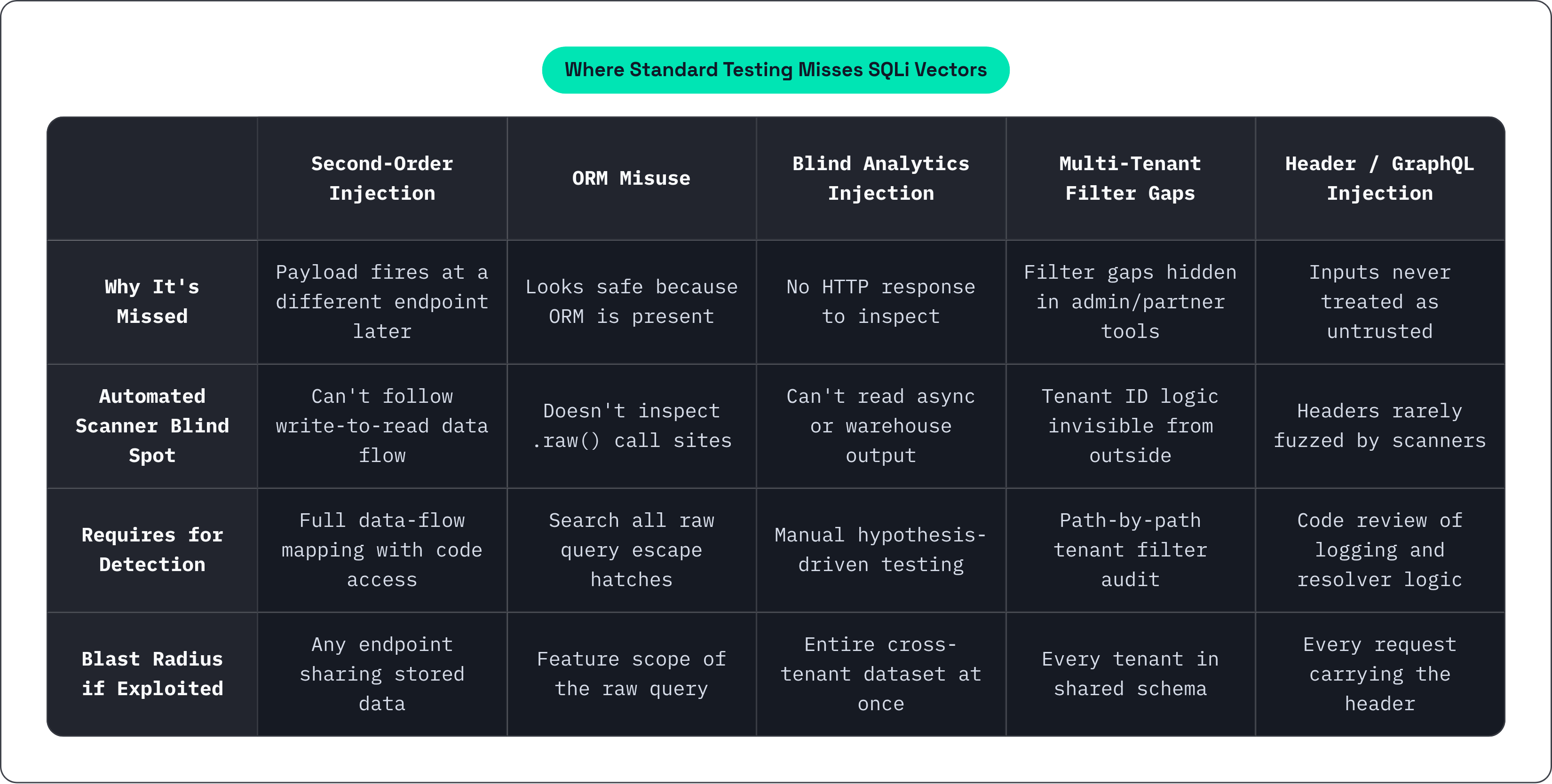
Automated scanners are good at exactly one thing: probing inputs they can see and reading synchronous signals back, error messages, timing shifts, reflected payloads. What they don't do is model how data actually moves through an app. They won't follow a payload from a write endpoint to whatever read endpoint eventually fires it, and they can't reason through an asynchronous pipeline at all. Injection tied to complex business logic or unusual data flows slips past automated tools constantly; manual testing by someone who actually knows what they're hunting for is still the thing that catches it.
Blackbox and greybox testing hit a structural ceiling too. Without code access, a tester can only test what they can find from the outside, and admin panels, internal APIs, background job parameters, and analytics inputs are usually invisible from that vantage point. Second-order injection needs someone tracing data from where it's written to where it's read, across different code paths entirely; that's close to impossible to do reliably without reading the source. ORM misuse that takes a code reviewer two minutes to spot could take a blackbox tester days of guessing, assuming they even find it.
Code access changes the math completely. A tester can search directly for raw query construction, string interpolation into SQL, dynamic column selection, every .raw() call in the codebase, finding all the candidates instead of the lucky few reachable from outside. Cloud config access shows which database roles the queries actually run under, whether the analytics pipeline has broader privileges than it should, and whether tenant isolation is enforced anywhere below the application layer. Architecture docs and diagrams point straight at the data flows where second-order injection likes to hide.
Finding a candidate isn't the same as proving it works. A real test has to demonstrate exploitability: an actual working exploit, not a guess, so the finding is a confirmed vulnerability rather than a false positive, with reproduction steps an engineer can actually act on. A report that reads "possible SQL injection in analytics module, could not confirm" doesn't satisfy an auditor and doesn't tell your team a thing about what to fix. A proven finding with a clear reproduction case does both at once.
None of this shows up in one big architectural rewrite either. Second-order injection and ORM misuse get introduced pull request by pull request: a new reporting feature here, a new API endpoint there. Scanning at the pull request level, flagging raw query construction and missing parameterization the moment it's written, catches these before they ever reach production.
How to verify your SaaS application's actual exposure to these vectors
Start by asking whether your last security test had code access. If it was blackbox only, treat the results as a partial picture, not a clean bill of health, since the vectors covered here mostly hide from outside-only testing by design.
Pull every raw query call in your codebase and check who wrote it, when, and whether user input ever reaches it. Do this for .raw(), execute(), string-formatted queries, dynamic ORDER BY clauses, all of it. It's tedious, but it's also exactly the kind of tedious that catches real bugs.
Trace your multi-tenant filtering logic path by path. Don't just check the main application flow; check every admin tool, every partner-facing API, every reporting and export feature you've got. If the tenant filter lives in the UI and not the service layer, you have a gap, whether or not anyone's exploited it yet.
Look hard at your analytics and background job code for elevated database privileges. If a pipeline can read across every tenant's data, that pipeline needs the same scrutiny as your primary application, maybe more, since a single flaw there scales to everyone at once instead of just one account.
Finally, ask for proof, not a list of maybes. A test that names a possible issue but never confirms it leaves you exactly where you started: guessing. Insist on reproduction steps and a working exploit for anything flagged as a finding, since that's the difference between a report you file away and one your engineers can actually fix.