Black Box vs White Box Penetration Testing for Growth-Stage SaaS

Penetration testing is the deliberate simulation of adversarial techniques to prove real-world exploitability. Prove is the operative word. A vulnerability scan produces a list of potential issues: automated, fast, useful for tracking known weaknesses across an asset inventory. A penetration test goes further. A skilled human tester attempts to actually exploit those issues, chain them together, and demonstrate what a real attacker can accomplish. Knowing a door is unlockable is one thing. Watching someone walk through it is another.
A credible finding is not a "possible vulnerability" flagged by a tool. It is a proven, exploitable path with a working exploit attached, showing what an attacker can access, what data they can reach, and how far into the system they can move. Plenty of reports circulating in this industry are essentially glorified scan outputs dressed up with narrative. That type of report is worse than having nothing, because it closes the conversation before the real work begins.
The compliance ecosystem has caught on. Auditors reviewing SOC 2, HIPAA preparedness, and ISO 27001 controls increasingly want evidence that a control was actually tested against real attack scenarios, not merely documented. Cyber insurance underwriters have tightened in parallel; policies above certain coverage thresholds now require evidence of human-led findings, not scan output alone.
For SaaS specifically, scope matters as much as the fact that a test occurred at all. A test that only surfaces code flaws misses business logic, multi-tenant data flows, and cloud configuration entirely. For SaaS products, the cloud layer is usually the primary attack surface, not a secondary concern someone will get to eventually.
How Black Box, White Box, and Grey Box Testing Differ in Practice
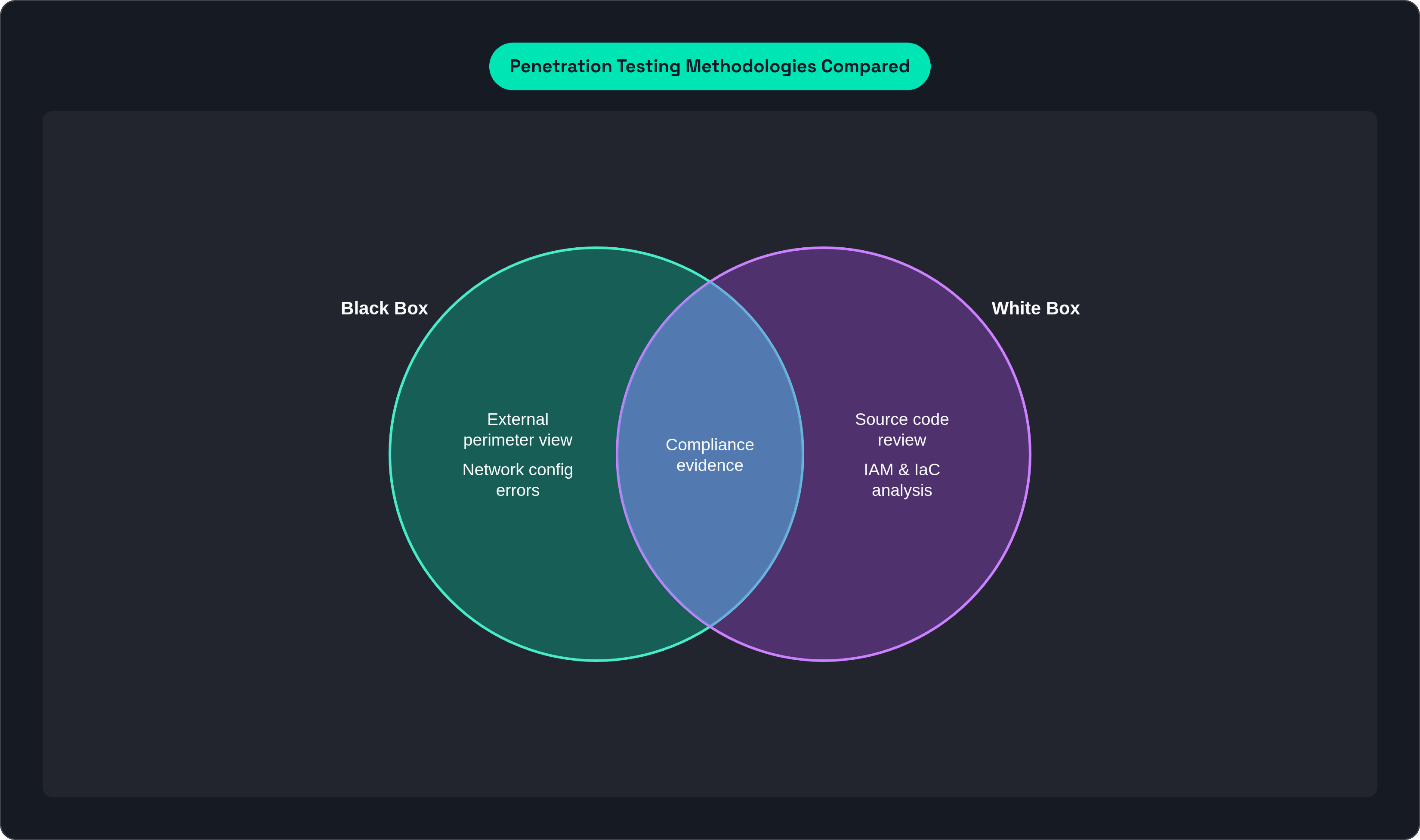
These three methodologies describe the starting state of a tester's knowledge, and that starting state determines what the test can and cannot reach. Most companies treat the methodology choice as an afterthought, something to confirm after scope and price. It should be the first decision.
Black box begins with zero internal knowledge. The tester simulates an unauthenticated external attacker: they see what the internet sees, nothing more. This surfaces publicly visible vulnerabilities, exposed services, and network configuration errors that manifest externally. If the tester cannot breach the perimeter, everything inside remains untested. That is not a limitation of the tester's skill; it is the structural ceiling of the method. A significant portion of engagement time goes toward reconstructing attack surface information that an insider would already possess, and that reconstruction time comes directly out of depth.
White box inverts this entirely. The tester receives complete access: source code, internal architecture diagrams, cloud configuration, infrastructure-as-code, documentation. Rather than simulating an attacker who knows nothing, white box simulates something closer to what sophisticated adversaries actually are, people who have done their homework, stolen credentials, or obtained insider access. This enables analysis of logic flaws, insecure defaults baked into code, and misconfigurations that produce no externally visible signal whatsoever. Given equivalent time, white box achieves a qualitatively different level of coverage.
Grey box sits between them. The tester receives partial information, typically authenticated user credentials or limited architectural context. It is the most common model in practice, and it meaningfully outperforms black box for SaaS environments because it gets the tester past the login wall and into the product's actual behavior. Still, it remains blind to the underlying code, to secret storage, to IAM policy scoping, and to infrastructure-as-code configurations. The tester sees what an authenticated user sees, not what the codebase contains.
Security researchers consistently advocate for combining methodologies because each surfaces a different class of vulnerability. Treating one as sufficient is a way of feeling thorough without actually being thorough.
The Specific Ways Black Box Testing Falls Short for SaaS Products
The structural ceiling of black box testing is simple: if nothing meaningful is visible from the outside, the engagement concludes without having tested the interior. For traditional network infrastructure, that ceiling is high enough to be useful. For SaaS, the most consequential risks live in the interior by definition.
Multi-tenant isolation failures, the scenario where one customer can access another customer's data, are a code and logic problem. They do not manifest at the perimeter. They emerge from flawed data scoping in the application layer, from missing tenant identifiers in query logic, from authorization shortcuts taken during a fast release cycle. A black box tester has no path to them. I have watched companies spend $15,000 on an external test, receive a clean report, and then discover a catastrophic tenant isolation flaw during a customer security review half a year later. Not because the test was conducted poorly. Because it was structurally incapable of finding that class of problem, and no one thought to ask that question before signing the contract.
API authorization vulnerabilities follow the same pattern. Broken object-level authorization, privilege escalation across user roles, insecure direct object references: all of these require understanding what the API was intended to do. You cannot identify where authorization logic fails without access to what that logic was supposed to enforce in the first place.
Hardcoded secrets, insecure defaults in infrastructure-as-code, misconfigured IAM policies: none of these emit an externally visible signal, and all of them are actively exploitable. Vulnerability exploitation now accounts for a substantial share of all incidents tracked by major security research bodies. These are not theoretical edge cases. Attackers are using them at scale, routinely.
The "realism" argument for black box testing also does not hold for the threat model actually relevant to SaaS. Enterprise-level adversaries regularly use credential theft, token abuse, session hijacking, and post-login exploitation. They do not confine themselves to perimeter probing. Simulating only an unauthenticated external attacker undersells the actual threat by a meaningful margin, and the time economics compound this: every hour a black box tester spends reconstructing attack surface is an hour not spent on depth.
What White Box Access Makes Possible That Other Methodologies Cannot
Source code access lets a tester trace every data path through the application: where user input is sanitized, where it is assumed to be trusted, where tenant boundaries are enforced, and where they are assumed but never actually checked. A grey box tester can probe the surface behavior of an endpoint. A white box tester can read what happens to the input after it arrives. Those are not the same activity, and conflating them is how serious vulnerabilities stay hidden for years.
Cloud configuration review requires access to the configuration. There is no way to evaluate whether IAM policies are correctly scoped, whether storage buckets are over-permissioned, or whether infrastructure-as-code introduces insecure defaults by examining external behavior. These are internal artifacts. Examining them requires being inside.
Architecture documentation reveals integration points, third-party dependencies, and inter-service data flows that external testing would require significant time to partially reconstruct. Access collapses that reconstruction time into analysis time, which is where the actual value of the engagement lives.
Logic flaws and business rule violations are the vulnerability class that automated tools and external testing most reliably miss, not because finding them is technically difficult, but because understanding what the code is supposed to do is a prerequisite for identifying where it diverges from that intent. This category causes the most damaging breaches in SaaS environments, precisely because it is invisible to the methodologies most companies default to.
When an auditor asks how you know your authentication logic is sound, "we ran an external scan" and "a certified tester reviewed the implementation and proved exploitability with a working exploit" are categorically different answers. Only white box access makes the second answer possible, and the gap between those two answers is not a technicality.
Where Grey Box Fits and When It Is the Right Starting Point
Grey box is the floor for a credible SaaS penetration test. It gets the tester into the product's actual behavior and surfaces the things most likely to affect an authenticated user: role-based access control, privilege escalation between user tiers, API behavior under a known identity, session management logic.
For a company early in its security maturity, or one conducting its first formal engagement, grey box is a reasonable entry point. It is time-efficient, produces findings that development teams can act on immediately, and is genuinely better suited to the SaaS threat model than black box testing.
But its ceiling is real. A grey box tester sees what an authenticated user sees. They can probe the behavior of an authorization boundary without access to the code that implements it, which means they will find some failures and miss others. It is a bit like trying to audit a financial institution by walking up to the teller window. You will learn something. You will not learn enough.
The practical answer for most growth-stage SaaS companies is a hybrid: grey box testing for application behavior combined with white box review of code and cloud configuration. This approach captures the threat realism of authenticated testing alongside the coverage depth of source-level analysis. It also answers the questions that enterprise customers and auditors are increasingly asking directly: has your cloud configuration been reviewed, and has your data isolation logic been examined by someone who could actually read the code underneath it?
How Compliance Frameworks Evaluate Methodology, and What Auditors Actually Want to See
SOC 2 does not mandate penetration testing by name, but auditors reviewing monitoring controls expect evidence that security controls were tested against real attack scenarios. A scan report satisfies the letter of some interpretations; it does not satisfy an auditor who is looking for genuine assurance that controls actually function under adversarial conditions. The distinction between "we have a firewall" and "we tested whether the firewall is bypassable" is exactly the kind of assurance SOC 2 auditors are trained to surface, and experienced ones are increasingly impatient with the former.
ISO 27001 goes further in spirit. Its requirements around technical vulnerability management and system security testing, combined with its emphasis on continual improvement, reward depth over checkbox frequency. An engagement covering code, cloud, and configuration answers these requirements more convincingly than one covering only the external perimeter.
HIPAA's regulatory trajectory is instructive even before proposed updates become binding. The proposed Security Rule revisions signal clearly where regulators are heading: explicit, time-bound penetration testing requirements, not just general language about security testing. Companies building for healthcare customers should be calibrating to that standard now, not waiting for the rule to finalize and scrambling after the fact.
A properly scoped engagement can satisfy SOC 2 monitoring control requirements, ISO 27001 Annex A technical testing requirements, and PCI-DSS's explicit annual testing mandate simultaneously, but only if the vendor understands all three frameworks and the scope document explicitly addresses each one. Many engagements leave this entirely on the table, which means companies pay for testing that partially satisfies multiple frameworks instead of fully satisfying any of them.
What auditors are increasingly rejecting: scan-only outputs, reports without retesting after remediation, findings that reappear year over year without closure. The pattern of checkbox security has become recognizable to experienced auditors, and more of them are saying so directly in formal audit responses.
What to Look for When Evaluating a Penetration Testing Vendor for a SaaS Engagement
Price is a signal. If a proposal comes in below roughly $4,000 to $5,000 for what is described as a penetration test, ask directly what percentage of the work is manual versus automated. At that price point, the engagement is almost certainly a vulnerability assessment with a different label on it. Standard SaaS-scope engagements from credible vendors typically run from the mid-four figures into the mid-five figures; enterprise-grade firms working complex environments run considerably higher. The spread is wide because the work is genuinely variable, but the floor is real and it exists for a reason.
Certifications signal hands-on exploitation competency. OSCP, OSWE, OSEP, GPEN, and GXPN are credentials earned through demonstrated skill, not governance study. A vendor whose team holds these is telling you something meaningful about their actual capability, not just their familiarity with frameworks.
Ask specific methodology questions. How do you test multi-tenant isolation? How do you approach broken object-level authorization in APIs? Can you assess IAM policies and infrastructure-as-code? How do you handle retesting after remediation, and is that included in the engagement cost? Vague answers to specific questions are informative. So are confident, detailed ones.
Ask to see a sample report before signing. A vendor with strong deliverables will show one without hesitation. Look for whether findings include working proof-of-concept exploits, clear remediation guidance tied to specific code or configuration, and severity ratings with business context attached. A report that reads like tool output with narrative pasted around it is not a penetration test deliverable.
The red flags worth taking seriously: a vendor who cannot name who will conduct your test, methodology documentation that is generic or absent, no post-remediation validation, no familiarity with your compliance framework, reliance on tool output without human expert review layered on top. And this one in particular: a vendor who does not surface critical findings immediately during the engagement. You should not learn about a catastrophic access control failure for the first time in a final PDF, two weeks after the tester found it.
Integrating Penetration Testing Into the SaaS Development Lifecycle, Rather Than Treating It as an Annual Event
Annual point-in-time testing creates a coverage gap that grows in direct proportion to how fast you ship. A SaaS codebase in active development changes constantly between test cycles; vulnerabilities introduced after the last test will not surface until the next one, which is eleven or twelve months away. For a growth-stage company iterating architecture and deploying frequently, that is a sustained exposure window that compounds with every release.
White box access is the prerequisite for closing it. Continuous security scanning integrated into the development pipeline, reviewing pull requests and catching newly introduced secrets, authorization changes, and dependency vulnerabilities at the moment of introduction, only functions if you have access to the code. This is one of the most underappreciated arguments for white box testing as a baseline posture: it enables the kind of continuous integration that black box methodologies are simply not structured to support.
The annual penetration test retains its value as a holistic, expert-led validation of the full attack surface. Automation catches regressions. Human testers find logic flaws that automation misses. These are not redundant functions; they address different problems and should be treated as complementary rather than interchangeable.
The maturity progression for a growth-stage company is sequential. Start with a rigorous white box baseline engagement covering code, cloud, and configuration. Retest after remediation to confirm findings are actually closed, not just acknowledged and filed away. Then integrate scanning into the CI/CD pipeline to catch regressions between annual cycles. Programs that combine penetration testing with continuous vulnerability scanning consistently outperform automated tools used in isolation, in both time-to-detection and breach impact.
The annual test is not the end state. It is the foundation.