Source Code Access Requirements for Effective Pen Testing
Blackbox testing starts from zero. No credentials, no documentation, no codebase. The tester begins where an external attacker begins, which is exactly its value and its ceiling.
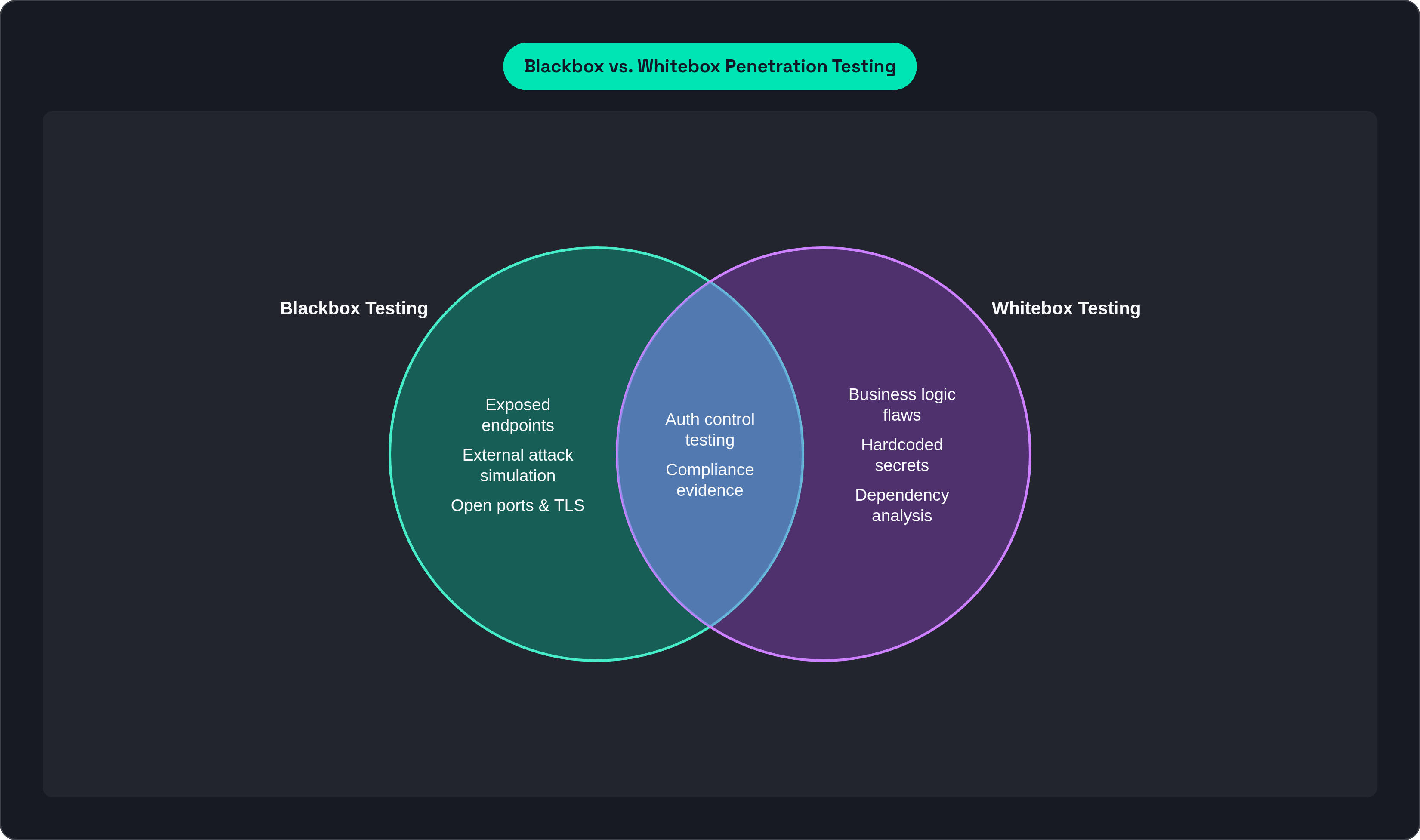
What blackbox does well is real. It tests what is actually exposed to the internet: misconfigured TLS, open ports, exposed admin panels, unauthenticated endpoints that should require authentication. These are legitimate findings. Blackbox also validates whether detection and response controls behave correctly under genuine attack traffic. For simulating an opportunistic external threat actor, it is the right tool.
The ceiling is structural. A tester cannot find a vulnerability in code they cannot read. Business logic flaws are embedded in application logic that produces no externally visible signal until the moment they are exploited. Hardcoded secrets live in config files, not HTTP response headers. Insecure deserialization paths are patterns in source code, not anomalies in network traffic. Unsafe direct object references look like valid requests until you understand the data model sitting behind the endpoint. None of this is a skills problem. It is a visibility problem, and no amount of skill closes it.
There is also a time problem that compounds the coverage problem, and I see this underestimated constantly. Blackbox reconnaissance, reconstructing your attack surface from the outside, consumes a disproportionate share of an already time-boxed engagement. A thorough manual test of a non-trivial SaaS application needs focused time on actual testing. Blackbox burns a significant portion of that budget just mapping what a whitebox engagement already knows on day one.
The best tester in the industry cannot reason about code they have never seen. Full stop.
What Source Code Access Actually Gives a Tester That Reconnaissance Cannot Reconstruct
Source code access does not give a tester more information. It changes the nature of the exercise entirely. This distinction matters more than most buyers realize when they're comparing quotes.
From day one of a whitebox engagement, the tester has a complete attack surface map: every route, every endpoint, every parameter, including undocumented internal routes that would never surface in any external scan. Shadow endpoints, deprecated API versions still wired into the codebase, dead code that still executes under specific conditions. None of these appear during external probing. They are invisible by design or by neglect, and they are readable in minutes from a repository.
Code-path tracing is what makes logic vulnerabilities findable. The tester reads the exact conditions under which access is granted or denied, then reasons about edge cases the developer never tested. They trace how state is passed between steps in a multi-step workflow and identify where a validation that ran on step one is assumed but not re-enforced on step three. Insecure deserialization looks like a recognizable pattern in source: an object reconstructed from untrusted input without type constraints. That pattern produces no reliable external signal until it is actively exploited.
Automated SAST tools flag candidate vulnerabilities at scale, but that is the beginning, not the result. What a human tester does is read the surrounding context to determine whether a flag represents a real exploitable path, a false positive, or something that chains to another finding and becomes critical only in combination. Take SQL injection: automated scanners find reflected patterns, but source code review finds the parameterized query that was bypassed in one specific context, the ORM escape overridden by a developer who did not understand why it existed, the template where two engineers wrote different sections and mixed safe and unsafe rendering without realizing it.
Hardcoded secrets are discoverable in minutes from a cloned repository. API keys, database credentials, private keys embedded in source or configuration files: none of these are visible in any external probe. Infrastructure-as-code and cloud configurations reviewed alongside application source reveal privilege misconfigurations that only become exploitable when both are visible together.
Dependency risk requires code access to assess properly. A whitebox tester can inventory every dependency with version specificity and cross-reference against known CVEs. Without source access, you are guessing at libraries in use from response headers and indirect signals. This matters increasingly because AI-generated code is prevalent in modern codebases, and recent research has found it contains meaningfully more vulnerabilities per line than human-written code, with failure modes that are not externally legible.
Architectural trust boundary violations are invisible to any external probe and readable in minutes of architecture review. A service that assumes it will only receive requests from an authenticated upstream gateway, but enforces nothing at the service layer itself, has a complete authorization bypass for anyone who can reach it directly. That assumption lives in the design.
How Business Logic Vulnerabilities Specifically Require Code-Level Visibility to Find
Business logic flaws are worth their own section because they are the clearest illustration of what blackbox testing structurally cannot find, and they are the vulnerability class most likely to produce actual financial or data loss at a SaaS company. I want to be specific about why.
A business logic flaw is not a coding mistake in the conventional sense. The application does exactly what the code says. The problem is that what the code says is wrong from a security standpoint. The developer made an incorrect assumption: about how the system would be used, about where validation was already being enforced, about what values a user could actually supply.
Consider a payment flow that validates cart price on step one, then passes an order ID to step three, trusting that the price associated with that order is immutable. A tester who can read the code sees immediately that the price is retrieved from a user-modifiable parameter at step three rather than from a server-side record. A blackbox tester must guess that this architecture exists, then probe every parameter in every request across the checkout flow hoping to stumble onto it. Some do. Many do not, particularly in complex workflows with dozens of parameters.
Authorization checks that gate a user-facing dashboard but not the underlying API endpoint the dashboard calls are similarly structured. The dashboard is visible externally. The API endpoint it calls may not be documented, may not appear in any scan, and may return fully privileged data to anyone who discovers it. A source code reader sees both in the same five-minute review. A blackbox tester might spend two days and never find the endpoint at all.
Discount stacking logic that is prohibited in the UI but not enforced in the server-side calculation. Role escalation paths where a user can modify their own role field because the update endpoint trusts user-supplied values. None of these vulnerabilities produce an anomalous HTTP signature. The request looks valid. The response looks normal. The vulnerability lives entirely in what the server decides to do with valid-looking input.
What source code makes possible is a specific reasoning exercise: read the authorization logic, trace data from entry point to persistence or execution, and ask whether there is any path through this code where the developer's assumption about who controls a value, or where a validation runs, is wrong. That question has no answer from the outside. There is no external signal to probe. The Verizon 2024 Data Breach Investigations Report found that over 68% of breaches involved a human element or misconfigured controls, and business logic and access control failures sit squarely in that category.
Where Greybox Testing Sits and When It Is a Reasonable Compromise
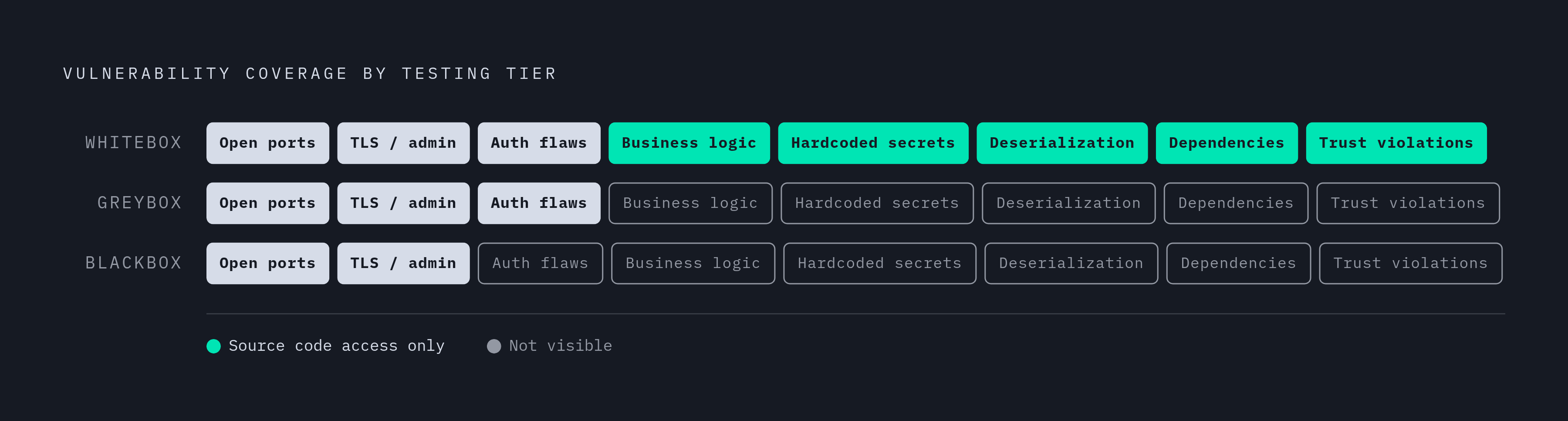
Greybox gives the tester credentials and authenticated access, sometimes API documentation, sometimes architecture diagrams. No source code.
The genuine advantage over blackbox is real. Reconnaissance time drops because the tester starts authenticated rather than mapping the perimeter. Internal controls, role separation, and privilege escalation paths become testable. A meaningful share of authorization flaws, the ones requiring authenticated state to observe, surface in greybox engagements that would have been invisible in a blackbox test.
What greybox still cannot see is the logic beneath the authenticated surface. The tester can probe what the application does. They cannot read why it does it, where the branching conditions live, or what assumptions the developer made about who would ever call a given endpoint. Hardcoded secrets, unsafe dependency usage, and architecture-level trust failures remain invisible. Any vulnerability whose externally observable behavior is indistinguishable from correct behavior remains undiscoverable.
Greybox is a defensible choice in specific contexts. A regulatory deadline with a fixed scope and a team not ready to grant code access. A mature product with a narrow, well-understood scope where the primary concern is authenticated-user attack paths. It also works reasonably well as a complement to a prior whitebox engagement: validate that previously identified issues were remediated, then test new surface.
The cost comparison is the piece most often misread. Greybox costs less than whitebox because it takes less time, but the time savings come from discovering fewer vulnerability classes, not from testing more efficiently. The question for any technical decision-maker is not what can we afford. It is what attack paths are we accepting we will not discover.
What Compliance Frameworks Actually Require Versus What Auditors Actually Look For
The common misread of compliance frameworks is that because SOC 2, HIPAA, and ISO 27001 do not prescribe whitebox testing by name, teams treat that as permission to use the shallowest test available. This is technically defensible and practically dangerous, and experienced auditors know the difference.
SOC 2's CC4.1 requires demonstration that an organization evaluates and communicates information security risks. Auditors want evidence that controls function under real conditions, not that a scan was executed and a report was generated. HIPAA's Security Rule requires ongoing risk analysis validated against ePHI systems, and a proposed 2025 rule update is expected to make annual penetration testing explicitly mandatory for covered entities and business associates. ISO 27001 requires a risk-driven testing plan with traceability from findings to the Statement of Applicability and corrective action records, with testing depth proportionate to the documented risk assessment.
What auditors look for in practice has shifted. They want evidence that findings were manually validated, not listed from a scanner export. They want confirmation that critical paths, payment processing, authentication, data access controls, were specifically in scope and tested. They want retest evidence: documentation that findings were remediated and verified, not just acknowledged. Experienced auditors and enterprise security reviewers can read a penetration test report and tell you within five minutes whether a human did manual testing or whether it is a reformatted scanner output. CVSS scores without exploit proof, generic CWE descriptions without code-level context, no mention of business logic or authorization testing: these signals are legible to anyone who knows what they are looking at.
The specific risk for growth-stage SaaS companies is not just audit failure. Enterprise customers in financial services, fintech, and healthcare conduct their own vendor security reviews. A thin penetration test report in a vendor security questionnaire response is a deal risk, not just a compliance risk. A 2025 Data Breach Report found that organizations performing regular penetration tests and vulnerability scanning reduced breach impact by 38% on average compared to those relying solely on automated tooling. The compliance outcomes and the security outcomes point in the same direction.
What to Look for in a Scoping Conversation to Know Whether Source Code Access Is on the Table
The scoping conversation is where methodology gets decided, and it is also where most buyers accept defaults they did not realize they were accepting. The vendor asks for a URL and a budget. The buyer assumes the rest is standard.
A few questions reliably reveal whether a vendor is capable of source-code-informed testing. Ask: "Do you perform static code analysis as part of the engagement, or only dynamic testing?" A legitimate whitebox provider has a specific answer and can describe how SAST output is reviewed and validated by a human analyst, not just run and exported. Ask: "How do you handle hardcoded secrets or insecure dependencies discovered during testing?" This question only has a meaningful answer if the tester has code access; a vendor who hedges or pivots to discussing scanner output is telling you something. Ask: "Walk me through how you would identify a business logic flaw in a payment or authorization flow." The answer should describe reading and reasoning about code, tracing data through functions, identifying where validation assumptions are made versus where they are enforced. If the answer describes probing HTTP responses, that is a blackbox methodology being presented in whitebox language. Ask: "What do you need from us besides a URL and credentials?" A blackbox vendor needs almost nothing. A whitebox vendor needs repository access, cloud configuration access, and architecture documentation.
Red flags in the response matter. A vendor who quotes a price before asking about scope cannot price a whitebox engagement correctly, because codebase size, language stack, and number of services all determine how long the engagement takes. A timeline shorter than seven days for a non-trivial SaaS application suggests source code review is not genuinely happening. A sample report that reads like scanner output, with CVSS scores, no exploit proof, and no code-level finding detail, is exactly what it looks like. On certifications: CEH validates knowledge through multiple-choice examination, while OSCP, OSWE, and CREST certifications validate practical exploitation ability under real conditions. A team credentialed exclusively in the former has not demonstrated the skills the latter requires. And if retesting is excluded from scope or offered as a paid add-on, the engagement is incomplete by design.
From the buyer's side, a credible whitebox engagement requires read-only repository access, cloud configuration access or exported configs, architecture documentation and data flow diagrams where they exist, and a named technical contact who can answer questions during the engagement. Ask to see a sample report before signing. A whitebox report contains code-level findings with line references, proof-of-concept exploit detail, and remediation guidance specific to the actual codebase. Generic CWE descriptions are not remediation guidance.
How Continuous Pull-Request Scanning Extends Whitebox Coverage Beyond the Point-in-Time Test
Every point-in-time penetration test has the same structural limitation: it captures security posture on the day it runs, and code ships the next week. New endpoints are added. A dependency is updated. An engineer refactors authentication middleware under deadline pressure. The test's findings remain accurate for what was tested. They say nothing about what was introduced afterward.
This is not a criticism of penetration testing. It is just how software development works. A test that ran in Q1 and found nothing does not mean Q3 is safe. I have seen organizations treat a clean annual test as a kind of insurance policy, which is a comfortable misreading of what the test actually represents.
Continuous pull-request scanning addresses this gap by applying code-level analysis at the moment new code is proposed, before it merges. Every pull request becomes a checkpoint. Secrets accidentally committed to a feature branch are caught before they reach production. A new API endpoint introduced without an authorization check surfaces in the PR review, not six months later during an annual test. Dependency updates introducing a known vulnerability are flagged at the point of change, when the engineer who made the update is still in context and the fix is a one-line revert.
The economics shift with the coverage model. Findings identified in a pull request cost a fraction of what they cost to remediate post-deployment. The engineer who wrote the code is still working in that context and the change set is small. Findings from a penetration test, particularly architectural ones, arrive after the code has been deployed, integrated, and built on top of. Unwinding that is not a quick fix, and anyone who has had to walk an engineering team through a structural remediation six months after deployment knows exactly how that conversation goes.
A whitebox penetration test and continuous pull-request scanning answer different questions. The penetration test provides a comprehensive, adversarial evaluation of the system as it exists, including the cumulative effect of every design decision and shortcut across the codebase. Continuous scanning provides ongoing assurance that new code does not introduce the categories of vulnerability the test already identified. Running one without the other leaves either coverage that is too narrow or assurance that expires the moment the next commit merges.
Both require access to the code. That is the question the entire methodology debate comes down to.