White Box Penetration Testing Explained for SaaS Teams
Whitebox testing reveals the attack paths that matter most for SaaS products.

The standard industry framing goes like this: blackbox simulates an external attacker with no prior knowledge; greybox gives the tester some information, like credentials but not source code; whitebox gives them everything. Pick based on what threat you want to simulate. Clean, logical, and mostly useless guidance for SaaS teams.
The flaw is in what that framing assumes about your most dangerous adversary. It assumes they are starting from zero, outside your perimeter, trying to find a crack. For a modern SaaS product, that attacker is not the one keeping your security team up at night. The real threat looks like a compromised employee whose credentials now belong to someone else, a supply chain compromise through a CI/CD integration with perfectly legitimate access to your build pipeline, an API key committed to a repository and found by an automated scan, or an insider operating from partial access they already hold legitimately. Every one of those scenarios starts with the kind of access whitebox testing already assumes. A test that deliberately withholds that access from your tester is simulating a threat model that is not, in 2025, your most probable path to compromise.
The SaaS attack surface compounds this. Your real risk does not live at the network perimeter the way it does for an on-premise enterprise system. It lives in IAM policies, in multi-tenant isolation logic, in how third-party integrations handle tokens, in deserialization code buried in a microservice that no external scanner ever reaches. None of that is visible without code and configuration access. Trying to assess it from the outside is like diagnosing engine trouble by listening at the keyhole — you might hear something, but you will never see where the oil is leaking.
Greybox closes part of the gap. A tester with credentials can authenticate and explore. But they cannot read your dependency manifests, trace authorization logic through the code, or find the secret hardcoded three commits back in a config file that never touched production directly. The application's interior logic remains opaque.
The "realism versus depth" trade-off the three-methodology framing implies is itself the misleading part. For SaaS teams, depth is realism. The most accurate simulation of how your product actually gets compromised requires exactly the access whitebox testing provides.
The vulnerability classes that only appear clearly under whitebox conditions
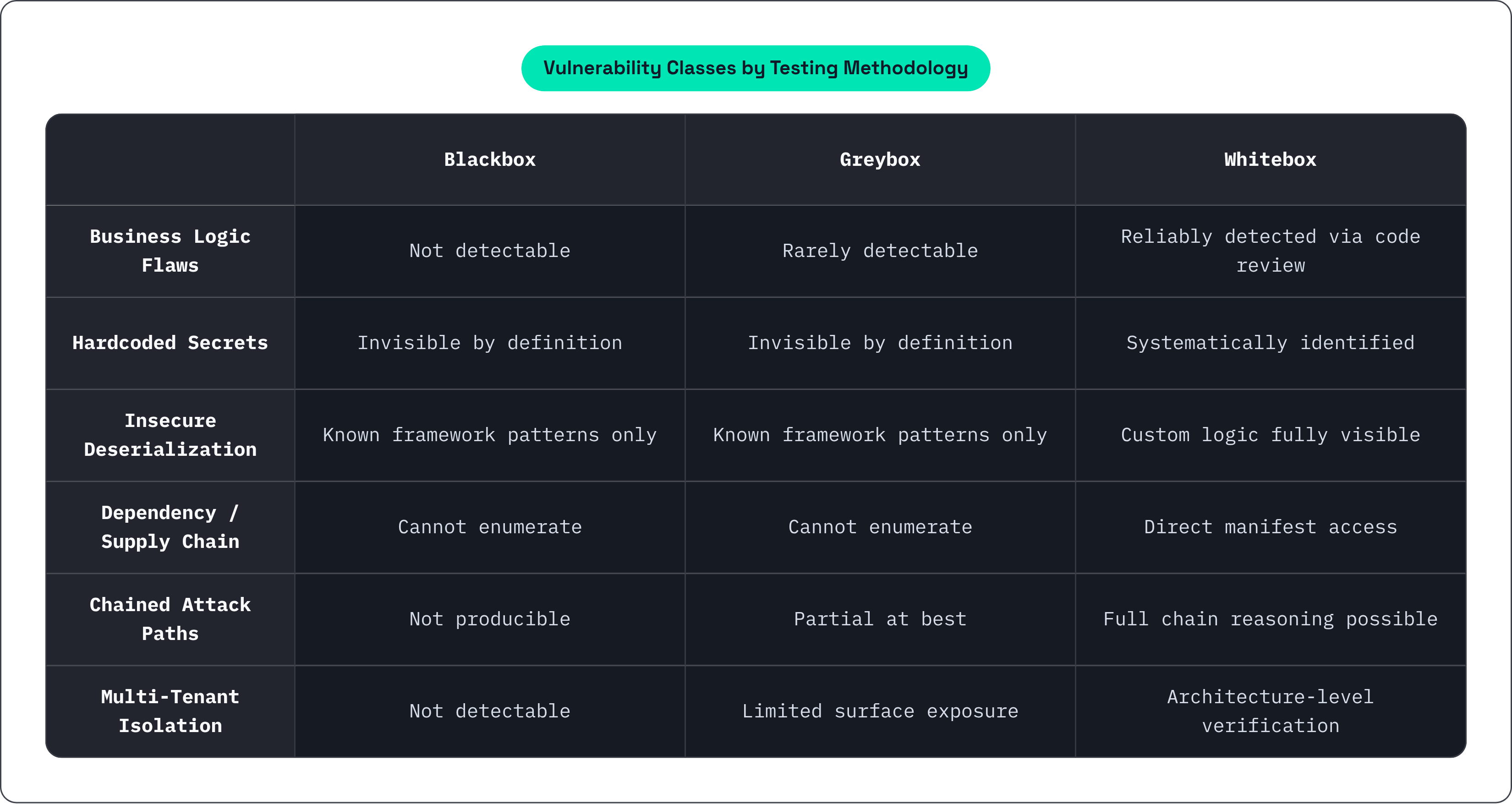
Some vulnerability classes are technically detectable through external scanning. Business logic flaws are not among them, and that distinction matters more than most teams appreciate until they have found one the hard way, usually after the fact.
A business logic flaw exists when the application does exactly what the code says it should do, and what the code says is wrong. Broken multi-tenant isolation is the canonical SaaS example: one tenant's data becomes accessible through a legitimate API call made in a sequence the developer never anticipated. No scanner catches that. External testers cannot reliably surface it. You find it by reading the code, understanding the intended behavior, and identifying where implementation diverges from what the architecture diagram assumed.
Hardcoded secrets are invisible to external testers by definition. They live in configuration files, environment handling logic, and commit history. A secret rotated out of active use three months ago but still present in a commit from six months back is a real credential if the underlying key was never revoked. Whitebox testers look for this systematically; external testers cannot.
Insecure deserialization requires understanding how objects are constructed in the codebase. The tester needs to see the code handling serialized input, identify the classes being instantiated, and reason about what a crafted payload actually triggers. Dynamic scanning catches some well-known deserialization patterns in widely-used frameworks. It does not catch the custom deserialization logic your team wrote for an internal data pipeline, because it has no way to know that pipeline exists.
Dependency and supply chain vulnerabilities require direct access to your dependency manifests, whether that is package.json, requirements.txt, go.mod, or whatever your stack uses, plus visibility into your build pipeline configuration. These are simply not things a tester can enumerate from the outside.
The most consequential finding category, though, is the chained attack path, and this is where I have watched teams most consistently underestimate what they are missing. A whitebox tester finds three issues that individually score low on a CVSS scale: a misconfigured IAM policy, a code-level flaw that allows a specific internal API to be called with an insufficiently validated parameter, and a logging configuration that writes tokens to a storage location with overly permissive access. None of those findings, in isolation, justifies an executive briefing. Combined, they represent a path from an authenticated low-privilege user to a customer database. Finding that chain requires understanding the application logic, the cloud configuration, and the relationship between them simultaneously. Automated scanners enumerate findings; they do not produce chains. Think of it this way: the scanner hands you a bag of puzzle pieces and confirms pieces exist. It cannot tell you what the picture looks like, or how close to the edge you already are. The scanner tells you something is wrong. It cannot tell you how the pieces connect or how far an attacker gets when they do.
How whitebox testing maps to SOC 2, HIPAA, and ISO 27001 audit requirements
SOC 2 does not explicitly mandate penetration testing as a named control. What CC4.1 requires is demonstration that security controls work in practice, not just in documentation. A whitebox test report that ties a specific finding to a specific code path and traces remediation evidence back to a pull request gives an auditor exactly what they need to verify that a control gap was identified and closed. A scan report listing CVEs against IP addresses does not provide that. Experienced auditors notice the difference, and the ones reviewing SaaS companies with complex architectures are increasingly sophisticated about what they are looking at.
Shallow blackbox reports frequently fail audit review not because they are technically insufficient but because they lack the traceability auditors require. The finding needs to connect to a system in scope, a control that was supposed to prevent it, and evidence that it was remediated. Whitebox testing produces that structure naturally because the tester worked from your actual architecture, not from what happened to be visible from the outside.
HIPAA's Security Rule requires ongoing risk analysis and risk management for systems touching ePHI. Whitebox testing directly validates access control enforcement and encryption implementation at the code level, which is the only level where you can verify those controls are actually doing what the policy says they do. There is no substitute for that verification if you are genuinely trying to satisfy the substantive requirement rather than the paperwork version of it.
ISO 27001 takes a risk-driven approach to testing cadence, where frequency is determined by your risk treatment plan rather than a fixed calendar, and is triggered by significant changes to infrastructure or application architecture. The key audit requirement is that findings trace back to the Statement of Applicability and generate corrective action records. A whitebox report with specific code-level findings provides that traceability directly.
One practical efficiency worth noting: a properly scoped single engagement can satisfy SOC 2 CC4.1, relevant ISO 27001 Annex A controls, and PCI-DSS Requirement 11.4 in one pass, if the statement of work explicitly scopes for all three. The incremental cost for dual or triple scoping runs meaningfully lower than funding separate engagements. IBM's Cost of a Data Breach 2024 report, covering over 600 organizations across more than a dozen countries, put the global average breach cost at $4.88 million, with healthcare breaches averaging $9.77 million and financial services at $6.08 million. For a SaaS company selling into either of those verticals, the arithmetic is not complicated.
What compliance-grade pen tests omit that whitebox testing catches
Most penetration testing vendors exist because compliance frameworks created a market for testing. The incentive is to satisfy the auditor at minimum cost, not to find what an attacker would find. These are related objectives but not identical ones, and the gap between them is where real exposure lives.
A compliance-grade test asks whether the required controls exist and function as documented. A real adversarial test asks how far an attacker can actually get. Those questions diverge most sharply on business logic, application-specific attack paths, and chained exploitation, which are precisely the categories compliance testing is unlikely to pursue, not out of negligence, but because the incentive structure does not reward finding them.
Verizon's 2025 Data Breach Investigations Report found that exploitation of vulnerabilities rose 34% year-over-year. Point-in-time compliance tests, by definition, cannot protect against vulnerabilities introduced after the assessment window closes. That is a structural limitation of the model, not a criticism of any particular vendor.
Automated scanners, Nessus, Qualys, Burp Suite running in automated mode, find known vulnerabilities against known signatures. They are fast, thorough against established patterns, and a legitimate starting point for any engagement. They are not an engagement on their own. They do not find business logic flaws, complex authorization bypasses that depend on application-specific state, or attack chains. Those require a human tester reasoning about your specific application, and that reasoning takes more time than compliance-minimum budgets typically accommodate.
The false confidence problem is real and genuinely underappreciated. A passing score creates organizational confidence, and that confidence can quietly reduce internal pressure to invest in deeper security practices. Sophisticated attackers bypass compliance scores routinely; that is the documented pattern across breach investigations, not a theoretical concern. A report that certifies compliance is not a report that certifies safety — a passing grade on a fire drill is not the same thing as a fireproof building.
A real test report shows a path to compromise. It demonstrates how specific findings were chained to reach meaningful assets: customer data, administrative credentials, infrastructure with blast radius. If a report you receive lacks this, it is compliance-grade work regardless of what methodology the vendor claimed to run. One useful proxy for test quality: quality engagements allocate the substantial majority of engagement time to manual testing, with automated scanning as the starting point rather than the substance.
How to evaluate whether a whitebox pen test vendor will actually deliver
The clearest single red flag is a fixed low price quoted with a 24-hour turnaround and no scoping call. That is an automated scan delivered in a report template, regardless of what the proposal says about methodology. I have seen this more times than I want to count, and vendors who operate this way are not running engagements; they are running a print shop.
Five questions worth asking before signing anything.
What percentage of engagement time is manual testing versus automated scanning? Vendors who answer this with tool names instead of ratios are telling you something important about where their value actually sits.
Who specifically will run this engagement, and what are their credentials? OSCP, OSWE, CREST, and GPEN validate practical, hands-on exploitation ability. CEH is a multiple-choice examination. Ask for the specific people, not the organization's aggregate credential list.
Can you share a redacted sample report? Refusal to provide samples signals there is nothing worth showing. Vendors confident in their work share examples without hesitation.
How do you test business logic and authorization flaws beyond what scanners surface? Listen for specificity. A tester who can describe their approach to tracing multi-tenant isolation logic or authorization bypass patterns in a specific tech stack knows what they are doing. Vague answers about "manual testing" without substance are not reassuring.
What does remediation support look like between report delivery and retest? The finding is not the end of the engagement; it is the beginning of the fix cycle.
Scoping is itself a quality signal. A thorough scoping process covers target IP ranges, application URLs, user roles across privilege levels, testing windows, excluded systems, and out-of-scope conditions. A vendor who quotes a flat fee without asking detailed scoping questions has already underscoped the engagement. You will get a test of something, but probably not everything that matters.
Remediation support, in a quality engagement, means a findings debrief with your engineering and security teams, availability for developer questions during the fix cycle, fix review before the formal retest, and prioritization guidance that accounts for your actual risk profile. Ask specifically what is included and what triggers additional cost.
Ask for proof of professional indemnity insurance before signing. Penetration testing involves deliberate attempts to break systems; this is the minimum due diligence before granting a third party access to production environments.
Finally, require that the engagement methodology maps to a named public standard: OWASP WSTG, PTES, or similar. Vendors who cannot identify the standard they follow are not running a structured whitebox engagement. They are improvising, and improvised is not what you want when the evidence needs to hold up in an audit.
Integrating whitebox testing into the SaaS development lifecycle beyond the annual assessment
The annual point-in-time penetration test is the compliance standard. It is not a security program. Conflating the two is one of the more expensive mistakes a growth-stage SaaS company can make, and it is remarkably common. The Verizon 2025 DBIR finding that vulnerability exploitation rose 34% year-over-year is not an abstraction; it is a description of what happens during the eleven months between annual assessments.
Whitebox access to source code and cloud configuration is the prerequisite for closing that window. You cannot scan pull requests for new vulnerability patterns, or flag new misconfigurations in infrastructure-as-code, without the access whitebox testing already establishes. The access model you build for a whitebox engagement is the same access model you need for continuous coverage. That alignment is not incidental; it is why continuous security integration and whitebox methodology belong in the same conversation from the start.
In practical terms, this means pull request scanning that flags new vulnerability patterns before code ships to production, retests scoped to changed components after remediation rather than full re-engagements every time, and an ongoing channel between your security team and the testing provider for questions that arise during the fix cycle. These are not exotic capabilities. They are the natural extension of a whitebox engagement with a vendor structured for ongoing work rather than transactional delivery.
The SDLC alignment argument follows from this: whitebox testing treats security as a property of the code and configuration, not a gate at the end of a release cycle. Security as a terminal gate creates pressure to scope it narrowly, rush it, and declare victory. Security as a property of the codebase creates incentive to find issues before they accumulate into the kind of chained vulnerability scenario described earlier.
For a growth-stage SaaS company, the progression is straightforward. An initial whitebox engagement establishes the baseline and satisfies the first audit cycle. Remediation and retest closes confirmed findings against a documented record. Continuous PR scanning and targeted retests on significant architectural or infrastructure changes close the window between annual assessments. Each cycle builds on the prior one, and the evidence accumulates.
The audit-readiness payoff is that the next SOC 2, HIPAA, or ISO 27001 cycle does not require assembling evidence from scratch. The development record already contains a continuous testing history, remediation traceability, and corrective action documentation. Sophisticated auditors, and they are increasingly sophisticated about SaaS architectures specifically, respond to that record differently than they respond to a single annual report with no supporting history. That difference, accumulated across audit cycles, is the compounding return on a testing program designed for both security and compliance from the beginning.