Continuous Pull Request Security Scanning vs Point-in-Time Pen Tests
Pull request scanning runs automated security checks on every code change before it merges. That's it. The value is in the timing: catching a vulnerability at the moment of introduction costs orders of magnitude less than finding it six months post-deployment, and that shift-left economics argument is genuine, not marketing copy.
What it finds well: known vulnerability patterns in dependencies, static analysis hits like hardcoded secrets and injection sinks, insecure configurations, deviations from secure coding baselines tied to a specific commit. Software composition analysis picks up the library-level CVEs. These are real findings with real remediation value.
What it cannot find is where the conversation usually goes sideways. A scanner has no mental model of what your application is supposed to do. Business logic flaws are invisible to it by design. Authorization bypasses that depend on understanding role relationships don't resolve to a known pattern. Chained attack paths that cross components require someone to reason about context, not match signatures. Vulnerabilities that only manifest at runtime, or in the interaction between services, won't surface in a diff.
The tooling landscape here includes GitHub Actions with CodeQL, OWASP ZAP in CI pipelines, open-source vulnerability databases, and several commercial platforms. These map reasonably well to SOC 2 CC6 and CC7. But the output is a signal, not a verdict. Flagged items require triage, and the false positive rate matters more than most buyers realize. The moment developers start dismissing alerts as noise, the tool's operational value drops to near zero regardless of its theoretical coverage. I've watched that happen. It's quiet and fast and very difficult to reverse once it sets in.
Frequency does not equal depth. That's the limitation to carry forward. Scanning more often across a wider surface is genuinely useful; it is not the same thing as adversarial reasoning about novel attack paths.
What a Real Penetration Test Does That Automation Cannot Replicate
A penetration test is a time-boxed, goal-driven attack by a human reasoning about your specific system. Not a scan. Not a tool run. Quality engagements put 60 to 80 percent of their time into manual testing; automated scanning is an input to that process.
The human advantage is concrete. Consider a server-side request forgery finding in a cloud environment. In isolation, it rates medium severity. A skilled tester follows the chain: the SSRF reaches an internal metadata service, yields infrastructure credentials, enables lateral movement to a production database. That chain requires someone who understands the deployment model, the cloud architecture, how the pieces interact. No scanner follows that reasoning because no scanner was designed to. It's a fundamentally different cognitive task.
Business logic flaws live in the same category. A payment flow bypass requires understanding the application's intended behavior and verifying whether the code actually enforces it. Authorization chains where privilege escalation spans multiple components require a tester who can hold the whole architecture in mind and probe the seams between systems. Individually low-severity findings that combine into a critical attack path don't announce themselves; someone has to assemble them.
Whitebox access changes the depth ceiling entirely. A tester working with source code, cloud configurations, and documentation can map attack surfaces that blackbox scanning cannot even see. And every legitimate finding should arrive with a working exploit, not a CVSS score and a probability estimate. Unverified maybes dressed up in a PDF are not findings.
The gap between a real pen test and a scan-disguised-as-pen-test is not subtle once you've seen both. A 60-page report that turns out to be a Nessus scan with the tool's name swapped out still satisfies a compliance checkbox. That's precisely why the checkbox alone tells you almost nothing.
The Problems Each Tool Is Actually Designed to Solve
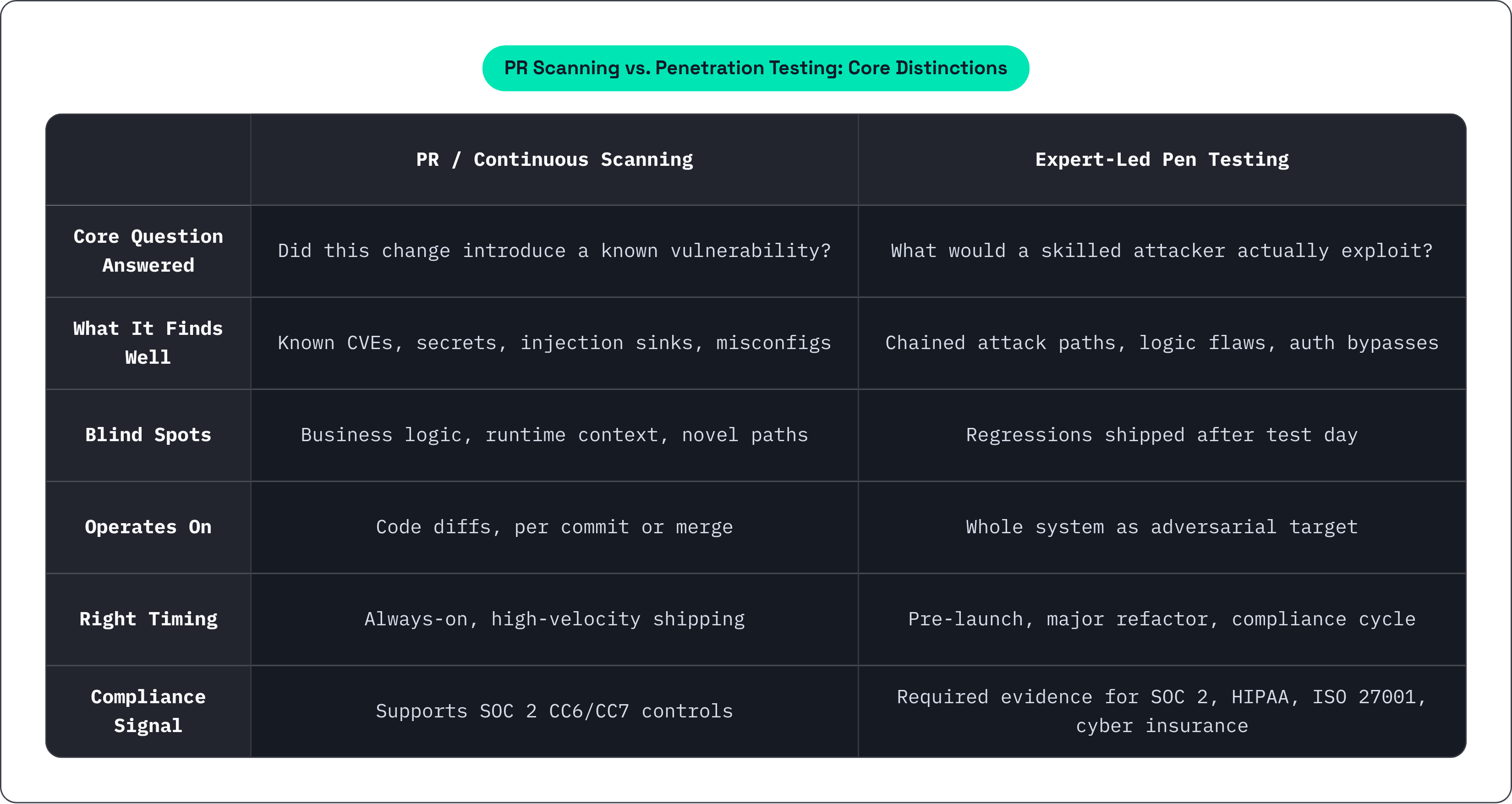
PR scanning answers one question: did this code change introduce a known vulnerability? That is the right question when you're shipping fast, managing a large contributor surface, and regression risk is the primary concern. It is the wrong question when you need to know whether your authentication architecture is fundamentally sound.
Penetration testing asks something different: given everything about this system, its code, its cloud footprint, its logic, what would a skilled attacker actually exploit? That's the right question pre-launch, before an enterprise sales process, after a major architecture change, or during a compliance audit window. It is the wrong question when you need real-time feedback on ten pull requests a day.
The structural distinction is this: scanning operates on diffs; penetration testing operates on the whole system as a living adversarial target. A codebase with clean PR scans can still harbor deep architectural vulnerabilities that were never introduced by a single commit. A clean annual pen test report covers the system as it existed on test day; everything shipped in the next sprint is uncharted territory until someone tests it.
Neither tool makes the other redundant. Treating them as substitutes is exactly how organizations end up with both a clean compliance report and a breach.
Where Continuous Scanning Earns Its Keep: Catching Regressions at the Speed of Deployment
Continuous scanning is built for high-velocity environments: frequent deploys, large contributor surfaces, open-source dependencies that receive upstream CVEs on their own schedule. The regression problem is concrete. A feature branch that looks clean in Q1 can introduce a SQL injection sink in Q3 when a developer adds a raw query escape hatch to an ORM-managed codebase. Nothing in an annual test catches that, because the vulnerability didn't exist at test time. That's not a failure of the test; it's a structural mismatch between the cadence and the risk.
Dependency risk compounds this in ways that are easy to underestimate. A library used across dozens of services gets a new CVE; PR scanning surfaces the exposure at the point where a version bump lands. The alternative is discovering it six months later, at which point the blast radius is larger and the remediation is messier. The developer feedback loop is also genuinely different in character. When a scan flags specific lines with specific remediation guidance on the same day the code was written, the developer who introduced the issue is still thinking about that code. Annual pen test findings arrive months later, often reviewed by someone who has since moved to a different team and has no memory of the decision.
Coverage width is another real advantage for organizations with large, diverse attack surfaces that no pen test budget can fully cover in a single engagement. Automated platforms can validate controls across a broad surface on a frequent cycle. That matters. But broad coverage of known patterns is not adversarial reasoning about novel attack paths, and confusing the two is where security programs accumulate false confidence.
Where Expert-Led Pen Testing Earns Its Keep: Mapping Attack Paths That Require Human Reasoning
Expert-led penetration testing earns its keep at inflection points: pre-launch, before an enterprise sales process, after a major refactor, during compliance audit cycles, whenever the question is about systemic risk rather than incremental regression.
The chained attack path problem is the clearest illustration. An SSRF vulnerability in isolation is medium severity; that same SSRF in a cloud environment reaching an internal metadata service, yielding credentials, enabling lateral movement to a production database is critical. Only a human tester following the chain discovers the actual severity. SSRF attacks surged dramatically between 2023 and 2024, driven partly by AI-powered tooling and cloud microservices expanding the attack surface. This is precisely the vulnerability class where runtime context and cloud architecture knowledge matter, not pattern matching.
Business logic is opaque to scanners by construction. An authorization bypass that lets a user of one role access another role's data doesn't resemble a known vulnerability signature. It requires understanding the application's intended behavior and verifying whether the enforcement actually holds. There is no automated mechanism for that reasoning. Someone has to think through it.
The compliance credibility question is also straightforward. Auditors for SOC 2, HIPAA, and ISO 27001 want evidence that security controls hold under real adversarial conditions. A scan report doesn't provide that evidence. A signed attestation from a certified tester does. Cyber insurance carriers have tightened underwriting materially since 2024; policies above certain thresholds now commonly require evidence of qualified human testing. A vulnerability scan no longer satisfies the requirement at many carriers. For fintech, healthcare, and anti-fraud environments, the credibility of the finding matters to enterprise buyers, not just internal teams.
How a Mature Security Program Integrates Both into One Workflow
The architecture isn't complicated: continuous PR scanning as the always-on regression layer; penetration testing as the periodic deep-dive interrogating the whole system as a living adversarial target. The integration is where most programs underperform, not the individual tools.
Cadence calibration looks like this in practice. PR scanning runs on every merge. Penetration testing happens at minimum annually, aligning with industry standard expectations; ISO 27001 requires periodic testing, HIPAA's proposed rule moves toward mandatory annual tests, and PCI DSS requires annual external and internal pen tests plus biannual segmentation testing for service providers. Beyond the annual floor, pen tests belong after significant architecture changes, new product surfaces, and before high-stakes enterprise deals. These are not bureaucratic checkboxes; they're moments when the risk profile shifts enough that last year's findings are stale.
The feedback loop between layers is where integration actually earns its value. Pen test findings should inform what patterns the scanner is tuned to catch going forward. Scanner findings accumulated over time can surface patterns worth deeper investigation in the next scoping conversation. Retesting belongs in both layers: specific fixes get targeted retests, new code gets ongoing scanning. On-demand retesting fills the gap between annual cycles after a new authentication system, a new API surface, or a major dependency upgrade.
What this requires from vendors is also worth stating plainly. The pen test provider needs to understand your CI/CD context well enough that findings are actionable at the sprint level, not just presentable in a PDF. The scanner configuration should reflect the threat model surfaced by the pen test, not just default rulesets that ship out of the box. A dedicated channel for ongoing collaboration is the operational difference between a vendor and a partner. When the pen test team and the engineering team never talk except at report delivery, you're leaving most of the value on the table.
What to Watch for When Evaluating Tools and Vendors in Each Category
For PR scanning tools, the false positive rate is the leading indicator of whether the tool will actually get used. Developer trust is fragile and doesn't rebuild quickly. Coverage of the vulnerability classes that appear in your actual stack matters in practice; a tool optimized for Java patterns adds limited value to a Go and Python shop, regardless of what the vendor's marketing materials claim. Integration depth is a deliberate policy question: does the tool block merges on critical findings, or does it report and move on? The answer should reflect your team's risk tolerance and review culture. Defaulting to whatever ships out of the box is an implicit decision; make it explicit.
For penetration test vendors, start with one question: what percentage of the engagement is manual testing versus automated scanning? Providers who can't answer that specifically are almost certainly scanner-heavy and probably not worth the conversation. Ask for named testers with verifiable credentials: OSCP, OSWE, CREST CRT or CCT, GPEN, GXPN. These certifications require actually exploiting systems. They're not multiple-choice exams.
Red flags are identifiable quickly once you know what they look like. A flat fee with no scoping call is a red flag. A 24-hour turnaround is a red flag. A price substantially below $8,000 for a standard SaaS scope is a signal pointing toward automated scans repackaged with a pen test label. Every finding should come with a proven working exploit; anything less is an unverified guess. Retesting should be included in the base engagement; a vendor who prices it as a paid add-on is telling you something about how they expect their findings to be received. Methodology should reference a named, versioned framework: OWASP Web Security Testing Guide, OWASP API Security Top 10, PTES. "Our proprietary methodology" is a deflection, not an answer.
On the compliance side: SOC 2 doesn't mandate penetration testing by name, but auditors increasingly expect substantive evidence under CC4.1, and scan reports alone are losing credibility with experienced auditors. If you're managing SOC 2 and ISO 27001 simultaneously, scope both into one engagement; the marginal cost is a fraction of two separate engagements. Cyber insurance carriers now distinguish between human-tested and scan-only reports, and that distinction directly affects your coverage terms and limits. Know which type of documentation your carrier requires before you schedule anything.