How AI-Native Pen Testing Tools Map Attack Paths at Scale
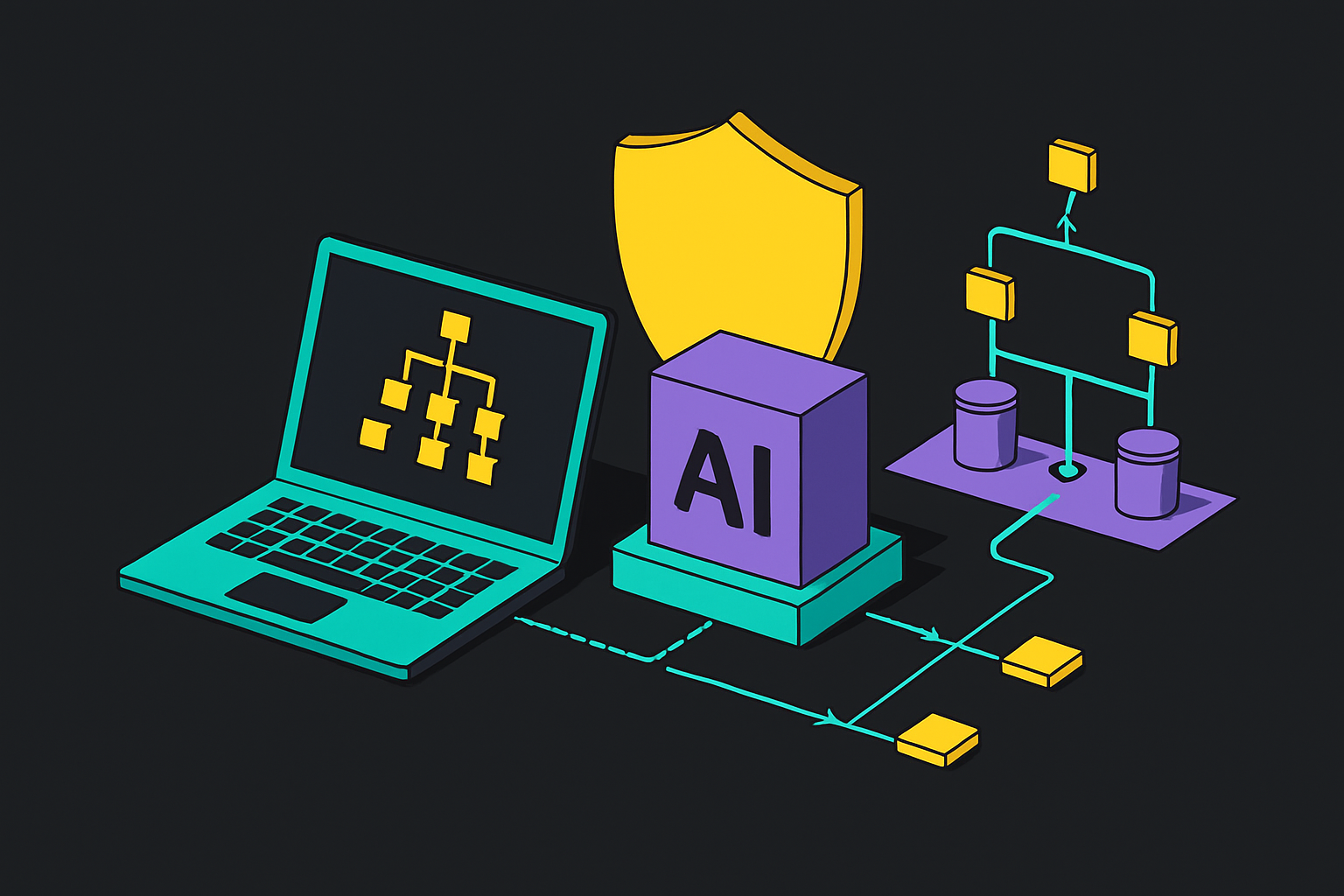
An attack graph is a directed model of exploitable conditions and the transitions between them. Nodes represent system states; edges represent attacker actions that move from one state to the next. The point is not to enumerate vulnerabilities in isolation. Real breaches unfold in sequences, and the graph makes those sequences visible in a way that a flat list of findings simply cannot.
A single misconfiguration rarely ends an organization. What ends organizations is the misconfiguration that connects to an overpermissioned role, which connects to an internal service that was never meant to be reachable from that context. Miss one of those connections and the picture you have is wrong in ways that matter enormously, and wrong in a specific direction: it looks cleaner than it is.
Building a complete graph means pulling from code-level flaws (injection points, insecure deserialization, hardcoded secrets, business logic errors), cloud and infrastructure configuration (IAM policies, overpermissioned roles, publicly exposed services), and identity and permissions relationships simultaneously. Not sequentially, and not in parallel silos that never compare notes. At the same time, because the chains only appear when all three layers are visible to the same reasoning process.
Palo Alto Networks found in 2024 that 80% of cloud exposures involve identity and permissions. I'd push back on treating that number as settled science, but the directional reality it reflects matches what practitioners see: identity is not a separate audit workstream you schedule for later, it's woven through everything. SpecterOps found that 94% of Active Directory users have at least one attack path to Domain Admin. That figure only surfaces when identity relationships are fully modeled rather than simply observed at the network layer, which is precisely why it surprises people every time.
A partial graph is not a lesser form of coverage. It is a specific liability. The invisible edges are absent from the model, not absent from the environment. The attacker finds them regardless.
How Whitebox Access Changes What the Tool Can Ingest and Therefore What It Can Model
Whitebox access means direct integration with source code repositories, cloud configuration state, infrastructure-as-code definitions, and the documentation that governs how a system actually behaves. Not inference from an external surface. The definitions themselves.
That distinction compounds quickly. With whitebox access, the tool reads how authentication and authorization logic is actually implemented, not how the architecture diagram says it works. Those two things disagree more often than most teams expect. It finds secrets hardcoded in application code, CI/CD pipeline configs, or environment variable files before those secrets ever appear on an external surface. It maps every API endpoint, including internal and undocumented ones, from the route definitions themselves. It understands how cloud roles and service account permissions are structured in Terraform or CloudFormation, not just what is visible when queried from outside.
Think of it this way: a blackbox tester sees what an unauthenticated attacker observes on day one. A whitebox tool sees what a sophisticated attacker would reconstruct after weeks of post-compromise exploration. The test should start from the harder position. Letting the attacker do that reconstruction work inside your production environment is not a testing methodology; it is just waiting.
Greybox sits in the middle: credentials but no source access. It catches a meaningful subset of application-layer issues. But code-level vulnerabilities and infrastructure-definition flaws remain structurally invisible, because you can interact with the results of the definitions without ever being able to read the definitions themselves. That gap is not small.
Whitebox is not a preference or a philosophical position on access. It is the only input set from which a complete attack graph can be constructed. Every other methodology produces a graph with missing nodes, and missing nodes produce a specific kind of false confidence that is worse than acknowledged uncertainty.
How AI-Native Tools Process These Inputs Simultaneously to Surface Chains, Not Isolated Findings
Speed is not the architectural difference that separates AI-native tooling from conventional automated scanning. The difference is the capacity to reason across all three input categories at once, rather than processing them in silos that never share context.
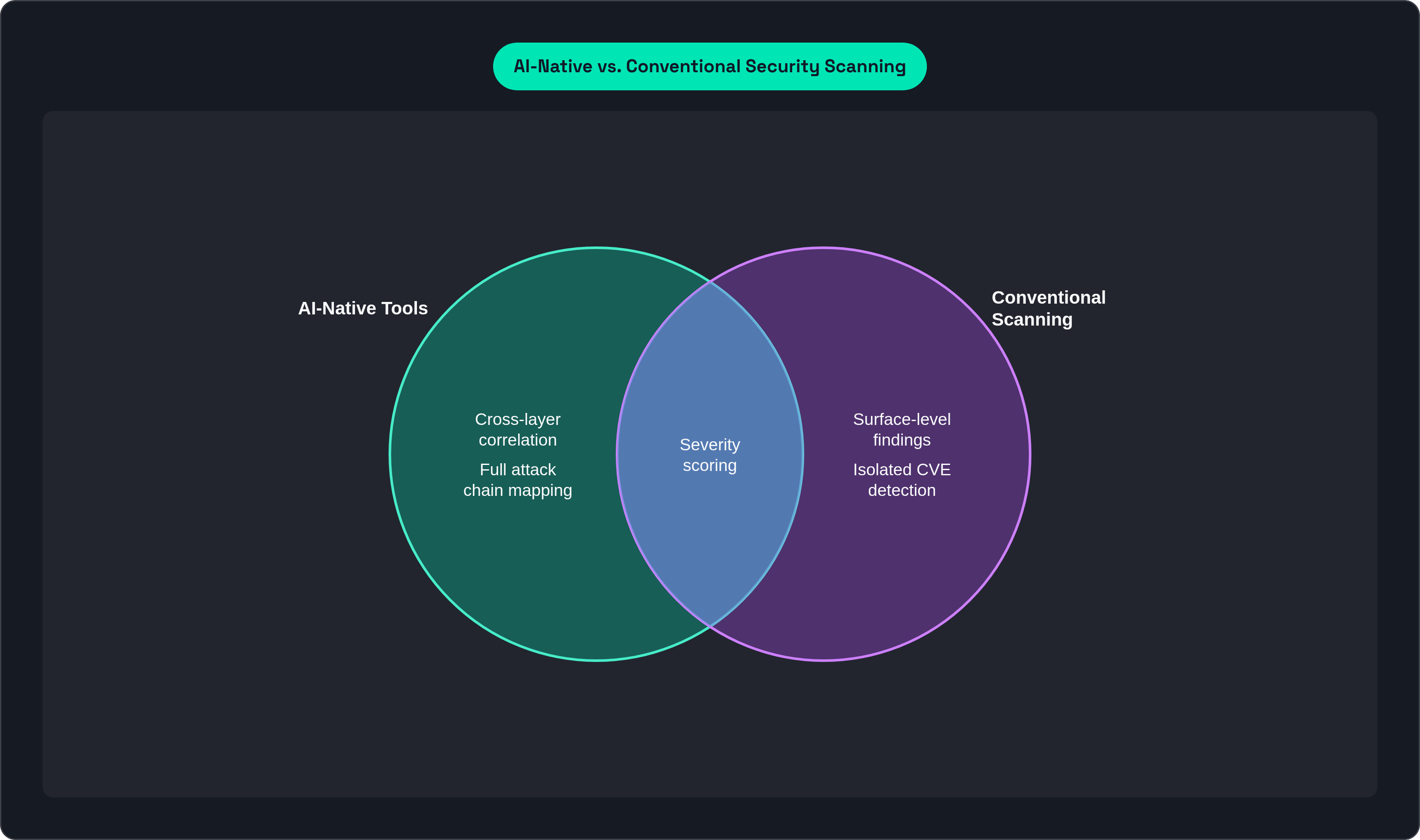
Traditional automated scanning runs known signatures against observed surfaces and returns a list of individual findings, each scoped to its detection rule. A network scanner does not know what an IAM policy says. An application scanner does not know what permissions the service account it just authenticated against actually holds in the cloud environment. The tools produce outputs; the outputs never meet. Someone is supposed to synthesize them manually, and that someone is usually underwater.
AI-native processing changes the output category entirely. Code analysis tracks actual data flow: where user input enters the application, how it moves through internal logic, where it eventually reaches an interpreter or privileged function. Cross-layer correlation connects a misconfigured IAM role identified in cloud configuration to the service account referenced in application code, which connects to the API endpoint reachable without authentication. Chaining logic then identifies not just that each condition exists, but that condition A enables condition B, which enables condition C, producing a traversable path rather than three separate medium-severity findings that nobody connects.
The Verizon DBIR 2024 found credential abuse in 77% of breaches. The attack paths that credential compromise enables are precisely the multi-hop sequences that require cross-layer analysis to map, and no single-layer tool produces them.
Scale matters here and deserves to be named directly. A codebase with hundreds of services, dozens of cloud accounts, and a complex IAM hierarchy cannot be completely graphed by a human team in a time-bounded engagement. Something always gets sampled, and the sampling decisions are rarely made by the person who would most want to know what got skipped. AI processes the full scope. The output is a graph where every node has evidence and every edge represents a demonstrated exploitable transition, not a ranked list whose ranking reflects what got examined before the clock ran out.
What Attack Path Mapping Finds That Point-in-Time Scans Structurally Cannot
Two classes of finding require cross-layer context to surface and are therefore invisible to conventional scanning.
The first involves individually low-severity findings that combine into a critical path. Consider a world-readable S3 bucket containing a configuration file with a service account key that holds write access to a production database. Examined in isolation, each component gets flagged at medium or low severity. Together they constitute a breach path. The scan produces three findings with modest CVSS scores. The graph produces a single critical chain with a clear terminus. Those are not equivalent outputs.
The second involves business logic flaws that only appear when you understand what the application is supposed to do: authorization bypass conditions, privilege escalation via role assignment logic, insecure direct object reference patterns in multi-tenant SaaS architectures. None of these are detectable by signature. They require understanding the intended behavior well enough to recognize where the implementation diverges from it, which is exactly what a tester who has read the source code can do and a tester who has not cannot. This is where whitebox access stops being a preference and starts being a prerequisite.
Server-side request forgery illustrates the chaining dynamic concisely. An SSRF vulnerability that reaches the cloud metadata service retrieves instance credentials. Those credentials carry IAM permissions permitting lateral movement to adjacent services. The SSRF finding alone is serious. The chain to credential theft and lateral movement to production data is categorically worse, and it is the chain that determines actual blast radius.
Hardcoded secrets in source code follow the same pattern. Invisible to any test beginning at the external surface, trivially discoverable in whitebox review, and frequently the first link in a chain that terminates at production data or administrative access.
The structural limit of point-in-time scanning is not that it misses individual vulnerabilities, though sometimes it does. The structural limit is that it carries no model of post-access attacker movement, which is where most breach impact actually occurs. The compliance-grade test that found nothing critical often found nothing because it could not see the chains, not because the chains are absent.
Why the Graph Needs a Human Expert Before Its Findings Mean Anything to an Auditor or a Board
An AI-generated attack graph is a hypothesis set. It identifies conditions and sequences that appear exploitable based on code and configuration analysis. Confirmation requires a skilled human to attempt actual exploitation against the live environment, and the distinction between those two things is not pedantic; it is the difference between a finding and a claim.
A finding proven with a working exploit is categorically different from a finding identified by pattern match. Auditors, enterprise security teams, and cyber insurance underwriters treat these as distinct evidence categories, because they are. A graph edge that appears traversable in static analysis may be blocked by a runtime control, a network policy, or an application-layer check that does not appear in the source. Human review filters those before they reach the report, which preserves the credibility of everything that remains.
Expert review adds more than false positive reduction. It adds contextual severity judgment, the kind that recognizes a critical finding in one architecture as a dead end in another. It adds chain validation: confirming each edge in the proposed path is actually traversable in the live environment, not just logically consistent in the model. And it adds attestation, a signed report from a credentialed reviewer, OSCP-level or equivalent, that procurement teams, auditors, and board-level stakeholders can rely on as evidence of tested defenses rather than automated output.
Cyber insurance underwriting tightened considerably after 2024. Policies above certain coverage thresholds now require evidence of human-tested defenses, not automated scan results. A report without expert attestation does not satisfy that requirement. That is a policy condition, not a theoretical future risk.
The architecture the better tools have converged on is AI breadth combined with human depth: AI to graph every path in scope at scale, human expertise to validate every significant finding before it becomes a claim. Neither alone is sufficient. AI without human review produces unvalidated hypotheses. Human review without AI coverage produces sampled results. Both failure modes leave real attack paths unaddressed, and the attacker benefits equally from either one.
How Continuous Integration with the Development Cycle Changes What Attack Path Mapping Can Catch
The annual penetration test produces an accurate graph on the day it runs. Every pull request merged after that date potentially adds new nodes or edges to the attack graph, invisible until the next engagement. DeepStrike's 2025 data found that 32% of companies still test only annually, which means the majority of the development lifecycle occurs inside a window with no active attack path monitoring. Engineers ship code; the graph sits still.
Pull request scanning changes that calculus. When the tool connects to the CI/CD pipeline, each code change is analyzed against the existing attack graph to detect whether the change introduces a new exploitable condition or extends an existing chain. This is not a secondary scan layered on top of regular testing. It is continuous maintenance of the graph itself.
What this catches that annual testing cannot: a new API endpoint added in a feature branch that lacks the authentication middleware present on every existing endpoint; a dependency update introducing a known-vulnerable library into a service that handles sensitive data; an IAM policy change in infrastructure-as-code that expands permissions beyond what the service requires. These changes are straightforward to catch at the moment they occur. Retroactively identifying them months later, against the backdrop of hundreds of other changes, is genuinely difficult, and the conversation with engineering is worse when the finding is that old.
The architectural implication matters. The attack graph is not a deliverable from a fixed engagement. It is a living model that evolves with the codebase, and the annual penetration test becomes a point of deep validation within a continuous monitoring program rather than the entirety of the program.
This model also changes remediation dynamics in ways practitioners recognize immediately. A finding surfaced in a pull request has a clear owner, a scope limited to the diff, and a clean retest path. Findings from a point-in-time engagement arrive weeks later with diffuse ownership, because the engineer who wrote the vulnerable code has moved on to three other features since the test ran. Earlier findings are cheaper fixes, and the relationship between security and engineering stays healthier when the feedback loop is tight.
What to Actually Verify When Evaluating Whether an AI-Native Tool's Coverage Claims Hold Up
The first coverage claim to interrogate is "we test every attack path." Ask immediately what the tool's input sources are. If it cannot ingest source code and cloud configuration state directly, the graph is incomplete by definition, regardless of what the sales materials assert. That one question eliminates a significant portion of the market.
From there, specific questions separate real capability from positioning. Ask to see a sample finding: does it show the full chain from initial condition to exploitable outcome, or is it an isolated vulnerability entry with a severity score attached? Ask how the system handles a finding it identifies in static analysis but cannot confirm with a working exploit. Does it include the finding, flag it differently, or suppress it, and why? Ask who reviews and signs off on findings before they reach the report, and what those reviewers' credentials are. A risk score with no human attestation and no audit trail is a black box, not evidence.
Ask how the tool updates the attack graph when infrastructure or code changes between engagements. A tool that cannot answer that question is selling a deliverable, not a program.
One red flag specific to AI vendor claims: "we autonomously test the exploitability of every CVE." If no working exploit exists for a CVE, live execution is not possible. If an asset is appropriately scoped out of live testing, exploitation cannot safely run. Total automated coverage via live execution is overclaiming, and vendors making that assertion are describing something that does not exist.
Credible output has a consistent shape: every significant finding includes a chain of evidence rather than a pattern match, a demonstration of exploitability, a severity judgment attributed to a named reviewer, and a clear remediation path with a retest mechanism. The format matters beyond internal review. Depending on your context, the report needs to satisfy SOC 2 CC4.1, ISO 27001 Annex A controls, or HIPAA risk analysis requirements. Ask whether the vendor's output has actually been accepted by auditors operating in those frameworks, not whether the vendor believes it will be. Belief and acceptance are different things, and the auditor is the one who decides.
Access depth determines graph completeness. Human review determines finding credibility. Continuous integration determines whether coverage survives the next deployment. All three conditions must be present for a coverage claim to hold, and the gap between what was claimed and what was actually tested is exactly where the attacker operates.