Business Logic Vulnerabilities That Scanners Cannot Find
Automated scanners cannot detect what they were never designed to understand: business intent.

Scanners don't miss business logic vulnerabilities because their signature databases are incomplete. They miss them because they have no idea what the application is supposed to do in the first place. A scanner can tell you that input looks malformed or a header is missing. It cannot tell you that a 200 response just handed one customer another customer's invoice.
That distinction matters more than most security conversations give it credit for. A SQL injection has a shape: bad input goes in, an error or an unexpected data dump comes out. A business logic flaw has no shape at all, because the request is well-formed, the response is well-formed, and the only thing wrong is the meaning of what just happened. The wrongness is semantic. Nothing about the packet tells you that.
This is why the security community stopped treating business logic issues as a side category. OWASP's upcoming Business Logic Abuse Top 10 doesn't try to fit these flaws into pattern-matching rules the way older frameworks did for injection or cross-site scripting. It models them as automata, mapped closer to Turing-machine primitives than to a list of bad strings. That's a tell. When the standards body writing the rulebook has to reach for computation theory instead of a regex, you're looking at a class of problem that scanning was never built to touch.
Four properties show up again and again once you start looking for these flaws, and I'll come back to each one as we go through specific vulnerability classes:
- Context-dependent. The behavior is only wrong measured against what the business process was supposed to allow. There's no wrongness in a vacuum.
- Action-based. The flaw usually comes from a sequence of individually fine actions, not one bad input.
- Server-side in impact. The root cause often sits in missing server-side validation, which a scanner probing the client-facing surface will never see.
- Normal-looking in transit. Traffic from a working exploit frequently looks exactly like traffic from a happy customer.
Keep those four in your head. Every section below is really just a variation on them.
Insecure Direct Object References and why authorization context cannot be inferred from responses
IDOR is old, well-documented, and still everywhere. It happens when a resource (say an order ID, a file, an account record) gets exposed through a direct reference the server doesn't check against who's asking. Change the number in the URL, get someone else's data back.
Here's the part that trips up automated tools completely: the response looks fine. A scanner sees an HTTP 200 and a properly structured JSON body. It has no way to know that the "id" field in the URL belongs to a different customer than the one logged in. That mapping (who owns what) lives entirely in the application's authorization model. It isn't observable on the wire. You'd need to already know the answer to spot the question.
Testing for IDOR the right way means:
- Two separate authenticated sessions, ideally representing different roles or tenants
- A tester who actually knows which record belongs to which account
- Deliberate substitution of one user's object reference into another user's session, on purpose, as a designed test rather than a scan pass
The USPS incident from a few years back is worth remembering here. An API tied to informed delivery returned personal data (names, addresses, phone numbers) for any authenticated account that asked, and it stayed that way for well over a year before anyone flagged it. Nothing about those responses looked anomalous. They were structurally correct. That's the entire problem in one sentence.
IDOR shows up constantly in bug bounty reports as one of the highest-paying and most common finding categories, and API-focused attacks lean on it heavily, mostly because the barrier to entry is a browser and the willingness to change a digit in a URL. Multi-tenant SaaS platforms are especially exposed if resource IDs are sequential, though switching to UUIDs only removes the guessing game, not the underlying authorization gap. If the check isn't there, or isn't consistent across API versions, the format of the ID is beside the point.
Race conditions as a timing-dependent class that scanners process sequentially by design
A race condition happens when two operations touch the same piece of shared state, and the outcome depends on which one gets there first. Classic version: a wallet or gift card balance gets checked, then debited, and if two requests land close enough together, both pass the balance check before either debit posts. Congratulations, you just spent the same fifty dollars twice.
Scanners struggle here by nature. They fire requests in sequence, or with concurrency settings that have nothing to do with how the target application actually processes transactions. The bug only exists in a narrow timing window; run one request at a time and the window never opens. Finding it on purpose means knowing which two operations share state and then timing concurrent requests to land inside that window, which is an act of understanding.
You see this pattern most often in payment flows, subscription upgrades, inventory holds, promo code redemption, and voting or rating systems, basically anywhere a "check, then act" sequence touches something mutable. And once you've found the window, exploiting it is often almost anticlimactic: a short script firing parallel requests, a browser extension, sometimes even manually racing two open tabs. The hard part was the analysis. The execution is almost boring by comparison.
Worth saying plainly: a scanner that comes back clean on race conditions hasn't cleared the app. It just never ran the experiment that would have found the problem.
Multi-step workflow flaws where the vulnerability only exists across the full sequence
Scanners test one endpoint at a time. Business logic flaws in multi-step processes live in the relationship between steps, which means testing endpoints individually will never surface them, no matter how many you check.
Take a checkout flow that validates a coupon at step two but never re-checks it at step five, the final order submission. Apply the coupon, move forward, swap items in the cart, and the discount rides along because nothing forces revalidation. Or a password reset flow that doesn't enforce the order of operations, letting someone jump to the password change step without ever proving they control the email account tied to it. Or a signup form where account type gets submitted as a plain client-side field and the server just trusts it. The scanner sees a POST request. It has no concept that "admin" was never supposed to be a value a regular user could pick.
Finding these requires reconstructing three things:
- What the intended sequence actually is: which steps have to happen, and in what order, for the flow to count as legitimate
- Where enforcement really lives: which step actually checks that the prior one happened correctly, versus which steps just assume it did
- Where the gaps sit: which transitions the server trusts without verifying
That reconstruction comes from reading documentation, understanding the user journey the product team designed, and then hunting for shortcuts around it. And having source code access changes the math here in a real way; a tester who can read the state machine directly finds these gaps far faster than one stuck reverse-engineering it from black-box responses alone.
Privilege escalation through features that are working exactly as built
This category is different from the others, and it's the one that tends to surprise people. Nothing is broken. The code does exactly what the developer meant it to do. The flaw lives in the decision behind the feature, not in a missing check somewhere.
An admin panel might check a role correctly, but if that role is read from a cookie or a JWT claim without verifying it was legitimately granted at issuance, the check is worthless. A referral program that unlocks extra storage or seats once a usage threshold is hit can be triggered by one person spinning up throwaway accounts to self-refer. A "view as" feature built for support staff, letting them impersonate a customer to debug an issue, might not confirm the person invoking it actually holds a support role before letting them in.
None of this trips a scanner. The requests are syntactically clean, the server returns success, nothing is malformed. There's no signature to match because nothing is technically wrong with the traffic.
Finding it takes a different kind of question: what happens if a regular user crafts a request that reaches this code path anyway? That's a threat modeling question, and it means going feature by feature and asking whether each one that grants extra access or changes trust level actually verifies that grant independently, or just inherits it from whatever state came before. Fast-growing SaaS codebases are especially prone to this, since authorization logic tends to get bolted on feature by feature and rarely gets reviewed as a whole system once the company is past its first few years.
What human review must actually do that scanning cannot approximate
At bottom, a human tester is building a model of what the application is supposed to do, then checking, deliberately, where the real implementation drifts from that model. That's the entire job. No scanner ingests the inputs needed to do this:
- Product documentation and user stories: what roles exist, what each one is allowed to do, what the intended path through a feature looks like
- Source code: where authorization checks live, or don't, what state gets stored and where, what assumptions the data model quietly bakes in
- Cloud configuration: what's exposed externally, what the IAM policies actually allow, whether internal services assume that being on the network already means being trusted
The method follows from that: map the attack surface using the application's own design, not a crawled list of URLs. Find every boundary where privilege is supposed to change. List every state transition. Then test whether each boundary enforces what it claims to enforce, one by one.
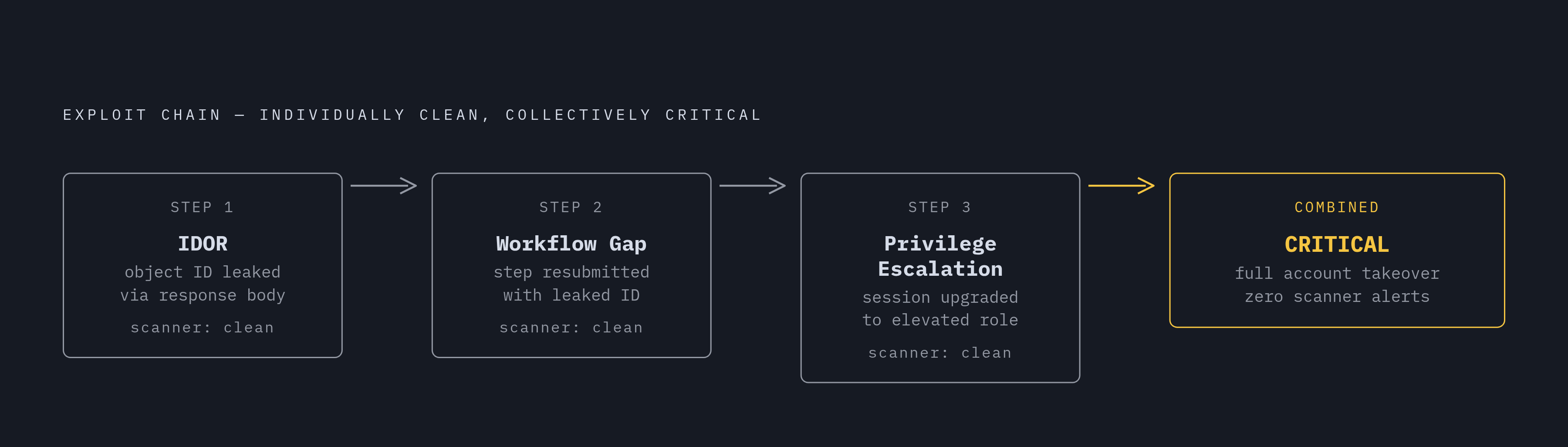
The real damage often comes from chaining, not any single flaw. An IDOR that leaks an object ID, paired with a workflow gap that lets a step get resubmitted, paired with a privilege escalation that upgrades the resulting session, adds up to something serious, even though a scanner checking each endpoint on its own would flag none of it.
Whitebox access doesn't just speed this up, it changes what's findable at all. Certain flaws (missing revalidation between steps, gaps in a state machine that only show up three transitions deep) are practically invisible unless someone can read the intended behavior in the source rather than guess at it from outside.
And there's a step that shouldn't get skipped: a certified tester has to sign off, confirming the flaw is real, the exploit chain actually works end to end, and the business impact is described accurately. AI tools can speed up mapping the surface, but that judgment call still rests with a person. The deliverable that matters is a demonstrated attack path: a working exploit, a reproduction sequence, a plain account of what an attacker walks away with. That's what separates real security work from a scan report with a nicer cover page.
How business logic testing integrates with development cycles rather than replacing point-in-time assessments
Here's the tension nobody likes to say out loud: business logic flaws get introduced continuously, every sprint, every feature ship, while most security testing happens once a year. An annual test tells you the state of the app on the day it ran. It says nothing about what shipped the following Tuesday.
Picture this, because it happens constantly: a company passes its annual pentest in January. In March, the team ships a new billing feature. By May, someone's found a race condition in that billing flow and is exploiting it quietly. The January report isn't wrong. It's just no longer relevant, and nobody told the board that.
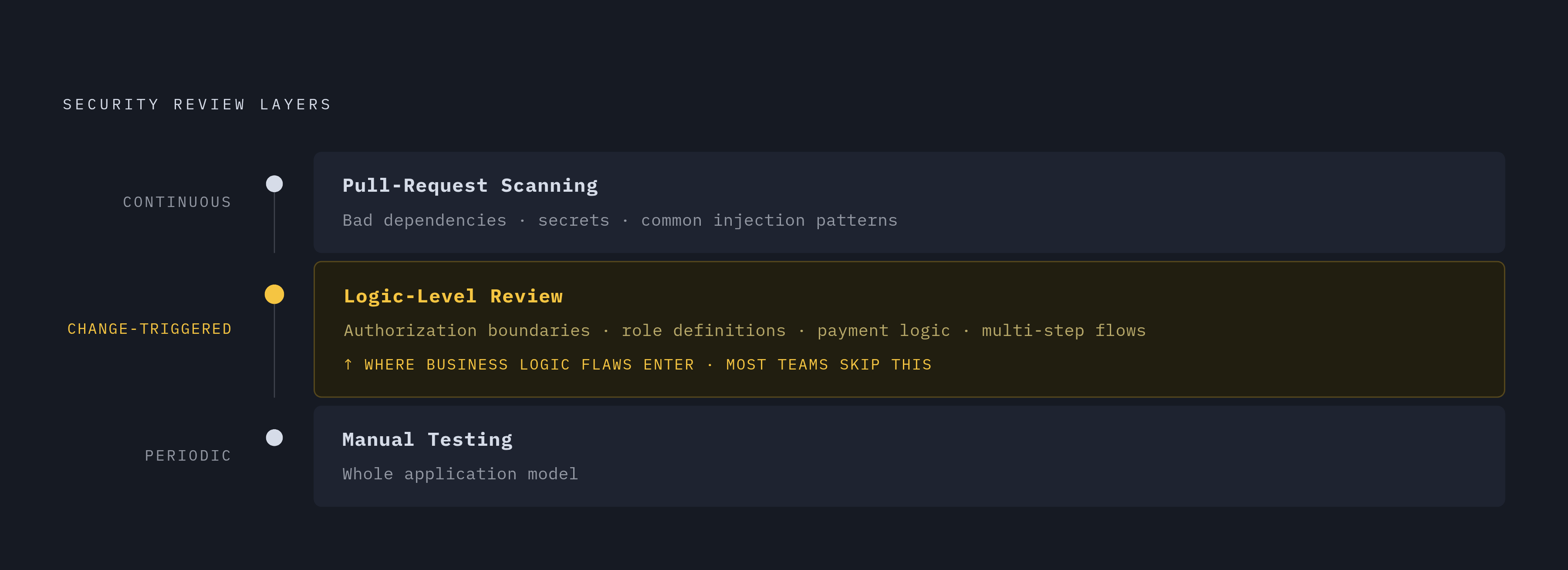
Closing that gap means layering security review differently:
- Pull-request-level scanning for known technical vulnerability classes, bad dependencies, secrets committed to code, common injection patterns. This is exactly where automated tools are good and should be doing the work.
- Logic-level review triggered specifically by changes to authorization boundaries, role definitions, payment logic, or multi-step flows, since those are the changes most likely to introduce exactly the flaws covered above.
- Periodic manual testing that covers the whole application model, not just whatever changed since the last pass.
Scope decisions made before testing even starts determine what's findable at all. A test scoped around realistic attacker goals and the app's actual trust boundaries turns up far more than one scoped to a list of URLs, and auditors under SOC 2, HIPAA, or ISO 27001 increasingly want proof that controls hold up under an actual attempt, not just a report showing no known CVEs were flagged.
The practical shift for engineering teams: treat business logic review as part of designing a feature, not cleanup after it ships. Threat model new authorization boundaries at the design stage, while they're still cheap to fix, and save manual pentesting for validating the system as a whole rather than catching the obvious stuff that should've been caught earlier. This approach pairs whitebox access to source and cloud configuration with certified human testers and continuous pull-request scanning. The split between what a machine checks and what a person judges is the architecture.