Reading and Acting on a Pen Test Report as an Engineering Leader
Transform a pen test report from compliance paperwork into an actionable engineering priority.

Most pen test reports die in a shared drive. The engineer skims the PDF, files a couple tickets for the Critical findings, and the rest just sits there, aging, until next year's test flags the same gaps all over again. Vulnerability exploitation now drives 20% of all breaches, up 34% year over year according to the 2025 Verizon Data Breach Investigations Report, and a pen test exists to catch exactly those paths before someone else does, but the report only matters if somebody builds a process around it.
I've sat in enough remediation kickoffs to notice the pattern. Teams treat the report like a compliance artifact to file away, so here's what actually works: how to read the thing correctly, how to tell real risk from noise, how to build a remediation process that survives a real sprint calendar, and how to close the loop so next year's audit isn't a fire drill.
What a well-structured pen test report actually contains
A good report has two audiences in one document. The executive summary is for leadership, the board, and auditors, and it needs to be readable by someone who's never heard of CVSS. It covers what got tested, the methodology, overall risk posture, finding counts by severity. Needing a security background just to parse the summary is a red flag on the provider (full stop).
Then there's the methodology section. This is the part that tells you how much of your attack surface actually got touched: scope, testing windows, access level (blackbox, greybox, whitebox), what credentials the tester had, what got excluded. I used to skim right past this section, and then a test I trusted turned out to have excluded a staging environment and run without authenticated access, which explained a lot about what it missed.
Technical findings are where quality separates fast. Each one needs a title, a severity rating, the affected component, a clear description, proof-of-concept evidence, business impact, and remediation guidance specific to your setup. The proof-of-concept piece isn't optional, since a finding without one is a hypothesis, not a confirmed vulnerability, and treating it as confirmed burns engineering hours chasing ghosts.
You also want a remediation summary or risk register in table format, something that can feed straight into your ticketing system, plus an attestation letter. That letter is the signed document auditors ask for first, separate from the full report body.
A weak report gives itself away fast: scanner output with a logo slapped on top, no proof-of-concept anywhere, remediation advice lifted word for word from a CVE description, no methodology section at all. Treat it as a pen test and real gaps go unexamined.
How severity ratings are assigned (and where to trust them, and where not to)
Most reports score severity with CVSS, or a Critical/High/Medium/Low/Informational scale built on top of it. CVSS measures exploitability (attack vector, complexity, privileges required, user interaction) and impact (confidentiality, integrity, availability), scored in the abstract, and it has zero idea what your environment actually looks like.
That's the gap you fill in yourself. A High CVSS score on an internal system holding no sensitive data, requiring authenticated access, is a different animal than a Medium sitting on an unauthenticated endpoint that touches payment records. The number alone won't tell you which one to fix first.
Good testers write the missing context into the finding themselves, translating an abstract CVSS number into your actual risk. When that context is missing, treat the severity as a starting point for your own judgment, not a verdict handed down from on high.
Chained findings deserve extra scrutiny. A cluster of individually Low or Medium issues can combine into something far worse, and these chains are often the single most valuable output of manual testing (exactly the kind scanner-heavy engagements miss). Picture an information disclosure bug (Low), a misconfigured role (Medium), and a weak session token (Medium): none of those alone keeps anyone up at night, but chained together, that's an account takeover path, Critical by any measure. If your report lists everything as isolated items with zero mention of chaining, ask the tester directly whether they saw one, since silence might just mean nobody wrote it up that way.
Give the Informational findings a real look too, instead of tossing them straight in the trash. They flag architectural choices that aren't vulnerabilities today but compound into real risk over a year or two, so give them their own backlog.
Separating real risk from noise before a single ticket gets written
Run every finding through three questions before it reaches an engineer. Is it actually exploitable in your environment as configured, not just in theory? What does successful exploitation actually get an attacker: read access to a log file, or a path straight to customer records? And is there a compensating control already in place that the tester might not have seen?
Even good reports carry false positives. A finding can be technically accurate and still inapplicable because of a WAF rule, a network segment, or a config detail the tester never saw from outside, so validate before you escalate, every time.
Whitebox testing earns its cost back right here. Give a tester source code and cloud config access up front, and false positive rates drop noticeably, because now they've actually seen your compensating controls instead of guessing at them from outside.
Some noise isn't the report's fault at all. Out-of-scope systems flagged anyway, already-documented accepted risks, third-party components outside your control: none of these need a remediation ticket. They need a documented disposition, and then you move on.
When you hit a disputed finding, skip the email argument. Get a short sync with the pen test team before anything moves to triage, since most quality providers offer a Slack channel or a debrief call built for exactly this. If yours doesn't, that's a gap to flag before you sign the next contract.
What comes out of this step is a validated finding list, every item marked Confirmed, Disputed, Accepted Risk, or Out of Scope. That list is what triage actually works from.
Building the remediation workflow from the validated finding list
Every finding needs one owner, not a team, a name on the ticket who knows it's theirs. Pair that with a target remediation date tied to severity, set at the organization level before the report ever lands, not negotiated case by case after the fact. A reasonable starting framework: Critical within 24 to 72 hours, High within two weeks, Medium within 30 to 60 days, Low folded into the next sprint or quarterly cycle.
Treat the report as a source document, not a project tracker. Build tickets in whatever system your team already lives in (Jira, Linear, GitHub Issues, wherever). Each ticket needs a minimum set of fields: finding title, severity, a link to the relevant part of the report, owner, due date, remediation steps pulled straight from the report, and a field for the retest result. That last field is the one almost every team skips, and it's the first thing auditors ask about.
Prioritization inside the validated list isn't just severity order. Exploit-proven Criticals and Highs on internet-facing systems go first, because that's exactly what a real attacker chains together first too. Treat a chained attack path as one unit, not separate line items; closing one link doesn't close the whole path. Mediums touching authentication, authorization, or data handling jump ahead of Mediums sitting in some lower-risk corner of the system. Informational findings get their own backlog with a set quarterly review date, so they don't quietly disappear.
Map dependencies before sprint planning starts. Some fixes need infrastructure changes, library upgrades, or architectural calls touching more than one team, so surface that early, or individual tickets stall for weeks waiting on someone else's roadmap.
Here's the trap that catches teams year after year. Blaze InfoSec's 2025 data puts the average finding count at 7.0 per SOC 2 pen test, which sounds manageable if your workflow actually runs, but partial remediation compounds quietly: fix four of seven this year, and next year's test finds those three plus whatever's new. The backlog just keeps growing while nobody's watching it.
Running the retest and closing the evidence loop
Remediation without verification is a guess dressed up as a fix. A code change addressing the symptom described in a finding can leave the underlying vulnerability exploitable through a slightly different path, and you won't know that unless someone checks.
A real retest means the same tester, or one with equivalent context, re-runs the specific exploit against the patched system. A re-scan won't tell you that, and neither will a developer eyeballing their own diff and calling it done.
Scope the retest by severity. Every Confirmed Critical and High gets one, and so should any Medium touching authentication, authorization, or injection. Low and Informational findings can be self-attested with evidence, a code diff, a config change, a screenshot, something concrete on the record.
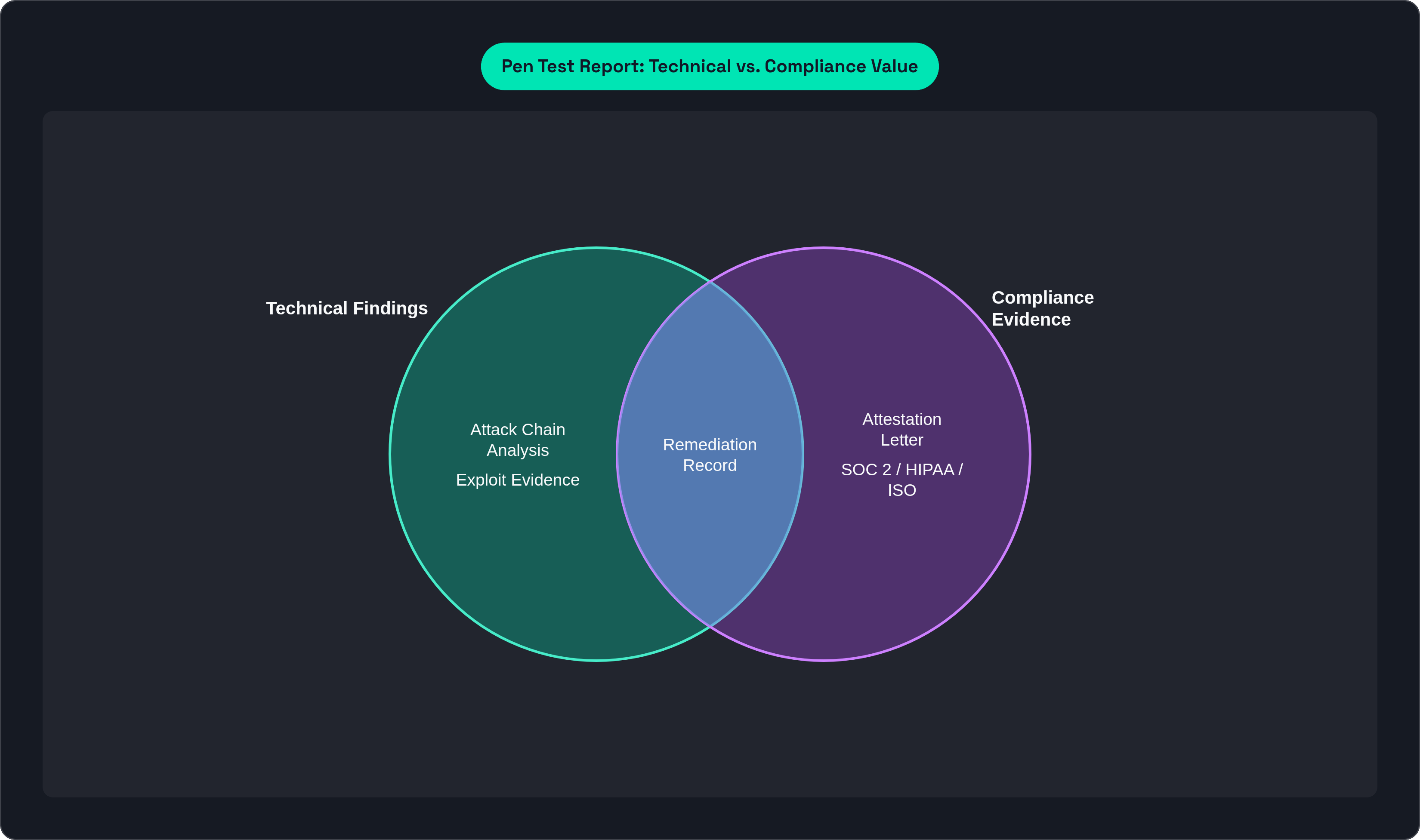
What comes out is written confirmation from the tester that the specific exploit no longer works. That document, not the remediation ticket, is what satisfies an auditor's evidence chain. Auditors want the full sequence: original finding with proof-of-concept, remediation record with owner and date, retest confirmation closing the loop. Miss a link and you've got a pen test that works as a security exercise but fails as compliance evidence.
If a provider excludes retesting from the base engagement, or sells it as a paid add-on, that tells you something about their incentives. A provider that doesn't expect its own findings to get fixed isn't going to price the confirmation step into the core offering.
Point-in-time retesting closes the loop on this year's findings, but code ships every week between annual tests, and any of those changes can reintroduce something already fixed once. Continuous pull request scanning is the natural complement, catching regressions before they hit production instead of waiting for next year's engagement to rediscover the same hole.
Using the report to satisfy SOC 2, HIPAA, and ISO 27001 auditors
Auditors don't want a report. They want a chain: testing, findings, remediation, retest, sign-off, all documented, all linked to each other.
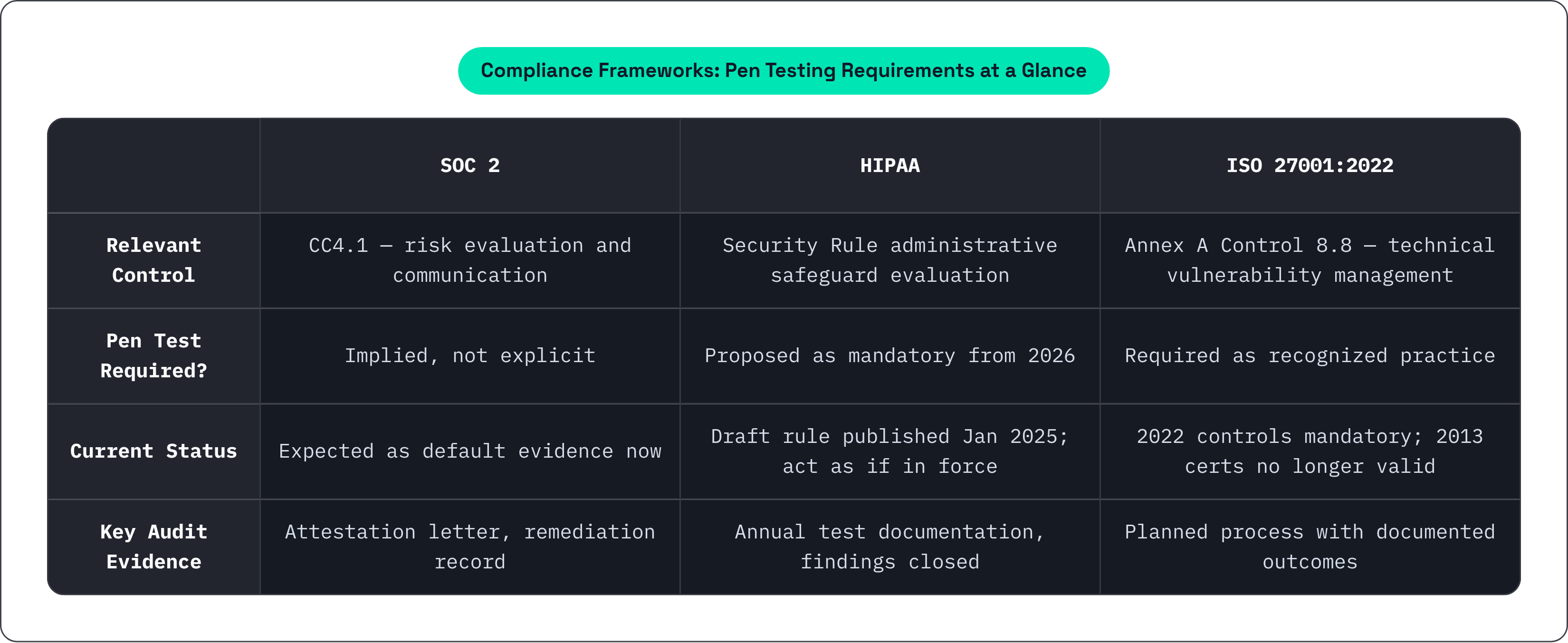
SOC 2 doesn't technically name pen testing as a required control, but CC4.1 requires you to show that security risks get evaluated and communicated, and a pen test with documented remediation is the most direct way to satisfy that. Auditors expect it as the default evidence now, even without an explicit line item demanding it by name.
HIPAA has carried an implied expectation here for years, through the Security Rule's administrative safeguard evaluation requirement. That's shifting toward explicit: a proposed HHS rulemaking published January 6, 2025 would make annual pen testing mandatory for covered entities and business associates handling ePHI, with finalization expected in 2026. Start acting like the rule already passed, since waiting for it to become law first just means scrambling later.
ISO 27001:2022's Annex A Control 8.8, Management of Technical Vulnerabilities, directly requires a planned process for assessing technical vulnerabilities, and pen testing is the recognized way to satisfy it. The October 2025 transition deadline already passed, so ISO 27001:2013 certifications are no longer valid, and every certified organization now operates under the 2022 controls, whether their process has fully caught up or not.
The attestation letter is what actually crosses the desk in most audits, more so than the full technical report. It's signed confirmation that a credentialed tester ran the engagement using a recognized methodology. Auditors may also ask for the executive summary and evidence that findings got closed out. The technical findings section itself usually stays protected as sensitive, and rightly so; it's essentially a map of where you're weak.
Build the full documentation package before the audit starts, not during it: signed attestation letter, executive summary, evidence of finding ownership and remediation dates, retest confirmations for anything material. Time the test with room to breathe, too, since an annual pen test that finishes two weeks before your audit window leaves no time to remediate or retest anything. Plan for 60 to 90 days of runway before the audit, more if your codebase is large or genuinely messy.
What to demand from the next engagement based on what this one revealed
The report you just got is also a diagnostic on the test itself. Scope gaps, findings that felt thin on evidence, disputed items that turned out real after all: each one tells you something to change before you sign the next contract.
Ask yourself a few things once the dust settles. Did the scope actually cover every asset that matters, or were meaningful systems left out? Did the tester surface any attack chains, or was everything listed as isolated items, which usually means the testing stayed shallow? Was every Critical and High backed by a working exploit, or were some just probabilistic guesses dressed up in severity language? Did the tester have whitebox access to source and cloud config, or were they working blind from outside? Access level is what actually determines how deep the coverage went.
If the report came back clean, no High or Critical findings, and your codebase has grown a lot since the last test, don't pop the champagne. A clean result like that rarely means a genuinely secure environment; more often it's a scope or methodology problem that let real issues slide past undetected.
Annual, point-in-time testing only ever catches what's present the moment the test runs, and vulnerabilities introduced in the months after accumulate quietly, undetected, until the next cycle finally catches up. If you're shipping frequently, evaluate continuous or PR-level scanning as a complement to the annual test.
When you're picking the next provider, look for testers holding OSCP or equivalent credentials, people who can walk you through their manual methodology instead of just handing over scanner output. Look for retesting included in the base engagement rather than sold separately, a direct communication channel during and after the test, and reports built on working exploit evidence instead of theoretical scores.
I've watched this done well and watched it done badly enough times that the difference shows up fast, usually in the first ticket triage meeting. What separates the two comes down to a specific set of practices worth insisting on: whitebox access to source code and cloud configs at kickoff, an OSCP-certified reviewer on every finding, working exploit proof required before anything gets reported, on-demand retests and PR scanning included rather than bolted on later, and a signed attestation letter that SOC 2, HIPAA, and ISO 27001 auditors accept without pushback. Whatever provider you end up choosing, that's the bar: a report that actually changes your security posture and earns a spot beyond the compliance folder.