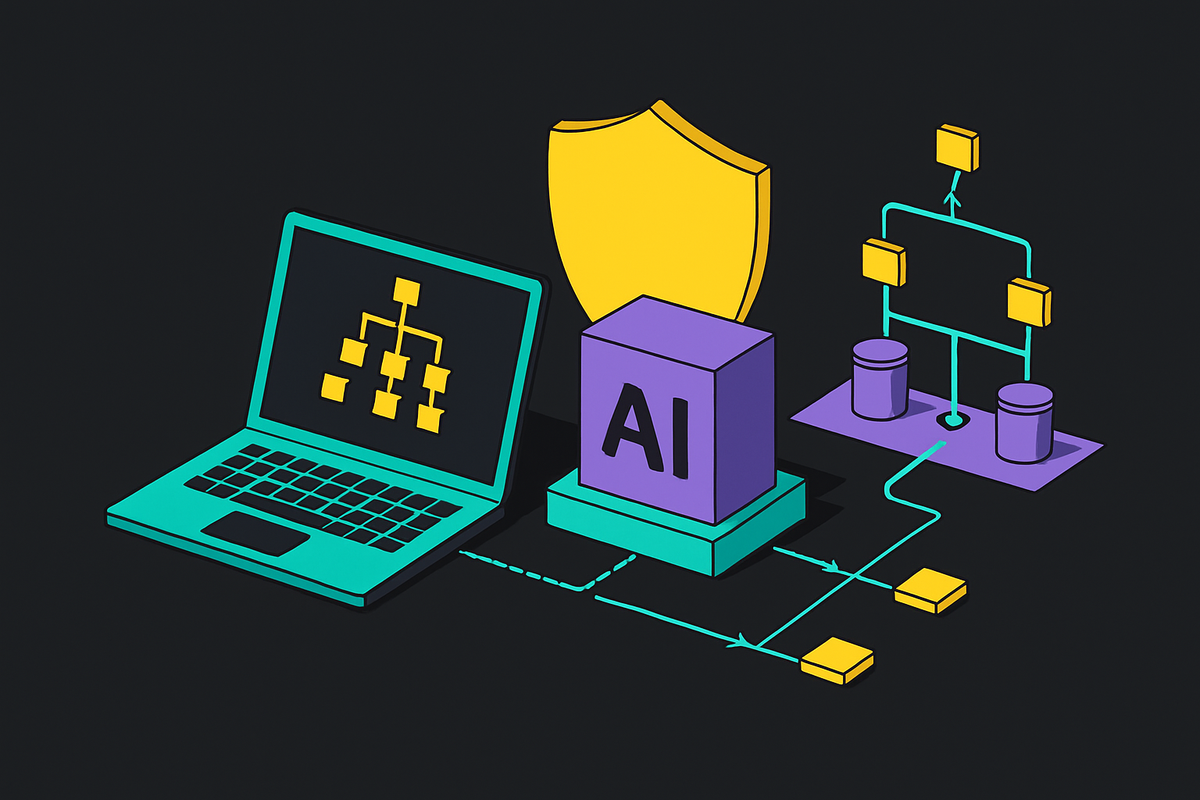
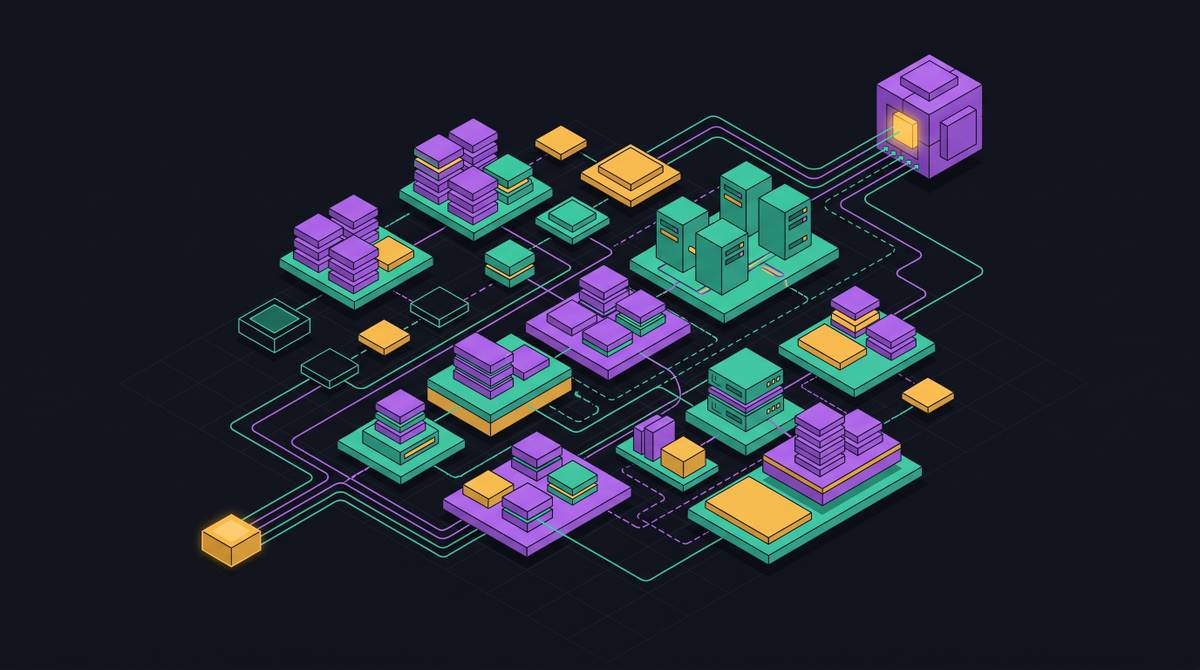
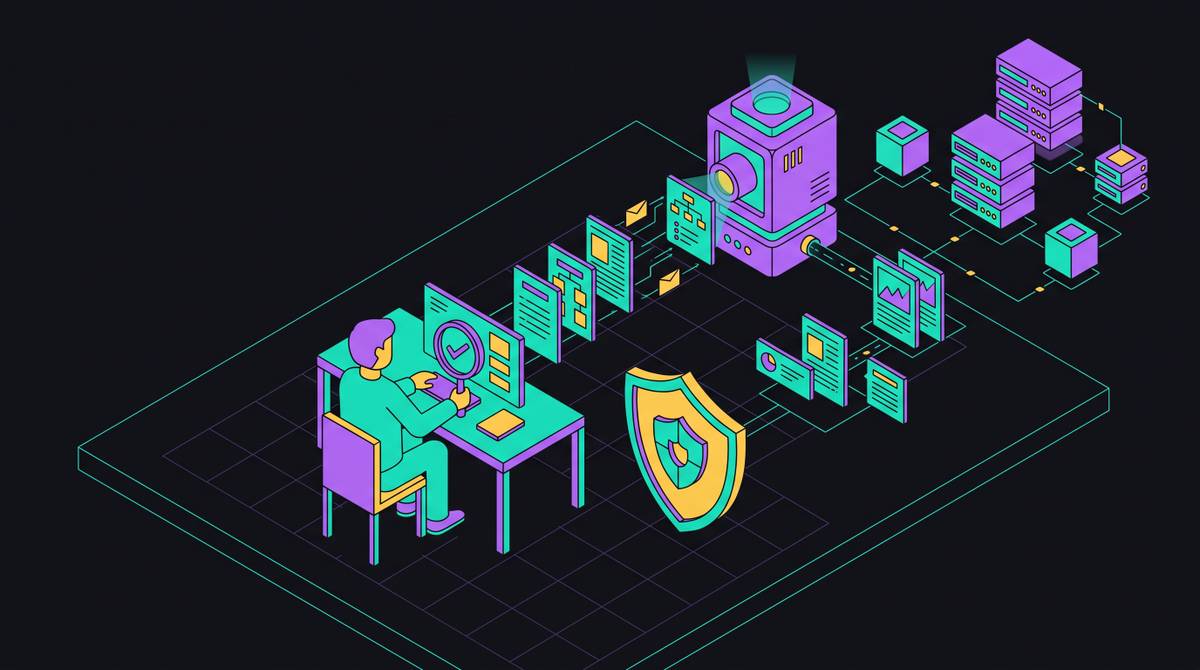
Continuous Pull Request Scanning vs Annual Pen Test Schedules
Continuous scanning catches vulnerabilities when they're cheaper to fix.
Every code push that touches authentication, authorization, or data access creates new, untested paths through your application. Not a hypothetical. The ordinary output of an ordinary engineering team doing ordinary work.
Third-party integrations introduce supply-chain exposure that didn't exist at test time. New cloud services, adjusted IAM policies, modified container configurations: each one alters the environment the original engagement evaluated. By the time your developers are reading the pen test report, the system it describes has already moved on without them.
The vulnerability classes that surface in those gaps are not exotic. Server-side request forgery in new service integrations. Insecure deserialization in updated API endpoints. Hardcoded secrets committed during fast-moving feature work. Authorization bypasses introduced when access control logic gets refactored mid-sprint. These are the normal byproducts of normal engineering velocity.
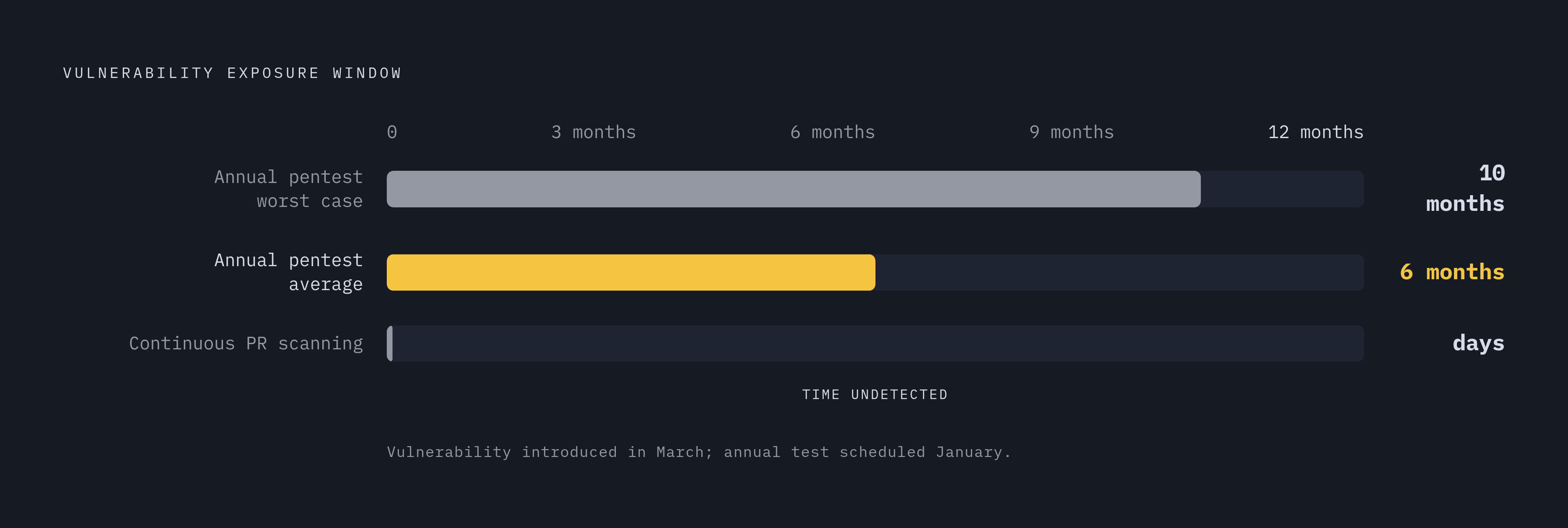
Consider the deployment velocity gap: the window between when a vulnerability is introduced and when it gets detected. In an annual model, the maximum exposure window is the full calendar year. Since code changes don't all land the day after the test, the average exposure across vulnerabilities introduced throughout the year is roughly half that. A system can pass a pen test in January and be genuinely vulnerable by March, with nothing to catch it until the following January.
This isn't a vendor problem or a budget problem. It's a timing mismatch baked into the model itself, between when risk enters the system and when anyone goes looking for it. The team that shipped the feature has already moved on to the next sprint. The contextual knowledge that would make remediation fast is already fading.
Why Finding Vulnerabilities Close to When They're Introduced Changes the Economics of Fixing Them
The engineer who wrote the code still has the mental model of it when a finding surfaces days later. Months later, that model is largely gone. Business requirements haven't shifted. The surrounding codebase hasn't evolved in ways that make refactoring harder. Proximity to introduction makes fixes faster, cheaper, and more accurate. I've watched remediation timelines compress by an order of magnitude just by catching something in the pull request rather than a quarterly report.
Annual testing creates a remediation spike. Dozens of findings arrive simultaneously in one report, competing with ongoing feature work for sprint capacity. Critical findings get addressed. Lower-priority findings get scheduled, then rescheduled, and some never get resolved before the next annual cycle begins. The structural incentive of the annual model is, perversely, to defer risk.
Continuous discovery distributes findings across the development calendar. Teams address a handful of issues per sprint cycle rather than burning a dedicated remediation sprint on a backlog that arrived all at once.
IBM's 2024 Cost of a Data Breach report put the average breach cost in the millions. I've seen organizations treat that number as abstract until they're the ones filling out the incident report. Early detection compresses exposure. The longer a vulnerability lives in production, the more expensive its consequences become, and that relationship holds consistently enough to treat as operational fact.
What Continuous Pull Request Scanning Actually Does, Technically
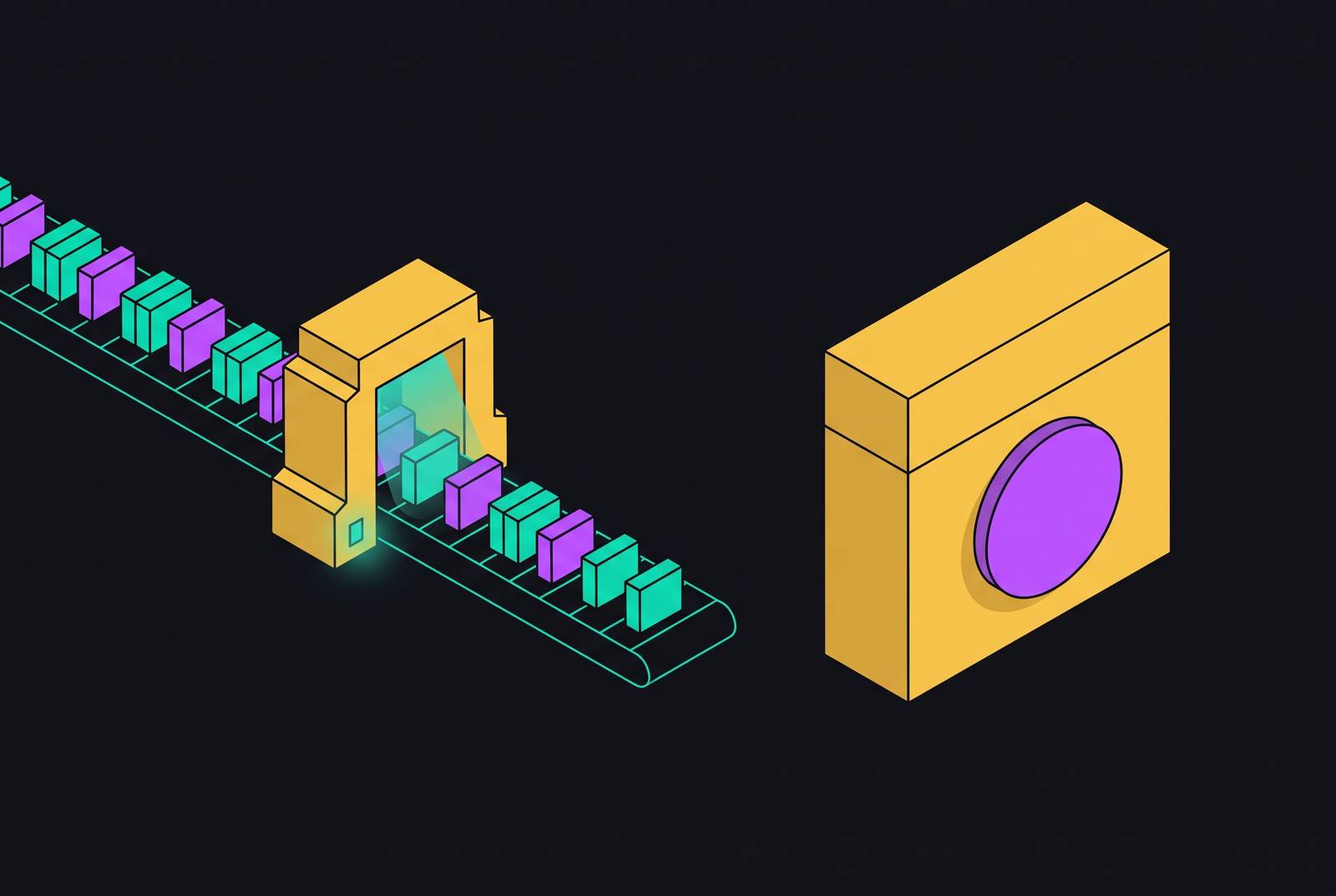
PR scanning intercepts code changes at the point of submission, before the merge, before the deployment. It analyzes the diff and its downstream effects: new routes, changed access control logic, new dependencies, modified infrastructure configuration. It is not a static analysis linter. Conflating the two is a meaningful and surprisingly common mistake.
Effective PR scanning surfaces exploitable vulnerability classes in application logic, not just style violations or known CVEs in third-party packages. Tools like Dependabot and Snyk OSS do valuable work catching known vulnerabilities in open-source dependencies. PR scanning for security should catch logic-level vulnerabilities in the application code itself: injection flaws, authentication logic changes, authorization regressions, secrets exposure, SSRF-prone patterns in new integrations.
Findings surface in the pull request itself, with the author and reviewer already present and already in context. The fix happens before the code ships.
Whitebox access is what makes this possible at any meaningful depth. Scanning the actual source code, the real configuration, the genuine access control implementation, rather than just the deployed surface, separates a tool that catches vulnerabilities from one that generates noise. Without it, you're working from the outside in, and there's a lot you simply cannot see from there.
Where Continuous Scanning Reaches Its Limits and Why Human Expert Review Doesn't Go Away
Automated scanning, however sophisticated, cannot replicate the judgment a skilled tester applies to chained vulnerabilities and business logic flaws. This is a structural constraint, not a criticism of the tooling.
Business logic flaws are the clearest example. When an application does exactly what it was coded to do, but the logic itself creates an exploitable condition, no automated tool catches it. There's no pattern to match. The vulnerability lives in the intent of the design, not the syntax of the implementation. I've watched genuinely talented engineers feel confident after reviewing clean scan results, while the actual exposure was sitting in a workflow they'd never thought to question.
Lateral movement scenarios illustrate a related limit. A tool can check for weak credentials. It cannot test whether credentials recovered from one system grant access elsewhere in the environment. That requires a tester reasoning across the whole architecture, holding multiple components in mind simultaneously, asking what a patient attacker would do with the combination.
Chained attacks are perhaps the most significant gap. Two individually low-severity findings that combine into full account takeover or privilege escalation are only visible to someone who holds both findings simultaneously and thinks through what happens when they're used together. Architecture-level risk, including threat model gaps and systemic access control design problems, requires that kind of human judgment applied to the full system.
Netragard, a boutique penetration testing firm, has argued that a single high-quality annual test can produce more security value than several shallow automated cycles. That argument has merit. The issue isn't the depth of manual testing; it's treating one point-in-time test as sufficient coverage when your deployment cadence is continuous.
Compliance frameworks reinforce the necessity of expert testing. SOC 2 auditors increasingly expect evidence that controls hold under real conditions. HIPAA's proposed Security Rule changes, if finalized as expected in mid-2026, would mandate annual penetration testing for covered entities. ISO 27001 requires testing cadence tied to risk and to significant system changes. None of these frameworks treat automated scanning as a substitute for expert engagement.
The Hybrid Architecture: How PR Scanning and Periodic Expert Testing Complement Each Other
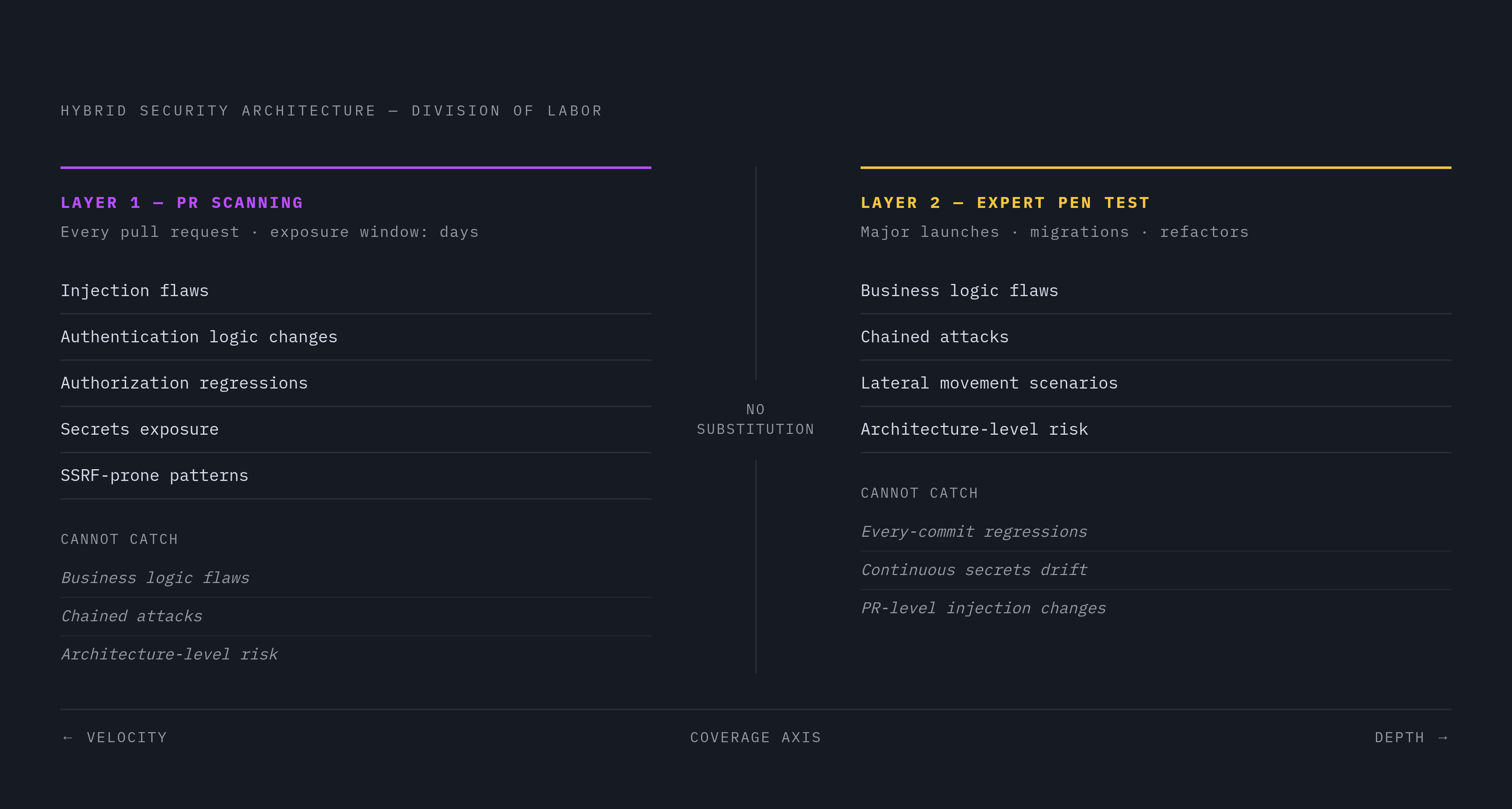
The functional model here is two distinct layers with different jobs, running in parallel rather than in sequence.
PR scanning is the continuous layer. It catches vulnerability classes as they're introduced, integrates into the developer workflow, and compresses the exposure window from months to days. It's not trying to do what expert testing does. It's doing what expert testing structurally cannot do at continuous deployment velocity, because no team of testers can review every pull request the moment it's submitted.
Periodic expert pen tests are the depth layer. They evaluate the full system at the architecture level, chain findings across components, and validate that controls hold under active adversarial pressure. In this model, their job changes. They're no longer the primary mechanism for finding individual vulnerabilities scattered across the codebase. They're the mechanism for finding what the continuous layer can't see: the logical flaws, the chained exposures, the architectural assumptions that were wrong from the start.
The triggers for expert testing should extend beyond the annual calendar. Major feature launches, infrastructure migrations, new third-party integrations, significant authentication or authorization refactors: each of these events materially changes the attack surface and warrants a focused engagement. Waiting until January is a habit, not a strategy.
Compliance consolidates under this architecture in a way that's genuinely useful. A single well-scoped expert engagement can satisfy SOC 2, ISO 27001, and, under proposed HIPAA changes, HIPAA simultaneously, mapping findings across frameworks from one test. PR scanning evidence supplements the audit record throughout the year, providing continuous documentation that controls were actually monitored, not just tested once and assumed to hold.
Remediation workflows also split cleanly. PR-level findings go straight to the author in the pull request. Expert test findings go to a structured remediation sprint with formal retesting. The pen test report remains both an audit artifact and a procurement asset; enterprise security questionnaires still ask for it. What changes is that the report now describes a system that has been continuously monitored, not one tested once and left to drift.
What to Look for When Evaluating Tools and Vendors for Each Layer
The evaluation criteria for each layer are distinct. Conflating them produces bad purchasing decisions and, eventually, a false sense of coverage.
For PR Scanning Tools
Ask what vulnerability classes are detected beyond known CVEs in dependencies. If the answer centers primarily on package manifests, the tool is a dependency scanner with different branding. Ask whether it analyzes actual code paths or only surface-level configuration. Ask for a sample finding with exploitation evidence. A severity score without a demonstration of exploitability is an opinion dressed up as a finding.
For the Expert Pen Test Layer
Methodology should reference a specific standard. OWASP WSTG, OWASP API Security Top 10, and PTES are the credible references. A vendor who names only their proprietary process or their tool stack is telling you something important about whether they're doing security testing or running automated scans with a report template attached.
Credentials matter, but selectively. OSCP and OSWE validate practical exploitation ability. GXPN validates advanced network and exploit development skills. CEH alone does not validate the capacity to conduct a genuine penetration test, regardless of what the marketing materials suggest.
Every finding should include a working exploit demonstration. Unverified theoretical risk is not a penetration test finding. If a vendor cannot show you how the vulnerability is actually exploited, they have not confirmed it's real.
Ask what percentage of engagement time is manual versus automated. Sixty to eighty percent manual is the operational benchmark for a genuine test. Below that threshold, you are paying for an automated scan with a human signature on the cover page.
Retest policy is non-negotiable. A vendor who won't retest after remediation is not invested in whether you're actually secure.
Whitebox access, including source code, cloud configurations, and architectural documentation, enables complete attack surface coverage in a modern SaaS environment. Blackbox testing alone misses too much. It's the security equivalent of evaluating a building's structural integrity by only looking at the exterior.
Pricing Context and Hard Disqualifiers
A medium SaaS application plus API engagement typically runs between $15,000 and $40,000 over two to three weeks. A full continuous PTaaS subscription runs from $40,000 into the hundreds of thousands annually. The right model depends on deployment velocity and compliance requirements.
Some disqualifiers are worth stating plainly. Sub-five-business-day turnaround for a real application engagement is not a pen test; it's an automated scan. Per-IP pricing on an application test indicates the vendor is thinking about network scanning, not application security. Inability to name the specific person who will run the engagement is a due diligence failure. No sanitized sample report available means you're committing to an unknown deliverable quality.
One more flag worth calling out: "We use AI" without specifics about what it validates, how findings are confirmed, and what human review looks like is a marketing claim. AI-assisted tooling has genuine value in raising coverage and reducing the time skilled testers spend on lower-complexity analysis. But the pitch has to go somewhere beyond the buzzword. Ask for the methodology behind it, and watch what happens when you do.
The security architecture question isn't continuous scanning versus annual testing. It's whether your program is calibrated to how risk actually enters your system, or to a deployment reality that stopped being true years ago.