Why Human Expert Review Cannot Be Removed from AI-Augmented Pen Tests
Human judgment separates actual vulnerability discovery from automated detection noise.
The distinction between detecting a potential vulnerability and proving it is exploitable is not a technicality. It is the entire difference between a scan output and a penetration test, and conflating the two is how organizations end up with a false sense of security and a useless compliance artifact.
AI tooling is genuinely good at pattern-matching against known signatures. What it cannot do is understand what an application is supposed to do, and that understanding is prerequisite to recognizing when something has gone wrong in a way that matters. Payment flows, role hierarchies, multi-tenant isolation, application-specific business logic: none of this has a generic signature to match against. Authorization bypasses, insecure deserialization edge cases, race conditions, these require a tester who has built a working model of the system during the engagement itself, not one retrieving analogous patterns from a training corpus assembled before the engagement started.
The training data constraint is worth sitting with for a moment, because it's harder to solve than vendors acknowledge. When attackers innovate in ways the corpus didn't anticipate, the model misses the vulnerability, and there's no mechanism for it to flag its own blind spot. It cannot know what it doesn't know. A larger dataset doesn't fix this; a better model doesn't fix this. It's structural.
False positives make the situation worse in practice. Findings that look like vulnerabilities in isolation are frequently complete non-issues in context. Only someone who understands the application's intended behavior can make that call reliably, and a report full of unvalidated maybes burns engineering cycles on non-issues, erodes confidence in future findings, and slows remediation of the real ones.
Every credible pen test finding needs a working exploit behind it, proof that the vulnerability is actually reachable and impactful in this environment, not just theoretically present in the code. AI surfaces candidates. A human decides which candidates are real. That division isn't going anywhere soon.
The Chained-Vulnerability Problem That Scanners and AI Both Miss
Real attacker behavior rarely exploits a single critical vulnerability in isolation. It chains several lower-severity issues into a path that reaches something meaningful. This is not an edge case. It describes the majority of confirmed breaches involving credential abuse and technical exploitation.
Here is what this looks like in practice. Two findings rated medium in isolation, an IDOR in one endpoint and an insufficiently scoped session token in another, can combine to give an attacker full account takeover. A low-severity misconfiguration in cloud storage, chained with a hardcoded credential surfaced from source code, exposes production data without triggering any individual high-severity alert. Evaluated separately, neither finding demands urgent remediation. Evaluated together, the path to compromise is obvious and the remediation priority changes entirely.
Automated scanners evaluate findings individually. They are not designed to reason about how paths compose across an application's attack surface, and this is not a gap that prompt engineering closes. The problem isn't language generation; it's contextual, adversarial reasoning across a specific environment the model has never seen before.
Building an attack chain requires the tester to hold a mental model of the application: its trust boundaries, data flows, privilege structure, and the operational logic underneath all of it. Then reason forward the way an attacker would. That is the kind of thinking that produces findings worth remediating, and it is also the thing a report has to demonstrate to be credible to auditors and to the engineering teams deciding what gets fixed first.
A report that doesn't show how findings chain into a path to compromise is delivering scanner output, not adversary emulation. The branding on the cover and the tools listed in the methodology section don't change that.
What Auditors Actually Examine When They Review a Pen Test Report
Auditors reviewing for SOC 2, ISO 27001, or HIPAA are not asking whether vulnerabilities exist. They are asking whether the testing process was rigorous enough to be trusted as evidence of control effectiveness. The report is evidence of a process, not a list of findings, and that distinction shapes everything they look for.
They look for named, credentialed testers who can be verified. A report signed by someone carrying OSCP, CREST CRT, or GPEN carries evidentiary weight that an AI-generated output cannot replicate, because those certifications require candidates to actually exploit systems under controlled conditions. They want evidence of actual exploitation, not detection. CVSS scores and scanner output alone stopped satisfying experienced reviewers years ago. Scope documentation matters too: the test must demonstrably cover the right systems at the right time, relative to the audit window.
Framework-specific requirements tighten the standard further. SOC 2 CC4.1 references penetration testing as a method for performing required ongoing evaluations; auditors want to see that a human made judgment calls, not that a tool ran. ISO 27001 Annex A Control 8.8 requires that vulnerability findings feed into the risk register, receive formal risk treatment decisions, and be verified for remediation, a chain of management artifacts that requires human sign-off at each step. Under proposed HIPAA Security Rule updates, annual penetration testing is expected to become mandatory for covered entities and business associates, which raises the stakes considerably for what "testing" is understood to mean.
An AI-generated report without human attestation creates an audit gap. The organization cannot produce a named expert who stands behind the findings. Experienced auditors recognize that absence immediately, and no amount of polished formatting papers over it.
Cyber insurance underwriting has moved in the same direction. Carriers above certain coverage thresholds now require evidence that a qualified human tested the environment, not that an automated tool completed a scan. The same rigor that satisfies an auditor is the rigor that actually finds what matters.
How to Tell Whether a Pen Test Had Real Human Judgment Behind It
AI-assisted scans are increasingly packaged and sold as penetration tests, often with professional branding that obscures what was actually done. The report looks substantial. The language is confident. The page count is impressive. Then you look closely.
A sixty-page branded report with authoritative language can turn out, on examination, to be a Nessus scan with the tool's name swapped out. No manual testing. No business logic coverage. No proof of exploitation. A missing HTTP security header rated "medium" with a CVSS score attached. That is a scanner report sold as a penetration test, and it satisfies no auditor who knows what they're looking at.
A few questions cut through the branding quickly. What percentage of engagement time is manual testing versus automated scanning? Quality engagements allocate the majority of their time to manual work; a vendor who deflects to tool names rather than answering with an actual ratio is telling you something. Can they share a sample report from a comparable engagement? Does it show how findings chain into attack paths, or is it a list of CVEs with boilerplate remediation advice? Who specifically will conduct the test, and what are their certifications? OSCP, CREST CRT, GPEN, and GXPN all require candidates to exploit systems under examination conditions; CEH alone does not validate practical exploitation skill. Is retesting included, or billed separately? Providers who exclude retesting are signaling they don't expect their findings to require follow-through.
The red flags, once you know them, are not subtle. A fixed low price with a very short turnaround and no scoping call is a strong signal. No detailed questions about target systems, user roles, excluded assets, or testing windows means the engagement is almost certainly underscoped. "We use AI" as the primary capability claim, with no explanation of what the AI validates, in what environment, and with what evidence, is a deflection. Generic report language that could apply to any organization suggests the report was templated rather than authored.
Scoping rigor is itself a leading indicator. A thorough scoping process is evidence that a human is actively building a model of the target environment before testing begins. A flat-fee engagement with no scoping call means no such model exists, and you should expect the report to reflect that.
Where the Human-AI Boundary Sits in a Well-Designed Pen Testing Workflow
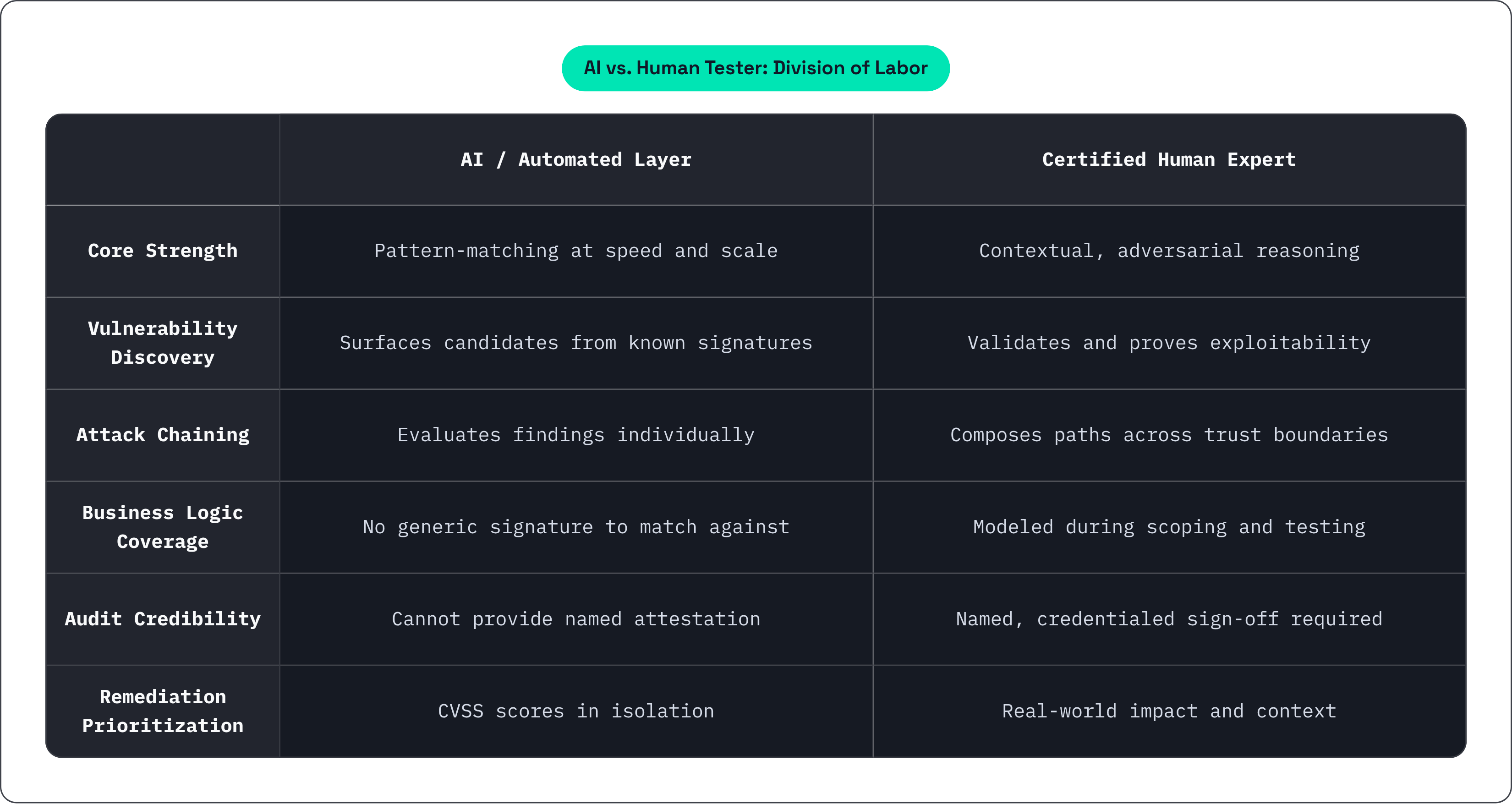
The productive model is not "AI or human." It is a defined division of labor where each does what it is actually suited for.
What belongs to AI is substantial. Continuous, broad surface scanning against every pull request, catching known vulnerability patterns at speed and scale, is exactly the kind of relentless systematic work that AI handles well. Reconnaissance, asset enumeration, and first-pass triage to surface candidates for human review belong here. Report drafting, evidence organization, and routine classification belong here too.
What stays with the certified expert is equally well-defined. Deciding which candidates represent real, exploitable vulnerabilities requires human judgment. Building and proving attack chains that cross trust boundaries requires the mental model of the target environment that a human builds during scoping and testing. Understanding what the application is supposed to do, so you can recognize when it can be made to do something else, is a form of reasoning that current AI systems don't perform reliably in novel environments. Signing off on findings that will be presented to auditors, customers, and boards creates the evidentiary credibility that an AI attestation cannot. Prioritizing remediation based on real-world impact, rather than CVSS scores in isolation, requires reasoning about consequence in context, and context is still a human domain.
Point-in-time annual tests are also structurally misaligned with how modern software ships. New code, changed dependencies, and new attack paths accumulate between tests. The logical evolution combines AI-driven continuous scanning on every pull request with periodic certified expert review: breadth always on, depth applied with judgment when it matters.
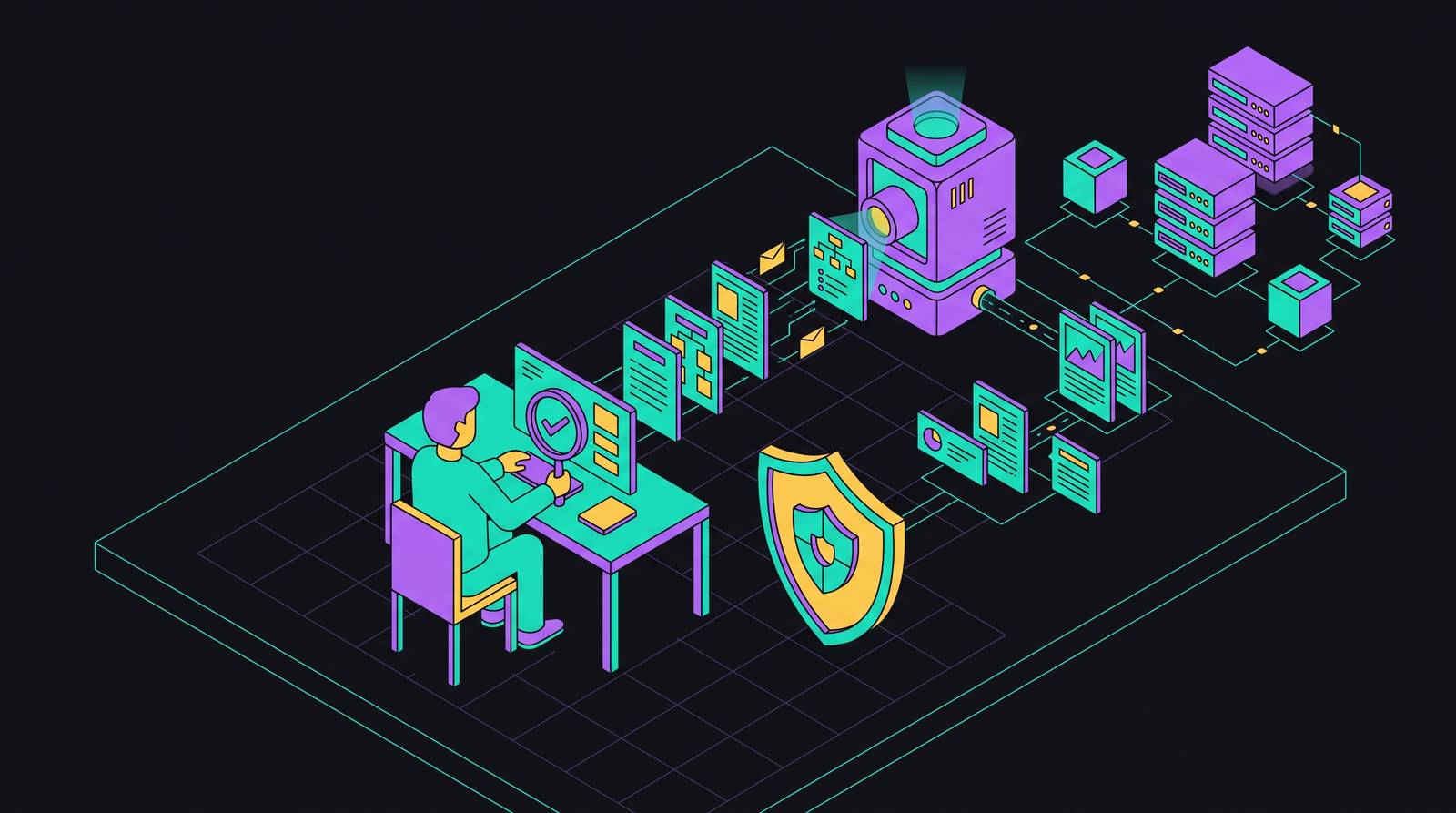
In this model, source code, cloud configuration, and documentation are accessible at the AI layer, with every finding reviewed and attested by a certified OSCP expert before it enters the report. A named expert stands behind every finding with a working exploit as proof, which is what satisfies SOC 2, HIPAA, and ISO 27001 audit requirements.
Removing the human from this workflow doesn't produce something faster and equally rigorous. It produces something faster and less trustworthy, because the tasks that determine whether a finding is real, reportable, and remediable all sit on the human side of the line. That ceiling isn't rising fast enough to change the calculus for any organization that needs its pen test to actually mean something.