AI-Powered Recon and Enumeration in Modern Penetration Testing
AI agents that reason across findings beat rules-based scanners at finding real attack paths.
Most vendors applying the "AI-powered" label to their recon tools are describing a faster scraper. That's not nothing, but it falls short of what the label implies. The meaningful distinction is between a system that executes predefined lookups quickly and one that reasons about what it finds and decides what to do next.
The word "agent" is doing real work here, and most marketing copy ignores the difference. A copilot surfaces suggestions; an agent acts on them. An AI recon agent runs commands, reads output, decides what to probe next, and repeats that loop across the entire attack surface without waiting to be told. The underlying architecture most serious tools use is called ReAct: observe state, pick action, execute, read result, update understanding, try again. That loop doesn't terminate when a checklist runs out. It terminates when the model's reasoning runs out of productive next steps, which is a fundamentally different stopping condition.
Two implementation approaches are converging right now. MCP-based tools, including Kali MCP and Hexstrike AI, use the Model Context Protocol to keep accumulated findings visible to the reasoning layer as they pile up, so the model is always working from the full picture. Direct tool-calling tools, including PentestGPT, CAI, Strix, and Autopentester, have the model issue structured calls and process the responses in a tighter loop. The plumbing differs; the core behavior is the same: the model reasons about what it discovers, not just what it was pre-programmed to find.
What this unlocks, concretely, is the ability to correlate signals that would never connect in a rules-based system. A DNS misconfiguration in isolation is low-signal. A job description revealing the internal toolchain, also low-signal. An AI agent that reads both simultaneously can infer a concrete access path from the pairing. Neither finding alone would have triggered anything. The connection only exists if something is reasoning across both at once, and deterministic scanners structurally cannot do that.
That capacity for cross-source reasoning is the correct criterion for evaluating whether a tool is genuinely AI-powered or just faster at the old workflow.
How the Swarm Model Extends Recon Coverage Beyond What a Single Agent Can Do
Sequential recon, even when it's an AI doing it, requires constant prioritization. The agent is always making a bet: this thread is more promising than that one. Low-signal sources that don't immediately resolve into actionable findings get deprioritized, not because they're unimportant but because the next step is always competing with the current one.
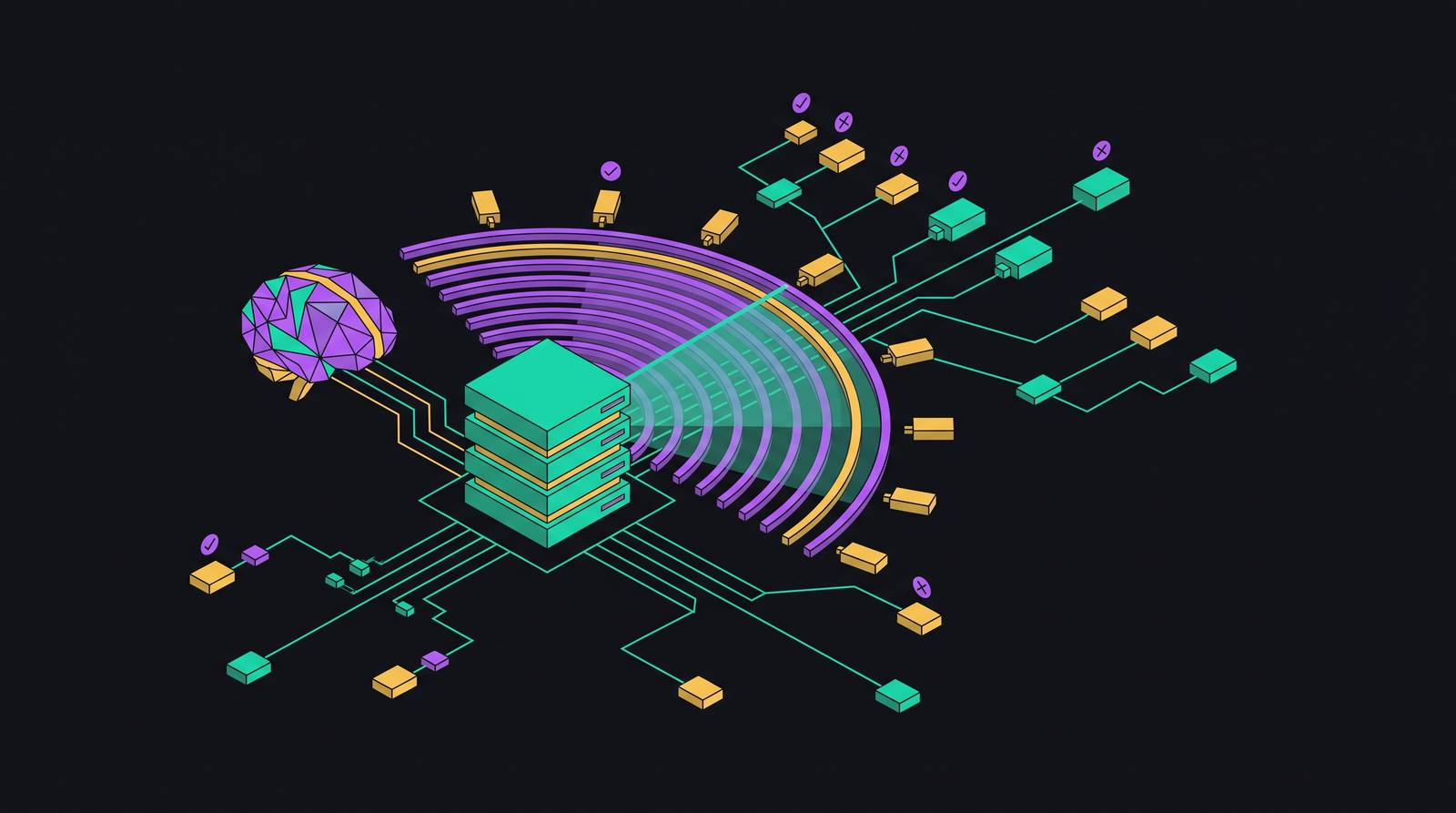
Swarm architecture eliminates that tradeoff. Rather than one model working through the surface in order, specialized agents run in parallel: a planner coordinates strategy, a recon agent maps exposure, an exploit agent probes for breakage, a reporter synthesizes everything. Tools operating this way include PentAGI, VulnBot, and D-CIPHER. The recon agent doesn't have to wait for the exploit agent to finish; low-signal threads get followed simultaneously rather than abandoned.
The planner's role is more interesting than it first appears. It's not just distributing tasks at the start of an engagement. It's updating strategy continuously as sub-agents report back, which means the recon surface itself expands during the engagement. A finding in one domain reshapes targeting in another. The scope isn't fixed at kickoff; it's dynamic.
The clearest empirical proof of this architecture's ceiling came from DARPA's AI Cyber Challenge, finals in August 2025. The first-place system, Atlantis, fielded by Team Atlanta, a collaboration among Georgia Tech, Samsung Research, KAIST, and POSTECH, combined multi-agent reinforcement learning with LLMs and symbolic analysis. Its final score was roughly equivalent to second and third place combined. The lesson from Atlantis isn't that any single AI approach wins. It's that no single approach, whether pure LLM, pure reinforcement learning, or pure symbolic analysis, beats a coordinated system that combines all three. Coverage improves nonlinearly as agents are added because the agents aren't redundant; they're complementary in ways that compound.
The Measurable Gap in Vulnerability Coverage That AI Recon Produces
Practitioners running AI in live penetration testing engagements over the past eight months report finding 30 to 40 percent more vulnerabilities in the same time window. That number is easy to misread as a speed claim. It isn't. Finding more in the same time means the tool is reaching attack surface the manual approach wasn't reaching. That is a coverage claim, and coverage defines the ceiling of what a test can find.
What the 30 to 40 percent figure doesn't tell you is whether the additional findings are high-severity or noise. The statistic is agnostic to finding quality, which matters enormously once you're triaging results and directing remediation resources.
The macro signal corroborating the coverage trend is the CVE publication rate: 48,185 CVEs were published in 2025, up 21 percent over 2024, with 2026 tracking higher still. Some portion of that acceleration reflects AI-assisted discovery reaching attack surface that was previously too costly to probe manually. The vulnerability existed before. The tooling to find it at scale didn't.
Two benchmark data points put current AI-driven recon in context. XBOW's autonomous agent reached the top spot on HackerOne in June 2025, eventually accumulating more than 1,060 valid submissions, a direct signal that AI-driven recon is competitive with experienced human bug hunters on certain vulnerability classes. ARTEMIS, evaluated in December 2025, outperformed the majority of human pentesters on a live 8,000-host enterprise network, precisely the environment where recon coverage at scale is hardest to achieve manually.
Those numbers describe what AI does well: breadth, correlation at scale, and speed across a large surface. They don't describe what AI does completely, and that's where the ceiling conversation gets serious.
Where AI Recon Reaches Its Ceiling Without Human Judgment
Here's the thing nobody in this space says plainly enough: AI recon finds more surface. It does not automatically understand what that surface means to a specific business.
Business logic flaws make this concrete. An AI agent can enumerate every API endpoint in a target application. Reliably reasoning about whether a specific sequence of calls violates the intended authorization model for that product's domain is a different problem entirely, because that model lives in the heads of the engineers who designed it, not in any configuration file or documentation the agent can read. The agent can find the endpoints. It cannot know what behavior between them was never supposed to be possible.
Context that exists only in human memory is a harder constraint still. An engineering leader knows that one legacy service runs as root because of a technical debt decision made three years ago, one never documented anywhere. No recon pass surfaces that. A skilled human interviewer working through threat intelligence with the client's own team can surface it in twenty minutes. That information asymmetry doesn't close with a better model.
The false positive problem layers on top of both. AI recon surfaces anomalies that look like attack vectors but aren't. Without a human who understands the target environment, signal-to-noise degrades, remediation effort goes to findings that aren't real risks in that specific context, and real risks get buried in the queue.
Anthropic's own assessment of Mythos Preview, released in April 2026, is worth sitting with here: the system found thousands of high-severity vulnerabilities across major operating systems and browsers, and Anthropic concluded it was too capable to release broadly. Raw capability without guardrails is its own risk category, distinct from the capability itself.
RapidPen offers another calibration point, less philosophically weighty but operationally relevant: autonomous IP-to-shell tests completed in roughly 400 seconds, with a reported 60 percent success rate. The other 40 percent is the gap between what AI attempts and what it completes. In a live engagement where the missed path is the critical one, that gap has real consequences. AI pentesting tools in 2026 compress the time to cover attack surface and surface anomalies human testers would miss under time pressure. They don't replace contextual judgment about what a vulnerability means to a specific organization.
How Whitebox Access Changes What AI Recon Can Reason About
The access model is upstream of everything else. An agent restricted to external probing can only reason about what's externally visible, regardless of how sophisticated its underlying model is. This sounds obvious, but its implications are routinely underestimated.
Blackbox AI recon is fast and broad. It finds what a well-resourced external attacker would find, which is genuinely valuable, and it is bounded by what's exposed from outside. Whitebox recon operates in a different register: the agent connects directly to source code repositories, cloud configurations, and infrastructure documentation, reasoning about what's present in the codebase before anything is deployed, finding vulnerabilities that are unreachable from outside by definition.
Whitebox access opens specific finding classes that external probing misses entirely. Hardcoded secrets buried in commit history don't surface from an external scan; they surface when something reads the repository directly. Cloud misconfiguration patterns across infrastructure-as-code files let an agent map the full blast radius of a misconfigured IAM role before it is ever tested from outside. Internal service dependencies, the full graph of what communicates with what inside the application, can be enumerated completely rather than inferred from perimeter-visible signals.
For SaaS companies, this distinction is particularly material. The attack surface of a SaaS product lives mostly in the application layer and cloud configuration, not the network perimeter. External scanning optimized for network targets misses the surface where the highest-severity findings actually cluster. The binding constraint isn't model sophistication; it's access model. A less capable model with full whitebox access will consistently outperform a more capable model restricted to external probing, because the more capable model simply cannot see what it would need to reason about.
What Separates AI Recon Tools That Add Speed from Those That Add Depth
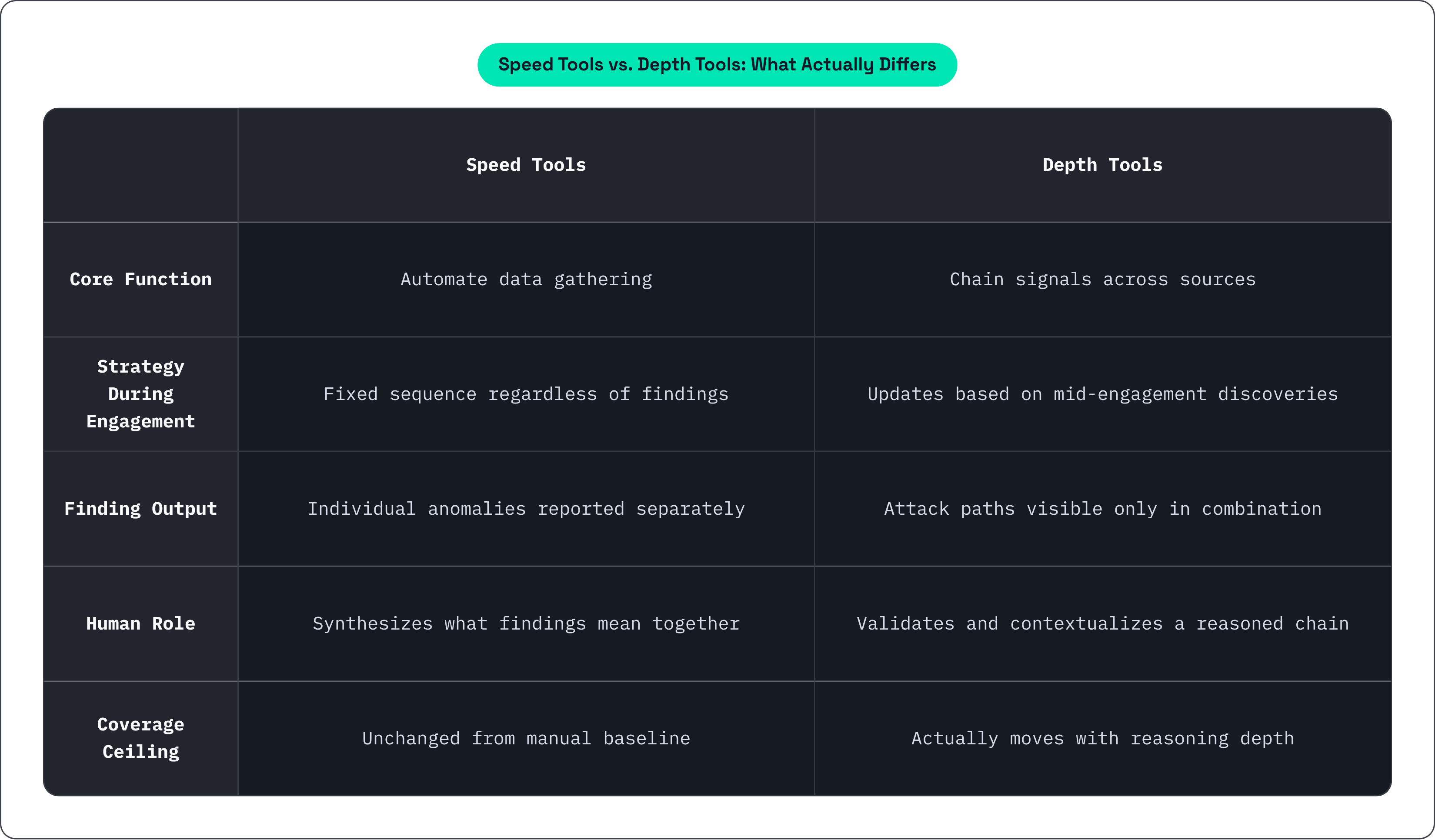
Speed tools automate data gathering. Faster DNS enumeration, faster port scanning, faster OSINT aggregation. The synthesis of what those findings mean together is still left to the human. Time saved; ceiling unchanged.
Depth tools do something structurally different. They chain signals across sources, update strategy based on what they discover mid-engagement, and surface attack paths that only become visible when findings are reasoned about in combination rather than reported individually. The ceiling actually moves.
Evaluating any vendor claiming AI-powered recon comes down to four questions. Does the tool adapt its enumeration strategy based on what it discovers mid-engagement, or does it follow a fixed sequence regardless of what it finds? Can it produce a specific example of a finding that required correlating signals from multiple sources, walking through the actual reasoning chain? How are findings validated before they reach the report, and what prevents the tool from surfacing anomalies that aren't real vulnerabilities in this environment? And what access model does the tool require, and what does it concretely miss when restricted to external probing?
Vendors who lead with "we use AI" without explaining what the AI validates, in what environment, against what evidence, are selling speed theater. The genuine signal of depth is a path-to-compromise narrative: a chain of findings that shows, specifically, how an attacker moves from initial access to a meaningful asset. Not a ranked list of individual vulnerabilities. A chain. That chain is what proves the tool reasoned rather than enumerated.
On the current tool landscape: PentestGPT is open-source and modular, with a self-reflective layer that evaluates its own coverage, which is a structural feature that distinguishes it from tools that only report forward. RapidPen is optimized for autonomous execution and rapid surface coverage, useful for what it does, though its completion rate is an honest signal about where autonomous depth still reaches its limits. Atlantis-class multi-agent systems, combining LLM reasoning with reinforcement learning and symbolic analysis, represent the current frontier of depth; they are not yet commercially productized for most buyers.
Where Human Expert Review Is Non-Negotiable After AI Recon Completes
AI recon produces a richer, broader, faster-synthesized attack surface map than any manual process can in equivalent time. It does not produce a validated, business-contextualized finding ready for an auditor or a CTO. Those are different products.
A finding that appears in AI output but hasn't been proven with a working exploit is a hypothesis. Hypotheses fail audits. They also misdirect remediation teams, which has real cost. The gap between "the AI surfaced this anomaly" and "a human expert confirmed this is exploitable, here is the proof, and here is what an attacker accomplishes by following this path" is the most consequential gap in the entire workflow.
What certified human review adds cannot be substituted. Running the exploit in the actual environment, not inferring exploitability from signatures or similarity to known CVEs. Translating technical findings into what an attacker can actually access or accomplish, framed in terms leadership can act on and make decisions from. Exercising scope judgment to determine which AI-surfaced anomalies are real findings and which are environment-specific false positives that would consume remediation resources without reducing risk. And providing attestation: an OSCP-certified tester who has reviewed and signed off on every finding gives the report credibility that AI-only output cannot carry in a SOC 2, HIPAA, or ISO 27001 audit context. The auditor wants a human signature. That requirement isn't going away.
The division of labor this implies is actually clean, once you accept it. AI does the saturation work, covering the full attack surface faster and more completely than a manual tester can in the same window. The human expert does the judgment work: determining whether what the AI found is real, exploitable, and meaningful to this specific organization.
Trace is built on this model. AI-native recon and enumeration with direct access to source code repositories, cloud configurations, and product documentation, followed by OSCP-certified human review and sign-off on every finding before the report and letter of attestation are issued. Continuous pull-request scanning extends that same AI-native coverage to every code change, surfacing findings at the moment of introduction rather than after they've reached production.
The right question for any vendor conversation isn't whether AI is involved in recon. It's who reviews what the AI finds, what they validate it against, and what their sign-off actually certifies. That question separates tools that make recon faster from tools that make recon mean something.