False Positive Rates in AI Security Tools and Their Cost to Engineering Teams
Legacy security tools generate false positives at rates as high as 78 percent.
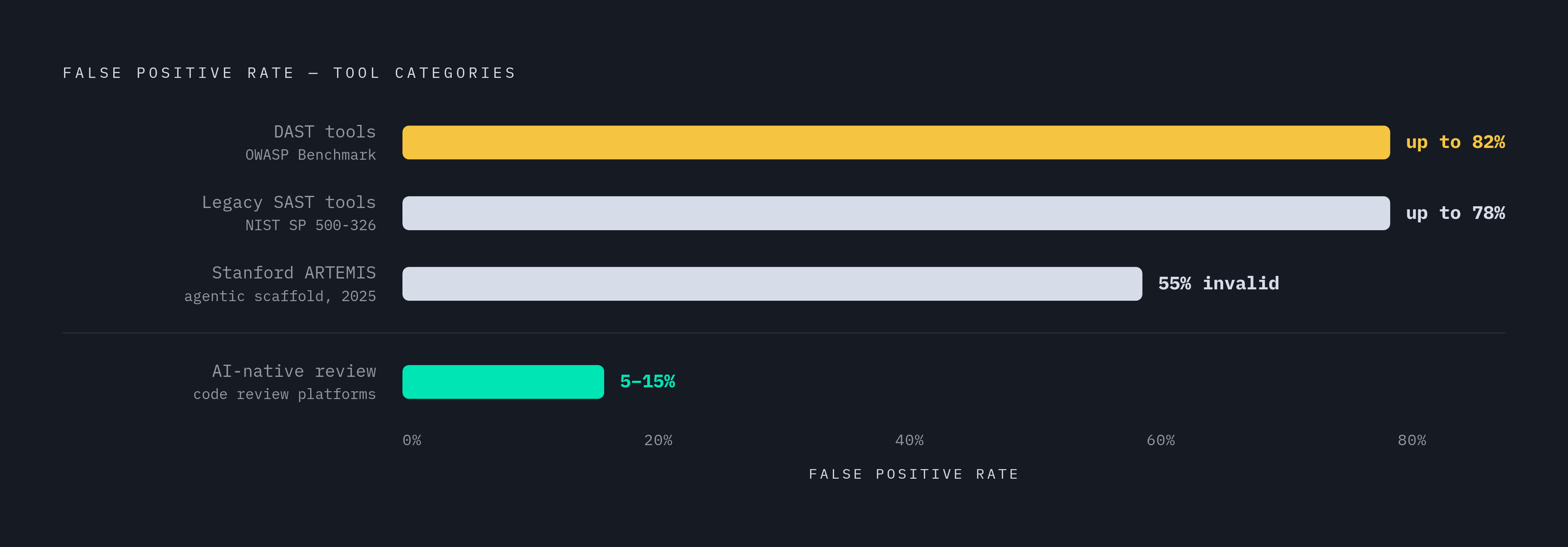
The numbers are not theoretical, and they are unflattering. Legacy SAST tools produce false positive rates as high as 78% for Java codebases, per NIST SP 500-326. DAST tools, despite operating closer to real attack conditions, fare no better: the OWASP Benchmark places DAST false positives as high as 82%. These are not fringe products. These are mainstream tools running in production at serious organizations right now.
AI-native code review platforms do better, typically landing in the 5 to 15% false positive range. Still not elimination, and the gap matters more than vendors acknowledge. Stanford's ARTEMIS 2025 research on agentic security scaffolds found that the best-performing scaffold reached only a 55% valid submission rate. Nearly half its outputs were invalid findings. From the category the market currently positions as most sophisticated.
Here is what gets buried in vendor marketing: a lower false positive rate does not automatically mean higher accuracy. A tool can reduce its false positive rate simply by flagging less, which inflates false negatives at the same time. You end up with a quieter tool that misses more real vulnerabilities. The silence is not the same as safety — a smoke detector that stops beeping because you removed the battery hasn't made the house any safer.
The survey data makes the scope plain. Seventy-three percent of security executives report that tools with traditional AI and ML capabilities generate false positives. Ninety-one percent say those tools require tuning after deployment. Tuning is not a minor configuration step. It is the process of manually teaching a tool the contextual judgment it was marketed as already possessing. "AI security tool" has always described a starting point, not a finished solution.
How 9,854 False Positives a Week Compounds into Alert Fatigue
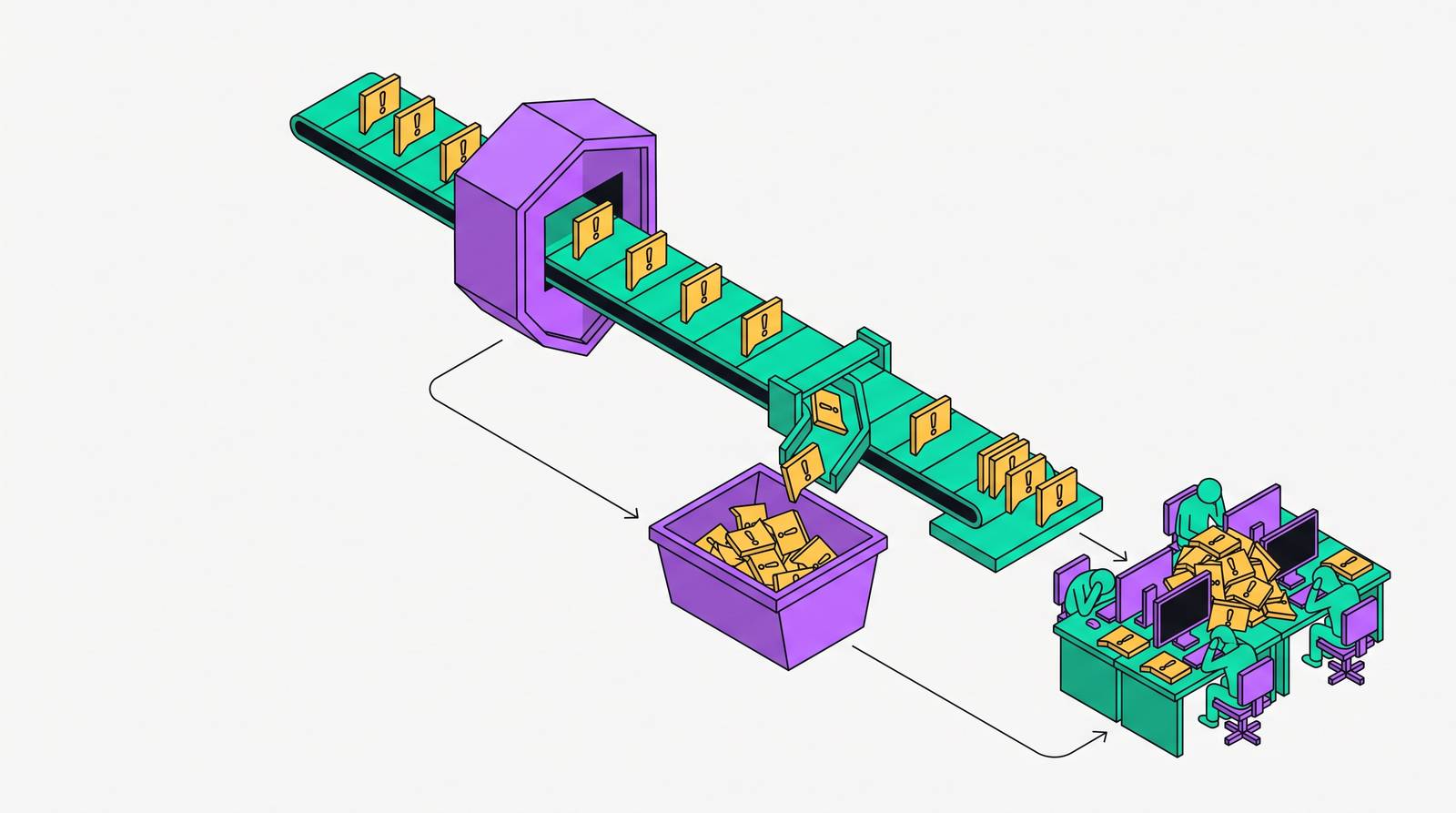
Ponemon's 2024 research puts the average at 9,854 false positives generated per organization per week. Five minutes of triage per alert, and the arithmetic collapses immediately for any team without aggressive automated pre-filtering. Pre-filtering is itself a judgment call with its own error rate baked in.
What actually happens is not that teams process every alert. They develop informal triage heuristics: rules of thumb, gut checks, pattern recognition accumulated from weeks of chasing dead ends. Those heuristics are efficient. They are also indiscriminate. Real threats get filtered by the same mental shortcuts as noise, because a real alert and a false positive look identical until someone investigates. It's like searching for a needle in a haystack — except someone keeps throwing in more hay.
A 2023 practitioner survey captured the end state plainly. One participant described their tool's output as "mostly false positives and a small fraction something we can actually fix." That is not someone venting frustration. That is a calibrated professional describing what the data taught them to expect.
The compounding is specific and worth tracing. An AI code review tool flags a potential SQL injection in a pull request. A senior engineer traces the data flow and finds the input is sanitized two layers upstream. Twenty minutes are gone. That happens dozens of times a week across dozens of PRs, and each time it resolves to nothing, the credibility threshold for the next investigation rises a little. Eventually the threshold rises past the point where something real gets ignored, not because anyone decided to ignore it, but because the accumulated experience of being wrong so many times made the right call feel indistinguishable from more noise.
The Hidden Financial Cost That Doesn't Show Up in the Tool's Price Tag
AI coding and security tools are priced to look accessible, somewhere in the $19 to $200 per user per month range, which positions them as inexpensive relative to traditional security vendors. That framing is misleading. The seat fee is only the visible cost. The engineering time consumed by false positive triage is the invisible one, and in my experience it is frequently the larger of the two.
The layers stack quickly. Direct triage time is the obvious one: senior engineer hours spent investigating findings that resolve to nothing. Remediation overhead is the less visible one: teams that act on false positives spend actual sprint cycles fixing issues that do not exist, which means real features get delayed. The opportunity cost is harder to quantify, but it shows up on delivery schedules just the same.
GitGuardian's remediation data gives a concrete benchmark: even a single real incident, a live credential exposed in production, averages at least two engineer hours to remediate, and that figure climbs substantially when the credential has propagated across multiple systems. When false positive volume generates enough noise to obscure that incident, the incident is delayed rather than prevented. Delay, in credential exposure, maps directly to blast radius.
A low-cost per user per month product with a 15% false positive rate against a high-volume codebase can consume more total engineering time than a more expensive, lower-noise alternative. The monthly seat cost is the wrong denominator. Total cost is seat fee plus triage burden plus the cost of the real vulnerabilities that get missed while the team is occupied with noise.
Why Automated Tools Keep Generating False Positives Even as They Improve
The false positive problem in automated security scanning is not primarily a model quality problem. Better models help, but they do not resolve the underlying issue, which is an information problem. Automated tools lack the contextual awareness to distinguish a vulnerable pattern from one that is safe within a specific application's data flow, or an injection point that matters from one that is sanitized three functions upstream. The tool sees a pattern. It cannot see what the application does with that pattern in practice.
This is why tuning exists at all. When 91% of security executives say their AI and ML security tools require post-deployment tuning, they are describing this gap directly: the tool shipped without the context of their environment, and someone on the team had to supply it by hand.
There is a structural ceiling here that does not move simply because models improve. Pattern-matching at scale, without exploitability confirmation, will always produce a population of findings that cannot be ruled out without human investigation. The tool flags something that resembles a vulnerability. It cannot confirm the finding is real. It cannot confirm it is exploitable. The finding lives in a probability space, and the only way to resolve it is a skilled human being tracing the actual data flow and attempting exploitation.
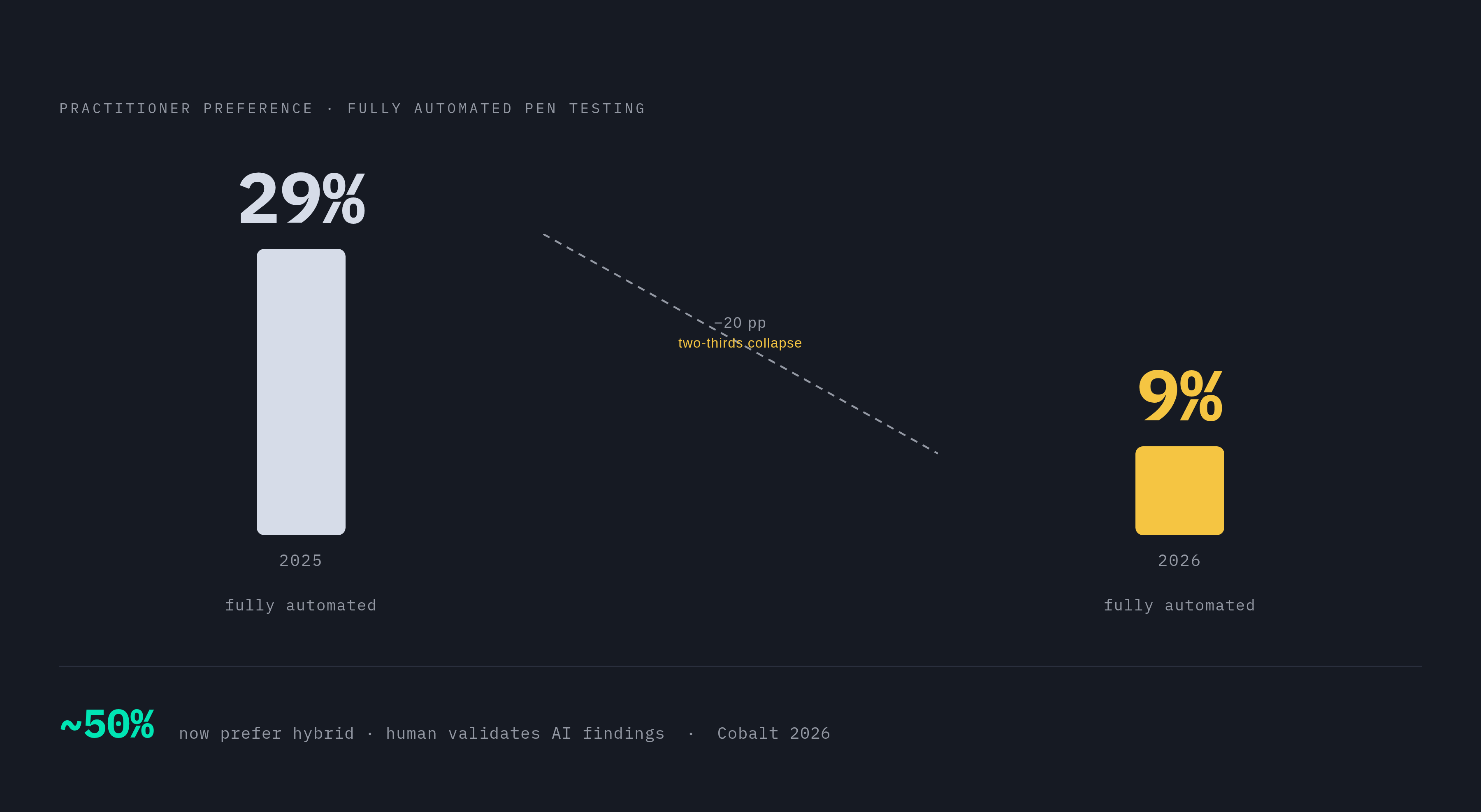
The market is beginning to internalize this. Support for fully automated penetration testing dropped from 29% to 9% in a single year, per Cobalt's 2026 data, while nearly half of respondents now prefer a hybrid model where humans validate AI findings. That shift reflects practitioners recognizing that automation without validation is incomplete by design, not a temporary limitation waiting on the next model release.
What a Near-Zero False Positive Standard Actually Requires
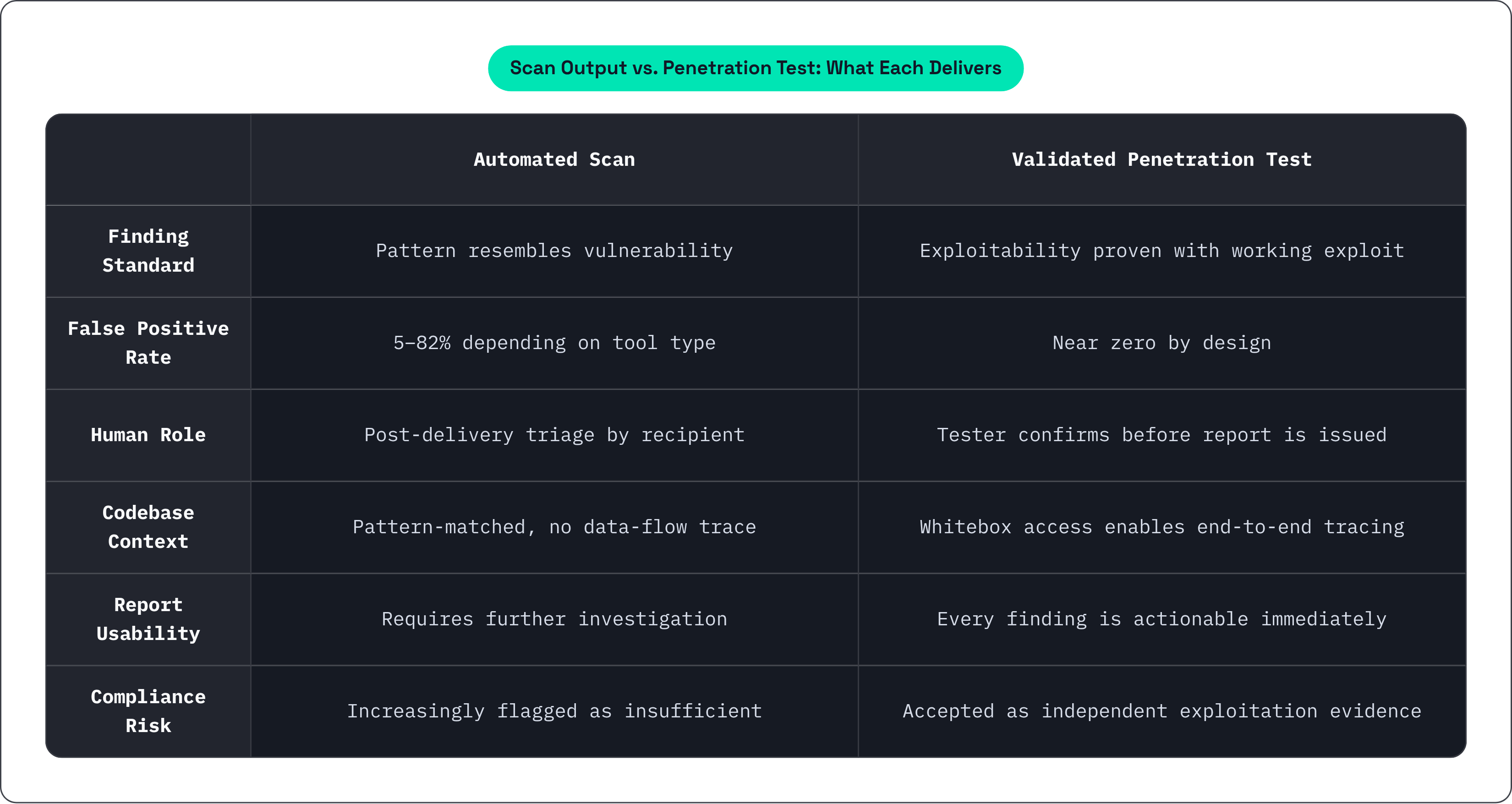
The acceptable false positive rate in a delivered penetration test report is near zero. Not because perfection is universally achievable everywhere, but because the standard of a penetration test is that every finding must be proven exploitable, not merely flagged as potentially vulnerable. Those are fundamentally different standards, and conflating them is the source of most of the confusion in how organizations evaluate their security programs.
Proving exploitability requires a working exploit. Someone must demonstrate that the flaw can be used to achieve real impact, whether that is unauthorized data access, privilege escalation, or lateral movement, under conditions that approximate an actual attack. Similarity to a known-vulnerable pattern is not proof. Probability is not proof. The proof is the exploit.
Operationally, this looks like a specific sequence. Automated scanning generates a candidate list. A skilled human tester investigates each finding, attempts exploitation, and confirms or discards it based on evidence. Only confirmed, exploitable findings reach the final report. The engineering team receiving that report does not triage. Every item on the list is something they actually need to fix.
Whitebox access is what makes this tractable. When a tester has access to source code, cloud configurations, and documentation, they can trace data flows end-to-end and make a definitive determination rather than leaving a finding in the probability space where false positives live. A scan produces a list of possibilities. A penetration test produces a list of proven attacks.
Certifications that require candidates to actually compromise systems under exam conditions, OSCP, OSWE, and CREST CRT among them, indicate a tester who has demonstrated the ability to confirm exploitability under pressure. A CEH is a multiple-choice examination. That distinction matters when the goal is a verified, near-zero-noise finding set.
How to Evaluate Whether a Security Vendor's Findings Are Actually Verified
The most important question to put to any security vendor is blunt: "How do you confirm that a finding is exploitable before it appears in your report?" A vendor who cannot answer that specifically, with a described process, is delivering scan output formatted as a report.
Follow-on questions expose low-validation approaches quickly. Ask what percentage of the engagement is manual testing versus automated scanning; a vendor who responds by listing tool names rather than describing how humans interact with findings is telling you something. Ask who specifically will conduct the test and what credentials they hold. Ask to see a sample report from a comparable engagement and look for working exploit evidence rather than severity ratings and CVE numbers. Ask whether retesting is included. Vendors who exclude retesting structurally do not expect their findings to generate remediation cycles.
There are red flags specific to AI-forward vendors. "We use AI" as a complete capability description is not an answer. The meaningful question is what the AI validates, in your specific environment, with what evidence. If there is no clarity on what a human reviewer does relative to what the tool outputs, assume the human's role is minimal. No scoping call, a fixed low price, and a fast turnaround are the signature of an automated scan wearing a report cover.
A good report has a recognizable shape. Each finding includes a working exploit or step-by-step proof of exploitability, not just a description of the vulnerability class. Findings are prioritized by actual impact in your environment, not solely by CVSS score, which is a population-level metric with no knowledge of your specific context. Remediation guidance is specific to your codebase rather than lifted from a generic advisory. A named, credentialed tester signs off.
The compliance dimension adds further consequence. Auditors for SOC 2, HIPAA, and ISO 27001 are increasingly scrutinizing whether submitted penetration test reports reflect independent exploitation testing or automated vulnerability management output. A report of scan results submitted as a penetration test gets flagged as insufficient. Re-engagement, scheduling delays, and compliance gaps cost multiples of the original engagement fee.
The verified-findings model requires whitebox access to source code, cloud configurations, and documentation, providing the contextual depth necessary to trace data flows and confirm or rule out findings before they appear in any report. Every finding should be reviewed and signed off by OSCP-certified human testers. On-demand retesting should be included, not quoted as an additional line item. Findings are proven with working exploits.