SQL Injection in Modern SaaS Applications and ORM Pitfalls
The assumption that ORMs solve SQL injection is one of the most expensive false conclusions in modern application security. Not entirely wrong, which is precisely what makes it dangerous. ORMs do reduce injection exposure, dramatically so, for one specific usage pattern. But 18% of ORM-backed SaaS applications are still vulnerable on first security scan, and that number is not a relic of poor engineering culture or outdated stacks. It reflects a structural misunderstanding of what ORM protection actually covers and where it stops.
January 2025 is instructive. Attackers breached the US Treasury by chaining CVE-2024-12356 and CVE-2025-1094, the latter a PostgreSQL SQL injection flaw in BeyondTrust's Remote Support platform. Rapid7's analysis was unambiguous: every exploitation scenario they tested required that PostgreSQL SQLi vulnerability to achieve remote code execution. Enterprise-grade infrastructure, in production, compromised through SQL injection. Injection as an OWASP vulnerability class has generated over 51,000 CVEs historically, with SQL injection accounting for more than 14,000 of those, per the National Vulnerability Database. It sits at number three on OWASP's Top 10 despite decades of awareness and widespread ORM adoption.
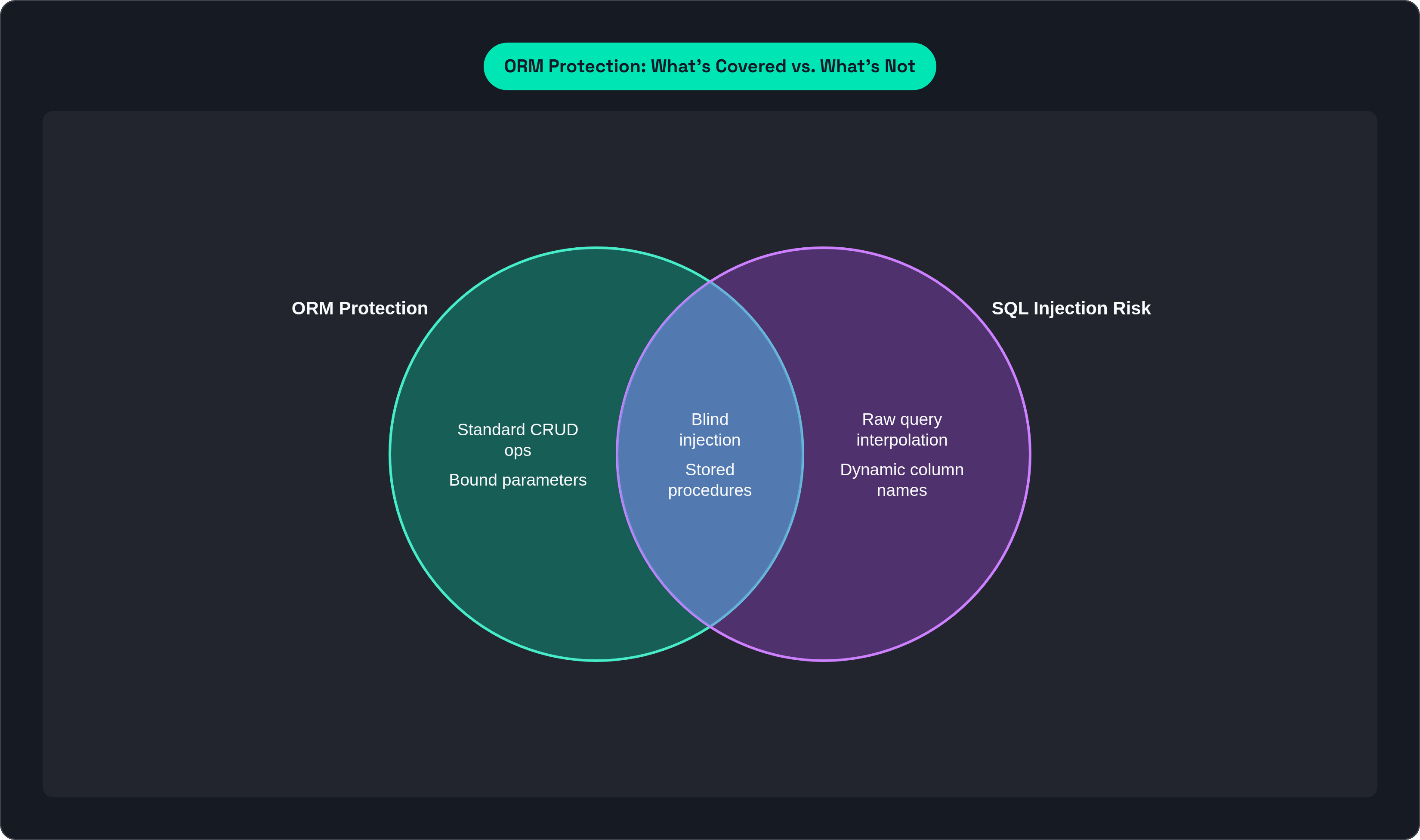
So, what do ORMs actually do? Parameterized queries separate the SQL template from the data. User input travels as a bound parameter attached to a pre-compiled SQL statement, never interpreted as SQL syntax. The database engine receives the structure of the query first, the data second; there is no moment where user-supplied characters can be read as commands.
The frameworks most teams know, Django ORM, Hibernate, ActiveRecord, Entity Framework, Sequelize, implement this by default. Standard CRUD operations parameterize automatically. Developers never write a bound parameter manually for a typical find, filter, or update call. The protection is real, and the reduction in attack surface compared to raw string-concatenated SQL is substantial. Classic injection, the kind that powered the breach epidemics of the early 2000s, is effectively eliminated inside the ORM's standard query methods.
That success is also the problem. It generates a cultural assumption that ORM adoption closes the injection chapter entirely. Security reviews skip SQLi testing on ORM-backed codebases because someone sees "Django" or "Hibernate" in the stack and treats injection as settled. The protection is scoped, precisely and exclusively, to standard ORM query methods with bound parameters. The moment a developer exits that pattern, the protection evaporates, and nothing in the stack announces that it has.
Where ORMs Fail: Raw Query Escapes and Direct String Interpolation
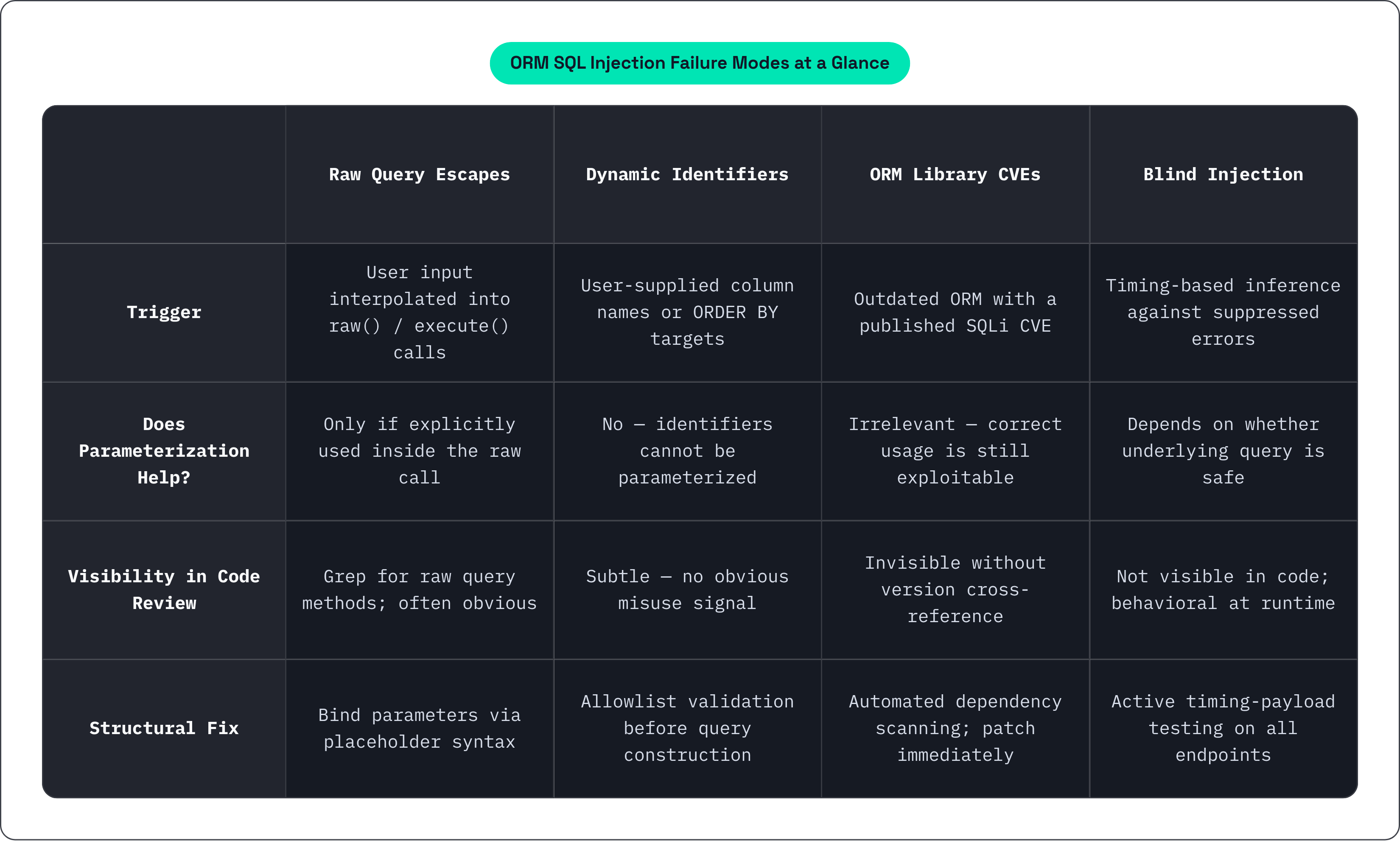
Every major ORM ships with a raw query escape hatch. Django has raw() and execute(). ActiveRecord has findbysql. Hibernate has createNativeQuery(). Entity Framework has FromSqlRaw(). These are not design failures; they exist because every abstraction has a boundary. Complex joins, performance-critical queries, database-specific syntax: sometimes none of it can be expressed through the standard API. The escape hatch is a necessity.
The failure is what developers do inside it. When a developer writes a raw SQL string and interpolates user-controlled values directly, through Python's f-strings, Ruby's string interpolation, or any equivalent, the ORM's parameterization is bypassed entirely. The query reaches the database as a concatenated string, structurally identical to unprotected code from twenty years ago. Sequelize's own documentation contains an explicit warning: do not put parameters in strings. It happens anyway.
I have seen this pattern more times than I can count. A developer needed to ship something fast, grabbed a raw query call, formatted the user input directly into the string, and moved on. The code works. It ships. Nobody flags it in review because the file uses an ORM, and the assumption is that the ORM is handling it. It is not.
Stored procedures carry an unearned reputation for safety here. A stored procedure that accepts input and constructs dynamic SQL internally using string concatenation is just as vulnerable as inline code doing the same thing. The procedure boundary adds indirection that makes the injection harder to spot, which makes things worse, not better.
Why does this keep happening across experienced teams? Developers using raw queries often assume the ORM layer is still performing some sanitization beneath them, which it is not. Code reviewers associate injection risk with "not using an ORM," so raw queries get less scrutiny, not more. Time pressure produces copy-paste SQL with interpolated variables because copy-paste is faster than looking up the parameterized syntax. None of these are failures of intelligence; they are failures of attention under conditions that punish slowing down.
The fix is binding. Raw queries must use the ORM's parameter placeholder syntax, passing user input as a separate argument, never embedded in the query string. Escaping and sanitizing the input string is not the answer. Escaping is fragile, encoding-dependent, and has a long history of being defeated. Every framework that exposes a raw query method also exposes a way to bind parameters to it. Teams just have to use both.
Dynamic Filters, User-Controlled Column Names, and the Query-Builder Trap
A different class of vulnerability surfaces in SaaS products that expose flexible query interfaces to end users. Reporting dashboards, admin data tables, API endpoints that accept parameters like ?sortby=createdat&order=desc: these all share a structural characteristic. The user is influencing not just the values in a query, but the shape of it.
This is where parameterization's fundamental limitation becomes visible. Bound parameters protect values; they do not protect identifiers. SQL does not allow parameterizing column names or ORDER BY targets, because those must be resolved at query-construction time, not execution time. When a developer passes a user-supplied column name directly into a query builder's sort or filter argument without validation, the parameterization mechanism offers no protection at all. An unvalidated column name in a sort clause is a viable injection vector, regardless of how correctly the rest of the query is constructed.
Django's CVE-2024-42005 is the clearest recent illustration. SQL injection was achievable through maliciously crafted JSON keys passed to the ORM's .values() method, as documented in Django's security release notes for that CVE. Not a raw query escape, not a developer misusing an API in any obvious way. The ORM's own standard API surface carried the vulnerability because user-controlled input reached an argument the ORM treated as an identifier rather than a value. Reading the application code, there is nothing that obviously signals the danger. That is exactly why this class of vulnerability persists, and exactly why developers who believe they are writing clean ORM code can still be shipping injection vulnerabilities.
The fix is allowlist validation, applied before any user input reaches a query builder. Build a lookup of permitted column names. If the incoming parameter matches an entry in that set, pass the known-safe constant from the lookup to the query. If it does not match, reject it. Never pass user input directly into any argument the query builder treats as an identifier. The allowlist is not optional; it is the only structural defense available, because parameterization cannot do this job.
SaaS products with rich filtering and reporting features face elevated exposure here. A more flexible API surface for users is, unavoidably, a larger attack surface for everyone else.
ORM Library Vulnerabilities That Exist Regardless of How Carefully Developers Use Them
Correct usage of a vulnerable library is still vulnerable. ORMs are software. They have CVEs. A developer who writes perfectly parameterized queries against an outdated ORM version is running exploitable code with no visible indication of it.
These are not historical artifacts. Django's CVE-2024-42005 is a library-level flaw; the developer did not misuse the API, the vulnerability was in how the ORM processed a specific argument type. Rails' ActiveRecord CVE-2023-22794 introduced SQL injection through a query method. Hibernate's CVE-2020-25638 exposed injection through a specific HQL execution path. Across the three most widely deployed ORM families, SQLi CVEs appear with regularity, documented in the National Vulnerability Database. Teams that pin versions and treat dependency updates as low-priority chores inherit these bugs deliberately, even if not intentionally.
ORM packages belong in automated dependency scanning alongside every other third-party library. A published SQLi CVE against an ORM in active use should trigger a patch-immediately response, not a slot in the next sprint. The window between CVE publication and publicly available proof-of-concept code is often measured in days, sometimes hours.
ORM adoption legitimately shifts some security responsibility to framework maintainers, and those maintainers do patch. But the obligation to track which version is running and act when a relevant CVE appears does not transfer. That part stays with the team, always.
How Modern Attackers Exploit ORM-Era SQLi: Blind Injection and AI-Assisted Discovery
ORM adoption has changed the landscape of SQL injection without eliminating it. The obvious, error-message-leaking injection of earlier eras is mostly gone. What remains is quieter, and attackers have adapted accordingly.
Blind SQL injection works by inferring database contents from application behavior rather than from returned data or errors. In time-based blind injection, the attacker submits a payload that causes the database to pause execution for a measurable interval on a specific condition. The application returns the same response it always would; the delay is the signal. An ORM-backed application with comprehensive error suppression, which describes most production deployments, presents a clean output surface. That cleanliness does not indicate the absence of a vulnerability. It indicates that the attacker needs to listen for timing signals instead of error strings, a technique well documented in SQL injection research and supported by tools such as sqlmap.
The tooling dimension has shifted materially in the last two years. Automated agents can now discover injection points, generate obfuscated payloads, and iterate across endpoint variations at speeds that manual testing cannot approach. A vulnerability in an endpoint with minimal traffic and a non-obvious parameter combination is not safe simply because it is hard to find manually. Automated discovery changes what "hard to find" means in practice, and the compression of the discovery-to-exploitation window raises the effective cost of leaving any injection path unpatched, however obscure.
WAFs deserve specific treatment here because teams routinely overestimate their value. JSON-based and GraphQL-based injections bypass WAF signature rules with regularity. An ORM-backed GraphQL API that exposes user-controlled filter arguments is precisely the kind of surface that WAF rules often fail to cover. WAFs reduce noise and catch commodity attacks. They are not a substitute for fixing the underlying vulnerability, and treating them as one is a reliable way to discover their limits through a breach rather than a test.
Testing ORM-Backed Applications for SQLi: What Automated Scanning Misses and What Whitebox Access Reveals
Automated scanners test what they can observe. They submit known payloads to visible input fields and monitor for error responses, timing anomalies, or behavioral changes. Against ORM-backed applications, this approach has structural blind spots worth naming plainly.
Dynamic filter parameters where injection lives in a column name or ORDER BY argument do not produce error messages on successful exploitation. Raw query usage buried inside service methods, not directly exposed as API endpoints, is invisible to a scanner probing the external surface. Blind injection in endpoints that return consistent response shapes requires active timing analysis. ORM version-specific CVEs require knowing what version is deployed, which network-level scanning does not reveal. The scanner can only see what the application shows it, and the most dangerous ORM-era vulnerabilities are specifically the ones that show nothing.
Source code access changes the picture entirely. A reviewer with repository access can grep for every raw query call in the codebase, trace user input through query builder chains, identify dynamic identifier construction at the point where it enters a query, and cross-reference ORM package versions against published CVEs. None of that requires sending a single network request.
What actually closes gaps is whitebox code review paired with exploitation testing. Review finds the structural patterns: raw queries, dynamic identifiers, outdated dependencies. Exploitation testing confirms that a given path is reachable and exploitable, not merely theoretically present. Every finding needs a working proof-of-concept. "This method accepts user input and passes it unsanitized to a raw query" is an observation. A demonstrated data extraction from a running instance is a finding. The distinction matters for prioritization and for verifying that remediation is complete.
The 18% first-scan vulnerability rate in ORM-backed applications reflects what surfaces when testing moves beyond automated scanning. A significant share of those findings originate in exactly the ORM-specific failure modes that network-layer scanners do not reach.
Closing the Gaps: A Remediation Checklist for Teams Using ORMs
This is not theoretically difficult material. The difficulty is in doing it consistently, under time pressure, across a codebase that is actively changing, with a team that has internalized the idea that using an ORM means injection is handled. That assumption is the actual vulnerability, and the items below are how you dismantle it.
Start with a full audit of every raw query call. Locate every invocation of raw(), execute(), createNativeQuery(), FromSqlRaw(), findbysql, and their equivalents. Confirm that each one passes user-supplied values as bound parameters through the framework's placeholder syntax, not as interpolated strings. Any raw query that formats user input into the query string is a vulnerability, regardless of how improbable the exploitation path appears. "Unlikely to be reached" is not a security control.
Allowlist every user-controlled filter or sort parameter before it reaches a query builder. Build a lookup table of permitted column names, pass the known-safe constant from the lookup into the query, and reject anything outside the allowed set at the boundary before it touches query construction. This is not an enhancement; it is the only structural defense available for this class of vulnerability.
Add ORM packages to automated dependency scanning and treat a published SQLi CVE as a patch-immediately event, not a backlog item. The window between disclosure and available exploit code is too short to treat this as routine maintenance.
Test explicitly for blind injection on every ORM-backed endpoint that accepts user input. Time-based payload testing should be standard in any security assessment against these surfaces. A clean response is not evidence of safety; it is evidence of a different signal to listen for.
WAFs belong in the stack as defense-in-depth, but relying on them as a primary SQLi control is a mistake you will eventually pay for. The controls that hold under adversarial pressure are the ones that eliminate the vulnerability structurally.
Integrate pull-request scanning to catch raw query introductions as they are written. The cheapest moment to identify a raw query with interpolated user input is before it ships. Finding these issues in production during an annual penetration test is an expensive and embarrassing quality control process.
Finally, retest after remediation using the same exploitation technique that found the vulnerability. Trust the test, not the diff.