Security Gates in CI/CD Pipelines for SaaS Engineering Teams
Blocking gates stop bad code before deployment; placement determines what each one catches.

A security gate is a discrete, automated enforcement checkpoint embedded in the CI/CD pipeline. It evaluates code, dependencies, configuration, or secrets against a defined policy and produces a pass/fail outcome that determines whether the pipeline continues. That last part is the whole point.
Scanners produce findings. Gates act on them. If your tooling surfaces a critical vulnerability and the pipeline deploys anyway, you have a reporting tool. The block is what separates the two categories, and without it, you are doing paperwork rather than enforcing security policy.
Gates are also position-specific by necessity. What you can see and enforce at pre-commit is genuinely different from what you can see at pre-deployment. Placement is part of the design, not a configuration preference you can revisit later.
What gates are not: monitoring tools. Those operate post-deployment; gates operate before. They are not compliance checkboxes either, though they get treated as such more often than anyone admits. A gate that blocks nothing, or that engineers routinely override without consequence, is a checkbox with a CI job attached. And gates are not a parallel security workflow running alongside the pipeline. They are embedded within the stages engineers already pass through every single day.
Here is the failure mode worth understanding early: tooling that only surfaces findings without blocking creates alert fatigue without reducing risk. Engineers learn to dismiss the output quickly. Threshold decisions need to be made before deployment pressure sets in. Once a release is imminent, those decisions have already been made for you, and usually in favor of shipping.
Where Security Gates Belong in the Pipeline and Why Placement Determines Effectiveness
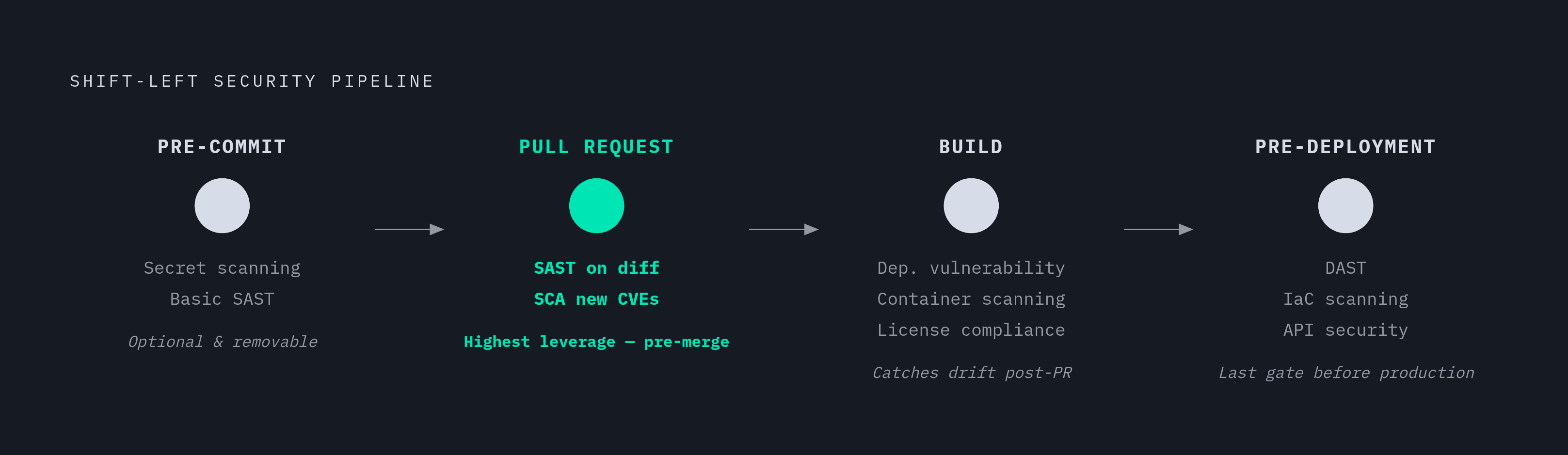
The pipeline is a sequence of natural enforcement points. Earlier gates are cheaper to run and faster to enforce; later gates catch integration-level issues the earlier ones simply cannot reach. No single gate catches everything. The value is in the combination and the deliberate placement, not any individual checkpoint.
Pre-Commit and the Local Developer Environment
The goal here is narrow: eliminate the lowest-effort, highest-embarrassment issues before they cost anyone else time. Secret scanning catches hardcoded credentials, API keys, and tokens before they enter version control history. Basic SAST hooks surface obvious patterns at the moment of authorship, when the fix is a two-minute change rather than a cross-team conversation.
The structural limitation is equally narrow, and worth being honest about. Pre-commit hooks are optional by nature. A developer who removes the hook removes the gate. Unless the check is enforced server-side somewhere downstream, this layer is a convenience, not a control. Still worth running. Catches things cheaply. Cannot be your last line.
Pull Request and Code Review
This is the highest-leverage placement in the pipeline. The code has not been merged. A conversation is already happening. A blocking finding lands exactly when engineers are engaged with the change and can actually do something about it, rather than three days later when they have moved on to something else entirely.
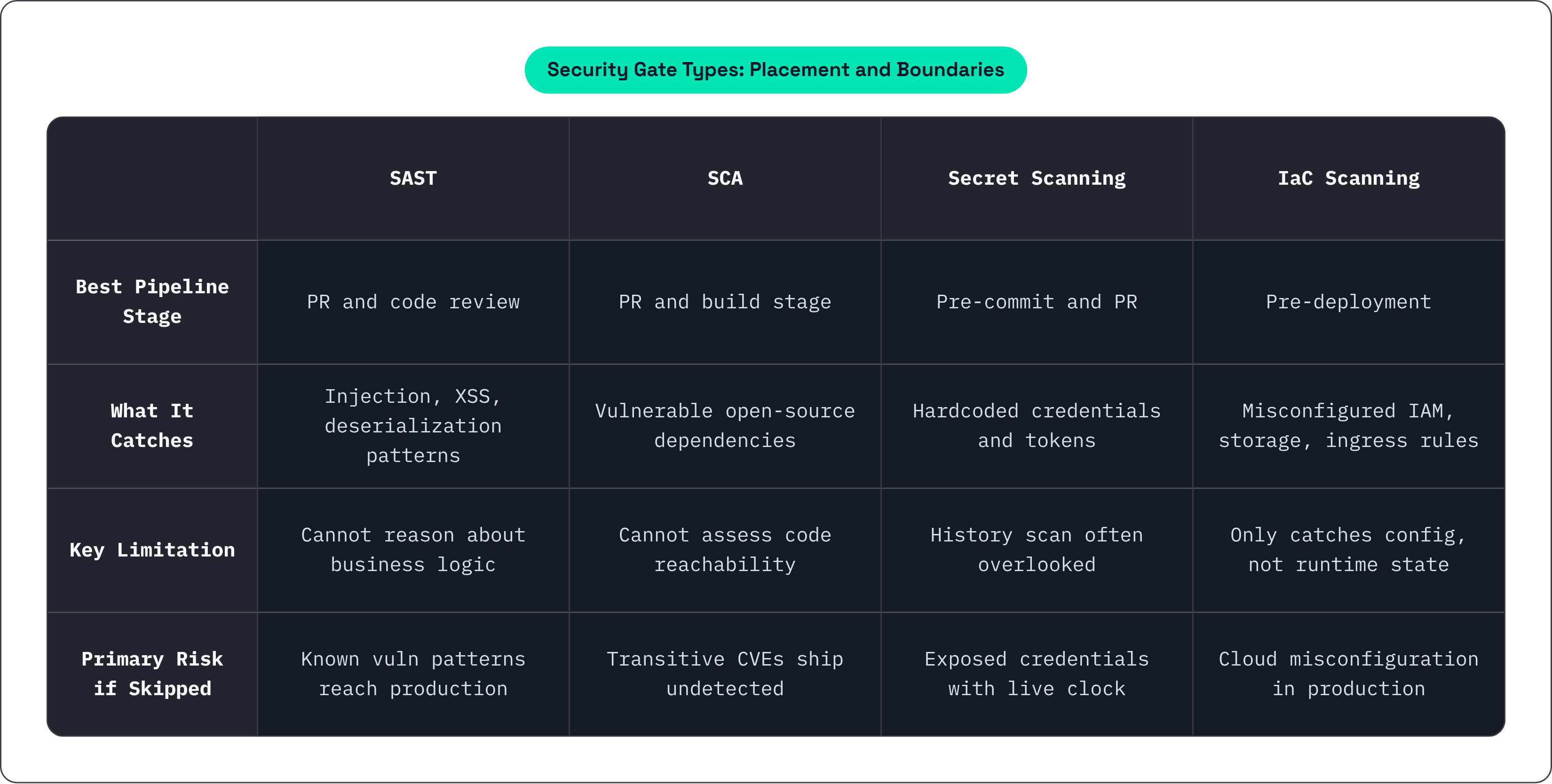
SAST at the PR stage scans the branch or diff for vulnerability patterns: injection sinks, insecure deserialization, XSS sources. SCA flags newly introduced dependencies with known CVEs. Both tools have access to the code before it becomes anyone else's problem.
The critical policy question here is fail-open versus fail-closed. Does a critical finding block the merge, or does it require documented acknowledgment to proceed? Decide this before you launch the gate. Inconsistency across teams — where some block and some click through — erodes the gate faster than any technical limitation ever will.
Build Stage
The build stage is where dependency vulnerability checks run against current CVE databases, container image scanning catches base image issues and unnecessary packages, and license compliance checks surface SCA findings that carry real legal risk in commercial products. These are not redundant with PR-stage checks. Dependencies update. Databases update. A library that passed clean at PR time will have a new advisory by the time the build runs three days later.
Container scanning deserves particular attention for SaaS teams shipping to cloud infrastructure. A container running as root with a vulnerable base image is a compound problem, and it is entirely visible at build time, before it becomes a production incident. That is the only time catching it is cheap.
Pre-Deployment and Staging
This is the last meaningful enforcement point before production. DAST tests the running application for vulnerabilities that only appear in execution: injection endpoints, authentication flows, session handling. IaC scanning evaluates Terraform, CloudFormation, and Kubernetes manifests for misconfigurations before they are applied, catching overly permissive IAM roles, open security groups, and unencrypted storage. API security testing checks for OWASP API Security Top 10 issues, broken object-level authorization, excessive data exposure, missing rate limiting.
Findings here are expensive to ignore, not because they are harder to fix technically, but because deployment pressure is highest at this stage. The gate needs to be credible enough that a blocking finding is treated as a real signal, not a bureaucratic obstacle someone calls security leadership to get around.
The stages are complementary by design. SAST cannot test a running application. DAST cannot scan source code. IaC scanning requires the manifest, not the deployed resource. Each gate handles what the previous stage structurally could not see.
The Four Gate Types SaaS Pipelines Most Commonly Need
SAST: Static Application Security Testing
SAST analyzes source code or compiled artifacts for patterns associated with known vulnerability classes: SQL injection sinks, XSS output encoding gaps, insecure deserialization, path traversal. It runs fast enough to execute on every PR and produces findings before any code runs anywhere.
The practical limitation is false-positive rate, and it is a real one. In many implementations, SAST generates enough noise that engineers begin ignoring the output entirely. That is the worst possible outcome — worse than not running the tool at all, because it produces false assurance. Threshold tuning is the difference between a gate that changes behavior and one that generates reports nobody reads. SAST also cannot catch business logic flaws, authorization gaps, or anything requiring understanding of what the application is actually supposed to do. It pattern-matches. That is its strength, and it is also its ceiling.
SCA: Software Composition Analysis
SCA inventories open-source dependencies and cross-references them against CVE databases and advisory feeds. The category that matters most is transitive dependencies — the libraries your libraries depend on. These are frequently the source of the highest-severity findings precisely because they are invisible to the developer who added the top-level package and never thought further about what came with it.
For SaaS teams, the specific risk is this: a dependency introduced to speed up a feature can pull in a known-exploitable vulnerability several levels down the dependency tree. SCA catches this. What it cannot evaluate is whether that vulnerable code path is actually reachable within your application. Reachability analysis is an emerging capability, not universally available. Treat SCA findings as real until proven unreachable, not the reverse.
Secret Scanning
A hardcoded secret in a commit is an immediately exploitable credential. If the repository is public, or becomes public, the exposure window opens the moment the commit is pushed. Secret scanning is among the highest-priority gates because a miss is not a potential risk; it is an active one with a clock running.
One implementation detail that gets overlooked consistently: the scan must cover commit history, not just the current state of files. A secret pushed and then deleted from a file remains in git history, fully accessible to anyone with repository access. The gate needs to look backward, not just at HEAD. False positives in secret scanning are manageable. The cost of a missed real secret is not. Calibrate accordingly, and do not let noise-reduction tuning drift into coverage gaps.
IaC and Cloud Configuration Scanning
This gate checks infrastructure-as-code for misconfigurations before they are applied: overly permissive IAM policies, publicly exposed storage buckets, unencrypted volumes, open ingress rules. For SaaS teams running on cloud infrastructure, this category carries disproportionate stakes. Cloud misconfiguration is a leading cause of data exposure, and IaC scanning is the point at which you can catch it before it becomes a production state that auditors and customers find out about.
Blaze's 2025 penetration testing data found cloud security assessments had the highest average vulnerability density of any assessment type, at 14.40 vulnerabilities per project. [Citation needed for this statistic.] IaC scanning does not eliminate that exposure, but it catches the most mechanical and repeatable instances before they ship.
All four gate types share one property: they enforce policy rather than merely report on it. Their value depends entirely on whether the pipeline actually blocks on their output.
How to Set Gate Thresholds That Engineers Will Actually Respect
The override problem is where most gate programs fail in practice. Block too aggressively and the gate gets bypassed. Block nothing and you have produced false assurance with extra steps. Threshold policy is an operational problem at least as much as it is a technical one, and treating it as purely technical is how you end up with gates that look rigorous on paper and do nothing in practice.
The common starting point is severity-based blocking: block on Critical and High findings, warn on Medium, log Low. Reasonable as an initial position, but it carries a structural flaw. CVSS severity reflects the vulnerability in isolation, not its exploitability in your specific environment. A Critical finding with no network path to it represents lower real risk than a Medium finding sitting in a public-facing API handler called ten thousand times a day. Contextual severity scoring — approaches like SSVC and EPSS — moves past raw CVSS ratings to prioritize actual exploitability and real exposure. Both SSVC (Stakeholder-Specific Vulnerability Categorization) and EPSS (Exploit Prediction Scoring System) are documented frameworks with published methodologies, and adoption is growing in mature security programs.
For teams carrying significant existing technical debt, the approach that actually preserves adoption is a new-findings-only policy: block only on vulnerabilities introduced in the current PR, not on the full pre-existing backlog. Every PR failing because the codebase has accumulated years of unfixed issues is how engineers start treating the gate as background noise. The new-findings approach also creates a clear engineering contract. You are responsible for what you introduce. Existing debt enters a tracked remediation backlog with a separate plan and a named owner.
Exceptions and suppressions need a paper trail. A temporary suppression should require documented rationale, a named owner, and an expiry date. A blanket suppression without expiry is not an exception; it is a permanent bypass that will be forgotten in six months, at which point the gate no longer enforces what it claims to enforce. Programs where the majority of active suppressions have no owner and no rationale are not functioning gate programs, and they provide the false assurance that makes the security posture worse than no gate at all.
Developer feedback quality matters as much as the block decision. A gate that fires and returns "HIGH: SQL injection detected" without a code location, a plain-language explanation, or remediation guidance will be treated as noise within weeks. Gates that surface exploitable examples and concrete fix steps actually get acted on.
Threshold decisions are security policy decisions. They should be made by security-aware engineering leadership, written down explicitly, and revisited as the team and threat model evolve. What makes sense for a ten-engineer startup is the wrong threshold for a hundred-engineer team with enterprise customers and SOC 2 obligations.
What Security Gates Cannot Catch and Why That Gap Matters for SaaS Products
Automated gates are excellent at pattern-matching against known vulnerability signatures. They are structurally incapable of reasoning about application intent, business logic, or how components interact under real conditions at runtime. That is not a failure of implementation. It is a hard boundary of the approach, and understanding it precisely is what allows you to use gates effectively rather than treating them as sufficient.
Business logic flaws are the clearest example. A gate cannot know that a user should not be able to approve their own expense report, transfer funds to themselves, or access another tenant's records. That requires understanding what the application is supposed to do, which is knowledge no scanner possesses. Authorization and access control gaps, insecure direct object references, privilege escalation, broken tenant isolation: these are frequently syntactically correct code that does the wrong thing semantically. The code looks fine. The behavior is the problem. No pattern-matcher catches that.
Multi-step attack chains are invisible to tools that evaluate components individually. Attackers rarely need a single critical vulnerability. They chain several small weaknesses across components into a complete breach, and the individual weaknesses each appear entirely benign in isolation. A SAST tool sees one function. The attacker sees the path across four services and two trust boundaries. API-level logic issues, missing rate limiting, excessive data exposure, broken object-level authorization: these require exercising a running API under realistic conditions, and reading source code does not surface them.
There is also a production environment gap worth naming directly. Gates operate on code and configuration before deployment. Misconfigurations that emerge from the interaction of deployed services, real data, and actual traffic volumes are invisible to pre-deployment tooling.
For SaaS specifically, the most serious findings in real assessments are rarely isolated technical bugs. They involve broken assumptions about users, tenants, roles, APIs, and internal workflows. That is exactly the category automated gates cannot evaluate, and it is exactly the category a well-resourced attacker is most interested in pursuing.
How Security Gates Feed Into and Amplify the Value of Periodic Penetration Testing
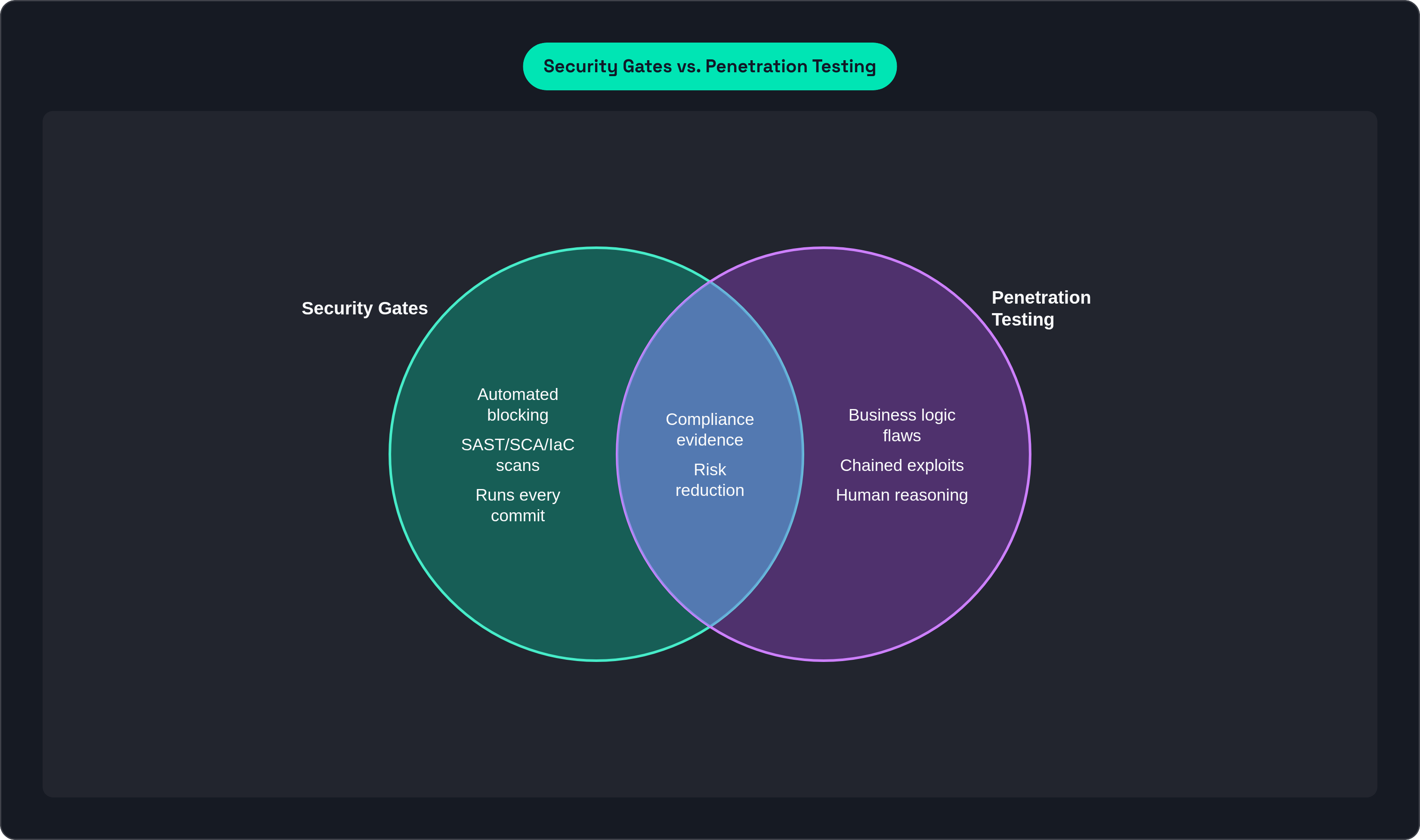
Gates change what a penetration test finds, and they change it in a direction that makes the engagement substantially more valuable. A team with mature gate coverage has already eliminated the surface-level, scanner-detectable issues from the scope. Hardcoded credentials, known-CVE dependencies, obvious injection patterns: these do not consume tester time when gates are working. That time goes instead to what only a human can find — logic flaws, chained exploits, trust boundary violations, the category of finding that a well-resourced attacker is actually pursuing.
A penetration test against a gated codebase is a higher-signal engagement than one that surfaces findings gates would have caught at PR time. The tester's expertise is deployed where it compounds rather than where it replicates automated output. Quality penetration testing allocates the substantial majority of engagement time to manual testing precisely because the automated component cannot reach the reasoning layer. Gates make that allocation more efficient by handling the mechanical surface, so the human examines what the human is actually good at.
Gates also change what the penetration test report demonstrates for compliance and audit purposes. Auditors evaluating SOC 2, ISO 27001, or applicable regulatory frameworks respond well to evidence that findings from the penetration test are structurally prevented from recurring. Gate policy documentation, threshold records, and suppression audit trails provide exactly that evidence. You are not just showing you found and fixed a vulnerability; you are showing that the class of vulnerability cannot re-enter the codebase without being blocked.
The cadence question is worth addressing directly. A team shipping dozens of times per week cannot reconcile that velocity with an annual point-in-time assessment. The assessment audits a snapshot; the codebase moves on the next day. Gates run on every change. The penetration test, run quarterly or following significant architectural changes, evaluates the reasoning-layer risks that have accumulated since the last engagement. One handles the mechanical layer continuously, at the pace of development. The other handles the logical layer periodically, with human expertise that automation cannot replicate. Both are necessary, and together they actually match the pace and complexity of modern SaaS development rather than relying on a once-a-year exercise as sufficient coverage.