Whitebox Pen Testing for Multi-Tenant SaaS Architectures
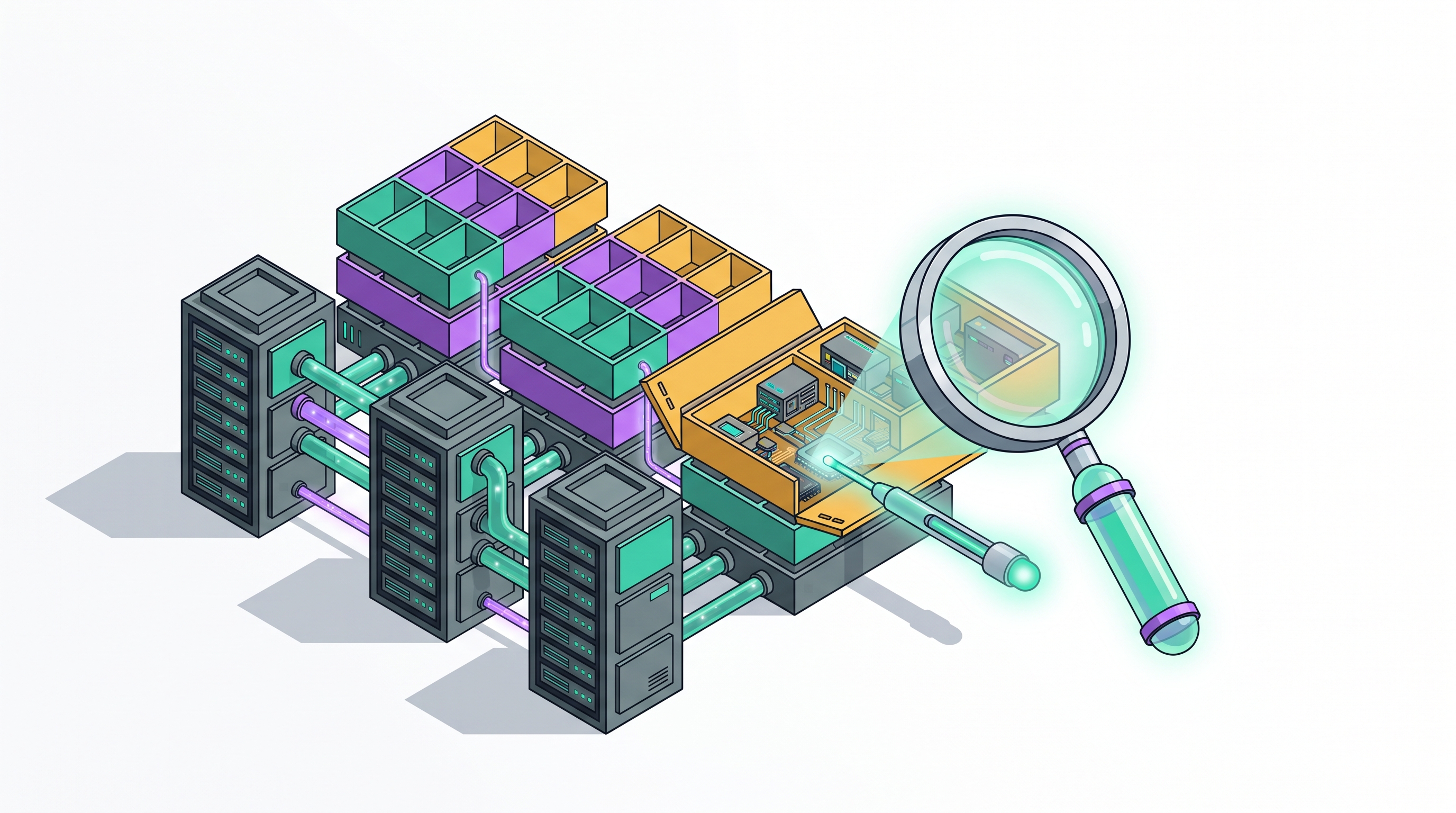
The security promise of multi-tenant SaaS is simple to state and genuinely hard to keep: every customer's data, actions, and privileges stay invisible to every other customer, always, across every layer of the stack. What nobody advertises is that this promise isn't enforced in one place. It's distributed across dozens of code paths, query layers, cloud configurations, and authorization checks, any one of which can fail independently. Blackbox and greybox penetration testing cannot reliably audit a surface that distributed. Whitebox testing is the only methodology that systematically maps and validates multi-tenant isolation. The rest of this piece explains why, and what that actually looks like when you're inside one of these engagements.
A multi-tenant SaaS application runs a single instance of the application, backed by shared data and shared compute, serving many customers simultaneously. Isolation is not a hardware boundary. It's a software contract, re-enforced at every database query, every API call, every cache lookup, every IAM policy evaluation. Authorization decisions get written by different engineers, under different assumptions, at different points in a product's history, and one inconsistency anywhere in that chain breaks the entire guarantee. Throw in continuous deployment, feature flags, and third-party integrations, and the boundary is never static. Wallarm's API Security Report H1 2025 clocked API attacks surging 104% year-over-year, with thirteen times more vulnerability exploits than websites. Almost every SaaS vulnerability is network-reachable through a JSON API and requires no user interaction to exploit.
The most direct expression of isolation failure is Broken Object Level Authorization, BOLA. An API endpoint accepts a resource identifier, an invoice ID, a user UUID, without verifying that the requesting tenant actually owns that resource. Tenant A substitutes tenant B's identifier, gets tenant B's data. It's pervasive not because engineers are careless but because authorization is often checked at login and then assumed to hold for every subsequent request. That assumption is wrong every time.
Privilege escalation across tenant boundaries is a distinct and equally serious class. Not the familiar vertical escalation of a regular user reaching admin capabilities within their own account. This is horizontal: a user in tenant A reaching admin-level capabilities within tenant B's context. This pattern surfaces in role-assignment endpoints, admin approval flows, and billing upgrade logic, wherever tenant context is implicitly trusted rather than explicitly verified.
Shared data layer leakage is subtler, and in some ways more insidious. Database queries that aggregate or filter records without tenant-scoping produce result sets that cross tenant boundaries quietly, without raising any obvious error. Row-level security policies that are incomplete, or bypassed by raw queries circumventing the ORM, show up repeatedly. Caching layers keyed on a resource identifier alone, rather than on a composite of tenant identifier plus resource identifier, will serve one tenant's cached data to another tenant without either party knowing.
Server-side request forgery is where things get genuinely dangerous in cloud-hosted multi-tenant environments. Webhook processors and URL-preview features are endemic to these products. When they make outbound HTTP requests using user-supplied URLs without adequate validation, an attacker can point that request at the cloud provider's Instance Metadata Service. A successful probe yields a Managed Identity token scoped to the entire environment. At that point the attacker isn't bounded by tenant at all.
Business logic abuse covers billing bypass, metering manipulation, and entitlement escalation. These flaws live in the sequencing and state management of multi-step workflows, not in a single broken parameter. Scanners cannot model workflows. Finding them requires understanding what the application is supposed to do, then probing the ways that sequence can be interrupted, reversed, or replicated out of order.
Authentication and session management failures complete the picture: token reuse across tenant contexts, missing invalidation on logout or tenant switch, OAuth misconfigurations in multi-tenant identity flows. These are implementation details that only become visible when you can read the implementation.
Why Blackbox and Greybox Testing Cannot Reliably Find These Flaws
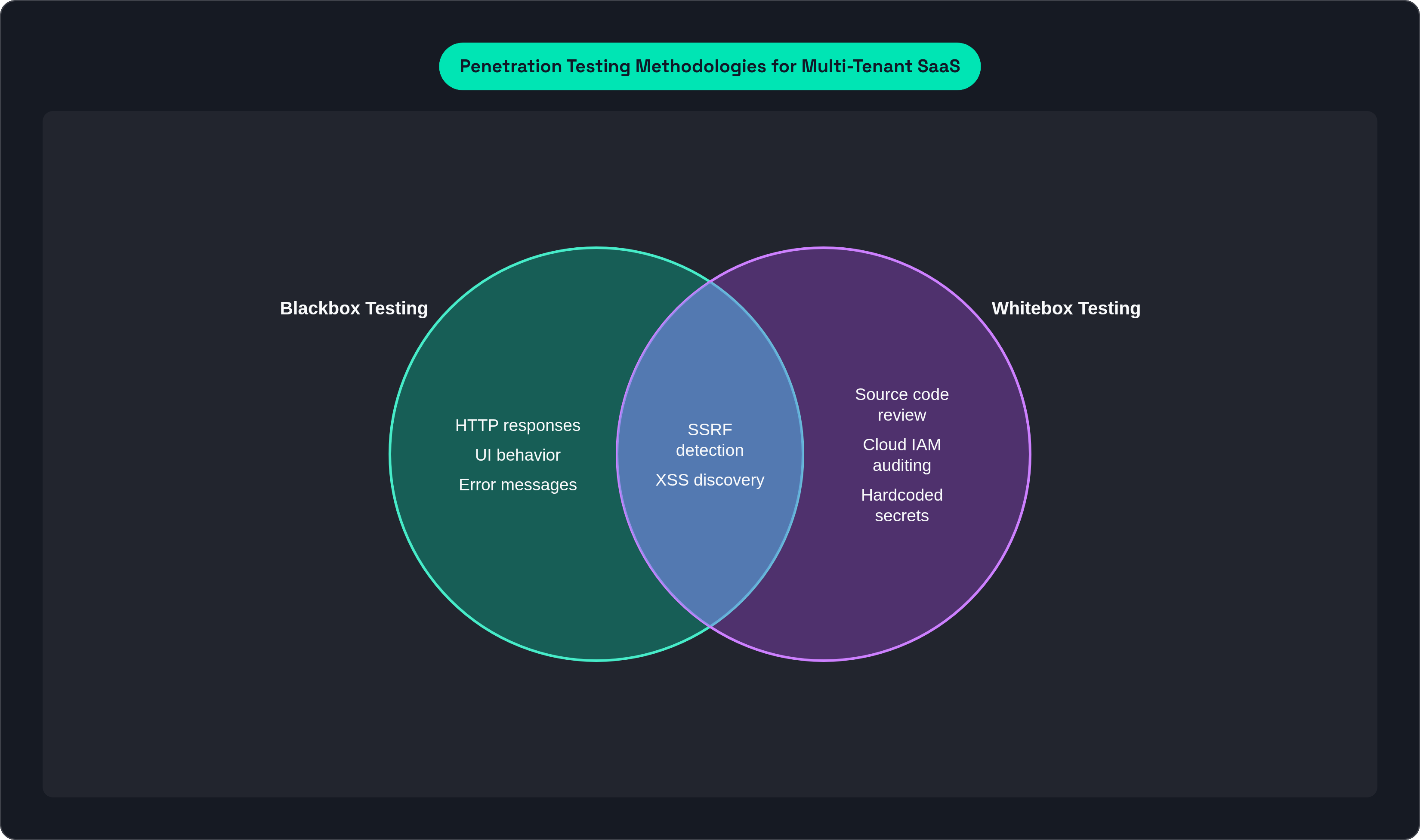
Blackbox testing sees externally observable behavior: HTTP responses, error messages, timing differences, rendered UI. What it cannot see is the database query behind the API, which table columns are tenant-scoped, what the ORM is actually executing, or where the tenant identifier is injected or omitted in the query chain. That's not a limitation of the tester's skill. It's a fundamental constraint of the methodology.
BOLA is nearly invisible to blackbox methods when tenant identifiers are non-guessable UUIDs. A tester with no account in tenant B has no way to enumerate tenant B's resource identifiers to attempt substitution. The attack is conceptually simple; executing it requires knowing what to substitute, which requires data the blackbox tester simply doesn't have.
Greybox partially closes the gap. With one or two tenant accounts, a tester can confirm an obvious IDOR when identifiers are sequential. But authorization logic distributed across microservices requires reading each service's implementation to understand where decisions are made and where they're assumed to have been made upstream. Greybox can't produce that map.
Shared data layer leakage is invisible to external methods unless the data itself is identifiably foreign. A blackbox tester sees query results, not the query. If a result set is missing a WHERE tenant_id clause and returns records from multiple tenants, that's only detectable if the tester happens to recognize that the returned data belongs to a different account. That's luck, not a methodology.
Cloud configuration vulnerabilities aren't observable from the application surface at all. IAM over-permission, public storage buckets, and metadata service exposure exist in a layer the blackbox tester simply can't reach. Business logic flaws require knowing the intended logic; without source code and documentation, a tester can only probe behaviors already exposed in the interface, missing every flaw that lives in a path they never thought to test.
There's also an economic argument. Blackbox and greybox engagements burn a significant fraction of total hours on reconnaissance, mapping behavior that's already documented in source code. That time comes directly out of exploitation. The 2024 Verizon Data Breach Investigations Report found more than 68% of breaches involved a human element or misconfigured controls, precisely the category that requires code and configuration access to audit systematically.
What Whitebox Access Actually Gives a Penetration Tester in a Multi-Tenant Engagement
Source code access means reading every authorization check, or its absence, directly. Trace every API endpoint to its database query. Verify that tenant scoping is present and correctly parameterized. Dead code paths, feature flags, and internal-only endpoints that never surface in the UI but remain network-reachable all become visible. Cryptographic implementations, token generation logic, and session management can be reviewed in the actual implementation rather than inferred from observable behavior. Hardcoded credentials committed to the repository can be found systematically rather than by accident.
Architectural documentation gives the tester a precise understanding of the intended tenancy model before probing begins. Knowing whether isolation is implemented at the row level, the schema level, or the database-per-tenant level allows the tester to target the specific failure modes each model introduces. Those three models have almost entirely different vulnerability profiles.
Cloud configuration access is the only way to audit the infrastructure layer. IAM policy review surfaces roles with excessive permissions reachable via SSRF or a compromised service account. Storage bucket permission audits confirm tenant data in object storage isn't accessible cross-tenant or publicly. Secrets management audits confirm credentials aren't stored in environment variables, plaintext configuration files, or CI/CD pipeline logs. These findings are invisible from the outside and consistently present on the inside.
The efficiency gain compounds across the engagement. With full knowledge of the codebase, a tester moves directly to the highest-risk functions without spending time discovering what the application does. A well-run whitebox engagement directs 60 to 80 percent of total hours toward manual testing and exploitation rather than reconnaissance.
Chained attack paths also become legible, which matters more than most scoping conversations acknowledge. A low-severity SSRF in a webhook processor, combined with an over-permissioned cloud IAM role, produces a critical cross-tenant compromise. Neither component looks alarming in isolation. That chain is invisible without the ability to read both application code and cloud configuration simultaneously, and it's exactly the kind of finding that justifies the methodology.
How a Whitebox Pen Test Is Structured for a Multi-Tenant SaaS Target
Scoping and threat modeling happen before any testing begins. The engagement must document the tenancy model precisely: how tenants are identified, where that identifier propagates through the stack, what isolation guarantees the architecture is designed to provide. Highest-value targets are identified up front, typically admin APIs, billing and entitlement logic, data export endpoints, webhook processors, and inter-service communication. Test accounts are agreed on at this stage. At minimum, two distinct tenant accounts at different privilege levels are needed to test horizontal isolation, plus an admin account to test privilege escalation paths. Skipping this step produces an engagement that wanders.
The code review phase is systematic. Every API route is enumerated and mapped to its authorization enforcement point. The review searches specifically for tenant identifier injection patterns: where is the tenant identifier applied, where is it absent, and where is it trusted from user input rather than derived from the authenticated session. ORM usage is audited with particular attention to raw queries that bypass ORM-level tenant scoping, a recurring source of cross-tenant leakage. Authentication flows are reviewed for token issuance, expiry, rotation, and invalidation logic. The dependency chain is reviewed for known vulnerable library versions.
Cloud configuration audit runs in parallel. IAM permissions are reviewed for over-privileged service accounts and roles. Storage service ACLs are verified. Metadata service exposure and IMDS access controls are examined. Secrets and environment variable hygiene is audited across deployment configurations and CI/CD pipeline definitions.
Dynamic exploitation follows code review and confirms what the review identified. A finding that says "the code suggests this is vulnerable" isn't a finding. Every identified flaw must be demonstrated with a working request and response showing actual impact. BOLA testing exercises every object-fetching endpoint with cross-tenant resource identifiers derived from the second test account. Privilege escalation testing attempts to reach admin-scoped endpoints from a standard-tenant account, including tenant-switching logic where it exists. Business logic abuse walks multi-step workflows including subscription upgrades, billing overrides, and admin approvals, looking for state that can be manipulated out of sequence. SSRF testing targets webhook processors, URL preview features, and every endpoint making outbound requests.
Reporting ties each finding to a specific code location. The file, the function, the line. The exact exploit request and response that proves impact. Remediation guidance specific to the codebase, not generic best-practice boilerplate that the engineering team will read once and ignore.
The Vulnerability Classes Most Commonly Surfaced in Multi-Tenant Whitebox Engagements
BOLA at the API layer is the most consistent finding, engagement after engagement, almost without exception. The root cause is almost always the same: authorization is checked at login but not re-checked at the object level for every subsequent request. Whitebox testing finds this by reading the controller or handler for every route, not by guessing identifiers. OWASP classifies Broken Access Control as the top web application risk category in its Top 10, and BOLA is its most common expression in SaaS architectures. The frequency with which this appears isn't an indictment of any particular engineering team. It's a consequence of how authorization logic accumulates incrementally over years of development.
SQL injection in multi-tenant query logic is doubly dangerous, and the severity gap between single-tenant and multi-tenant contexts is underappreciated. In a single-tenant application, a successful SQL injection is damaging. In a multi-tenant context, it can bypass tenant scoping entirely and reach records across the full dataset, turning a targeted attack into a platform-wide breach. Whitebox review identifies raw query construction in ORM bypass paths that dynamic scanning routinely misses.
Cross-site scripting carries cross-tenant session implications in SaaS that it doesn't in single-tenant applications. Stored XSS in a shared administrative interface or shared notification template can harvest session tokens from users across multiple tenants simultaneously. Whitebox review of Content Security Policy configuration and output encoding in shared UI components surfaces gaps that blackbox testing would require exhaustive form-fuzzing to find, if it found them at all. Mitre's CWE Top 25 Most Dangerous Software Weaknesses 2024 ranked XSS among the most common weaknesses in new CVEs; in a multi-tenant context, the blast radius of a single stored payload is meaningfully larger.
SSRF escalating to cloud infrastructure access has become significantly more prevalent. Wallarm's API Security Report H1 2025 documented SSRF attacks increasing sharply from 2023 to 2024, driven in part by AI-assisted exploitation tooling that automates payload generation and metadata service probing. Multi-tenant SaaS on cloud infrastructure is uniquely exposed: a successful SSRF reaching the cloud metadata service yields credentials scoped to the entire environment, not to any individual tenant. Whitebox access to webhook processing code and outbound HTTP client configurations is the reliable way to identify this surface before an attacker does.
Hardcoded secrets and insecure credential storage are findings that source code access makes systematic and blackbox access makes nearly impossible. Secrets in environment variables, configuration files, and CI/CD pipeline definitions aren't observable from the outside. In a multi-tenant environment, a compromised service credential is inherently a cross-tenant credential. The service account has no concept of which tenant the attacker came from. One compromised key, one exposed Managed Identity token, one hardcoded database password in a configuration file: that's simultaneous access to every tenant's data in the system. The methodology used to test these systems isn't a procedural preference. It determines what gets found.