Gray Box Penetration Testing in SaaS Application Security
Black box testing misses SaaS's real vulnerabilities, which live behind authentication.

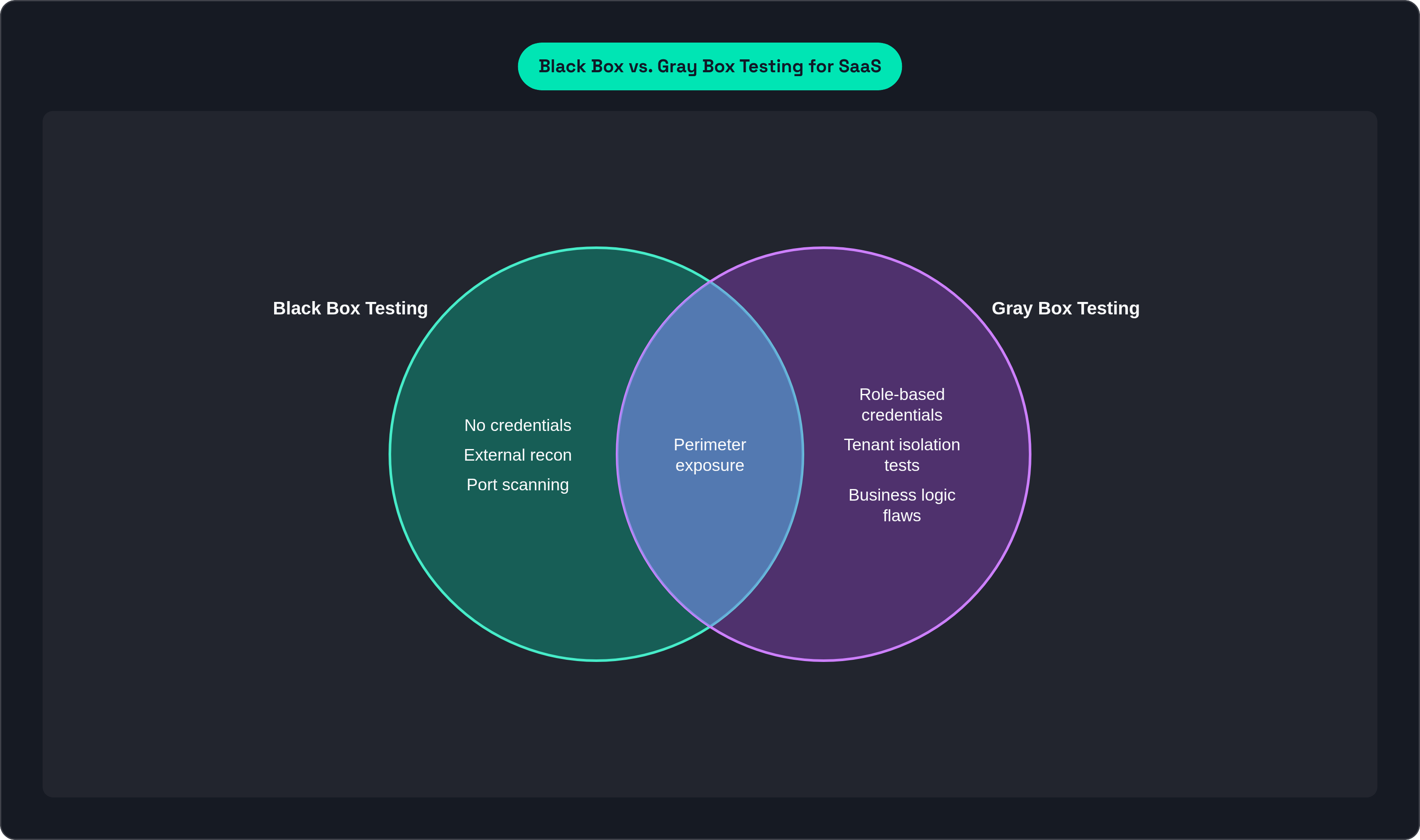
Black box testing starts with nothing: no credentials, no architectural context, no knowledge of what the application does internally. A tester shows up and tries to get in. That model made sense when the perimeter was the primary attack surface. For SaaS, it's the wrong tool for the job, and the gap isn't marginal.
What black box does well is limited but real. It maps external exposure: what's visible from the internet, which ports are open, whether unauthenticated endpoints are leaking data. For a hardened perimeter, useful. SaaS products, by design, have a thin perimeter and a sprawling interior.
The structural problem is that black box methodology spends the majority of its engagement time at the layer of a SaaS product that has the fewest vulnerabilities. Tenant isolation depends on application logic, not network separation. Role boundaries live in authorization code, not firewall rules. API endpoints that expose business logic require a valid session token to reach. None of those surfaces exist in a black box tester's world.
The practical consequence is predictable. A lending platform completed a standard black box engagement and received no critical findings. When gray box testers were subsequently given credentials for three user roles, they surfaced significant issues within two days that the prior test had never come close to. One was a borrower incrementing object IDs in API calls to retrieve other borrowers' loan records, a classic insecure direct object reference that required nothing more than an authenticated session and some curiosity. Another was a session token that retained the prior session's privilege level after a password reset, meaning a temporarily elevated user could still act at that level after cycling credentials.
Neither finding was accessible without authentication. The testers who ran the black box engagement weren't deficient; the methodology structurally prevented them from reaching those attack paths. That's the distinction worth carrying: black box isn't a bad methodology universally, it's the wrong methodology for the problem SaaS security actually presents.
What Gray Box Testing Actually Means and What Partial Knowledge Testers Work With
NIST SP 800-53A Rev. 5 describes gray box testing, which it terms "focused testing," as assuming some knowledge of the internal structure and implementation detail of the assessment object. The definition is intentionally spare. In practice, the partial knowledge package for a SaaS engagement is specific and deliberate, and what gets included matters as much as what gets withheld.
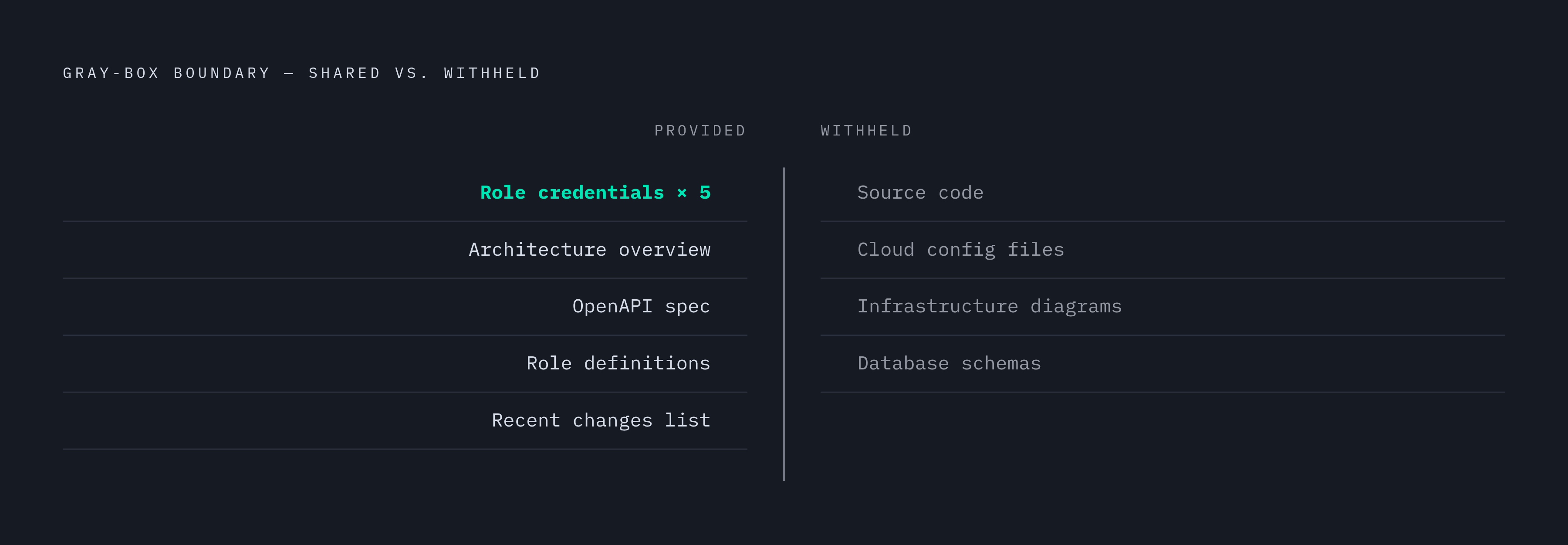
Testers receive credentials for each distinct user role: free tier, paid user, admin, API-only service accounts, partner or integration-specific roles. They receive an architecture overview covering which services exist, how the API is organized, and what the data model looks like at a conceptual level. Not source code. A map, not a blueprint. They receive API documentation, typically a Swagger or OpenAPI spec. They receive role definitions, a document describing what each user type is actually authorized to do, which becomes the authorization design intent against which the test is conducted. And ideally, the engineering team flags recent changes, new features, or areas they're genuinely uncertain about.
What testers don't receive in gray box is equally important. No source code. No cloud configuration files. No infrastructure diagrams. No database schemas. Those belong to white box engagements, which are more resource-intensive and serve a different purpose.
The tester's starting position is a legitimate user who now behaves like a sophisticated adversary. Most SaaS breaches and insider-threat scenarios begin exactly there, with valid credentials, not unauthenticated external reconnaissance. IBM X-Force's 2024 findings showed attacks using valid credentials rising 71% year-over-year. Gray box mirrors that threat model directly. The partial knowledge isn't a handicap or a shortcut; it eliminates the reconnaissance phase black box requires and redirects that time toward attack paths that actually produce findings.
The Vulnerability Classes Gray Box Testing Surfaces Best in SaaS
Broken access control, specifically Insecure Direct Object Reference, is the canonical gray box finding. A resource ID appears in an API call, and the server accepts it without verifying that the requesting user has any legitimate claim to that resource. The attack is invisible to black box because it requires an authenticated session. Gray box provides credentials and role context, making systematic cross-user and cross-tenant boundary testing possible. OWASP's 2025 data puts broken access control at the top position with an incidence rate of 3.73% across tested applications. That figure is almost certainly undercounted, because you can't count what you never reached.
Privilege escalation requires knowing what each role is supposed to be able to do. Horizontal escalation is user A reaching user B's data. Vertical escalation is a standard user invoking admin-only endpoints. Finding either requires the role definitions document that comes with the gray box package. Without it, testers are guessing at authorization design intent rather than testing against it.
API security vulnerabilities deserve specific attention, particularly mass assignment. APIs that accept more fields than they should allow users to set properties they're not permitted to modify: role, subscription tier, administrative flags. These findings don't announce themselves. Testers need the API documentation to map the full attack surface rather than spending days reverse-engineering endpoint structure, and the time saved goes directly toward walking the attack paths that matter. OWASP's API Security Top 10 from 2023 covers broken object-level authorization, broken function-level authorization, and broken object property level authorization, each of which requires authenticated access to test meaningfully.
Business logic flaws don't appear in scanner output. Finding them requires understanding what the application is supposed to do, and then deliberately trying to do something it isn't. Skipping steps in a multi-step workflow, abusing trial period logic, manipulating quota enforcement, exploiting state transitions out of sequence: these are the findings that cause the most organizational damage and generate the least automated detection signal. The architecture overview and role definitions give testers enough context to construct plausible out-of-sequence attack paths and validate whether the application handles them.
Session and authentication logic rounds out the primary classes. Token persistence after a privilege change, session fixation, improper logout handling, token reuse across tenants: all require authenticated access to reach, and all represent the kind of quiet, persistent vulnerability that doesn't trigger alerts. GitHub reported more than 39 million secrets detected on the platform in 2024. In a gray box engagement, API documentation and architecture context tell testers where to look for configuration exposure and hardcoded credentials that should have been stripped before reaching the client layer.
How Multi-Tenancy Makes Gray Box the Necessary Methodology, Not Just the Convenient One
Multi-tenancy is the defining architectural feature of SaaS. Multiple customer organizations share the same application, the same infrastructure, and frequently the same database, separated by application logic rather than physical or network boundaries. Every SaaS customer holds an implicit expectation: their data is invisible and inaccessible to every other tenant. That expectation is enforced entirely by code, which means it can be broken by code.
Testing whether that code holds requires simultaneous authenticated sessions representing different tenants. Black box cannot do this. No credentials means no tenants, which means the isolation boundary being validated never gets touched. White box can do it, but source code review adds overhead that isn't necessary to prove whether the boundary holds or fails in practice.
Gray box is purpose-built for this problem. With credentials for Tenant A and Tenant B, a tester can probe whether Tenant A's request parameters accept Tenant B's resource IDs, whether shared cache or session data leaks between tenants under specific conditions, whether a super-admin role in one tenant can reach another tenant's data through an API, and whether per-tenant subdomain or path routing logic can be manipulated to redirect requests across tenant boundaries.
For fintech, healthcare, anti-fraud, and any other SaaS operating in a regulated or high-stakes vertical, a tenant isolation failure isn't a medium-severity finding. It's a breach affecting every customer simultaneously, and the blast radius is the entire customer base. The methodology choice isn't theoretical. Using the wrong approach means these paths never get walked, and the finding only surfaces when a customer or a regulatory body finds it first.
Scoping a Gray Box Engagement So It Covers What Actually Matters
Most SaaS penetration tests fail before they start. They fail at scope. A flat fee quoted without a substantive scoping conversation is almost always underscoped, and underscoped tests miss entire API versions, internal admin panels, third-party integration endpoints, and any surface that wasn't explicitly named in the statement of work.
A well-scoped gray box SaaS engagement specifies all application URLs, including staging environments if production data flows through them. All API versions in active use: v1 endpoints still handling live traffic alongside v2 are one of the most common oversights, and they're almost always the less-hardened ones. All user roles, with a test account for each, including service accounts, webhook consumers, and partner or integration-specific roles. Mobile clients if they share the same API backend. Third-party integrations where the application sends or receives sensitive data. And any explicitly excluded systems with documented reasons for the exclusion.
The partial knowledge handoff at kickoff should include the role definitions document (not just "admin, user," but what each role is actually authorized to do), API documentation in Swagger or OpenAPI format, an architecture overview covering which services are in scope and how authentication flows, and a list of known concerns: features shipped in the last quarter, recent authentication changes, anything the engineering team is genuinely uncertain about. That last category is underutilized. Engineers usually know where the uncertain code lives. Asking them directly before the engagement starts is one of the most efficient investments in scope quality.
What the handoff excludes maintains the integrity of the test. No source code. No infrastructure credentials. No answers to specific questions mid-engagement unless the tester is blocked on a genuine scoping ambiguity rather than fishing for directional hints.
Define testing windows explicitly, particularly for production environments. Clarify whether load-generating tests, fuzzing, large-scale enumeration, are permitted in production or need to be confined to staging. These aren't bureaucratic details; they're the parameters that determine whether the engagement disrupts operations or runs cleanly.
What to Expect From Testers During the Engagement and How to Evaluate the Findings
The manual-to-automated ratio is the most informative quality signal in a gray box engagement. Quality engagements allocate between 60% and 80% of time to manual testing. Automated scanning is a component, a reconnaissance and triage component, not the methodology. Ask directly: what percentage of this engagement is manual versus automated? Providers who respond with tool names without describing the manual methodology behind them are scanner-heavy, and their findings will reflect it.
Certifications worth verifying include OSCP and OSWE from Offensive Security, CREST CRT or CCT, and GXPN. These require demonstrated exploitation ability. CEH is a recognized credential, but it's exam-based; a team listed exclusively under CEH warrants questions about depth. Certifications establish a floor. Judgment developed over years of engagements, the kind that recognizes a business logic vulnerability without a scanner pointing at it, matters equally and often more.
During the engagement, genuine gray box testing looks like systematic role-switching across every endpoint combination, finding chains where a low-severity information disclosure enables a medium-severity access control bypass to produce a critical-severity attack path, out-of-sequence workflow testing that revisits completed steps and replays requests in unexpected order, and active communication with the engineering team when scoping ambiguities arise. That last point is a quality signal, not a distraction. Silence until the final report is a problem, not professional discipline.
Evaluating the report comes down to evidence. Every finding should include a clear description, evidence in the form of screenshots and request/response pairs, severity rated in the context of your actual environment, and actionable remediation guidance. A cross-site scripting flaw in an internal admin tool used by three employees is not the same risk as the same flaw in a customer-facing portal serving thousands. Every finding should be supported by a working exploit, not flagged as a theoretical possibility based on pattern matching.
Ask for a redacted sample report before signing. Look at the evidence artifacts, not the severity ratings. Ratings are assessments. Artifacts are proof.
Retesting is not optional. A provider who excludes retesting or charges separately for it signals they don't expect you to act on the findings. Quality providers include 30 to 90 days of remediation support and retesting within the engagement. A finding closed on the calendar without validation isn't remediated; it's deferred.
How Gray Box Testing Maps to SOC 2, HIPAA, and ISO 27001 Requirements
The compliance frameworks governing most SaaS companies don't prescribe penetration testing methodology by name, but they are specific about what testing must demonstrate, and gray box maps to those requirements more completely than black box without the cost overhead of white box.
SOC 2 Trust Services Criteria require evidence that logical access controls function as designed. An auditor reviewing a SOC 2 Type II audit wants to see that role-based access enforcement has been validated under realistic conditions, not merely documented. Gray box findings against broken access control and privilege escalation produce exactly that evidence. A clean gray box report with documented retesting of remediated findings is substantive audit support. A black box report that never touched authenticated functionality is not, and experienced auditors know the difference.
HIPAA's Security Rule requires covered entities and business associates to conduct technical and non-technical evaluation of security measures, including in response to environmental or operational changes. For SaaS handling protected health information, multi-tenant isolation isn't a feature; it's a legal prerequisite. A gray box engagement that explicitly tests cross-tenant access paths produces the technical evaluation HIPAA requires. An engagement that couldn't reach those paths because it lacked credentials produces something that looks like a test and isn't.
ISO 27001's Annex A controls address information access restriction, secure development, and vulnerability management. The standard requires organizations to demonstrate that access rights are enforced according to policy, which implies testing those rights under adversarial conditions. Gray box testing, with its role definitions package and systematic cross-role methodology, produces documented evidence of how well access policy translates into technical reality.
Across all three frameworks, the recurring requirement is evidence that security controls work, not just that they exist. That evidence lives behind the login screen, inside the tenant boundary, at the API layer where business logic runs. Gray box testing is where that evidence gets produced. Every other methodology is testing something less important.