Attack Surface Coverage Differences Across Pen Test Methodologies

Blackbox starts the tester from zero. A URL, an IP range, a login page. No documentation, no credentials, no architectural context. The simulation is an external attacker who found you on the internet and knows nothing else.
Greybox hands the tester partial context, and the exact composition varies enormously between vendors. Sometimes it's a valid user credential and nothing else. Sometimes it includes API documentation, architecture diagrams, and multiple role-level accounts. This variability matters more than most buyers realize, and the market doesn't talk about it honestly.
Whitebox provides full access: source code repositories, cloud configuration files, infrastructure-as-code, internal documentation, credential sets across privilege levels. The tester sees the system more or less as the engineering team does.
Here's what that actually means in practice. These inputs aren't conveniences. They aren't ways to make the tester's job easier or faster. They directly determine which attack paths the tester can even attempt to construct. A tester without credentials cannot probe authenticated API authorization. A tester without source code cannot read a code path that's never triggered in normal use. The access level is the scope, and the scope is the coverage.
One more thing worth stating plainly: "greybox" is not a standardized term. Two vendors proposing greybox engagements on the same application are often working from entirely different information sets, and neither is technically wrong. Always define it in scoping calls, in writing, before the engagement begins.
The attack surface a blackbox tester can and cannot reach
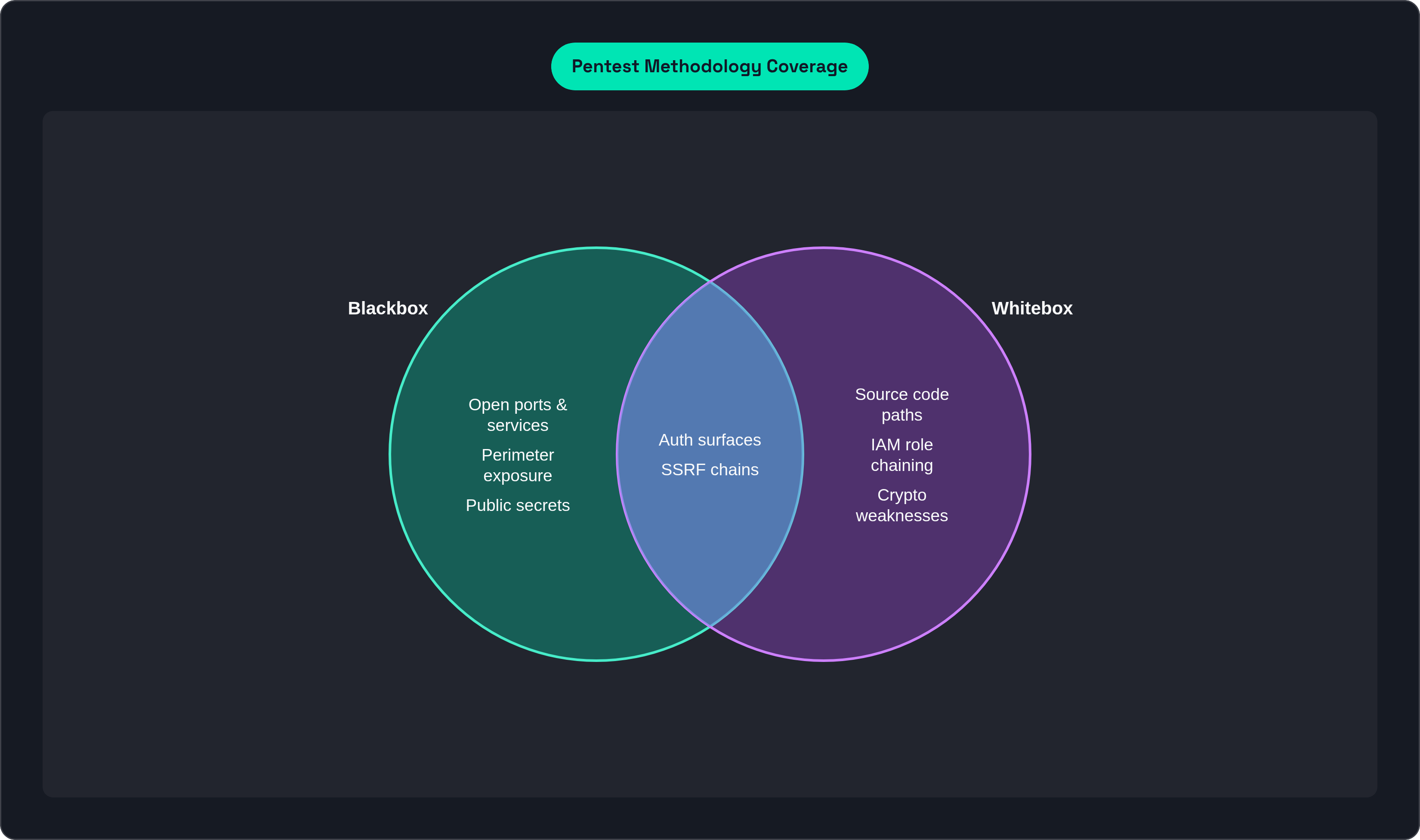
Blackbox does some things genuinely well. Open ports, misconfigured services, expired certificates, subdomain takeovers. Authentication surfaces visible from the internet: brute-force protections, credential stuffing exposure, OAuth misconfigurations that leak tokens. Publicly discoverable secrets like exposed environment files, API keys committed to public repositories, S3 buckets with open read permissions. If your question is "what does our perimeter look like to a stranger who found us on the internet?", blackbox answers it with reasonable fidelity.
The structural ceiling arrives fast, though, and it's worth being specific about where it lands.
Business logic flaws require understanding the intended flow. A pricing calculation that can be manipulated only if you know the expected discount chain is invisible to someone probing from the outside. Authorization vulnerabilities between internal user roles often never surface in external API responses. Hardcoded secrets buried in source code produce no externally observable behavior regardless of how persistently a tester probes. Insecure deserialization in service-to-service calls exists entirely inside the network boundary. Second-order injection flaws, where input is stored in one request and executed later in a background process, produce no visible response from the outside at all.
There is also a time cost that compounds the coverage limitation, and it rarely gets discussed honestly. Blackbox testers spend a substantial portion of every engagement on reconnaissance: mapping what they cannot see, inferring architecture from observed behavior, building a model of the application from the outside in. Whitebox testers skip that phase entirely and redirect that same time toward exploitation. Blackbox doesn't offer a different angle on the same surface. It offers shallower coverage of a smaller portion of that surface, achieved with more labor.
What greybox adds and where it still stops short
Credentials change the character of the test meaningfully. Once a tester holds a valid session token, entire vulnerability classes open up: insecure direct object reference, broken object-level authorization, privilege escalation between roles. Authenticated API behavior becomes accessible, including undocumented endpoints, parameter tampering on credentialed requests, and mass assignment vulnerabilities. If the tester receives accounts at multiple privilege levels, they can actually verify whether role boundaries hold rather than guessing from the outside.
The limitation is bounded precisely by what was shared, nothing more.
A user-level credential without service account access leaves internal microservice calls invisible. API documentation without the underlying data model lets the tester exercise endpoints but prevents reasoning about object-level relationships that create access control gaps. Without source code, testers must infer business logic from observed behavior. They will find what the application does visibly wrong. They will miss what the application does incorrectly in code paths that normal use never triggers, which is often where the consequential vulnerabilities actually live.
The misconception that does the most damage here is assuming greybox is nearly equivalent to whitebox. I've watched organizations make this assumption repeatedly, and it consistently produces a false sense of coverage. For logic-heavy SaaS applications, the gap between having credentials and having source code is enormous. Authenticated access opens the front door. It does not illuminate the interior architecture, and it offers no visibility into what's happening in the walls.
Greybox is often the right starting point for assessing authenticated external functionality. It leaves internal structure opaque by design, and that's not a flaw in the methodology; it's a property of it.
What whitebox access makes visible that the other methods structurally miss
Source code access changes the nature of the engagement categorically, not incrementally.
Testers can read every code path, including those never triggered in normal use: dormant features, deprecated endpoints, internal administrative routes absent from any routing table. Hardcoded secrets and internal service tokens are visible in the code and nowhere else. Cryptographic implementation flaws, things like weak pseudorandom number generation or improper key derivation, exist only in the code and produce no externally observable signal whatsoever. Insecure deserialization in internal processing pipelines generates no external error messages. Second-order SQL injection, where input stored in one request is executed when a background job processes it, is only findable if you can see both the storage path and the execution context simultaneously.
Cloud configuration access extends the scope further. IAM policies with overly permissive roles create privilege escalation paths through role chaining that are entirely invisible without reading the configuration. VPC misconfigurations, security group rules exposing internal services, S3 bucket policies: all of these live in infrastructure-as-code files. The deployment does what the files say, not what the documentation claims. That distinction has caused real breaches.
Business logic coverage becomes analytical rather than inferential. Testers trace the intended flow in the code and reason about where structural assumptions break, rather than probing observed behavior and guessing at intent. Race conditions and time-of-check-to-time-of-use flaws are discoverable by reading concurrent code paths, not by hammering an endpoint and hoping a timing anomaly becomes visible.
Whitebox is the only methodology that can credibly claim to have examined the full attack surface. Every other methodology can only claim to have examined the portion visible from its access level, and that distinction has direct implications for what the resulting report actually certifies.
The vulnerability classes that fall into coverage gaps by design
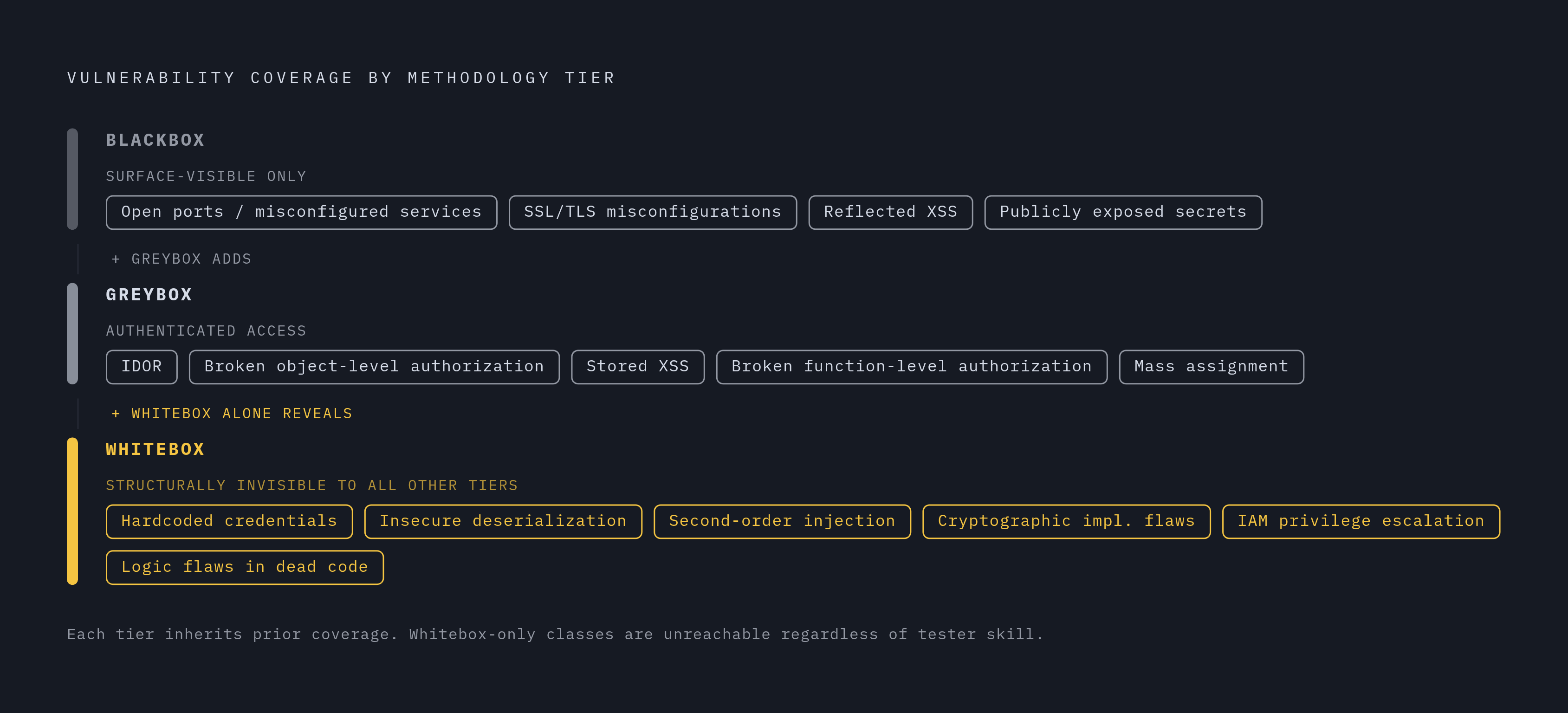
Some vulnerabilities surface reliably in blackbox testing: exposed services and open ports, SSL/TLS misconfigurations, reflected XSS in unauthenticated input fields, publicly exposed secrets in git history or open storage buckets. A competent blackbox engagement finds these consistently.
A second category requires authenticated access at minimum. Insecure direct object reference and broken object-level authorization require manipulating object identifiers in credentialed API calls. Stored XSS requires submitting content and retrieving it as an authenticated user. Broken function-level authorization means calling administrative endpoints with a user-level token. Mass assignment means sending undocumented fields in authenticated requests. Without credentials, none of these are reachable.
A third category requires whitebox access to find with any reliability. Hardcoded credentials are, by definition, not externally visible. Insecure deserialization in internal processing has no external trigger to probe. Second-order injection where the execution context is a background job produces no visible response from outside the boundary. Cryptographic weaknesses in custom implementations require reading the code. IAM privilege escalation through role chaining requires reading the configuration. Logic flaws in dead or rarely-triggered code paths require knowing the paths exist in the first place.
Server-side request forgery deserves specific mention. Basic SSRF surfaces in greybox testing of API inputs. But SSRF chains that reach internal metadata services or pivot through internal microservices only become fully explorable when the tester knows the internal network topology, which requires whitebox access or unusually comprehensive architecture documentation handed over explicitly.
The practical implication is uncomfortable: a company that completes a greybox engagement can receive a clean report while carrying critical vulnerabilities the methodology was structurally incapable of reaching. The report isn't misleading. It is bounded. Buyers treat a clean report as evidence of security rather than evidence of what the test could see. Those are very different things.
How coverage gaps compound over time in a SaaS deployment cycle
A point-in-time test has inherent limitations regardless of methodology. In continuous deployment environments, those limitations compound at a rate most organizations underestimate.
More than forty percent of organizations report that their penetration test findings are outdated by the time the report is delivered, because their environments change faster than the assessment cycle. SaaS amplifies this considerably. Code ships continuously. A greybox test completed in January, even a clean one, says nothing about the February deployment that introduced a hardcoded service token in a new internal module, or an undocumented API route added during a sprint that wasn't in the documentation handed to the tester.
The scenario plays out with depressing regularity. Organization completes an annual assessment in January. Compliance attestation is earned. A February update introduces a vulnerability in a code path the tester never had access to. By April, that path is in a breach report. This is structurally more likely when the methodology left internal code paths unexamined, because those paths are precisely where fast-moving teams introduce new functionality without thinking about security surface area.
New integration categories make the compounding worse. AI and large language model integrations introduce prompt injection risks and model output trust issues that are most thoroughly assessed in the code handling model inputs and outputs, not in runtime behavior alone. Third-party SDK and dependency chains are visible in package manifests and build configurations. Infrastructure-as-code drift creates a persistent gap between what the cloud environment actually does and what the most recent audit examined.
Annual tests without ongoing coverage produce expanding blind spots between cycles. Whitebox scope narrows those spots. But even a whitebox engagement is a snapshot, and that's the honest truth of it. Maintaining coverage as the attack surface evolves requires continuous assessment of new code changes, not simply larger annual engagements.
What compliance frameworks actually require versus what they incentivize
SOC 2 does not mandate penetration testing, and it certainly does not specify methodology. The relevant trust services criteria require demonstrated evaluation and communication of security risks. Penetration tests have become the accepted evidence mechanism, but the framework leaves scope and approach to the organization, which creates substantial room for interpretation.
ISO 27001 similarly stops at risk assessment and treatment. How that assessment is conducted, what methods it uses, and what access it involves is the organization's decision. The framework trusts you to make a reasonable choice, and that trust is frequently exploited in the direction of cost minimization.
HIPAA's Security Rule has historically required ongoing risk analysis without prescribing intervals or methodology. A proposed rule update would move toward explicit annual testing requirements; verify the final status of that rule before relying on it for compliance planning.
Auditors reviewing SOC 2 evidence have grown more sophisticated about the difference between vulnerability scanning and actual penetration testing. Submitting scan output as pen test evidence is a documented failure mode that sophisticated auditors catch. But auditors generally do not distinguish between whitebox and blackbox methodologies. A blackbox test that produces a report with findings and remediation evidence satisfies the checkbox.
This is where the compliance incentive structure diverges from the security outcome, and the divergence is significant. A blackbox engagement can satisfy an auditor while leaving the internal attack surface entirely unexamined. Compliance attests that testing occurred. It does not attest that testing was complete. Published industry figures show the average number of vulnerabilities surfaced in SOC 2-scoped engagements is meaningfully lower than in more comprehensive assessments, and that gap reflects scoping depth and methodology constraints, not a genuine difference in underlying application risk.
Buyers who choose blackbox because it satisfies an audit requirement and costs less are simultaneously making a coverage decision, usually without realizing it. A whitebox engagement that surfaces real vulnerabilities, proves them with working exploits, and documents remediation satisfies both objectives. The question is whether the methodology was chosen to accomplish both, or only to clear the threshold.
How to use methodology selection as a scoping decision, not a budget decision
Start with a threat model question, not a budget conversation: which portions of your attack surface carry the highest consequence if compromised?
External perimeter, internet-facing services, third-party integrations: blackbox covers this adequately. If your primary concern is what a stranger on the internet can do before they authenticate, a blackbox assessment of that surface is the appropriate tool for that specific question.
Authenticated application functionality, API authorization, multi-tenant data isolation: these require at minimum greybox access with full role coverage. A credential for one user role is not sufficient. If your application has administrators, standard users, and service accounts, the test needs all three to meaningfully assess whether privilege boundaries actually hold.
Internal business logic, source code secrets, cloud IAM, background processing pipelines: these require whitebox. There is no authenticated API call that reveals a hardcoded credential. There is no external probe that exercises a code path that normal traffic never triggers. These are not coverage limitations that clever testing can work around; they are structural properties of the methodology.
Most SaaS products contain all three categories. A single-methodology test will leave portions of the surface unexamined unless that methodology is whitebox with complete access scope.
When evaluating a vendor's proposed approach, ask specific questions. What exactly will you be handed at engagement start, itemized? Which vulnerability classes fall outside scope given that access level? How does the proposed methodology cover business logic flaws? What does the engagement leave uncovered, and why?
That last question is the most revealing one you can ask. A vendor who cannot clearly articulate what their proposed methodology cannot see is either not thinking carefully about coverage or hoping you won't. Methodology selection determines coverage, coverage determines what you actually know about your exposure, and the value of the exercise depends entirely on being honest about that boundary before you sign the statement of work.