Red Flags in Pen Test Scope Documents That Limit Whitebox Value
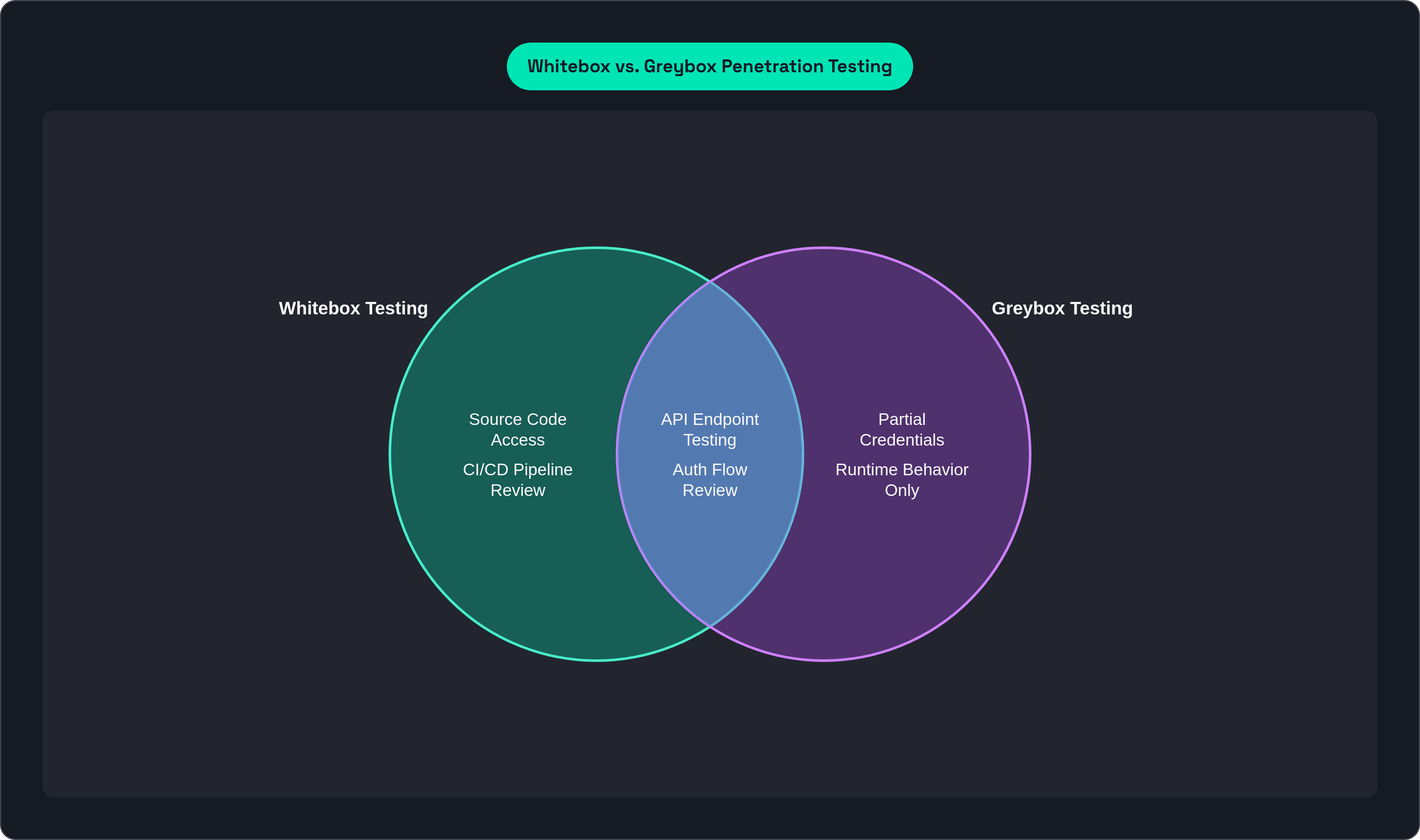
Whitebox testing means the tester arrives with everything: source code, architecture diagrams, cloud configurations, CI/CD pipeline access, credentials across every privilege tier. That information access unlocks a category of finding that no other methodology can reach. Logic vulnerabilities, the ones rooted in how an application was designed rather than how it's configured, only surface when a tester can read the intent of the code alongside its runtime behavior. Insecure deserialization chains and hardcoded secrets rarely appear in a runtime scan. Attack paths that chain from a code-level flaw through a cloud trust relationship into a downstream data store require the tester to hold all three layers simultaneously, which means the scope document has to grant all three layers simultaneously.
The numbers back this up. Across more than a thousand AI-assisted pen tests, whitebox testing uncovered seven times more vulnerabilities than greybox testing alone while requiring fewer attempts to reach exploitation, according to Cobalt's 2024 State of Pentesting report. That multiplier only materializes if the scope document actually delivers what the methodology requires.
The methodology label is a promise, and the exclusion clauses are where that promise gets quietly unwound. Greybox and blackbox have legitimate uses for the right engagement. But a buyer paying whitebox rates who receives greybox-equivalent scope has paid a premium for a discounted product. The report won't tell you that happened.
Scope Defined by IP Ranges and Hostnames Rather Than Business Functions
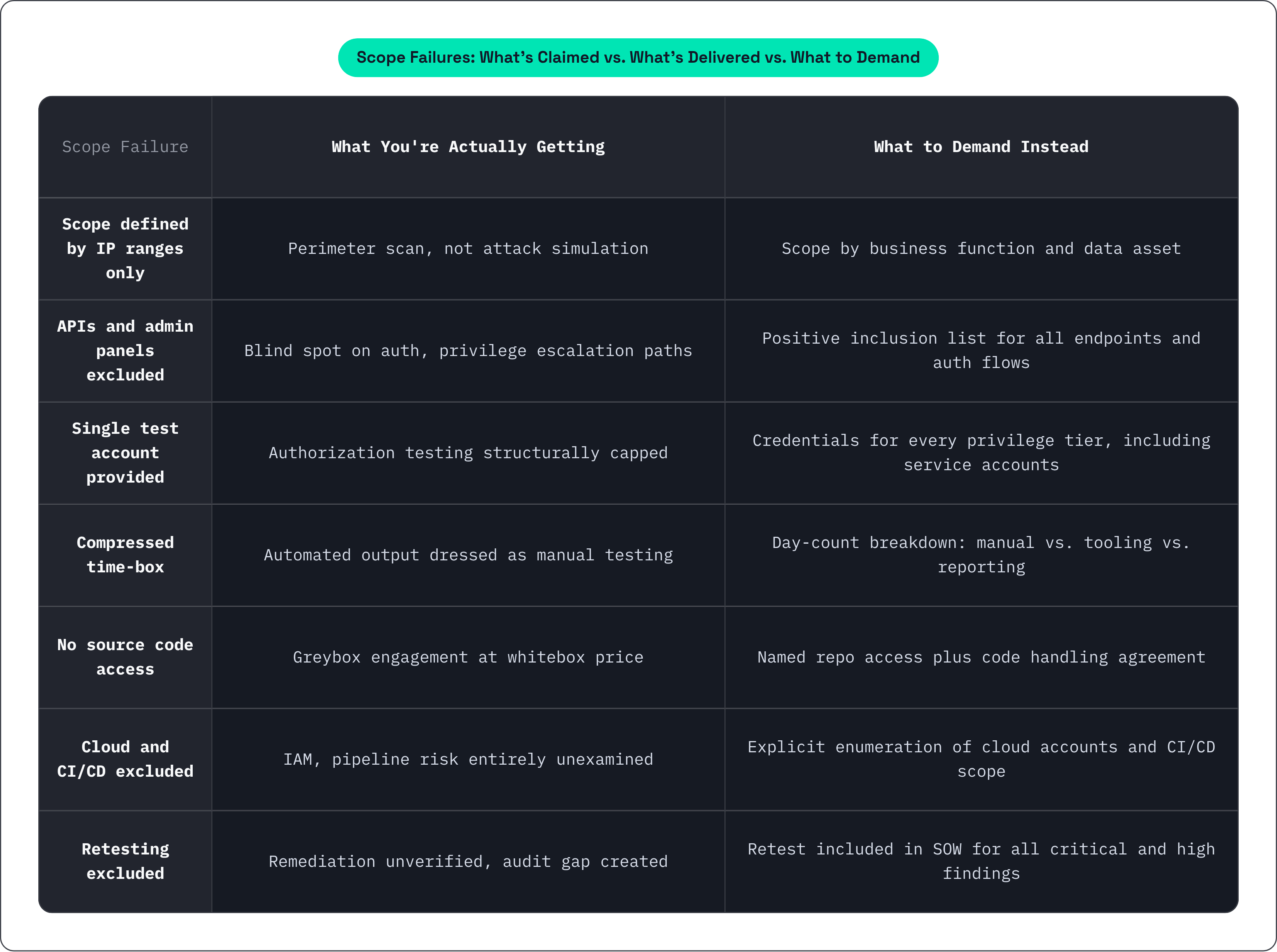
A scope built on IP ranges or hostnames produces a perimeter scan. Not an attack simulation. A perimeter scan.
The tester handed a CIDR block and nothing else will optimize for breadth across that range, surfacing configuration issues and known CVEs rather than chaining findings toward whatever actually matters to the business. You lose visibility into which data assets live behind each endpoint and what their exposure means. You lose the attacker's perspective on which user roles are worth targeting. You lose the actual paths from entry point to sensitive data. None of that is derivable from an IP list. The list tells you where the building is. It says nothing about what's inside worth taking.
Business-function framing forces the scope document to reflect how the organization actually fails. "The billing API and its downstream payment processor integration." "The admin panel accessible to support staff." "Multi-tenant data isolation between customer accounts." That framing is what separates a perimeter audit from a threat model, and it's the clause most organizations forget to negotiate before signing.
Exclusions of APIs, Admin Panels, Third-Party Integrations, and Authenticated Workflows
Exclusion clauses do the most damage while looking like reasonable risk management, and that's precisely what makes them worth scrutinizing.
Authentication flows, authorization logic, and inter-service trust relationships all live in APIs. Excluding APIs means skipping a substantial portion of the attack surface in modern application architecture. That isn't a conservative posture; it's a blind spot with a legal cover story. Admin panels are where privilege escalation and account takeover paths run. Excluding them caps the severity ceiling on findings, not because the vulnerabilities aren't there but because nobody was ever pointed at them. Third-party integrations carry OAuth misconfigurations and cloud trust relationships that represent legitimate lateral movement paths in current SaaS environments. AI-enabled workflows touching production are increasingly part of the attack surface too, and absent from most legacy scope templates because those templates were written before anyone had to think about them.
The pattern in exclusion clauses is consistent: they cluster around components that are operationally sensitive or technically complex. Real customer data. Intricate OAuth flows. Webhook endpoints. Those are exactly the components an attacker would not skip.
Demand a positive inclusion list for all authentication workflows, API endpoints both documented and undocumented, and integration touch points. Any exclusion should require written rationale. "We excluded the payment processor integration because of vendor SLA constraints" is defensible. "Third-party integrations are out of scope" with no explanation is not.
A Single Test Account Where Multiple Privilege Tiers Should Be
Authorization testing requires the tester to exercise every privilege tier the application exposes: unauthenticated, standard user, elevated user, admin, service-to-service. "One test account will be provided" caps what authorization testing can be performed regardless of how the engagement is labeled.
With a single credential tier, horizontal privilege escalation is invisible. One standard user accessing another user's data never gets tested. Vertical escalation, where a standard user reaches admin-only functions, is equally unreachable. In multi-tenant SaaS, role confusion across tenant boundaries requires credentials from multiple tenant accounts to demonstrate. And service account abuse (machine credentials with overly broad IAM permissions) requires service-level credentials in scope to surface.
Horizontal privilege escalation and multi-tenant isolation failures are among the most consistent high-severity findings that appear when authorization testing is performed with an adequate credential set. Without the right credentials, they are structurally invisible. Not unlikely. Invisible.
The scope document should enumerate every role type in the application and specify which credential sets the tester receives for each, including service accounts. Silence on credential types is not a whitebox scope. It's a greybox scope with a whitebox label attached.
Time-Boxes Too Short to Support Manual Work
A non-trivial web application or API typically requires seven to ten calendar days from kickoff to draft report for a single-scope engagement; two-scope engagements run ten to fourteen. These are the ranges reflected in PTES documentation and are consistent with what competent vendors actually quote. A three-day window for a multi-application SaaS platform is a structural guarantee that the majority of the output is automated. The math isn't complicated.
Manual attack path chaining requires iteration. A tester finds a partial vulnerability, understands its business context, builds the chain, pursues the next step. That process cannot be parallelized away. Source code review at meaningful depth is time-linear. Compressing the window compresses coverage, not methodology, and short windows favor tools that produce volume over testers who produce signal.
Watch for vendor pitches that describe broad scope in a compressed timeline with language like "our automated platform accelerates discovery." Acceleration is real and genuinely valuable; it should produce greater depth within a normal window, not justify a window that forecloses manual work entirely. Ask the vendor for their typical day-count for engagements of your scope size, and ask specifically how many of those days are allocated to manual testing versus tooling setup and report writing. A vendor who can't answer that clearly is already telling you something important.
No Source Code Access in an Engagement Sold as Whitebox
Source code access is what makes whitebox testing different from every other methodology. Not credential count. Not architecture diagrams. Not the word "whitebox" appearing in the contract header.
Without it, testers cannot identify insecure deserialization patterns before triggering them at runtime. They cannot find hardcoded secrets or API keys embedded in application logic. They cannot trace how user input moves across layers to identify injection points that don't surface at runtime. Custom cryptographic implementations, business logic that looks correct at the API level but is flawed underneath: none of that is auditable from the outside. These aren't esoteric findings. They're the findings that matter most in a real incident.
The common justification for excluding source code is IP protection. That concern is real. But excluding source code entirely is not a legal solution; it's a scope reduction. The actual fix is an NDA paired with a code handling agreement that specifies access controls, data retention limits, and post-engagement destruction procedures. This can be structured properly without complexity; it just requires the vendor and buyer to actually do it.
Get explicit written confirmation that testers will have read access to the production codebase, with specific repositories listed by name, and a clear data handling clause governing that access. A scope document that grants "whitebox-level access" while listing source code as out of scope is a greybox engagement at a whitebox price.
Cloud Control Plane, IAM, and CI/CD Excluded from Cloud-Native SaaS Tests
For a cloud-native SaaS company, the attack surface extends well past application endpoints into the infrastructure layer that governs who can reach what. That layer is consistently absent from scope documents written for pre-cloud application architectures, and the absence is consequential in ways that don't show up until something goes wrong.
When cloud infrastructure is excluded, IAM role overpermissioning goes unevaluated. A misconfigured role can allow a compromised service account to reach data stores or assume higher-privilege identities, and nobody looks at it. Misconfigured storage policies remain untouched; the 2019 Capital One breach involved a misconfigured AWS WAF and S3 bucket permissions, as documented in the U.S. Department of Justice case record, and it remains one of the cleaner illustrations of how infrastructure scope gaps translate into real incidents. CI/CD pipeline integrity never gets tested, which means a compromised pipeline capable of injecting malicious code into production sits as a high-value attacker target the engagement never touches.
A scope document that covers web application endpoints while excluding the cloud control plane is testing one entry point while leaving the infrastructure everything runs on entirely unexamined. The access controls, the service-to-service trust relationships, the deployment pipeline: that's where the most consequential exposures in cloud-native SaaS environments actually live. Scope templates written for on-premise infrastructure don't account for any of it, and most organizations don't notice the gap until they're using it.
Demand explicit enumeration of cloud accounts, IAM scope, and CI/CD systems in the scope document, with the same positive inclusion logic applied to infrastructure as to application components.
Automated Scan Output Described as a Penetration Test
Automated scanners generate lists of potential vulnerabilities against known signatures. They do not confirm exploitability. They do not chain findings into attack paths. They do not exercise business logic. A penetration test is a manual, human-led exercise that attempts to prove real-world risk by exploiting vulnerabilities, not by cataloguing their theoretical presence.
Business logic flaw discovery requires understanding what the application is supposed to do, which is not something a scanner can reconstruct. Chained attack paths, where finding A is only dangerous because it enables access to finding B, require a human analyst to see the connection. A scanner that flags a vulnerability has noticed something worth investigating. It has not demonstrated that the vulnerability is real or reachable, and there's a meaningful difference between those two things when you're presenting findings to a board or an auditor.
Watch for scope language like "automated assessment," "vulnerability scan plus report," "tool-assisted discovery," or any phrasing that omits manual testing hours or human analyst review. The report tells the story retroactively: findings populated with "possible" or "potential" without exploitation confirmation is scanner output, regardless of what the engagement was called.
Ask for a sample report before signing. This is not an unusual request. Any vendor who declines to provide one has answered the question.
Retesting Excluded from Scope or Priced as a Separate Future Engagement
A penetration test that ends at report delivery confirms vulnerabilities exist. It does not confirm that remediation worked. The security value of the engagement is only fully realized when fixes are verified against the same attack surface, by the same testers, with the context they built during the original work.
The vendor pattern is predictable: scope includes report delivery; retesting is described as "available upon request" or "a separate engagement we can scope at that time." Engineering fixes a vulnerability, redeploys, and has no verified confirmation the fix holds. The audit report shows findings without remediation evidence. A second engagement gets scoped and contracted to confirm work that should have been included from the start. You've now paid twice for one complete engagement.
SOC 2 and ISO 27001 audit frameworks increasingly expect retest confirmation alongside original findings, as reflected in guidance from the AICPA and ISO/IEC 27001:2022 documentation respectively. A scope document that excludes retesting creates an audit gap that eventually has to be filled by a second commercial transaction.
Retesting should be explicitly included in the statement of work for all critical and high-severity findings, with a defined window (typically thirty to sixty days post-report) and a clear deliverable confirming remediation status for each finding. Continuous testing models, including pull request scanning and on-demand retests, represent the structural evolution beyond the point-in-time retest problem entirely. Scope documents that include these provisions eliminate the gap rather than narrowing it.
Overly Broad Production Exclusions That Make the Test Environment Unrepresentative
Some production protection is rational. No responsible engagement deliberately corrupts live customer data or triggers customer-facing outages. The problem is when that rational caution gets written as a blanket exclusion of all production systems, defaulting everything to staging or development environments without examining whether those environments actually reflect production.
They frequently don't. Staging environments regularly lack the data volumes, traffic patterns, and configuration states that create exploitable conditions in production. IAM roles, secrets, and third-party integration credentials in staging are often materially different from their production counterparts (sometimes by design, sometimes because configuration drift has accumulated quietly). Testing a staging environment and drawing conclusions about production security is not a conservative position. It's an inaccurate one.
The ask is not unrestricted production access. Read access to a production codebase is not a risk to customer data. Authenticated API testing against production endpoints with test accounts isolated from real customer records is not an outage risk. These distinctions exist, and a competent vendor knows how to structure around them.
Push for a production access policy that distinguishes specifically between components requiring staging-only testing and components where production access is achievable safely. Every exclusion should carry a rationale that survives scrutiny. Blanket production exclusions without specificity are not security controls; they're scope reductions dressed up to look like risk management, and by now you know exactly what that costs you.