Pull Request Security Review Processes for Engineering Teams
Embed security review into pull requests, not post-release audits.
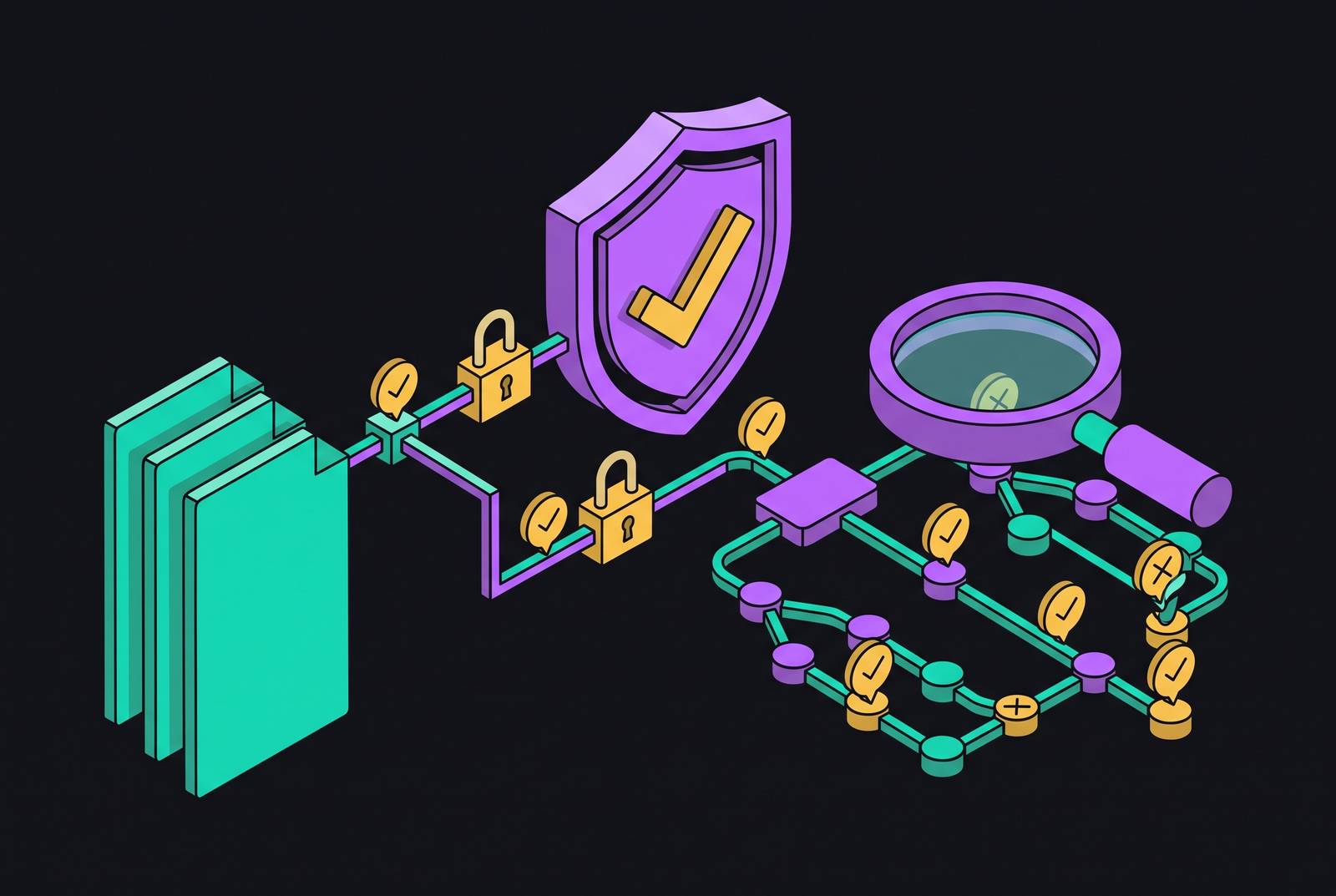
Pull request review already catches logic bugs, style violations, and sloppy naming. It rarely catches security flaws, and that's the gap this piece is about. Security review doesn't need to live in a separate audit phase that happens after merge or right before a big release; it needs to live inside the PR workflow that already exists, with the right checkpoints built in.
The 2025 Verizon Data Breach Investigations Report found vulnerability exploitation jumped 34% and now accounts for 20% of all breaches. Most of that exposure starts as code and configuration, and code and configuration ship through pull requests. If that's where risk enters the system, that's where the review needs to happen, not weeks later in a pen test report nobody reads until the branch is stale and the author's already moved to a different team.
What security review at the PR stage actually means
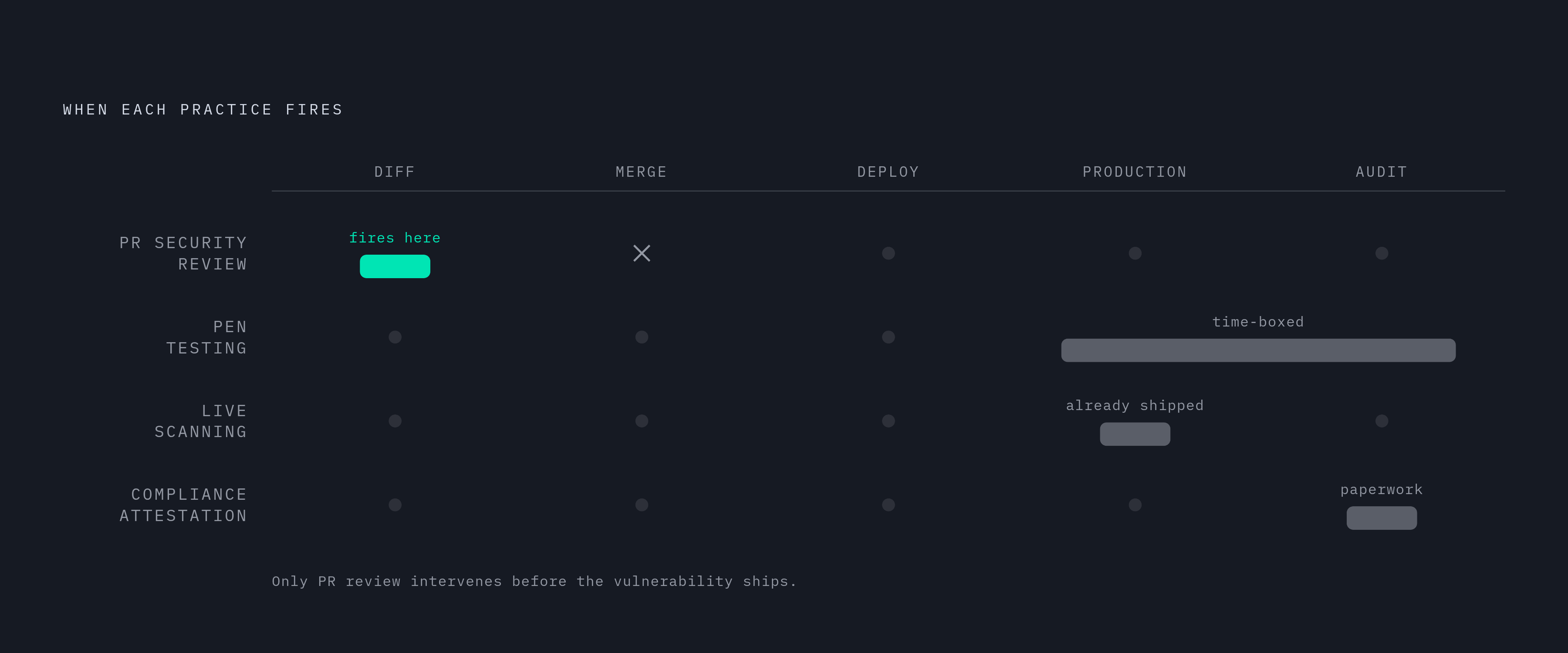
PR security review is the set of checks, questions, and tooling applied to a diff before it merges. It's not a new phase bolted onto the pipeline. It's a security lens on the review step that's already there.
It's worth separating this from three things it gets confused with. Penetration testing is adversarial and time-boxed, usually scoped to a whole system rather than a single change. Vulnerability scanning of a live environment finds problems after they're already running in production. Compliance attestation is a paperwork exercise that, done right, ends up being a side effect of good PR review rather than its purpose.
Two layers do the actual work. Automated scanning runs on every PR, catches known patterns fast: secrets, dependency CVEs, common injection points. Human judgment picks up where pattern-matching stops: what a diff does in the context of the running system, what it enables three steps downstream, whether it quietly moves a trust boundary. Neither one replaces the other. Automated tooling clears out the obvious so a human reviewer can spend their attention on the subtle stuff. Nobody's expecting perfect coverage at this stage; the goal is raising the cost of shipping something exploitable and catching the highest-yield issues early, before they're expensive.
The vulnerability classes most likely to appear in a PR diff
Forget the full OWASP checklist for a second. A handful of vulnerability classes show up over and over in real diffs, and they're catchable at review time if someone's looking.
Hardcoded secrets top the list: API keys, tokens, passwords committed straight into source, usually during a rushed integration or a "just get it working" fix. They're mechanically easy to spot, but easy to miss too, if a large diff slides past without a scanner flagging it.
SQL injection has sat near the top of OWASP's rankings for close to two decades, and it still shows up. Look for string concatenation in query building, raw user input handed straight to a database call, or an ORM getting bypassed for a "quick" raw query.
Insecure deserialization is harder to catch because it depends on context: what feeds that deserialization point, and whether any of it is untrusted. It's worth the extra attention because it's a common path to remote code execution. At review time, the thing to flag is any new deserialization call or any change to how untrusted input gets handled before it reaches one.
Server-side request forgery shows up whenever a PR adds a new outbound HTTP call, which happens constantly in feature work: webhooks, integrations, URL preview generators. It's especially dangerous in cloud environments where a metadata endpoint might be one unguarded fetch away. The moment a new outbound call gets introduced is exactly the moment to catch it.
Cross-site scripting hides in new rendering paths, changes to how user content lands in a template, or a sanitization step that got quietly removed during a refactor.
Broken access control is the one automated tools mostly can't see. New endpoints, modified permission checks, added roles: these are high-risk diffs by nature, and catching a broken one requires a reviewer who actually understands the application's trust model, not just its syntax.
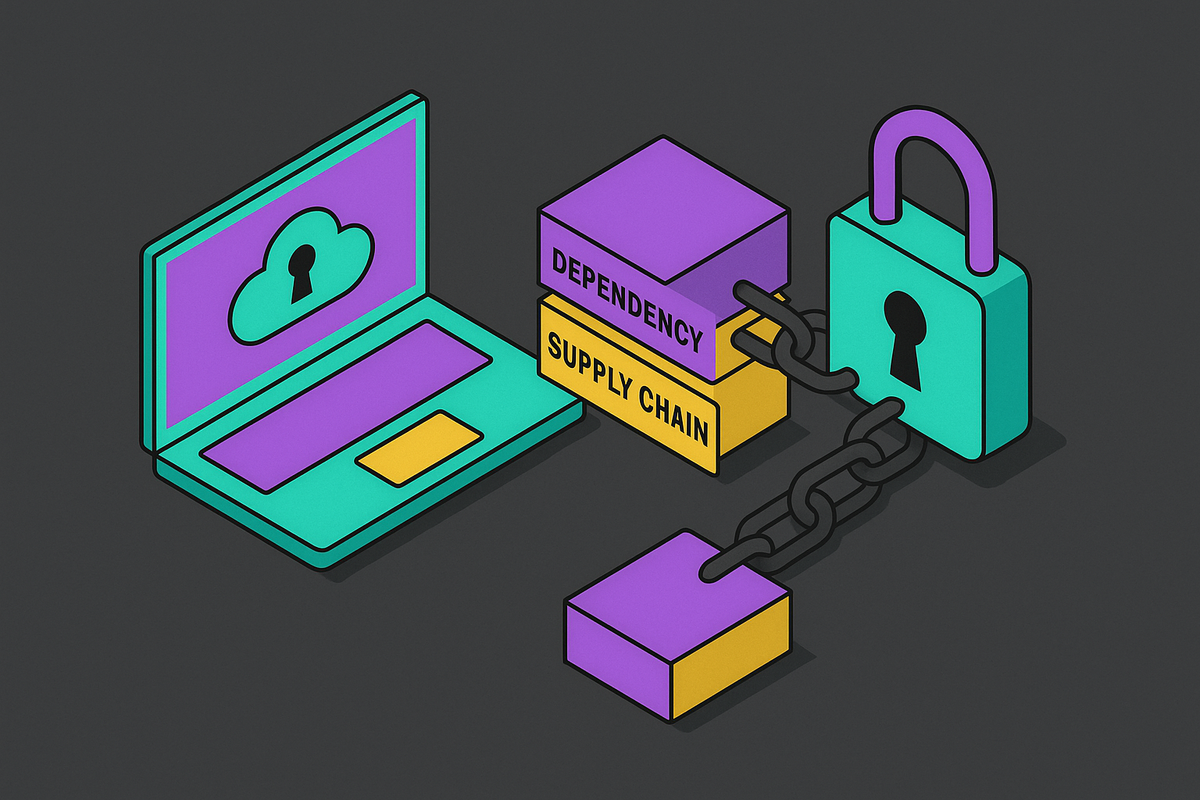
And then there's dependency introduction, which isn't really a code pattern at all. It's a supply chain decision. A PR that adds one package is quietly adding that package's entire dependency tree, and that tree deserves its own scrutiny.
Structuring the PR review process so security checks actually happen
Ad hoc security review has one core problem: it depends on whether the reviewer happens to be thinking about security that day. That's not a process, that's a coin flip.
PR templates fix a chunk of this cheaply. A short checklist in the PR description, not a bureaucratic form, works as a prompt: does this introduce new outbound HTTP calls? New deserialization? New credential handling? Having the author self-review against this before requesting review catches the obvious stuff before a second set of eyes is even needed. Keep it tight, five to eight sharp questions. A 30-item form gets ignored by the second week.
Not every PR needs the same scrutiny, either. Triage by change type. Authentication, session management, authorization logic, cryptography, external data ingestion, new dependencies, and infrastructure-as-code all deserve a security-focused reviewer. UI copy tweaks, internal refactors with no interface changes, and test-only PRs don't need the same treatment.
Ownership matters more than the specific model chosen. Maybe it's a security champion per team, maybe a rotating reviewer role, maybe a required sign-off from a dedicated security engineer. Whatever it is, it needs to be explicit. Leave it ambiguous and the honest answer is that nobody does it.
Branch protection closes the loop. Automated scan results should be a required status check, so a PR can't merge while a critical finding sits unresolved. Calibrate the thresholds carefully though: block on critical and high-severity findings, not on every informational note, or engineers will start looking for ways around the gate out of sheer frustration.
One more thing worth building in: when a reviewer spots a risk and the team decides to accept it anyway, write that decision down in the PR comment. Silent approval erases the reasoning. A documented decision gives the next reviewer, six months from now, the context to understand why a pattern was allowed through.
How automated scanning fits into the PR workflow without becoming noise
A few categories of tooling matter at PR time. Static application security testing, or SAST, analyzes source code for known vulnerability patterns without running it, and works best scoped to the diff rather than the whole codebase, for speed. Secret scanning catches credentials and tokens before merge; several tools exist for this purpose across common CI platforms. Software composition analysis flags known CVEs in dependencies that are new or just got bumped. And infrastructure-as-code scanning checks Terraform, CloudFormation, or Kubernetes manifests for misconfigurations, relevant anywhere infra changes ship through the same PR pipeline as application code.
These tools plug in as CI jobs triggered on pull request events, and their findings should show up as status checks or, better, as inline comments directly on the offending line. A separate report link that reviewers have to click into somewhere else almost never gets opened.
Alert fatigue is the real risk here. A scanner that dumps 200 findings on every PR teaches engineers to tune it out within a week. Start with high-confidence, low-false-positive rules, and suppress known-acceptable patterns with a documented suppression rather than turning off whole rule categories out of frustration. Scoping the scan to just what the diff introduces, instead of re-flagging every pre-existing issue in the file, keeps the signal relevant to the actual decision a reviewer is making.
None of this replaces judgment. A scanner can't catch a business logic flaw, because code that correctly implements broken authorization logic passes every check cleanly. It can't trace a chained attack path, because it sees individual sinks, not how two harmless-looking changes combine into something exploitable. And it doesn't know your data model, so it can't tell whether a given pattern is dangerous in this specific system or perfectly fine. Automation handles pattern-matching. Reasoning is still a human job.
What human reviewers need to do that tooling cannot
Reading a diff in context is the whole job, and it's the part no tool does. A reviewer needs to know what the code does inside the running system, not just what lines changed, which means real familiarity with the app's trust model, its data flows, its architecture. Security review done without that context is a much weaker version of the real thing.
Tracing data flow is where the actual reasoning happens. Where does untrusted input come in? Where does it land? Does this PR create a new path from one to the other that didn't exist before? That question is what separates a reviewer doing real security work from someone rubber-stamping a checklist.
Authorization changes deserve a deliberate, slow read every time. What did the old logic enforce, and what does the new logic enforce instead? Is there a case, even an edge case, where the new version permits something it shouldn't? A scanner can confirm the code does what it says. It cannot tell you whether what it says is the right design.
New dependencies and integrations deserve a similar level of skepticism. What permissions does this library ask for? What does it do with the data it touches? And is this actually the well-maintained package it looks like, or a similarly-named, lower-quality clone that snuck into the search results?
Sometimes the right call isn't a line comment at all. It's a question about the whole approach: a new feature that stores credentials directly in the database, say, when a secrets manager would be the safer place for them. That's a design conversation, not a nitpick.
None of this builds itself. Security champions, one or two engineers per team with deeper training, give teams a resource to lean on and a required reviewer for the riskiest PRs. And when a security issue does get caught, or missed, a quick post-mortem on it teaches the whole team more than any training deck could.
How PR-level security review connects to the broader security program
PR review shifts security left. It doesn't replace what comes after. Catching a flaw at the diff stage is far cheaper than finding it during a pen test, a bug bounty submission, or, worse, an actual incident. But PR review only sees one diff at a time; it can't map the full attack surface the way a pen test can. The two aren't competing practices. PR review raises the floor. Pen testing maps the ceiling.
Pen testing catches things PR review structurally can't: logic flaws that span several PRs and features, where no single diff reveals the full attack path. Vulnerabilities sitting in old code that predates the review process entirely. Cloud and infrastructure misconfigurations that live outside the application codebase. And chained exploits that only show up with a system-level view, which is why whitebox testing, done with access to source, cloud configs, and documentation, tends to surface things that blackbox testing of a live app simply won't.
There's a compliance angle too. A documented PR review process, complete with templates, merge gates, and recorded sign-offs, is concrete evidence that security controls actually function day to day. It maps directly to things like SOC 2's CC4.1 monitoring criteria and ISO 27001:2022's Clause 8.8 on managing technical vulnerabilities. Auditors care whether a control operates in practice, not whether it's written down somewhere in a policy binder nobody's opened. A PR log with documented security decisions is exactly the kind of evidence that holds up.
Annual pen tests capture one snapshot in time. A codebase deploying dozens of times a week looks nothing like it did at that snapshot within a month. Continuous scanning on every PR narrows that gap; it shrinks the window between a vulnerability getting introduced and someone catching it. The most mature setups run both: continuous PR-level coverage for the everyday churn, and periodic, deep pen testing with expert human review for the things only a system-wide view can find.
Starting points for teams that don't have a security review process yet
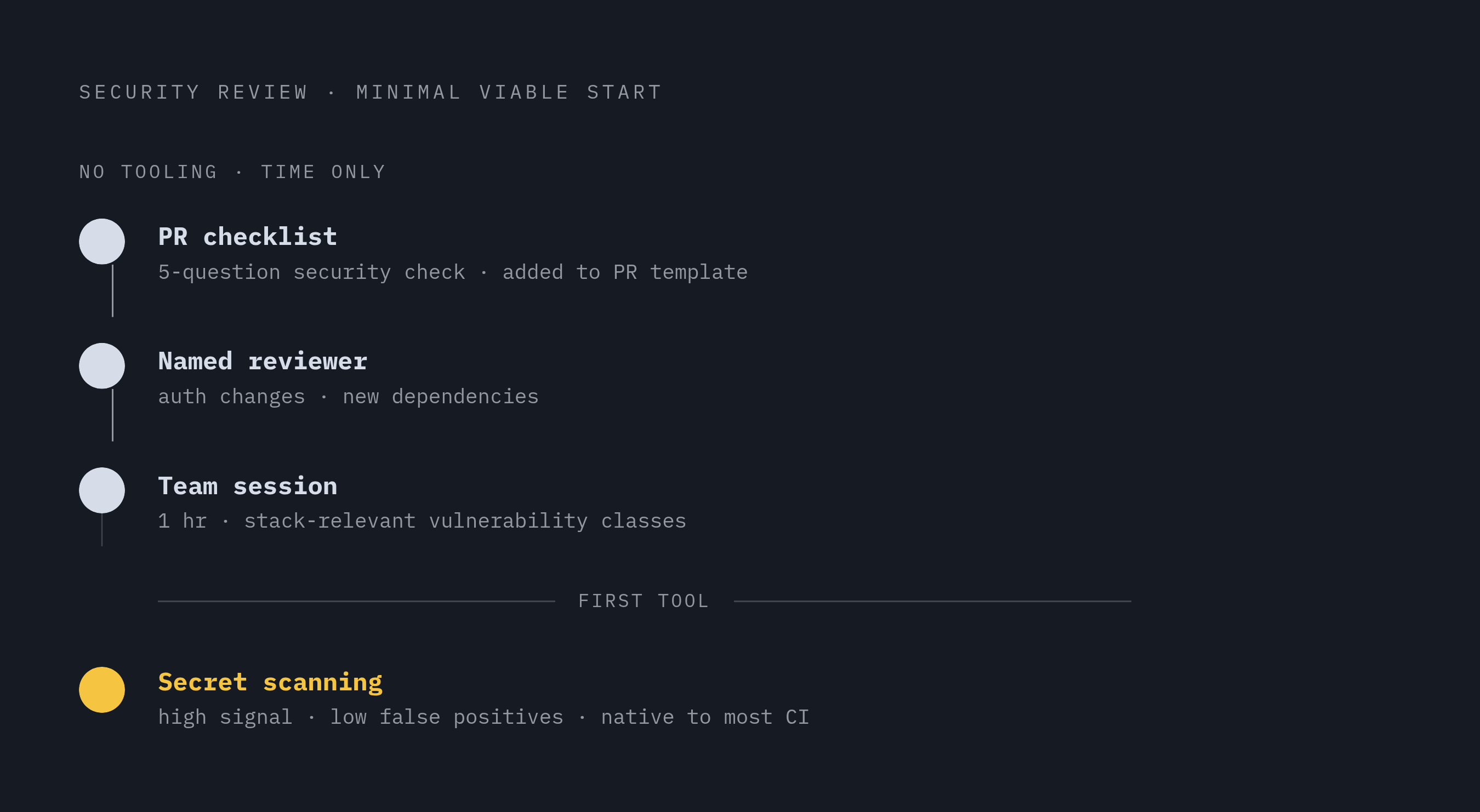
The most common way this fails is trying to stand up everything at once, hitting a wall of friction in week two, and quietly letting the whole thing die. Start smaller than feels sufficient.
In week one, with zero new tooling, three moves are enough to get going. Add a five-question security checklist to the PR template. Pick two or three PR categories, authentication changes and new dependencies are a good start, that will always require a named, security-aware reviewer. And run one focused hour with the team walking through the vulnerability classes most relevant to the actual stack in use. Shared vocabulary has to come before any process holds together.
After that, prioritize one tooling integration before any other: secret scanning. It has high signal, low false positives, and it's straightforward to turn on across most CI platforms in use today. It also closes off one of the most common, most damaging mistakes a team can make: a credential sitting in plaintext in a public or semi-public repo, waiting for someone to find it.