Security Review Process for Third-Party API Integrations in SaaS Products
Attackers exploit third-party integrations as a primary attack vector in SaaS environments.
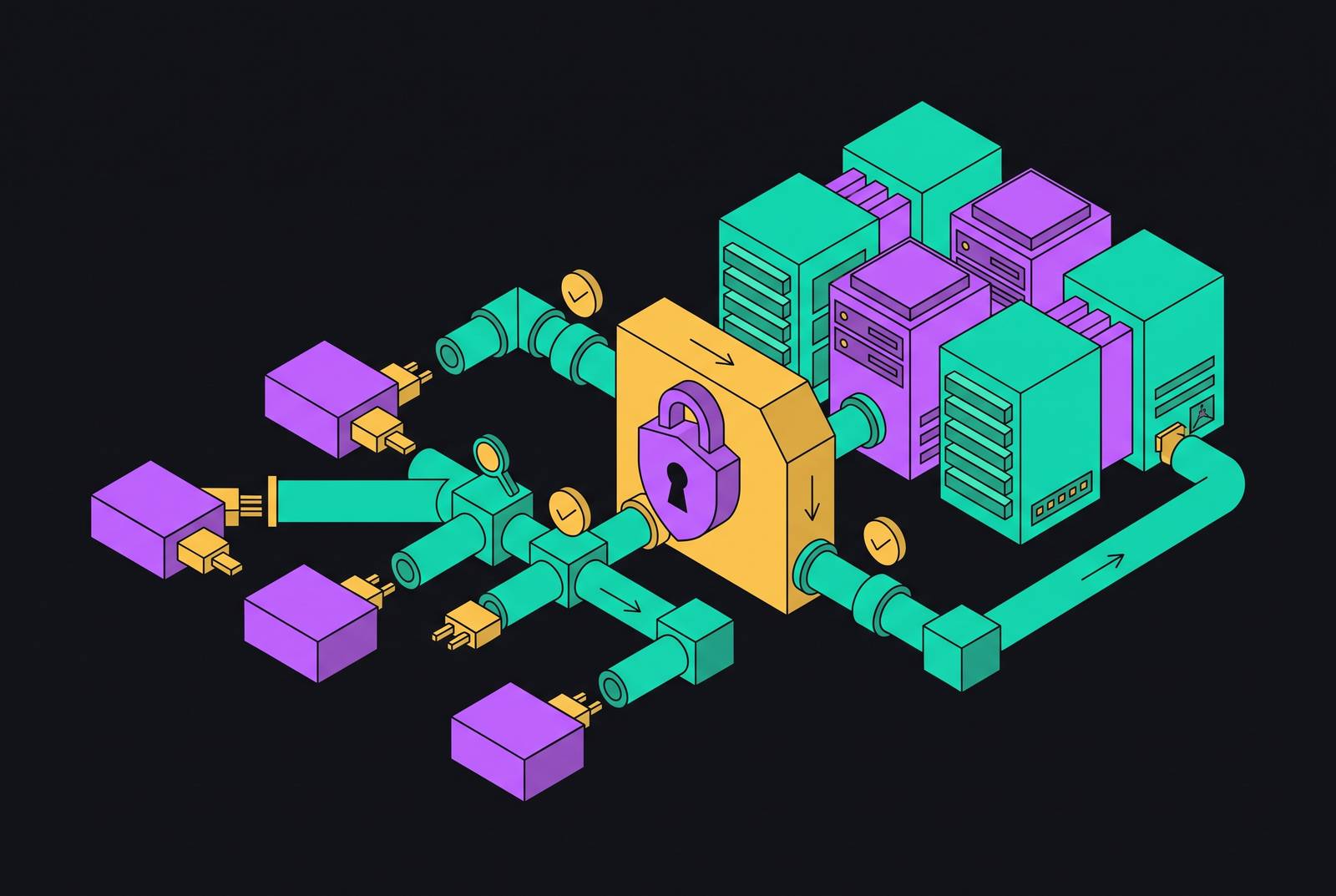
Integrating a third-party API into a SaaS product means extending your trust boundary to code, infrastructure, and access controls you don't own. This isn't a checkbox at launch — it's a review process that has to run on a schedule, because the risk surface here is structurally different from securing your own endpoints.
You can patch your own API when a flaw shows up, but you can't patch the vendor's. You can audit your own auth logic line by line, while you're stuck reading whatever documentation the vendor decides to publish about theirs. And once your data leaves your perimeter and hits their servers, you have no way of knowing, in any verifiable sense, what happens to it next. That's the trust problem in a sentence, and it's why integration review needs its own track, separate from however your team already handles first-party API security.
The scale of this makes it hard to treat as a secondary concern. Obsidian Security has put the average enterprise SaaS platform at 42 or more third-party connections. Each one is a door, and each one is a potential path for lateral movement that walks straight past the controls you built for your own environment. Research tracked by ResearchGate found supply chain attacks targeting SaaS ecosystems rose 1,300% between 2022 and 2025, an order-of-magnitude jump that reflects attackers figuring out the integration layer is often softer than the core product. SQ Magazine has found third-party integrations show up as an entry point in over 25% of API breaches. That's a primary attack vector, and the data says it deserves to be treated as one.
The 2025 Salesloft-Drift incident is the clearest illustration of what this looks like at scale. Attackers compromised a single third-party OAuth token and used it to reach hundreds of downstream environments. Obsidian's researchers estimated the blast radius at ten times greater than previous incidents of that kind. One token turned into hundreds of compromised environments. That ratio is the whole argument for treating integration review as its own discipline.
What the integration attack surface actually looks like before any review begins
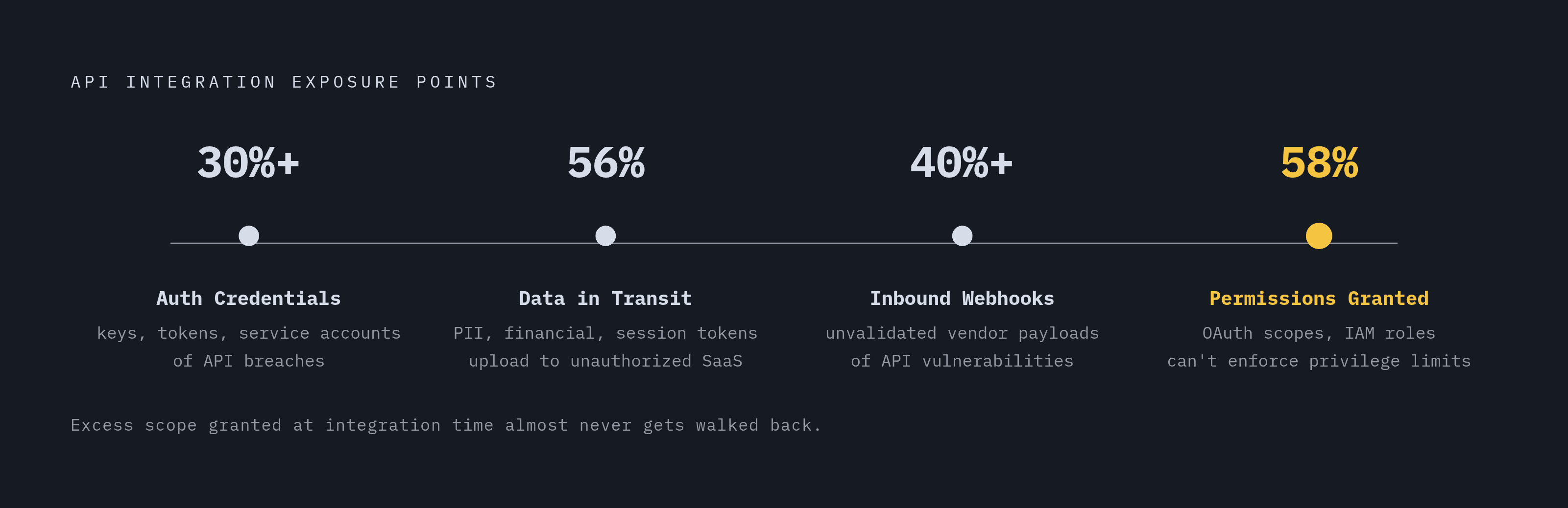
Before any review can be scoped properly, four exposure points need mapping.
First, authentication credentials: API keys, OAuth tokens, service account credentials sitting in code, in environment variables, or in a secrets manager if you're lucky. Second, data in transit: what you're actually sending to the third-party endpoint, whether that's PII, financial records, or session tokens, and whether you have any real control over what they do with it afterward. Third, inbound webhooks and callbacks, meaning payloads the vendor pushes back into your system that your code then processes, often with far less validation than anyone assumes. Fourth, the permissions you've granted: OAuth scopes, IAM roles, API permissions, usually broader than the integration needs, because narrowing scope takes effort nobody budgeted for.
These four points aren't abstract risks. SQ Magazine attributes over 40% of API vulnerabilities to broken object-level authorization, and integrations are a natural home for BOLA, since they lean on object references your application trusts without re-checking. Misconfigured authentication, per the same reporting, factors into over 30% of API breaches, and the integration setup step, done once at launch and rarely revisited, is exactly where those misconfigurations get born and left alone. SaaS companies report API vulnerabilities as a factor in 70% of security incidents, with multi-tenant architecture named as a contributor: integrations touching tenant data without tenant-scoped auth controls make that exposure worse, not better.
Then there's the overprivilege problem. CSA's 2025 SaaS benchmark found 56% of respondents had employees uploading sensitive data to unauthorized SaaS apps, and 58% said they struggled to enforce privilege limits at all. Excess scope granted at integration time almost never gets walked back later, since nobody schedules a meeting to shrink permissions that are already working fine.
So the gaps a real review needs to close are specific: undocumented data flows, token permissions with no ceiling, webhook payloads nobody's validating, and zero ongoing visibility once the thing is live and humming along in production.
Vendor security assessment before the integration is approved
This is the highest-leverage moment in the entire process, because it's the only stage where walking away costs nothing. Once the integration is wired into production, every later fix costs engineering time, coordination, and risk tolerance you didn't want to spend.
Request the following from any vendor before approval:
- A current SOC 2 Type II report or ISO 27001 certificate — an actual audited document, not a self-attestation or a slide deck.
- A penetration test summary from a third-party test conducted within the last 12 months.
- A data processing agreement that specifies what data they store, how long they keep it, and under what conditions it gets deleted or shared.
- An incident response SLA: how fast they notify you of a breach, and through what channel.
- A subprocessor list: who else touches your data downstream of them, and whether those subprocessors carry equivalent certification.
If a vendor can't produce a current SOC 2 report or equivalent, treat that integration as elevated risk by default. That doesn't mean automatic rejection; it means compensating controls and tighter scrutiny going forward.
Beyond the paperwork, a handful of questions separate vendors who take security seriously from ones who've just learned to say the right words. Do they support OAuth 2.0 with granular scopes, or is it one long-lived API key for everything? Do they sign webhooks with HMAC-SHA256 or something equivalent? Can credentials be rotated or revoked on your end without a support ticket and a phone call? Do they publish a security changelog, or disclose CVEs affecting their platform when they happen?
Risk-tier vendors by what they touch and how deep the access goes. A read-only analytics integration and one that can write records into your database or trigger a financial transaction are not the same category of risk, and the review depth has to scale with that difference. Document the outcome either way, approved or rejected, in a vendor risk register. That record matters for SOC 2 CC9.2 and ISO 27001 Annex A control 5.19, and auditors will ask for it whether or not the integration ever shipped.
Scoping the technical review: authentication controls and credential handling
Authentication review splits into two distinct questions: how does your system authenticate to the third-party, and how do you verify that whatever comes back actually originated from them and not an impostor?
Start with credential storage. API keys and tokens should never appear in source code, git history, or a client-side bundle; scan the repository before the integration ships and after, not just at merge time. Secrets belong in a proper secrets manager, AWS Secrets Manager, HashiCorp Vault, GCP Secret Manager, with rotation policies attached. Environment variables sitting in a CI/CD config file are one of the most common misconfigurations found in this space, largely because they're convenient and nobody circles back. Check git history explicitly, too: a secret that was committed and then deleted still exists in that history and can be pulled out by anyone who bothers to look.
OAuth implementation deserves its own pass. Confirm the integration requests only the minimum scopes it actually needs, since over-scoping is the default outcome, not the exception. Confirm access tokens live server-side only and never touch the browser or show up in logs. Confirm the state parameter gets used and checked during the handshake, or the whole flow is open to CSRF. And confirm refresh tokens rotate on use, with revocation that actually works end-to-end rather than just returning a 200 and doing nothing.
Webhook signature verification is non-negotiable. Every inbound payload should get checked against a shared secret using HMAC before your application touches it. Skip that step, and anyone who finds your webhook endpoint can push whatever payload they want straight into your processing pipeline. Timestamp validation matters here too, because a valid signature on a stale, replayed payload is still an attack, just a slower one.
Token lifecycle controls close the loop: credentials scoped to the minimum permission set, tied to a non-human service account with no other privileges attached, and set to revoke automatically the moment the integration gets decommissioned. The most common finding at this stage is mundane: credentials provisioned once, at setup, and never rotated since, because nobody defined a rotation process in the first place. Build that into the integration spec from day one, not as a cleanup task for later.
Mapping data flows and identifying what the integration actually exposes
Before any code review starts, write down, in plain language, what data goes out to the third-party endpoint and what comes back. This sounds like a basic step, but it rarely gets done in practice.
Once teams actually map it, the discoveries are consistent. Entire user records get sent when the integration only needed a user ID and an email address. Financial or health data ends up in the payload because passing the full object was easier than trimming it. Logging integrations capture PII or session tokens in structured fields without anyone noticing. Error reporting SDKs serialize exception objects that include full request bodies, sensitive fields and all.
CSA's 2025 SaaS benchmark found 63% of respondents reported external data oversharing. The mechanism behind that number is rarely a deliberate decision to overshare; it's an unmapped payload field that slid through because nobody stopped to ask if it was necessary.
Data minimization has to be a discipline, not a suggestion. For every field sent to a third party, there should be a documented reason it's there, and the default should be to leave it out. Then classify by sensitivity and apply matching controls: PII and health data need a DPA that explicitly covers that category, with storage and retention limits spelled out in the contract, not implied. Financial data needs an honest look at whether the integration pulls you into PCI DSS scope. And credentials or tokens should never transit a third-party endpoint at all; if one shows up in a payload, that's a critical finding, full stop.
Multi-tenant SaaS adds another layer. Confirm tenant A's data can't leak into a response or webhook meant for tenant B. Integration libraries that cache responses without tenant scoping are a known failure mode, and they fail quietly until they don't.
The output of this whole exercise should be a data flow diagram, one per integration, kept as a living document that gets updated whenever scope changes. That diagram matters for internal hygiene, and it's also the artifact SOC 2 and ISO 27001 auditors will want to see.
Trust boundary controls: how your application processes what the third-party sends back
Here's the inversion most teams miss: they trust the response coming back from an API they called, as if calling it themselves somehow makes the response safe. That response can be attacker-controlled if the vendor gets compromised, misconfigured, or spoofed somewhere along the way.
Server-side request forgery is the clearest example. If your application takes a URL or endpoint from a third-party response and then makes a server-side request to it, that's an SSRF surface, plain and simple. It shows up most often in integrations that accept media URLs, redirect targets, or webhook destination addresses supplied by the vendor. An attacker who can influence that value can use it to reach internal services, cloud metadata endpoints like AWS's instance metadata at 169.254.169.254, or other integrations sitting quietly on your internal network. The fix is an allowlist: your server-side HTTP client should only be permitted to contact known domains, and request targets should never come directly from third-party-supplied values without validation first.
Injection is the same story with a different shape. Data returned from a third-party API and dropped into a database query, an HTML template, a shell command, or an XML parser needs to be treated as untrusted, exactly the way you'd treat raw user input. Vendor-supplied strings rendered into your UI without encoding are a real XSS vector if that vendor ever gets compromised. A vendor response field inserted straight into a SQL query without parameterization is exploitable the moment that vendor's data stops being trustworthy, which is precisely the moment you won't see coming.
Insecure deserialization deserves a specific mention. Integrations consuming serialized objects, Java serialization, Python pickle, PHP serialize, are candidates for remote code execution if that deserialization isn't hardened. JSON-based APIs carry lower risk but aren't immune; schema validation before deserialization is the baseline, not the ceiling.
A handful of response validation controls close this out: schema validation on every inbound payload, rejecting or sanitizing anything with unexpected fields or types; size and rate limits to stop payload-based denial of service; and TLS certificate pinning or strict hostname validation on the outbound call to guard against man-in-the-middle. This is also, notably, where whitebox access, actually reading the code that processes third-party responses, turns up findings a black-box scan of the vendor's API surface will never catch.
Incorporating third-party integration review into the pen test scope
Most penetration tests are scoped to an organization's own application endpoints. Integrations with third-party APIs get excluded, or treated as out of scope, often because the tester has no access to the vendor's infrastructure and nobody thought to draw the line differently.
Scoping a pen test to actually cover integrations means naming them explicitly. Include the code paths that process third-party responses, since that's where SSRF, injection, and deserialization findings live. Include the credential storage and secrets management implementation as its own target. Include webhook receivers: can an attacker send a crafted payload to that endpoint without a valid signature and have it processed anyway? And include the OAuth flows themselves, checking for CSRF on the authorization callback, token leakage in logs or referrer headers, and improper state validation during the handshake.
There's a drift problem here too. A pen test conducted twelve months ago didn't review the two integrations added in Q2, and it didn't review the expanded OAuth scope your team accepted without much thought when upgrading a vendor plan. Verizon's 2025 DBIR found vulnerability exploitation now involved in 20% of all breaches, up 34% year over year, and that trend lines up exactly with this kind of drift: the attack surface keeps moving while the last audit sits frozen in time.
The practical fix is maintaining an integration inventory, the same data flow diagrams built during the mapping stage, and requiring that any integration added or materially changed since the last test gets explicitly named in the scope of the next one. Retesting matters here in a way that's easy to underestimate. A vulnerability in how your application handles a third-party response can get fixed at the code level and still linger in a cached layer, a microservice that never picked up the update, or a forked environment nobody remembered existed. Confirming the fix actually took, everywhere it needed to take, is the last step that makes the whole review worth running in the first place.