Security Regression Testing After Vulnerability Remediation
Retesting confirms fixes actually work before you trust them in production.

Remediating a vulnerability is a claim, and claims need evidence. A retest is what turns "we fixed it" into something a security team, an auditor, or a customer can actually rely on, and skipping it is the single most common way remediation budgets get wasted.
Per Indusface's State of Application Security report, 32% of critical vulnerabilities remain unresolved even after 180 days. Patches weren't available, the vulnerable code lived inside third-party dependencies nobody owned, or engineering bandwidth got eaten by everything else on the roadmap. The gap between "we triaged this" and "we confirmed it's fixed" is exactly where risk piles up quietly, on findings the organization already paid to discover. Trace, an AI-plus-human pen testing service, builds verified retests into its engagements for exactly this reason.
Google Mandiant's 2024 data puts a clock on that gap. Median time-to-exploit has dropped to five days after disclosure, with twelve percent of vulnerabilities weaponized within 24 hours and 29% within a week. A finding that sat in a backlog for a month, then got "fixed" without verification, may have been exploitable at several points along that timeline. Security regression testing closes that loop with a targeted, manual retest of the specific fix against the specific finding that produced it.
What security regression testing actually means in a pen test context
Software regression testing and security regression testing sound like cousins, and people mix them up constantly, but they check for different failures. QA regression testing asks whether new code broke an existing feature. Security regression testing asks whether a fix broke the security guarantee it was supposed to deliver, or worse, opened a new path in somewhere else.
A proper retest stays scoped to the original finding, the component that got patched, and whatever surrounding attack surface the fix might have touched on its way through the codebase. Running the whole engagement again wastes budget and buries the signal that actually matters.
Automated vulnerability scanning is good at matching known signatures against a patched build, and that's about the limit of what it's good for. It won't replicate the chained logic a human tester used to link three low-severity issues into one high-impact exploit, and it won't catch a business logic flaw that never had a CVE to begin with. Anyone treating a clean rescan as proof of remediation is trusting a tool to do a job it was never built for.
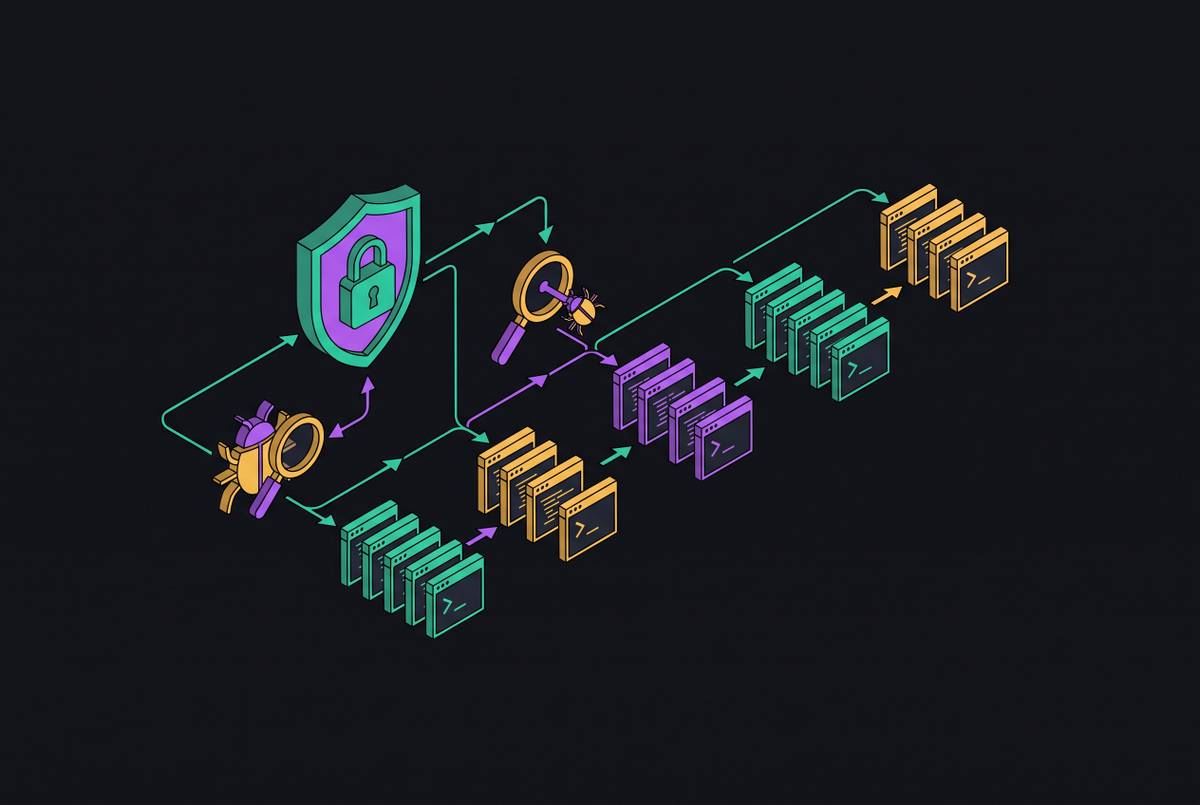
A retest that's worth the name does four things:
- Reproduces the original exploit against the patched version, confirming it no longer fires
- Probes variant attack paths: same vulnerability class, adjacent inputs, related parameters the fix might not have touched
- Checks whether the remediation itself introduced new exposure, like a patch that adds a bypass or a refactor that relocates the flaw instead of removing it
- Produces a written confirmation tied back to the original finding ID
None of that works if the original finding was vague. A pen test report that says "SQL injection possible in login flow" without exploit steps or affected parameters can't be retested with any precision. Report quality and retest quality are the same problem wearing two hats.
The ways fixes fail that a retest is designed to catch
Fixes fail in specific, recurring ways, and every one of them requires a human eye rather than a signature match.
Incomplete remediation is the most common: a developer patches the reported endpoint, but the same vulnerable function gets called from a second location nobody flagged. Fix displacement is sneakier. A SQL injection closed in a web form reappears in a background API that handles the same input field, because the underlying query logic never actually changed; it just moved.
Refactoring causes its own regressions, and this happens more than anyone likes to admit, especially in codebases with thin test coverage. A team touches surrounding code for unrelated reasons and reintroduces a flaw that had been closed in a prior cycle. Logical bypass is the classic pen tester's move: the fix blocks the exact payload demonstrated in the report, but not the underlying condition, so a slightly different input reproduces the same impact.
Third-party dependencies add a layer teams don't fully control. If the vulnerable component is a library, the "fix" might just be a workaround holding until the next upstream release. Configuration drift is the quiet one: code gets patched correctly, staging tests pass, but the environment variable or infrastructure setting that production actually runs on never got updated. The fix exists in code; it just isn't live.
A scanner rerunning the same check against a patched build will report "resolved" on a fix that a human tester, working from the original exploit logic, would break in five minutes. Skipping the manual step produces that outcome by default.
How to scope a security regression test so it's neither too narrow nor too broad
Start from blast radius, not location. The original finding lived somewhere specific, sure, but the real question is what else touches that same code path. What systems or data flows intersect it, what other inputs feed the same vulnerable function, and what did the actual diff look like when the fix went in? Does that change interact with anything upstream or downstream?
Severity should shape depth, not just priority order. An unauthenticated remote code execution finding earns a retest that goes hunting for adjacent paths and checks the fix across every environment it runs in, staging and production both. A medium finding, like missing rate limiting on a low-value endpoint, usually just needs confirmation that the control exists and does its job. Treating both with the same depth of effort is how retest budgets get burned on the wrong findings.
Build the retest scope straight from the pen test report: one line per finding, listing the original exploit steps, the remediation applied, and the exact checks the retester needs to run. Define what "pass" looks like before anyone touches the system, not after. Pass means the original exploit fails, the variant attempts fail, and nothing new surfaces as a side effect of the fix.
Keep retests and re-engagements separate. A retest closes confirmed findings; new discovery belongs to the next full engagement. If a tester stumbles on something unrelated during a retest, that goes on the list for next time, not into scope creep on this one.
Timing matters more than people expect. Retest as close to the remediation date as the schedule allows. The longer the gap, the more the surrounding code has shifted, and the harder it gets to isolate what the fix actually did versus what six other commits did in the meantime.
Where security regression testing fits in a CI/CD pipeline
A retest confirms a fix at one moment, but it says nothing about whether that same vulnerability creeps back in three sprints later when someone touches the file again, maybe without knowing what used to live there.
The fix for that is to treat every verified remediation as a permanent test case. Once a SQL injection path gets confirmed closed, add a test that exercises it directly. If a future pull request breaks the parameterization that closed it, the test fails in CI before the code ever reaches production. That's the mechanism that turns a single pen test finding into a lasting security asset instead of a ticket that gets closed once and forgotten.
Automated SAST, DAST, and dependency scanning in CI/CD catch known patterns well, but they don't replicate the business logic findings or chained exploits a manual pen test surfaces. Neither layer replaces the other, and organizations that lean entirely on one or the other are leaving a specific, predictable gap open. Pull-request-level scanning gives developers a feedback loop that actually means something: they see the security consequence of a change before merge, not eleven months later when the next annual test rolls around.
The scale of the problem backs this up. 48,185 new CVEs were published in 2025, a 20.6% jump over 2024's roughly 40,000. Every CI/CD gate that catches a regression before it ships shrinks the surface each new CVE has to land on.
Practically, this means tagging affected files or functions in the pen test report so tooling can flag future changes to those exact locations, feeding pen-test-derived test cases into the security suite rather than just QA, and requiring a signed-off security retest before a critical or high finding gets marked closed in the tracker. Full stop, with no exceptions for "looks fine."
What auditors actually need to see when a pen test finding gets remediated
Auditors don't want the pen test report alone. They want proof that findings got fixed and that the fix actually held up under pressure.
For SOC 2, that proof is a retest report mapping each finding to its remediation and confirming closure. A closed Jira ticket doesn't cut it: there's no way for an auditor to know from a ticket status whether anyone verified anything, and a good auditor will ask the follow-up question that exposes the gap.
ISO 27001's Annex A Control 8.8 requires organizations to assess technical vulnerabilities and act on the results. Retesting is the piece that proves "acted on" meant "confirmed resolved," not "assigned to a developer and moved on." Healthcare organizations should also take note of the proposed 2025 HIPAA Security Rule update, which would make annual penetration testing an explicit requirement for covered entities and business associates. Anyone in that sector without a formal retest process is behind where the rule is headed, not just behind best practice.
The documentation chain auditors want, laid out plainly:
- The original pen test report, with finding IDs and severity ratings intact
- A remediation record tied to each finding ID, whether that's a commit, a pull request, or a config change
- A retest report or signed letter confirming closure, finding by finding
- A timeline showing reasonable time-to-remediate for each severity level
Here's the efficient part: a single, well-scoped pen test with documented retests can satisfy SOC 2, ISO 27001, and HIPAA evidence requirements at the same time. Scope the engagement to cover the superset of what each framework asks for, map findings to each one, and retest once instead of three separate times for three separate auditors. A retest that satisfies an auditor is the same retest that confirms real risk is gone.
What to look for in a pen testing vendor's retest process before you sign
Ask this first: does retest access come bundled into the engagement, or does the vendor bill separately for it? A vendor charging extra to confirm their own findings got fixed has a built-in incentive to find things and then charge again to close them out, which is a conflict of interest dressed up as a line item. Walk away from that pricing structure; it's a signal about the whole relationship.
Ask who runs the retest next. If it's not the same tester who found the original vulnerability, that person is walking in without context. They'll check the exact exploit from the report and stop there, because they have no reason to go looking for the variant paths someone with full context would think to try.
Ask what the deliverable actually looks like. A written report closing each finding by ID is an artifact worth keeping. A verbal "we checked, it's fine" over a call leaves auditors with nothing to point to.
A few red flags are worth walking away from outright: no defined retest window, so the engagement just ends at report delivery and retesting becomes a separate negotiation later; retests handled entirely by an automated rescan rather than the human who found the issue; no process for partial fixes, where a finding that's 80% remediated just gets marked closed anyway.
Beyond the retest stage specifically, a few signals predict how the whole engagement will go: findings backed by working exploit proof, not just a description of "potential" risk, since only a reproducible finding can be verified closed; testers holding credentials like OSCP, which require actual hands-on exploitation skill rather than a multiple-choice exam; reports mapped to a public methodology like OWASP WSTG or PTES, giving the retest a shared reference point everyone can work from; and a live communication channel during the engagement, since retesting partial fixes always generates back-and-forth that email threads handle poorly.
Skipping the structured retest process leaves half the job undone. The finding gets identified, and the loop never closes.
Building a remediation and retest workflow that compounds over time
Something interesting happens after two or three cycles of this: verified fixes stop being isolated data points and start forming a picture. Repeated injection findings show up in one service. Recurring access control failures show up in another. Those patterns tell an engineering org where its architecture, not just its code, has a weakness, and that's a different kind of decision than patching one endpoint.
Time-to-remediate by severity, tracked across cycles, is a metric worth putting in front of leadership. The useful question isn't whether things are getting fixed, which is a low bar. It's whether criticals are getting fixed faster than they were a year ago. That's a trend a CISO or CTO can bring to a board meeting as actual evidence of a functioning program.
A lot of organizations run the same annual pen test and rediscover the same vulnerabilities, year after year. That's the checkbox cycle, and it's expensive in ways that don't show up on an invoice. It's also, plainly, a failure of process rather than bad luck. Verified retests paired with CI/CD integration are what break it.
For a growth-stage SaaS company, the arc tends to look something like this. Year one: run the first pen test, remediate what it finds, verify with retests, and produce the compliance artifacts that come with it. Year two: scope the next engagement using patterns from the first, and add CI/CD scanning specifically on the components that kept surfacing repeat findings. From there, it's an annual point-in-time test running alongside continuous pull-request scanning, where the annual test hunts new attack surface and the continuous layer stops old vulnerabilities from sneaking back in.
The goal, stated plainly: "we fixed it" should always come with "and here's the retest that proves it held." That discipline, more than any single tool or vendor, separates a security program that actually improves over time from one that just finds the same holes on repeat.