Integrating AI Security Testing Into an Existing AppSec Program
AI AppSec layers filter noise and speed triage, but humans stay essential for logic flaws.
Jira queues are filling faster than security teams can clear them, and the gap is widening every sprint. That is the real story behind "AI is changing software development": the volume of code, dependencies, and risk entering the pipeline has outpaced the speed at which humans and static gates can review it. Three specific sources drive this surge: new open-source dependencies that AI coding tools pull in automatically, static analysis findings introduced by AI-written code changes, and secrets that end up embedded directly in generated code. None of these are new categories of risk. What's changed is how fast they accumulate.
Look at a payment API flaw that an AI-assisted code change created. It passed every static check in place at the time, and only runtime validation against real execution paths caught it. OX Security points to this case as a pattern now repeating across industries: the scanner said the code was clean, and the code still broke in production.
Corgea's 2026 AI AppSec guide names the actual bottleneck directly. It isn't a shortage of scanners. Most teams already run SAST, DAST, SCA, and more. The bottleneck is triage and remediation, and specifically whether a team can do both at the speed code actually ships. When that speed mismatch sets in, tickets sit untouched in Jira, CI gates get skipped because nobody has time to investigate what tripped them, and security findings start getting treated the way an inbox treats spam: filtered out rather than read.
What a mature AppSec program already contains
Most AppSec programs already have the right layers. SAST, DAST, software composition analysis or dependency scanning, infrastructure-as-code scanning, and periodic pen testing cover different parts of the attack surface, and each one has a specific weak spot that AI tooling is now positioned to address.
SAST runs early and cheap, so it catches issues before the code ever reaches a running environment. Its weakness is a high false-positive rate that buries developers in findings that don't hold up, leading them to mute the tool. Checkmarx's 2026 overview of AI security testing platforms states that static coverage works best paired with dynamic validation, because static analysis alone can't confirm how code actually behaves at runtime or whether a business logic flaw exists.
DAST fills part of that gap. It catches runtime-only issues and business logic flaws that static analysis structurally cannot see, since it tests the application as it actually runs. The tradeoff is setup cost: DAST needs a live environment and authenticated scanning configured correctly, and it can only test what it can reach. Anything outside its configured scope stays invisible.
Dependency scanning faces a newer version of an old problem. As AI-generated applications pull in open-source libraries automatically, tracking what's actually in a codebase by hand becomes impractical. OX Security says supply-chain exposure has to be a core requirement of any current AppSec program, not an option you add later.
A human tester backs pen testing and proves exploitability instead of just flagging a possibility, which puts it at the deepest layer. Its limit is timing: a pen test is point-in-time by nature. It evidences a specific, scoped set of systems on a specific date. It says nothing about the weeks before the engagement or the weeks after.
Across all four layers, the same failure repeats. None of these tools correlate findings with each other. A SAST finding, a DAST finding, and a dependency alert sit in separate dashboards, and without cross-layer context, nobody can answer the question that actually matters: is this exploitable?
What AI tooling does inside each AppSec layer
AI hasn't created a new category of AppSec tool. It's added a set of capabilities, false-positive suppression, exploitability scoring, automated fix generation, and cross-layer correlation, that sharpen the signal coming out of tools teams already run.
Inside SAST specifically, Corgea describes AI models that re-analyze flagged findings with deeper code context: data flow, control flow, and framework-specific sanitization patterns the original static rule couldn't account for. The model suppresses findings that aren't actually exploitable given that context. The practical effect is simple: developers start looking at what's left in their queue, because what's left has a better chance of being real.
Corgea also lays out a fix-generation pipeline, and it ties the layers together end to end. A vulnerability gets ingested from SAST, DAST, or SCA output. The system retrieves code context around the flagged location. An LLM generates a fix aimed at the root cause, not just the symptom. That fix runs back through static validation to confirm it holds up. Then a pull request gets created, with an explanation of what changed and why, so a human reviewer isn't starting from zero.
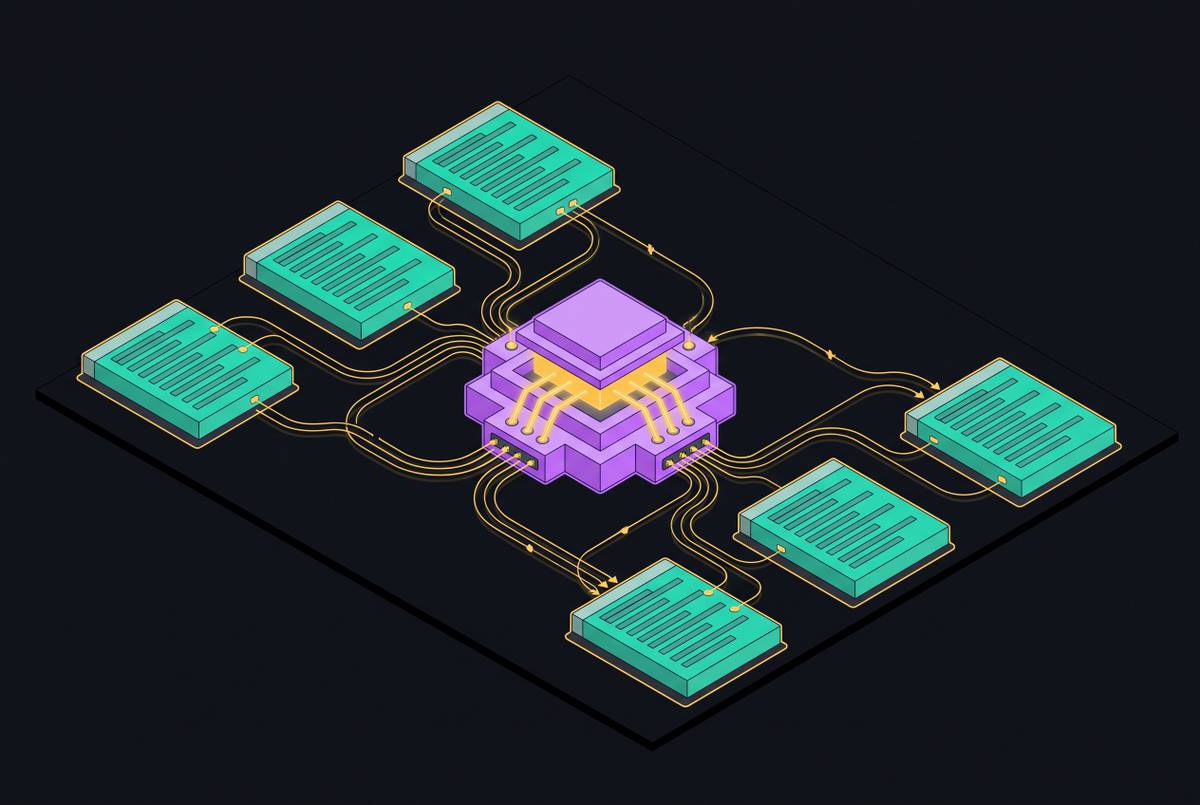
The same correlation logic applies across layers, not just within one. AI platforms can tie findings across code, open-source dependencies, configuration files, and container images together, turning a pile of isolated scanner outputs into a single picture of what's actually exploitable.
Threat modeling benefits in a quieter way. Corgea notes that AI eliminates the stall that happens when a team sits down to threat-model and doesn't know where to start. That makes it realistic to threat-model more often, instead of once per major release, which is how many teams have historically treated it. AI doesn't replace a seasoned threat modeler here. It gives that person a faster starting point.
None of this works the same way across every tool on the market, and the difference comes down to one question: was the model fine-tuned on security-specific data, or is it a general-purpose LLM wearing a security prompt? Corgea draws a sharp line between the two outcomes. One produces a noisy annotation machine, and developers mute it within a week. The other explains data flow paths clearly enough that a developer can verify the reasoning, not just accept the verdict.
Black Duck's 2026 AppSec predictions put AI-powered vulnerability scanning and predictive analytics alongside two other priorities: fortifying software supply chain practices, and building a workforce with real AI security expertise. Black Duck also flags the other side of that coin. Attackers use AI too, which turns defensive AI investment from a nice-to-have into something closer to a requirement just to stay level.
AI Tooling's Coverage Gaps and Noise
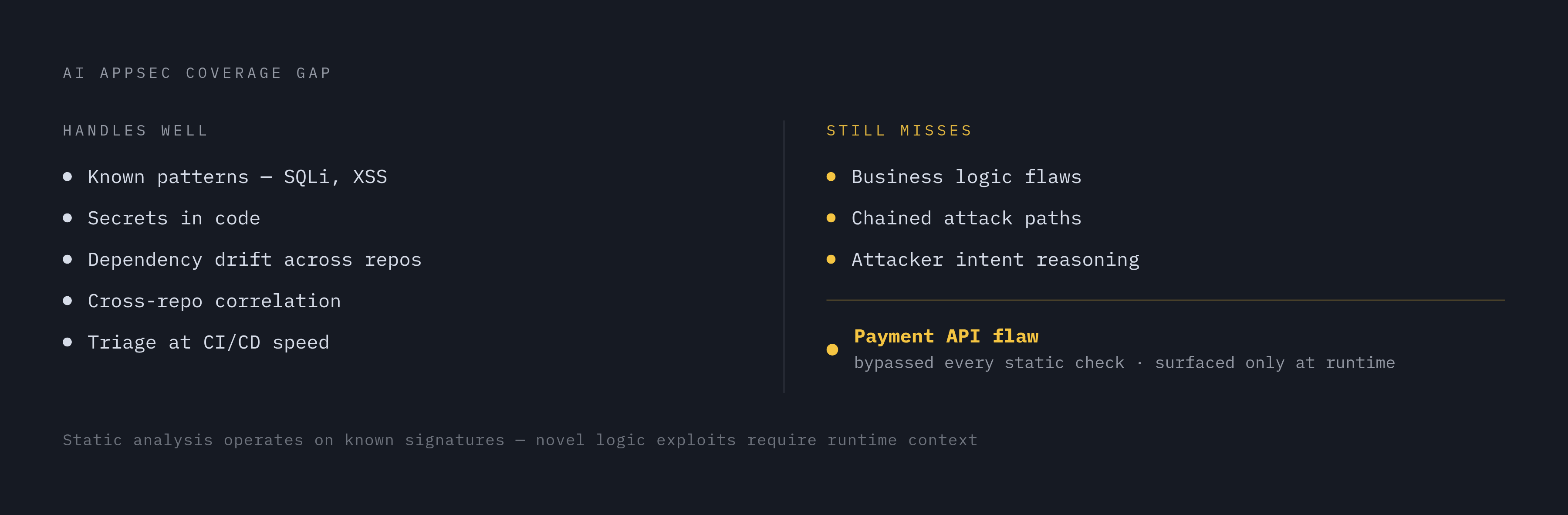
AI tooling earns its keep on high-volume, pattern-recognizable work. But it falls short when you need to reason about attacker intent or chain several small issues into one real exploit.
What it handles well is concrete: known vulnerability patterns like SQL injection and XSS, secrets accidentally left in code, dependency drift across repos, cross-repo correlation, and triage at the volume and speed CI/CD actually runs. These are tasks where matching against a large training corpus of known-bad patterns is enough to get the job done.
What it still misses matters just as much. Business logic flaws and chained attack paths need contextual human reasoning, and pattern matching can't give you that. The payment API flaw from OX Security bypassed every static check in place and only surfaced through runtime validation against real execution paths. No amount of pattern training closes that kind of gap, because the flaw wasn't a known pattern. It was a new one.
AI tooling also drags its own risks into the picture. Black Duck points out that securing AI systems across their lifecycle is a new problem on its own: AI models and LLMs are vulnerable to data poisoning and prompt injection. If you add AI tooling to an AppSec program, you cover a new attack surface, not just old gaps.
Agentic AI, autonomous systems built for complex decision-making, is starting to detect and respond to threats without a human triggering every step. Black Duck treats this as a capability still maturing, one that raises new trust and governance questions.
A reasonable skeptic might push back here: if AI reduces false positives, shouldn't it reduce false negatives too? The two aren't the same problem. Suppressing false positives means recognizing a known-bad pattern reliably. So catching false negatives means catching a genuinely novel attack path, one that wasn't in the training data to begin with. Getting better at the first doesn't automatically improve the second.
Runtime Context, CI/CD Integration, and the Triage Calculus
Static findings alone can't carry triage decisions anymore. OX Security describes teams leaning on behavioral telemetry and exploitability data instead, because runtime signals looped back into development make remediation precise and tied to how the application actually behaves, not how it looks on paper.
CI/CD integration makes that loop operational. Checkmarx describes testing that runs automatically on every commit, pull request, and build, with AI helping prioritize the highest-risk findings and tune scan performance so security checks don't slow down delivery. The scan happens whether or not anyone remembers to trigger it.
Pushing security into the IDE and the PR workflow moves detection earlier in the lifecycle, and earlier detection is cheaper to fix by a wide margin. Checkmarx also describes agentic AI assistants that give developers real-time feedback as they write code, so you get organizational security policy enforced the moment code gets typed, not weeks later in a review queue.
OX Security lays out five trends it expects to define AppSec in 2026: AI-driven analysis, container security across the full lifecycle, zero-trust design, constant testing built into DevSecOps rather than bolted onto it, and dependable SBOM adoption. Every one of these demands continuous validation.
That continuity matters most at the dependency layer. A service deployed today may rely on a library an AI assistant introduced yesterday, one that doesn't appear in any legacy inventory because the inventory was last updated before that dependency existed. OX Security treats SBOM lineage and runtime context as prerequisites now, not nice-to-haves, because without them there's no reliable way to know whether a given finding is even live in production.
Where human expert judgment remains non-negotiable
Human review proves exploitability, validates chained attack paths, and produces findings an auditor or a customer's security team will actually accept as evidence.
Scanners, AI-augmented or not, can't find certain classes of flaws. Business logic problems and chained attack paths need reasoning, and a pattern-matching model doesn't do that. Automated tools can't test human factors, can't reliably demonstrate that a theoretical issue is actually exploitable in production, and don't bring the intuition and creativity a skilled human tester brings to a live engagement.
The standard that separates a real finding from an unverified maybe is a working proof-of-exploit. For a web vulnerability, every finding worth acting on should come with a curl command or a short Python script that demonstrates the exploit; for a logic flaw, it should come with a documented step-by-step sequence that reproduces it. A finding that can't be confirmed to work shouldn't appear in a final report.
Auditors want that proof increasingly often, not just a list a scanner spat out. A human-signed attestation is what satisfies SOC 2 CC4.1, ISO 27001 Annex A controls A.8.8 (management of technical vulnerabilities) and A.8.29 (security testing in development and acceptance), and the proposed HIPAA annual pen test requirement, if it's finalized. None of these frameworks accept an automated scan report as a substitute for a signature a named, credentialed person stands behind.
AI-powered SAST and DAST tools raise the quality of what reaches a human reviewer, cutting the noise and surfacing findings more likely to be real. They can't sign off on those findings in a way that carries weight with a customer's security team or a compliance auditor. That signature requires a certified human expert, OSCP, CREST, or an equivalent credential. CREST's own equivalency program, built in partnership with OffSec, formally recognizes OSCP and OSCP+ as meeting the requirements toward its Registered Tester qualification, which is the industry's own way of saying these credentials represent the same bar of proven, hands-on skill.
Full access to source code, cloud configuration, and product documentation, a whitebox engagement, gives both AI tools and human testers their widest possible view of the attack surface. AI tools benefit from that access. A human expert working with the same access can reason about architecture and intent in a way a pattern-matching model structurally cannot, because intent is a judgment call about what a system was built to do and where that intention breaks down.
Continuous pull-request scanning is good at catching known-pattern regressions as they get introduced. But it doesn't replace a structured engagement, where a skilled tester maps the full attack surface, chains individual findings into a real attack path, and proves impact from start to finish.
Mapping your existing program: which layer gets AI augmentation first
Start wherever the volume problem is worst. For most teams, that's SAST: the false-positive rate is high enough that developers have already started ignoring findings, and AI-driven re-analysis with deeper code context delivers an immediate, measurable improvement in what actually gets reviewed. If your team runs SCA at scale on AI-generated codebases, prioritize dependency correlation next, because that's where legacy inventories are most likely to miss something an AI assistant introduced last week.
DAST and IaC scanning benefit from AI-assisted prioritization, but they depend on runtime and infrastructure context that takes longer to wire up correctly. Treat those as the second wave of integration, not the first.
Pen testing shouldn't be automated away at any stage of this rollout. As AI tooling raises the volume and quality of findings reaching the review queue, the human engagement that proves exploitability and signs off for an auditor becomes more valuable, not less. The goal of mapping AI onto an existing program is to make sure the findings reaching the person who signs it are the ones that actually deserve the attention.