Limitations of Fully Automated Penetration Testing Tools
Machines can't replace human judgment when vulnerabilities hide in real-world complexity.
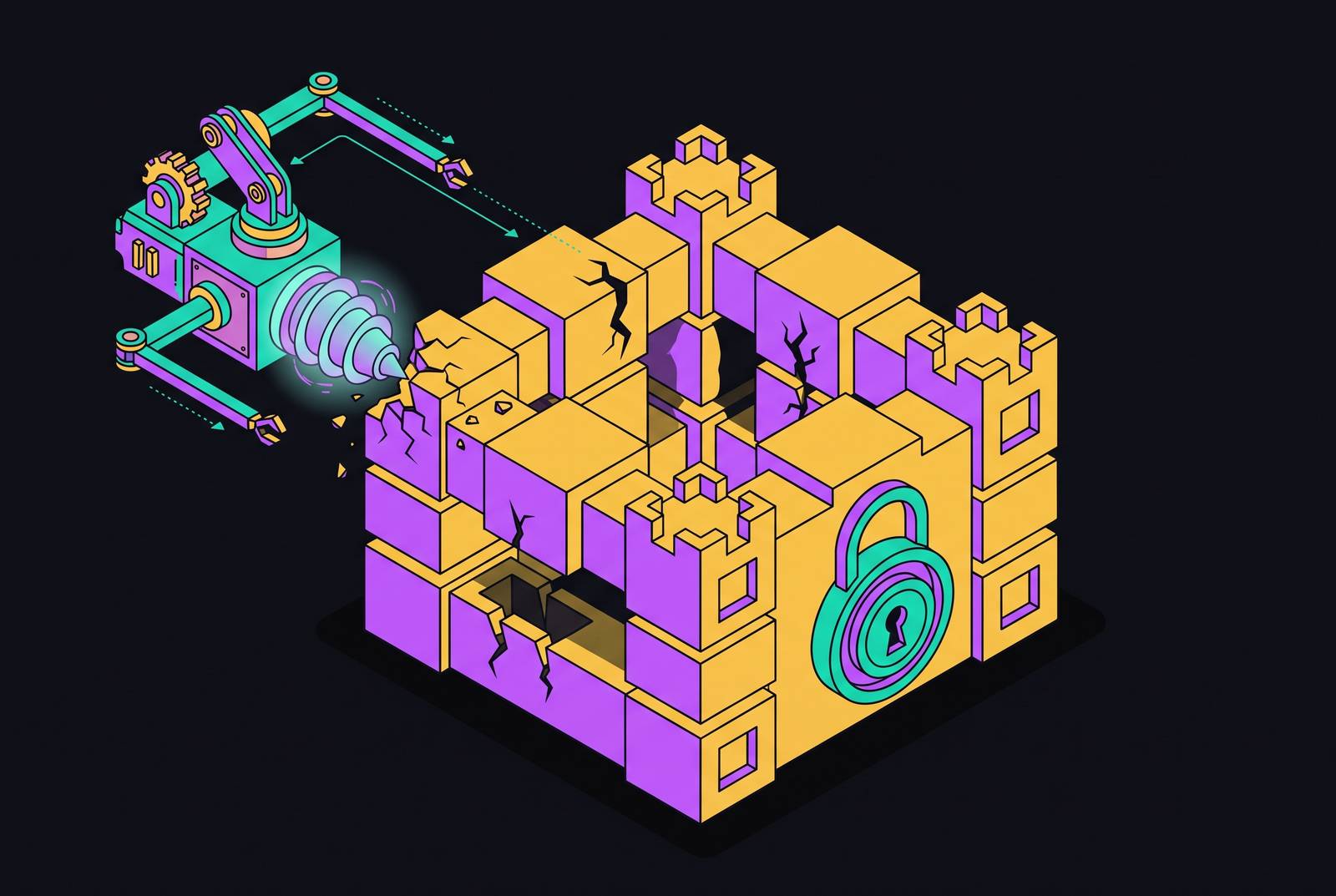
Limitations of Fully Automated Penetration Testing Tools.
Why automated penetration testing tools have proliferated without solving the core assurance problem
Automated penetration testing tools promise speed and coverage that human testers simply can't match, but the tools flooding the market have not settled the question of whether machine-driven testing can actually stand in for human judgment. By March 2026, roughly 70 open-source AI penetration testing tools had been catalogued, up from fewer than five before GPT-4 shipped in April 2023. That's not gradual growth.
The pressure driving this boom is not hypothetical. IBM's 2025 Cost of a Data Breach Report puts the average breach at $4.44 million globally IBM 2025 Cost of a Data Breach Report IBM Cost of a Data Breach Report 2025.
Each does something different. Vendors rarely explain which bucket they're in, and buyers rarely ask. That proliferation has made evaluation harder, not easier. The rest of this piece works through exactly where that gap sits, and why it hasn't closed yet. The 2025 Verizon DBIR found that credential misuse and vulnerability exploitation combined account for over 40% of all breaches, with web applications among the top three most targeted assets, showing that the threat pressure is real and growing Verizon DBIR 2025 XHack Blog - Best AI Pentesting Tools 2026. The market has split into distinct categories that are routinely conflated: autonomous web/API exploitation, autonomous network and attack-path validation, agentic external attack-surface testing, human-led PTaaS, and human-in-the-loop AI testing.
What automated tools do well and the limits of their design assumptions
Give automation its due. Continuous coverage at machine speed, repeatable tests that don't degrade with tester fatigue, scanning across authenticated flows and API surfaces at a scale no human team could sustain, fast retesting after every code push, and a real dent in the backlog of low-hanging-fruit vulnerabilities that eat up analyst time. IBM's 2025 report found organizations using security AI and automation saved close to $1.9 million per breach IBM 2025 Cost of a Data Breach Report. That's real money, and it's proof automation earns its keep when it's pointed at the right problem.
Look at what each category actually does well. Autonomous network and attack-path validation platforms, such as Horizon3 NodeZero, harvest credentials and pivot between hosts to prove out internal attack paths through Active Directory. Agentic external attack-surface tools like Hadrian run continuous discovery against internet-facing assets, catching exposure the moment the attack surface shifts.
Every one of these tools shares the same underlying assumption, though: the vulnerability has to exist in a form the agent recognizes, the attack path has to be reachable from wherever the tool sits, and the finding has to be something machine logic can verify without asking what the business actually needed the application to do. That last part is where things start to break down. Autonomous web/API exploitation agents, such as Escape and XBOW, map application states, follow multi-step user journeys, and surface authorization failures at scale.
The benchmark problem: why tool performance claims don't transfer to production environments
Vendor claims about detection rates come from somewhere, and that somewhere is usually a controlled benchmark, not a live production system. Most automated penetration testing tools get evaluated against Capture-the-Flag challenges or benchmark environments like DVWA and OWASP Juice Shop, according to EPAM's findings. Two problems compound each other here escape.tech petronellatech.com. The targets in these environments are predefined, planted specifically to be found, which bears no resemblance to a production system where the attack surface is genuinely ambiguous. Worse, these same benchmark environments often appear in the training data used to build the AI agents being tested on them, which hands the agent the answer key before the exam starts.
The gap this produces is not subtle. In EPAM's testing, the strongest performer of the group, AWS Security Agent, found fewer than half of the security vulnerabilities actually present. That's the best result in the field, on a benchmark that already favors the tool. EPAM's conclusion from that round of testing was blunt: most open-source automated penetration testing agents aren't production-ready, and they function closer to traditional vulnerability scanners wearing a reasoning layer than genuine replacements for a penetration test.
For a buyer evaluating vendors, the takeaway is straightforward. A benchmark score tells you almost nothing about how a tool will perform against your actual application. The gap between a controlled test environment and a live production system is the risk nobody's quantifying in the sales deck, and it's exactly the risk that matters most.
The false positive drag: why DAST output volume is not the same as signal
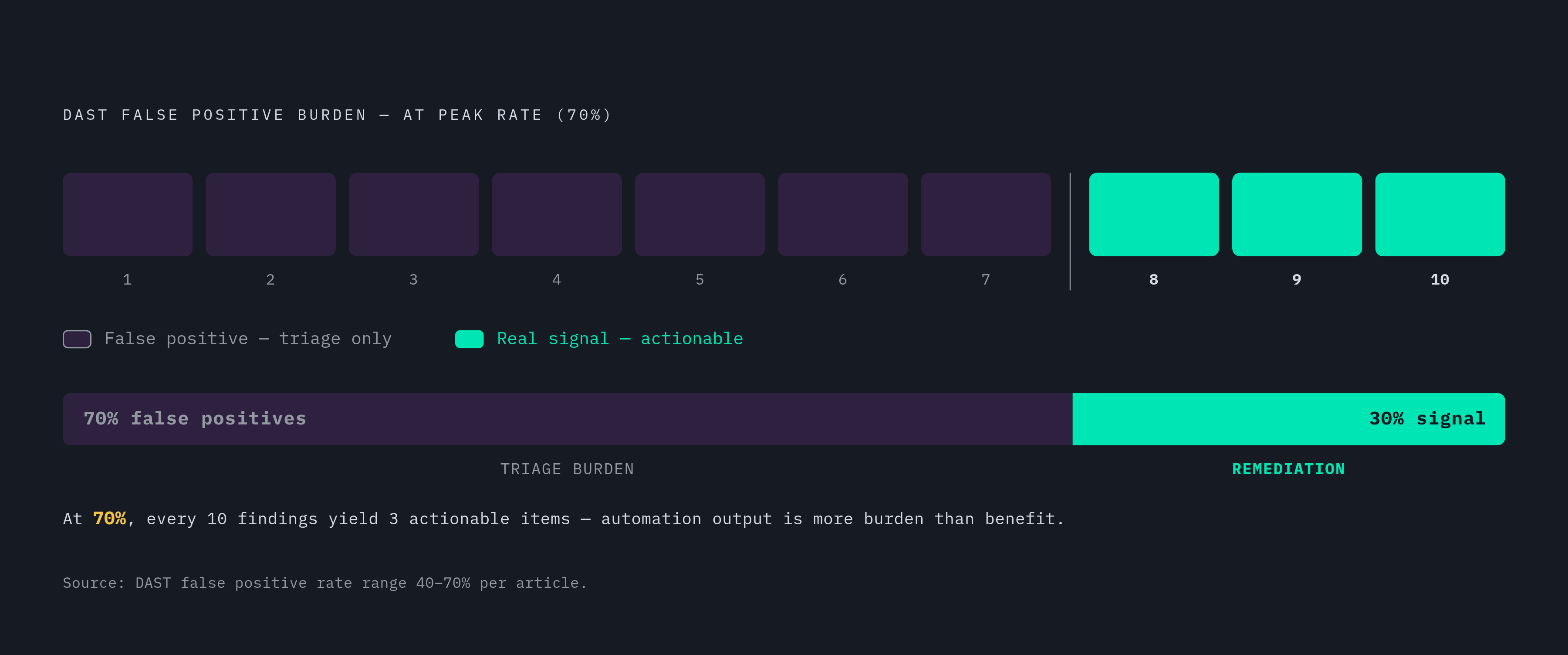
Volume of findings feels like progress until someone has to read through them. DAST scanners, running automated checks against known vulnerability signatures, typically produce false positive rates somewhere between 40% and 70% Verizon DBIR Verizon DBIR 2025 XHack Blog - Best AI Pentesting Tools 2026. At the high end of that range, nearly three out of every four flagged issues need a human to sit down and figure out whether they're real before any actual remediation work can start Verizon DBIR Verizon DBIR 2025 XHack Blog - Best AI Pentesting Tools 2026.
This is also where the line between a vulnerability scanner and a penetration testing tool starts to blur in practice, even though the two are supposed to be different things escape.tech petronellatech.com. A vulnerability scanner, something like Nessus or Qualys, checks a system against a list of known CVEs and spits out a list of what might be wrong, with little to nothing in the way of proof that any of it is actually exploitable. A penetration testing tool is supposed to go further: attempt the exploit, chain the attack paths, confirm the finding through demonstrated exploitation. But once false positive rates climb into the 40-70% range, that distinction gets harder to spot Verizon DBIR Verizon DBIR 2025 XHack Blog - Best AI Pentesting Tools 2026. Intruder's research team put it directly, as quoted by Escape.tech: often when people go looking for an automated pentesting tool, what they're actually looking for is a vulnerability scanner. The confusion isn't just semantic. It costs real time.
Every hour a security team spends triaging false positives is an hour not spent on security work. It's scanner maintenance, dressed up as testing. That's exactly where the efficiency automation was supposed to deliver quietly disappears. Some vendors have built specifically against this problem. Hadrian, for instance, runs event-driven testing triggered by changes to the attack surface, rather than firing off a fixed battery of checks on a schedule, which cuts down on noise considerably. Still, that approach is scoped to external-facing assets, and no version of it removes the need for a human to judge whether a given finding actually represents business risk. Noise reduction is not the same thing as judgment.
Business logic flaws: the category of vulnerability automated tools structurally cannot reach
Some vulnerabilities don't get missed because a tool is unfinished or under-trained. They get missed because catching them requires knowing what the application was supposed to do in the first place, and that's not something you can extract from an HTTP response. This is a structural limit tied to what automated testing can see, not a maturity gap that better training data closes next year.
Take broken access control across multiple user roles: a low-privilege user reaching an admin function the application's logic was meant to block, but where enforcement was applied inconsistently somewhere in the code. Or take an IDOR buried three API calls deep inside a nested endpoint chain, the kind of thing HackerNoon's coverage of Astra's agent design describes: reaching that flaw needs reasoning, not a signature match. Checkout flows and onboarding sequences carry their own version of this problem, where price manipulation or order-state bypasses only look wrong to someone who understands what the transaction was supposed to accomplish.
Even the vendors building tools specifically aimed at this territory are honest about where their scope ends. Hadrian's own comparison listings note that it doesn't focus on detecting deep business logic flaws like BOLA, IDOR, or access control gaps. Burp Suite carries the same limitation: catching BOLA, IDOR, and workflow bypasses still needs a human in the loop. A broader pattern reflects this same limitation. Automated scanners routinely produce risk ratings that don't reflect real, quantifiable business risk, because without asset context a team ends up burning engineering time on low-priority flags while a genuinely dangerous path, one that abuses a compensating control nobody flagged, sits untouched. Business logic is the one category where whitebox access, meaning real access to source code, internal documentation, and the intended user flows, is the only route to full coverage. A tool sitting outside the system has no way of knowing what the inside was built to enforce.
Exploit chaining: why finding individual vulnerabilities is not the same as proving real impact
A real attacker never stops at the first thing they find. An SSRF vulnerability becomes a stepping stone into an internal metadata service, which yields credentials, which opens the door to privilege escalation. The danger was never any single link in that chain. It was the chain itself.
Most automated tools are built to surface individual findings and slap a CVSS score on each one. What they cannot do is build the narrative connecting those findings, the story of what a real attacker would actually do with that specific combination of weaknesses against a specific environment. HackerNoon's assessment of the field doesn't soften this: most tools run a scheduled scan, match the target's stack against a CVE list, and hand over a report an attacker could never act on directly. Genuine autonomous pentesting requires chaining findings into a working exploit and proving the impact end to end.
A handful of tools push further than that baseline. XBOW brings adversarial realism, with exploit chaining and validation built in, though it stays limited to web applications, doesn't scale well for large enterprise environments, and its triaging and remediation support remains thin.
Even the most capable of these platforms produces a chain that a machine validated inside its own isolated agent context. Turning that into something an auditor or a customer will actually trust still takes a human expert reading the chain against the real business environment it's meant to describe. A finding without a working exploit behind it leaves a buyer stuck: no way to prioritize it, no confidence to remediate it, and nothing solid to hand a customer as proof of rigor. Unverified maybes don't belong in a real security report. Horizon3 NodeZero offers proof-of-exploitation, not just theoretical findings, is agentless, and comes with accessible pricing starting around $10,000–$30,000 per year, though it remains strongest on the network layer petronellatech.com.
Point-in-time testing and the exposure window that opens immediately after the report
The failure mode plays out over and over. An organization runs its annual penetration test in January and comes out with a clean report. In February, the development team ships a routine update. By April, attackers have already found and exploited a vulnerability that update introduced. The test was accurate when it was run, but it stopped being true the moment the code changed.
Astra's State of Pentesting research, cited by HackerNoon, found a critical vulnerability discovered somewhere in the wild every 48 seconds in 2025 Astra State of Pentesting research. Against that pace, a clean annual report has a shelf life measured in weeks, not months. Plenty of organizations are stuck in a loop because of it: commission the annual test, get the PDF, patch a handful of the findings, and show up a year later to discover half of the same issues have quietly resurfaced.
Continuous automated testing is the industry's answer to that loop. Platforms like Escape run agentic tests that carry business context forward across engagements, turning complex findings into permanent regression tests so a fixed vulnerability can't silently reappear. That's a genuine fix for how often testing happens. It does not fix how deep the testing goes, though, and conflating the two is a mistake escape.tech petronellatech.com. Continuous automated scanning closes the gap between test dates. It does nothing to add the business logic and exploit chain coverage that automation structurally can't reach on its own. The pattern the evidence actually points to is both: an annual human-led pentest running alongside continuous automated testing, not one replacing the other. PCI DSS v4.0.1 requires exactly that combination explicitly, mandating both annual human-led pentests and automated vulnerability scanning. SOC 2 Type II auditors expect a human-led pentest even though it's not formally written into the requirement. HIPAA currently asks only for periodic technical evaluations, with annual pentesting proposed but not yet finalized. CMMC Level 2 doesn't mandate penetration testing at all; that obligation only kicks in at Level 3.
How compliance frameworks treat automated testing output
Compliance frameworks are where the "automated tool alone" argument runs out of road fastest. SOC 2 doesn't name penetration testing as a hard requirement, but auditors treat it as the default evidence for Trust Services Criteria monitoring under CC4.1, and they're increasingly asking for proof that controls function under real conditions, not just proof that a policy document describing those controls exists.
HIPAA is a framework in motion. HHS proposed a Security Rule update in January 2025 that would make annual penetration testing an explicit requirement for covered entities and their business associates, and as of the most recent tracking, that update remains proposed rather than finalized. Anyone operating under HIPAA today should be watching that rule closely rather than assuming the current, looser standard holds indefinitely.
ISO 27001 has already moved. The ISO 27001:2013 transition deadline of October 31, 2025 has passed, and ISO/IEC 27001:2022 is the only valid version as of November 2025. Organizations certified under the newer standard have to demonstrate they meet updated vulnerability management controls, penetration testing included, during their certification audits.
Outside the formal frameworks entirely, a bar appears in nearly every enterprise sales cycle: the buyer asks for a recent third-party penetration test before signing off on a vendor, and that ask is often stricter in practice than whatever the underlying framework technically requires. In Secureframe's 2025 benchmark survey, 61% of security, compliance, and IT professionals said achieving compliance was required to win or renew customer contracts. Automated tool output on its own does not clear that bar in most enterprise contexts. What satisfies an auditor or an enterprise security reviewer is a report signed by a certified human expert, an attestation letter, and evidence the findings were actually exploited, not just flagged. A scanner printout doesn't substitute for any of that. A properly scoped pentest can satisfy SOC 2's CC4.1, ISO 27001's Annex A controls, and PCI-DSS Requirement 11.4 all in a single engagement, but that only happens with explicit scoping written into the statement of work, done by a vendor who actually understands all three frameworks. That's a negotiation an automated tool has no way to conduct on its own behalf.
Red flags that signal a vendor is running a scanner and calling it a penetration test
Ask any vendor a direct question early: what percentage of this engagement is manual testing, and what percentage is automated scanning? A vendor who can't give a specific answer, or who deflects into a list of tool names, is almost certainly leaning scanner-heavy.
Watch for proposals built around brand names like Nessus, Qualys, or Burp Suite's automated scan mode, with no actual manual testing methodology described anywhere in the document. Watch too for a flat fee quoted before anyone has asked a serious question about the environment being tested. A vendor who never asks about IP ranges, application URLs, user roles, the testing window, or which systems are explicitly excluded has underscoped the engagement before it even starts, and critical assets will slip through untouched. And when the final report lands listing mostly missing security headers and an outdated jQuery version, take that as a signal rather than a relief. Those findings rarely include the access control bug that actually matters, and a report full of them without a serious business logic or authorization finding is usually the surest sign that a scanner did the work and a human never sat down with the results.
Sources
- Top Automated Penetration Testing Tools (2026)
- Best Automated Pen Testing Tools 2026: Buyer Guide - Petronella Cybersecurity News
- Best Autonomous Pentesting Tools for 2026 | HackerNoon
- Automated pentesting in 2026: where it helps and where it fa...
- Best AI Pentesting Tools 2026: An Honest Buyer Comparison
- solutionshub.epam.com