AI Security Testing Tools That Combine Code Visibility With Data Flow Mapping
Tracing untrusted data through code reveals exploits that pattern matching misses.
Rules-based scanners fail at the same class of vulnerabilities attackers exploit most often, and the reason comes down to what these tools actually look at. A pattern-matching scanner reads code the way a spellchecker reads a sentence: it checks for known bad shapes, not for what the words actually do once the program runs. It can flag a dangerous function call sitting in plain view, but it has no way of knowing whether the argument feeding that function came from a trusted internal value or from a stranger's web request three function calls earlier.
A dynamic scanner runs into a version of the same wall from the outside. Picture a DAST tool sending SQL payloads to a POST endpoint and watching what comes back. If the response looks identical no matter what gets injected, the scanner moves on and marks the endpoint clean. The flaw in that case lived somewhere inside the path the data took to get to the database, a path the scanner never had eyes on.
This is not a minor gap. Legacy tools tend to produce thousands of alerts, and a large share of them turn out to be false positives or low-priority noise, while the paths attackers actually use slip through unflagged. A security team drowning in low-value findings has little room left to go hunting for the handful of exploitable chains still buried in the noise. The failure is structural: these tools were built to recognize syntax, not to follow data.
Inter-procedural taint analysis: tracing untrusted input to the sinks where exploits happen
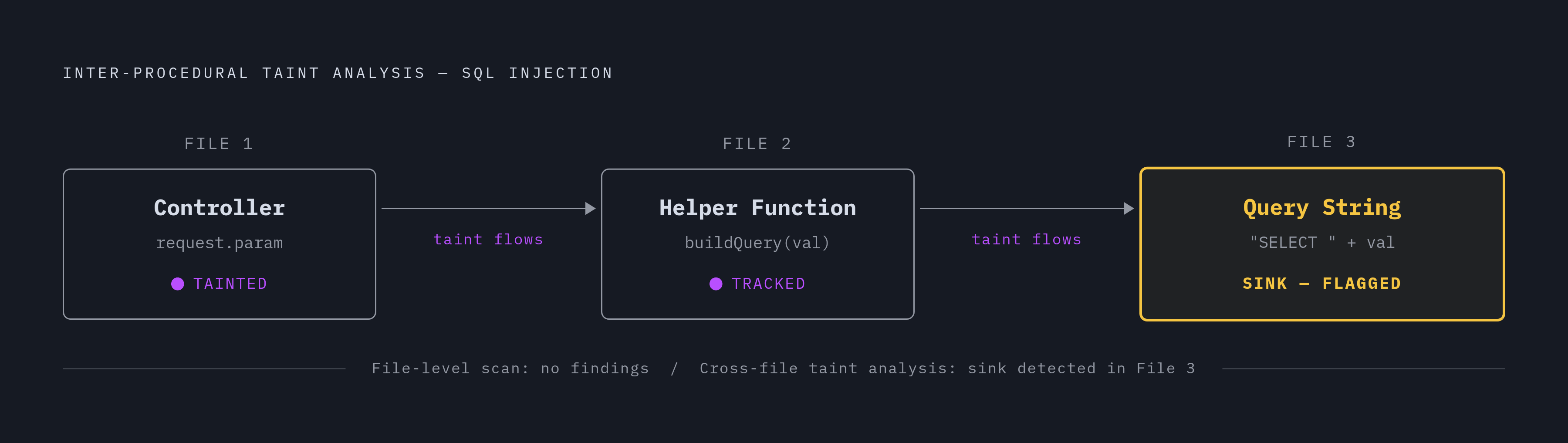
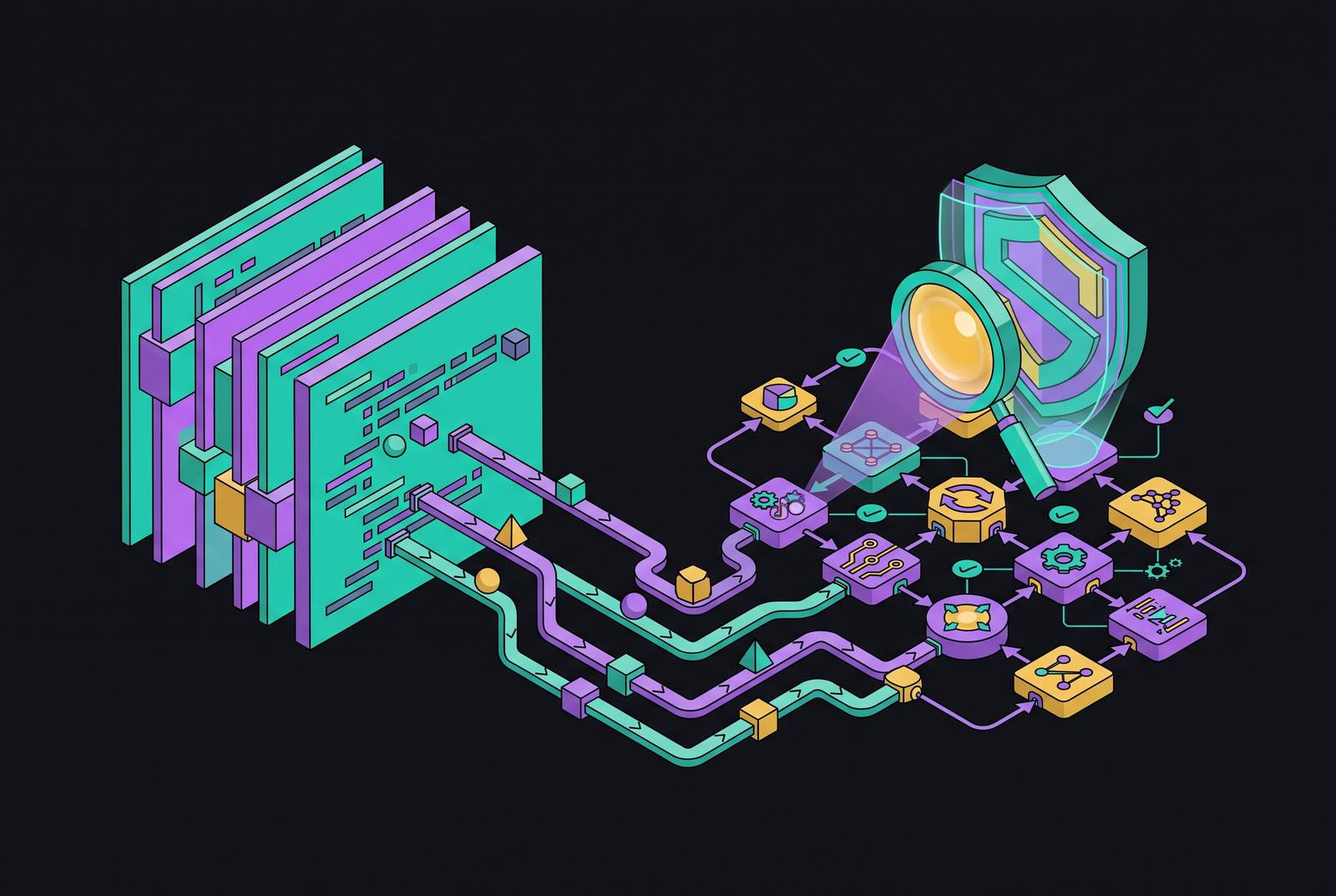
The capability that closes this gap has a name: inter-procedural taint analysis. It tracks untrusted input as that input moves across function boundaries, file boundaries, and service boundaries, all the way until it reaches a dangerous sink, whether that sink is a database query, a shell call, an HTTP client, or a deserializer.
"Taint" is a simple idea once it's unpacked. Any value that originates from something a user controls, a query parameter, a request body, an environment variable pulled from an external store, gets marked. From that point forward, the analysis follows the mark through every assignment, every transformation, every place that value gets passed as an argument. It doesn't stop at the edge of one function. It keeps going.
That's what "inter-procedural" means, and it is what separates a useful analysis from a shallow one. Intra-procedural analysis, the kind that only looks within a single function, stops exactly at the boundary where most real exploits cross. Inter-procedural analysis keeps the taint mark attached as it moves into called functions, into imported modules, and across service boundaries.
The sink is where the judgment actually gets made. A tainted value landing in a parameterized query is handled safely.
SQL injection makes the mechanism concrete. User input arrives in a controller. The controller passes it to a helper function. That helper function interpolates the value into a query string sitting in a third file entirely. A scanner that reads each file on its own sees three clean-looking snippets and nothing wrong anywhere. Taint analysis follows the value through all three hops and flags the sink where the string concatenation happens.
Server-side request forgery shows the same pattern from a different angle. A URL gets built from a request parameter. That URL passes through a validation function that only checks the prefix. It then gets handed to an HTTP client sitting in a shared library. Each piece of that chain looks reasonable in isolation: a parameter, a prefix check, a library call. Only tracing the value across all these boundaries at once reveals that the prefix check does nothing to stop a crafted URL from reaching an internal resource.
Code visibility versus black-box and pattern-based approaches
Tracing a value through three files requires something a black-box tool simply does not have: a view into the code itself. A DAST tool observes a running application from the outside. It can confirm an endpoint exists and poke at how it responds, but it has no way to follow a tainted value through internal function calls to a database query it never sees in the first place.
Source access solves part of that problem, but only part. Third-party dependencies create a second layer of opacity, because without visibility into library code, the analysis runs out of road at the boundary of the imported module. Endor Labs addresses this with function-level reachability analysis, tracing data flows into and out of open-source dependencies and bringing previously opaque library code into the analysis itself, a technique Cycode's research credits with a 92% reduction in noise.
Having the source code in hand still does not guarantee a full call graph. Semantic indexing, compiler-accurate parsing, and LLM reasoning over full call chains are distinct capabilities, and a tool's taint tracking is shallow or complete depending on whether it has built all of them. OX Security's AINAPP, for example, maps an AI pipeline from prompt all the way to runtime, which is what lets it tell a theoretical jailbreak apart from a system exposure that an attacker could actually use.
That distinction matters for anyone evaluating a tool. A vendor who advertises "code-based scanning" might mean file-level grep, regex matching, or a shallow pass over the abstract syntax tree, none of which amounts to inter-procedural data-flow analysis. Engineering leaders sitting down to evaluate these products need a specific question ready: how does this tool handle a value that crosses from one function into another, or from one service into another, and what evidence backs up the results it produces. The answer to that question is where the next comparison starts.
Leading tools' implementations of code visibility and data flow mapping
Tools in this space answer that question in different ways, and the differences in how each one implements inter-procedural analysis determine which vulnerability classes it can and can't catch.
Snyk's DeepCode AI engine combines symbolic AI with generative AI, running data-flow analysis across millions of recorded data flow cases to find and fix vulnerabilities. In independent testing, it found 10 of 26 known vulnerabilities. The platform covers SAST (Snyk Code), SCA (Snyk Open Source), container scanning, IaC security, DAST (Snyk API & Web), and ASPM (Snyk AppRisk). Its transitive reachability analysis cuts down on SCA noise by tracing whether a vulnerable function in a dependency is actually reachable from application code. Snyk's engine is only available as SaaS or through Snyk-managed Private Cloud, with no self-hosted option.
DryRun Security takes a PR-native approach. Its Code Review Agent uses what the company calls Contextual Security Analysis to deliver high-confidence findings while keeping false positives low. A separate DeepScan Agent runs a full repository security scan in a matter of hours. Teams can write natural-language code policies and have them enforced automatically on every pull request through the Custom Policy Agent, and a Code Insights MCP component gives security teams always-on visibility into the codebase through natural-language queries. The product is built around agentic development workflows, with explicit support for Claude Code, Cursor, and Codex. Most of the value from this approach comes from enforcing guardrails directly inside pull requests, rather than waiting for a late-stage CI scan to catch the same issue.
Gecko Security builds its analysis around semantic indexing, compiler-accurate code analysis, and LLM reasoning that runs over full call chains across every service boundary. The goal is to catch account takeovers and privilege escalations, vulnerability classes that tend to involve several services cooperating in ways no single file reveals. The approach treats an entire codebase as one connected graph instead of a pile of individual files, which is the same principle behind inter-procedural taint analysis applied at the scale of a full system rather than a single function.
Each of these tools draws its boundary in a different place, whether that's the scope of its reachability analysis, the stage of development where it applies pressure, or the vulnerability classes its call-graph reasoning is built to surface. None of them eliminates the need to ask how far the tracing actually goes.
Data flow mapping problems in AI-generated code and agentic pipelines
The same question, where does untrusted input flow and what can it reach, takes on a new shape once the code being analyzed was written by a model, or once the "application" being tested is an agent capable of deciding what to do next rather than just what to say.
Visibility into AI usage across the software development lifecycle is thin across the industry. Cycode's State of Product Security for the AI Era 2026 report found that 81% of organizations lack visibility into AI usage across their SDLC. That gap has a direct consequence for static analysis: the source code sitting in the repository may already contain patterns introduced by a model that was never optimizing for secure architecture in the first place.
AI models are tuned for speed and for producing working output, not for secure design. That tuning can introduce hallucinated dependencies, insecure patterns, and implicit trust assumptions faster than a traditional code review process can catch them. Aikido Security's 2026 survey reports that real-world incidents tied to AI-generated code are growing. The code arriving for analysis today carries a different risk profile than code written by a human engineer following an established review process.
Agentic systems add a second layer. In an agent, the model decides what to do next, and that decision can include calling an API, querying a database, or modifying a resource. A chat response that reads "I cannot access that data" offers no guarantee that an internal query never fired, if the execution path behind that response wasn't restricted in the first place. Watching which tools an agent actually called, and with what parameters, becomes just as important as reading what it said back to the user.
Static taint analysis, built for deterministic code, runs into a wall here because LLM behavior is probabilistic rather than fixed. A prompt phrasing change can trigger a failure that a different phrasing avoids, and the same shift can occur as conversation history accumulates or as a user introduces a persona partway through. A model that passes a security test in one conversation can fail the same test once context accumulates over several turns. Security in an agentic system is a moving condition that a single scan cannot certify once and close out. Catching this layer requires watching the system behave over many runs.
Why point-in-time scanning fails despite capable tools
Even the most capable inter-procedural analysis engine produces a false sense of safety if it only runs once a year against a codebase that ships new code every week. The attack surface that exists on the day of the test is not the attack surface that exists on any other day.
The timing gap is easy to picture. An organization runs its annual test in January and the codebase comes back clean. In February, the development team ships a routine update, the kind of change that happens dozens of times a month without anyone treating it as significant. By April, attackers have already found and exploited a vulnerability introduced in that February update. The January test result reflected the codebase accurately on the day it was taken, but new code shipped immediately after, and each subsequent commit widened the gap between the report and the live system.
A scanner with full inter-procedural visibility, run on a schedule that doesn't match how fast the codebase actually changes, still leaves that February window wide open. Tracing a value across three function calls and a service boundary only helps if the analysis runs against the code that's live today, not the code that was live on the date of the last scheduled test. Coverage measured once a year describes a codebase that no longer exists by the time anyone reads the report.