Retesting Vulnerabilities After Remediation and What Confirms a Clean Fix
Evidence shows whether a fix actually closed the vulnerability or just hid the symptom.

A vulnerability marked "fixed" and a vulnerability that's actually fixed are two different things. Most breach post-mortems live in that gap. Retesting exists to close it, telling anyone, with evidence, whether the flaw is gone or just quiet.
Retesting as a distinct discipline
Most pen test engagements end the same way. Findings go to engineering, someone files a ticket, a developer pushes a change, the ticket gets closed. Everyone moves on.
A closed ticket proves someone did something. It doesn't prove the something worked. A patch can suppress the exact symptom a scanner flagged while leaving the underlying condition fully exploitable. Larger enterprises left 45.4% of discovered vulnerabilities unresolved within a 12-month window, and that number only counts what organizations tracked themselves. It says nothing about fixes logged as complete but never checked by anyone outside the team that wrote the patch.
Remediation verification testing answers one question with evidence instead of a status update: did the fix actually work? It reproduces the original exploit against the remediated system, using the same documented steps from the first engagement. No new theory, no benefit of the doubt. Same attack, same target, different outcome, or the same one as before.
What the remediation verification process looks like in practice
Retesting runs in three phases. Skipping one turns the whole exercise into theater.
Planning comes first. The tester rebuilds the conditions from the original engagement: same access levels, same environment state, same credentials used the first time. Without that baseline, a clean result means nothing, since there's no way to tell if the fix worked or the test just missed the target. This phase also means collecting the organization's list of what's been remediated versus accepted as risk, and locking down logistics so every item gets retested, not just the convenient ones.
Then the testing itself. Each documented finding gets revisited, and the original exploit gets run step-by-step, exactly as it ran before. The work doesn't stop at the original vector, though. A competent retest also probes variations and adjacent attack paths, because a fix that only blocks the documented steps leaves the underlying vulnerability class exploitable. It's a patch with a very specific shape.
Reporting closes the loop. The original pen test report gets updated with pass or fail on every finding, and a second deliverable gets produced for outside eyes: auditors, customers, compliance reviewers. That second document says, in writing, that verification happened and names who did it.
Unless an organization flags a finding as accepted risk or not ready for retest, the tester verifies everything in the original report. Silence isn't acceptance. Accepted risks need a name attached to them in writing.
The technical criteria that distinguish a genuine fix from a suppressed symptom
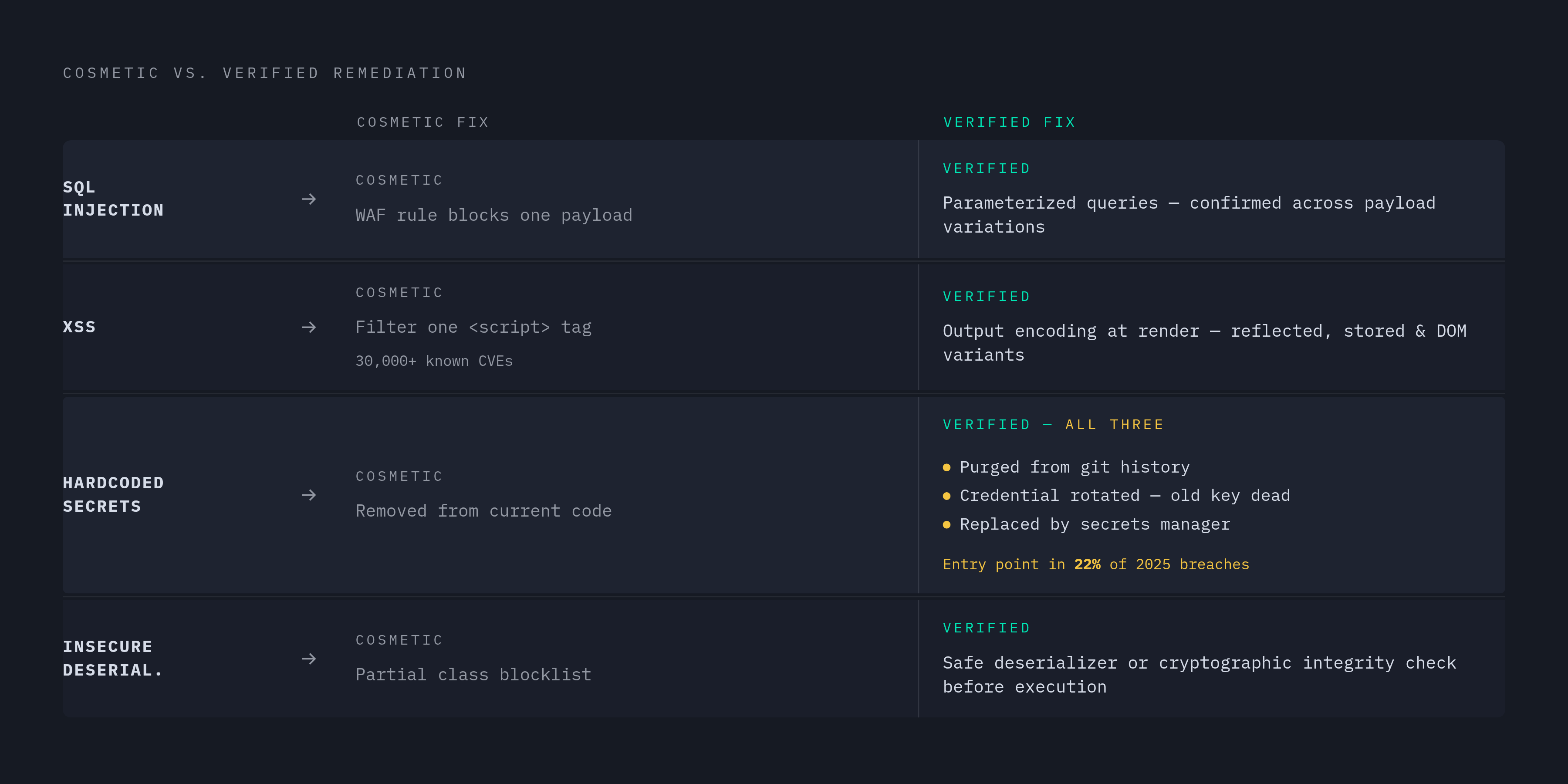
Real remediation removes the root cause. Cosmetic remediation just moves the symptom somewhere less visible. Most teams can't tell the difference until someone retests, and that's the whole point of this exercise.
Take SQL injection. A team adds a WAF rule that blocks the specific payload used during testing. The scanner stops firing. The finding looks closed. But the code underneath is still concatenating unsanitized input into a query string, so a slightly different payload sails right through. That's a filter, not a fix. A verified fix means parameterized queries or prepared statements in the affected code path, confirmed by code review and by throwing several payload variations at it beyond the one from the original report.
Variation testing matters because of exactly this pattern. A developer who read the pen test report and saw the exact injection string used against them might block that string and call it done, leaving the vulnerability class that made the string work in the first place untouched. A retest that only replays the original payload can get fooled the same way. So testers push encoding variations, try alternate injection points, and walk adjacent attack paths to confirm the fix addressed the category of flaw.
The criteria shift by vulnerability type, and each one has its own tell.
For cross-site scripting, confirming a fix means checking that output encoding happens at render time, everywhere, not that the specific script tag from the report got filtered somewhere upstream. Reflected, stored, and DOM-based variants all need separate checks. XSS spans more than 30,000 known CVEs, and a fix that closes one variant frequently leaves the others wide open.
For server-side request forgery, a genuine fix rejects internal address ranges and cloud metadata endpoints at the server-side validation layer. DNS rebinding variations and alternate metadata paths need testing too. Blocking a literal string is not the same as blocking a class of destination.
For insecure deserialization, the code has to stop deserializing untrusted input through unsafe methods, such as Python's unpickle on attacker-controlled data, or it has to enforce cryptographic integrity checks before deserialization runs. Anything short of that is a delay.
For hardcoded secrets, three separate conditions all need to be true. The secret comes out of the codebase, including git history. It gets rotated at the service level, so the old credential actually stops working instead of sitting there unused. And it gets replaced with a secrets manager or an environment variable. Stolen credentials were the entry point in 22% of breaches in 2025, so rotation closes an active risk. It's leaving the door unlocked after changing the sign on it.
For broken object-level authorization, checks need to run at the data layer for every object access. The way to confirm it: re-attempt access using a different authenticated user's object IDs and see what actually comes back.
For anything high severity, a clean result on the original attack path is a floor, not a finish line. The tester should also check that the underlying control, parameterization, output encoding, allowlist validation, gets applied consistently across the codebase, rather than patched at the one endpoint that happened to get reported.
Prioritizing fixes as they arrive
Fixes rarely land all at once. That's fine, as long as the order makes sense, and most of the time it doesn't. The Verizon 2025 Data Breach Investigations Report found that around 60% of breaches involved exploiting known vulnerabilities for which a patch already existed. The failure wasn't ignorance. It was sequencing: teams knew about the hole and didn't get to it in time.
Ordering remediation well starts with attack chains, not isolated line items. A medium-severity finding sitting on the path to a company's crown-jewel database outranks a standalone critical finding with no realistic route to anything valuable. Severity scores alone miss this, every time.
Reachability and active exploitation in the wild affect how urgently a finding should be prioritized, regardless of its raw CVSS score. Active exploitation in the wild, tracked through resources like CISA's Known Exploited Vulnerabilities catalog, should push a finding up the queue regardless of its base score. Reachability decides more than almost anything else: if the vulnerable component isn't actually reachable given the production configuration, it doesn't belong at the top, no matter how scary it looks on paper. And business context closes the loop. Does exploitation touch customer data, authentication systems, or anything compliance-relevant?
Not every finding gets fixed, and that's a legitimate outcome, as long as it's written down. When a finding gets risk-accepted instead of remediated, the decision needs a rationale, an owner, and a review date attached in the report. Accepted risks don't count toward the retest pass or fail tally, but they still need to show up in the final document, so an auditor reading it understands what happened to every finding, not just the ones that got patched.
Compensating controls, a WAF rule, network segmentation, a monitoring alert, can buy time while a real fix gets built. That's a legitimate bridge, but the control itself needs testing rather than blind trust that it's configured correctly, and the underlying finding stays open until the root-cause fix gets verified. A retest should check whether the compensating control actually stops exploitation in the live environment.
What retesting confirms for auditors
Independence is what makes the whole exercise count for anything. A developer's word that they patched something doesn't satisfy an auditor. It never has, because independence is what makes the whole exercise count for anything.
Auditors, regulators, and enterprise customers want proof that someone other than the person who wrote the fix checked it, backed by a deliverable that says remediation succeeded. SOC 2's CC4.1 calls for objective, separate evaluation of internal controls. ISO 27001 Annex A 8.8 wants evidence that vulnerability management closed the loop, even though it doesn't explicitly demand independent testing. Across all three, the operative word is independent, and self-attestation from the team that wrote the fix is not treated as sufficient verification.
A retest deliverable built for compliance has to do four things. It states which findings were verified remediated, which were accepted as risk, and which are still open. It shows evidence of an actual re-exploitation attempt. It carries a signature or attestation from the testing entity, separate from the organization's own security team. And it carries a date, since an undated or stale retest report invites questions, particularly around SOC 2 Type II periods where the timing of a fix matters as much as the fix itself.
The ISO 27001:2013 transition deadline passed in October 2025, so every certification now runs under the 2022 version. That version leans on continual improvement and a risk-based approach rather than mandating a fixed testing cadence. Remediation verification fits into that picture as proof the security management system is functioning.
There's a commercial angle too, and day-to-day it often carries more weight than any framework. An enterprise buyer asking for a recent third-party pen test before signing a contract almost always follows up by asking whether the findings got fixed and confirming that fixing got checked independently. The retest attestation letter ends up doing double duty: compliance evidence in one context, sales collateral in the other.
How continuous scanning changes the retest cycle
Point-in-time retesting has a shelf life that is shorter than most people assume. The moment new code ships, a new microservice goes live, or a cloud configuration shifts, the verified-clean report starts describing a system that no longer exists. Organizations running continuous penetration testing detect and resolve critical vulnerabilities up to 40% faster than teams relying only on annual checks.
Continuous pull-request scanning fills a gap a once-a-year or twice-a-year retest can't cover. It catches the moment a just-fixed vulnerability class reappears somewhere new: a developer fixes SQL injection on one endpoint, then a separate PR that same sprint introduces the identical pattern on a different endpoint. It also delivers feedback at the cheapest possible moment. Catching an injection flaw in a pull request costs a few minutes of a developer's time. Catching the same flaw in a post-production retest can cost an entire incident response cycle. And it builds a running evidence trail for ISO 27001's continual improvement expectations, instead of one static attestation dated once a year.
None of that replaces expert retesting. The line sits between confirming a signature stopped firing and confirming the root cause got fixed, and automated scanners only do the first one. They don't confirm whether the root cause got fixed or just buried under a filter. Attack chain analysis, business logic flaws, and authorization issues affecting object-level access all demand a human tester making judgment calls a scanner can't replicate, no matter how good its signature database gets. The attestation letter that auditors and enterprise buyers ask for has to come from a certified human reviewer, not an automated pipeline spitting out a green checkmark.
The workable model for a growth-stage SaaS team combines both layers instead of picking one. Continuous PR scanning runs as the ongoing regression check between formal engagements, catching new instances of old problems before they ship. Human expert retesting handles every finding from a formal engagement and produces the signed deliverable that satisfies compliance reviewers and enterprise customers alike. And a standing channel between the security team and the testers means remediation questions get answered before the retest starts, not discovered halfway through it.