Prioritizing Pen Test Findings for Remediation Sprints
A triage framework that weighs exploitability and attack chain position beats raw severity scores.

Not every finding in a pen test report deserves the same urgency, but most engineering teams treat them that way anyway. The report drops, someone sorts by CVSS score or just works top to bottom, and the sprint fills up with the easy stuff: a missing header here, an outdated library there. Meanwhile the actual path an attacker would take through the application sits untouched.
This matters more than it used to. A widely cited annual data breach report found that vulnerability exploitation rose 34% year-over-year and now accounts for 20% of all breaches. The gap between when a finding gets written down and when it gets fixed is exactly where that exploitation happens. A triage framework that weighs exploitability, business impact, and attack chain position turns a raw findings list into something a sprint can actually run on.
What pen test findings contain and what they leave implicit
A finding, structurally, has a title, the affected component, a severity rating (usually CVSS-based), a description of the vulnerability class, some proof, and a suggested fix. That's the skeleton. What separates a useful finding from a checkbox exercise is what's layered on top.
A good finding shows a working exploit. It gives some sense of how the issue connects to other findings in the same report. And it tells a business impact story: what does an attacker actually get if they pull this off?
Even good findings leave things for the engineering team to work out. Which findings stand alone, and which are links in the same chain? What data sits behind this component is the deeper cause: it determines which findings stand alone and which are links in the same chain. Does a "medium" severity finding become critical because it happens to be the only hop between an unauthenticated endpoint and the customer record store? None of that gets handed over pre-solved.
Automated scan output makes this worse. A scanner will list the same vulnerability class dozens of times with zero chain context, just a wall of repeated findings. A manual tester has usually already done some of that connective thinking. Triage should build on that work, not flatten it back into a spreadsheet sorted by severity label. One security consultancy's 2025 data, drawn from hundreds of penetration tests, found findings spanning more than 200 distinct CWE categories. That spread alone tells you severity labels from different vulnerability classes aren't comparable without extra context. A "high" SQL injection and a "high" missing rate limit are not the same kind of high.
The three dimensions that determine a finding's true priority
Three things decide how urgent a finding really is, and none of them is severity alone.
Exploitability is how hard it is, in practice, for someone to actually trigger this. Is it reachable from the internet or only from inside the network? Does it need authentication? Is there a public exploit already floating around? CVSS base scores touch on some of this, but they ignore environment. A CVSS 9.8 on an internal service sitting behind a VPN is not the same operational risk as a CVSS 7.5 on an unauthenticated public API. CVSS actually has temporal and environmental vectors built in to adjust for exactly this. In practice, they are rarely applied.
Business impact is what the worst case is if someone pulls this off. Does the path lead to PII, payment data, or credentials, or does it dead-end at low-value internal metadata? Could exploitation take down a revenue-generating service or destroy data? Does the affected system sit inside SOC 2, HIPAA, or ISO 27001 audit scope, where a breach means both a technical fix and a compliance headache? An annual cost-of-a-data-breach report puts the average breach cost in one major national market at $10.22 million. breach at $10.22 million. And increasingly, enterprise buyers ask for a recent pen test before they'll sign a contract, so a finding touching customer data carries deal risk that has nothing to do with the code itself.
Attack chain position is where this sits on the road to a full compromise. Entry-point findings hand an attacker their first foothold and unlock everything downstream, so they get treated as high priority no matter what the isolated CVSS says. Pivot findings let someone move laterally or escalate privilege once they're already in, and their urgency depends on how many entry points feed into them. Terminal findings are the payoff, direct access to a database, a credential store, an admin console, where severity is obvious but reachability is the open question. And isolated findings, the ones with no plausible route to anything sensitive, might be genuinely low-stakes no matter what label they were given.
Putting these together makes the ranking clearer fast. A finding that scores high across all three goes straight to the top, no argument. But a finding that's trivially exploitable yet leads nowhere near sensitive data can rank below something harder to exploit that happens to sit one hop from customer records.
Mapping attack chains before assigning sprint tickets
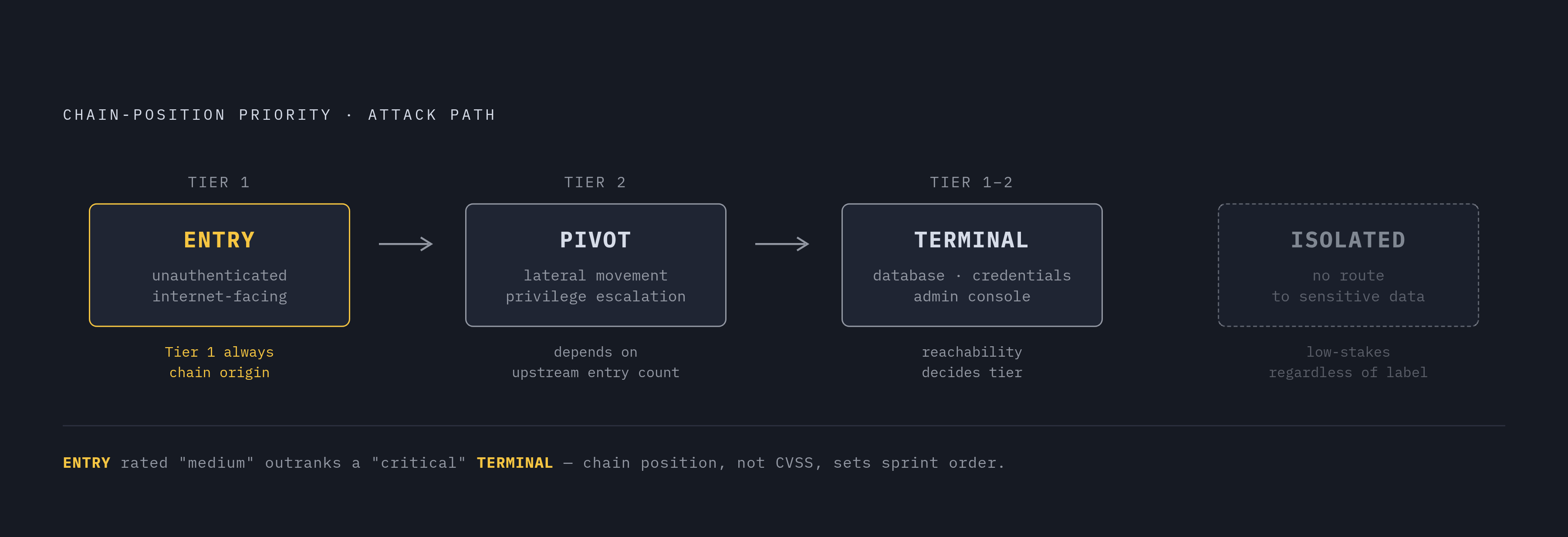
Findings can't be prioritized correctly on their own. A medium-severity SSRF that reaches the AWS Instance Metadata Service looks like a medium right up until someone notices it hands over a credential that unlocks a critical admin panel. Chain mapping has to happen before anyone opens a ticket.
The exercise itself isn't complicated. Start with whatever the tester flagged as entry points, unauthenticated, internet-facing, or low-privilege paths in. Tag each finding by its role in the chain: Entry, Pivot, Terminal, or Isolated. And where the report already narrates a chain, which a good tester will do, use that narrative directly rather than re-deriving it from scratch.
Some pairings are worth knowing by name.
- SSRF into a cloud metadata endpoint, leading to IAM credential theft and privilege escalation into production data
- XSS leading to session token theft, giving authenticated admin access without ever touching a password
- SQL injection, blind or union-based, leading to exfiltration of customer records or credential hashes
- A hardcoded secret sitting in source code, giving direct API or database access that skips every application-layer control
- Insecure deserialization leading to remote code execution and full server compromise, the kind of issue seen in vulnerabilities affecting default Next.js and React configurations
What comes out of this exercise is a short list of named attack chains. Each chain names the findings involved, their position in the sequence, and the worst outcome at the end of it. That's the actual unit the sprint backlog gets built from.
Whitebox access changes the quality of this mapping. When a tester had source code and cloud configuration in hand, not just the outside-facing surface, the chains they surface tend to be more complete. That means when a finding gets labeled "isolated," the triage team can trust it, instead of wondering if there's some internal path the tester simply couldn't see from outside.
Turning the triage output into a sprint-ready backlog
Build the backlog around chains, not individual findings. Each identified chain gets one parent ticket. Underneath it, child tickets for every finding in that chain, ordered by position, entry points first, then pivots, then terminals. Fixing only the terminal issue, the exposed database, while leaving the SSRF that got someone there wide open just means a different chain finds the same database next time.
Sprint priority breaks into three tiers.
Tier 1 gets fixed before the current sprint closes. This covers entry-point findings on internet-facing systems that touch regulated or customer data, anything with a public exploit already out there, and any chain where the terminal asset is PII, payment data, or authentication infrastructure.
Tier 2 gets fixed within the current sprint or the one right after. Pivot findings that extend an existing chain land here, along with isolated high-CVSS findings on sensitive systems and anything an auditor, SOC 2, ISO 27001, HIPAA, will want remediation evidence for.
Tier 3 moves through normal engineering throughput. Isolated medium or low findings with no chain connection, hardening work like missing security headers or TLS configuration tweaks, and anything sitting on non-production or low-sensitivity systems.
Every ticket needs real acceptance criteria, not "fix the vulnerability." Spell out the actual change: parameterize this query, rotate this credential and strip it out of the repo, add a Content-Security-Policy header with these specific values. Spell out the retest condition too, what a tester needs to confirm before the ticket actually closes, since retesting works better when it's planned into the sprint rather than tacked on afterward. And where relevant, note which audit control the fix satisfies once it's closed.
Most teams can't absorb a full pen test report in a single sprint, and that's fine. The real job of the framework is making the sequencing logic legible to product managers and founders, including beyond the security team. Chain-based epics do that almost automatically, since a manager can see "this whole chain closes when these three tickets close" instead of squinting at forty rows sorted by severity.
Point-in-time testing decays the moment new code ships. Teams running pull-request-level scanning or other continuous testing setups can feed new findings into this same chain-based backlog format, instead of shelving discoveries until the next annual engagement rolls around.
Where CVSS scores mislead
CVSS does one thing well: it gives a consistent, vendor-neutral way to describe a vulnerability's intrinsic traits. That's genuinely useful for comparing within a vulnerability class, for talking to auditors, and for tracking remediation over time. It just was never built to answer the questions that actually decide sprint order.
It misses environment entirely, so a critical-rated bug with no network path to anything sensitive can be lower real-world risk than a medium sitting on a public endpoint. It has no concept of chain position, since CVSS scores individual findings and chains don't exist anywhere in the framework. Its "confidentiality impact: high" label doesn't distinguish between leaked server logs and a leaked payment database, those get scored the same. And it says nothing about exploitability in the field: a 9.8 with no public exploit that needs physical access to a locked server room is not the same urgency as a 7.0 with a working public proof of concept aimed at the login page.
Some rules for overriding the score upward, regardless of what CVSS says: a public exploit or weaponized PoC exists (straight to Tier 1), the finding is the entry point of a chain that leads to regulated data (Tier 1), or the finding is a hardcoded credential sitting in accessible code (Tier 1, because rotation and removal are quick and the blast radius is unpredictable). If a system is in audit scope and the review window is coming up, bump the finding to at least Tier 2 so remediation evidence exists before the auditor asks.
And rules for moving a finding down: if the affected system genuinely has no network path from any realistic attacker, internal-only, access-restricted to an internal network, dev environment only, document that reasoning and defer it. If a finding is isolated with no chain connection and the data behind it is low sensitivity, let it sit in normal throughput.
Whatever the call, write the reasoning into the ticket. Auditors and customers will eventually ask why a "critical" finding sat in sprint four instead of sprint one. "Because it's unreachable from any outside position and the entry point chain closed in sprint one" is an answer. Silence is not.
How to run the retest so remediation is confirmed
Retesting isn't optional for anything audit-facing. SOC 2 auditors want evidence a control was tested and confirmed effective, not just a ticket in a tracking tool marked "Done." A closed ticket with no retest note behind it doesn't satisfy the Trust Services Criteria evidence requirement, full stop.
A valid retest has the same tester, or a team with equivalent access and context, re-run the original proof of concept against the fixed system. It targets the specific fix. And it produces an actual artifact: a retest note or updated finding status signed off by a credentialed reviewer. That signed note is the audit evidence.
Retests fail quietly more often than people expect. A tester running a slightly different variant walks right through it when the fix patches the exact payload from the proof of concept but leaves the underlying vulnerability class intact. Sometimes the fix landed in staging and never made it to production, or hit one service instance out of five. Sometimes a dependency got bumped in package.json but the app never got redeployed, so the old vulnerable version is still what's actually running.
Build the retest into the sprint as a dependency: the fix ticket isn't Done until the retest ticket closes with a pass. Give the tester a real window, something like 48 hours after the fix ships, so the sprint doesn't stall waiting on a retest that never gets scheduled. For teams running continuous or PR-level scanning, that retest loop shrinks down closer to the commit itself, which is the direction remediation confirmation is heading generally: closer to the code, further from the annual report.