Continuous Compliance Monitoring vs Point-in-Time Pen Test Evidence
Continuous monitoring keeps compliance evidence current as environments evolve daily.
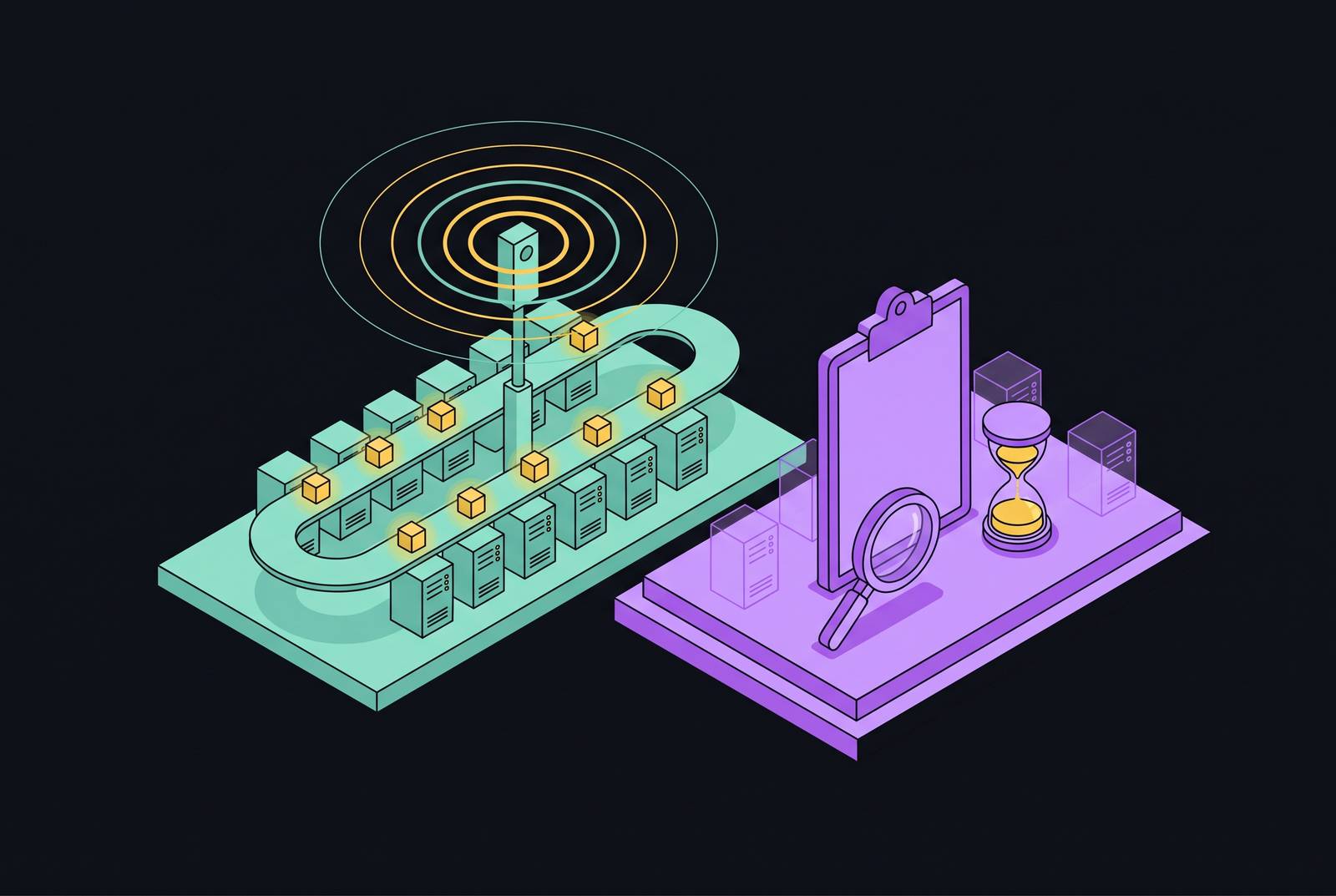
A point-in-time pen test and continuous compliance monitoring do different jobs. The test gives a trustworthy account of the environment it tested, while continuous validation keeps the evidence up to date as that environment changes. For a growing SaaS company, the choice is not one or the other. It is how to keep proof of security up to date between formal tests so that a useful report does not become just a record of the past.
Why a pen test report starts aging the moment it is delivered
Sprocket Security describes a familiar setup. An auditor arrives in six weeks, but the pen test report is nine months old. Since the test, three engineers have joined, two cloud instances have been spun up, and a new SaaS tool has been provisioned without IT knowing. Two CVEs have also been disclosed against the web framework. The report still says the environment is clean.
A penetration test describes the environment as it was during the test, so it does not cover a later code deploy, IAM change, or cloud addition. Teams deploying daily and provisioning infrastructure on demand open this gap continuously. An authentication change cannot appear in a report written before it existed.
Configuration drift explains how small changes compound. An emergency firewall rule stays in place, or permissions that were expanded for a one-off task never shrink again. Each change can erode a control that passed assessment without altering a word of the evidence on file. The original finding may have been sound. It simply cannot prove the condition of an environment that has since changed.
What compliance frameworks actually require from a pen test, and where the gap hides
SOC 2 does not explicitly mandate a penetration test, but most auditors expect one as evidence for Trust Services Criteria monitoring activities under CC4.1. Timing is part of that expectation. The test must fall inside the Type 2 observation window to count as evidence, regardless of how good an earlier assessment was. Auditors also expect human-driven adversarial testing that can uncover business logic flaws and chained exploits. Enterprise customers ask for the report itself more often now, so people outside the audit team can also see how old it is.
ISO 27001:2022 likewise has no clause that names penetration testing, and none of its 93 Annex A control titles contains the word “penetration.” Its requirements concern the work behind the assessment. Control 8.8 requires management of technical vulnerabilities, while control 8.29 requires security testing in development and acceptance. Certification bodies expect testing at least once a year across the scope of the information security management system, with a written account of how the tests were done and a record that tracks remediation. That annual expectation comes from certification practice.
HIPAA requires ongoing risk analysis and risk management. A proposed change would make that more prescriptive. HHS proposed a Security Rule update in January 2025 that would require annual penetration testing, but the final rule had not been issued in the sources available for this article. The rulemaking had moved to a long-term actions list with a target of July 2027. That proposal should not be presented as a finalized obligation, although a stale report can already undermine evidence of ongoing risk analysis.
These distinctions affect what a company must submit and when. They do not make a filed report update itself. Even where a framework requires ongoing management, the pen test artifact supports conclusions about the scope and period it covers. Meeting that evidence requirement leaves a separate question about the gap between the report’s coverage and the running environment after the assessment.
Why annual testing schedules cannot close the drift gap even when run on time
A company can run its annual test on time, use a credible vendor, and cover the agreed scope without closing the drift gap. Discipline alone cannot remove this timing problem. The annual model fits a slower release cadence, where infrastructure changes quarterly and applications change gradually. Daily deployments break that fit because the attack surface tested in January may look very different in July. With infrastructure as code, a single pull request can change the cloud layout.
Scheduled testing can also encourage choices that make the assessment less representative. A code freeze before the engagement can keep recent changes out of scope to avoid finding problems without time to fix them. Those changes may be the very ones introducing new vulnerabilities. Booking a test away from major releases also puts it in the quietest part of the development cycle. The schedule becomes easier to manage, but the test examines the environment when it is least in motion.
The work after the test can reinforce this cycle. Findings arrive, security and engineering teams sprint to remediate before the compliance deadline, and attention then fades until the next engagement. The resulting security posture resembles a sawtooth. Remediation brings a sharp improvement, followed by erosion as unexamined changes accumulate.
Quarterly testing narrows the interval between those bursts. It does not change what each test can establish. Every engagement still produces a snapshot, and the next deployment can introduce something it never examined. More frequent depth assessments can reduce the time a problem remains undiscovered, but frequency alone does not connect validation to the change that created the risk.
What "living evidence" means in practice and how continuous validation produces it
Living evidence is a record kept current through change detection, expert validation, remediation, and retesting. Its starting point is the environment actually running. Automated attack surface monitoring detects meaningful changes, including new subdomains, exposed services, expanded cloud permissions, exposed credentials, and newly relevant CVEs. Those changes go to human review instead of waiting for the next scheduled engagement.
Automation handles discovery and change detection at scale, while experts confirm whether a finding is exploitable, assess its business impact, and test its potential to chain with other weaknesses. Distinguishing a detection from a validated finding is especially important when an auditor or customer will scrutinize the evidence. Automated discovery can show experts where to look, but they still need to take responsibility for sign-off.
Security validation runs against code changes before they reach production, catching regressions when they are introduced. This targets the gap left by scheduled testing. A vulnerability introduced by last Tuesday’s deployment cannot be covered by an earlier annual report, but change-linked validation can examine the work that introduced it.
The evidence record changes with that process. Instead of relying on a single PDF, it includes testing logs, findings history, remediation records, and retest evidence tied to real changes. A fix has a corresponding record of revalidation, rather than remaining an open question until the next formal assessment. The baseline moves as the environment changes. That gives auditors evidence of systematic vulnerability management and ongoing monitoring.
Sprocket describes the result as giving auditors “current evidence that testing, remediation, and retesting are keeping pace with the environment.” The word “retesting” is central to that claim. Detecting a problem and recording a planned fix do not establish that the weakness has been removed. Linking the finding, remediation, and retest gives people a record they can use to judge whether controls are being kept up.
What to look for in a pen test vendor to get evidence that holds up between audits
For buyers, the practical lesson is to examine the testing model alongside scope and price. A sample report shows what the vendor considers evidence. If it consists mainly of CVE lists derived from version reconnaissance, it is scanner output. A timeline shorter than one week for a thorough web application test also signals a primarily automated engagement. Neither tells the buyer enough about how an attacker could use the application’s own logic.
Working exploit evidence separates a confirmed finding from an unsupported claim. If a vendor cannot show how a vulnerability was validated, an auditor can challenge it. Retesting is the other critical part of that record. When revalidating a fix requires scheduling a new engagement, remediation evidence lags behind the engineering work. A report can therefore age through both new risks and unresolved documentation of old ones.
A trustworthy test starts with a scope tied to business risk and goes beyond a list of IP ranges and application URLs. Whitebox access to source code, cloud configurations, and documentation gives testers the visibility needed for complete attack surface coverage. It also supports investigation of authorization logic and business processes that do not map to published CVEs.
That access should lead to accountable findings. Certified human experts should review and sign off on every finding before it is sent to the buyer, even when AI-assisted discovery helps find possible weaknesses. The report should also document a path to compromise, showing how individual weaknesses chain together to reach a meaningful asset. This is where adversarial testing goes beyond a compliance artifact. It explains the consequence of the findings, rather than leaving the buyer to infer it from separate entries.
Does the vendor provide continuous pull-request scanning to catch regressions before production? Is retesting included, and how quickly can a fixed vulnerability be revalidated? Is there an ongoing communication channel, such as dedicated Slack, for questions outside formal engagements?
Whitebox testing, working exploit evidence, and expert sign-off make the depth assessment credible, while continuous scanning and accessible retesting support assurance afterward. Both need to be present in the model. A vendor offering only one side leaves the company to close the other gap itself.
How to structure the relationship between your annual pen test and your continuous monitoring program
For a technical founder, the operating model is to use the annual or milestone-triggered pen test as the depth layer. That test gives experts time to work in depth on chained exploits, business logic, authorization flows, and infrastructure across the full scope. Its signed report and letter of attestation provide formal evidence, with scope documented against the relevant SOC 2, ISO 27001, and audit requirements. Major infrastructure changes, a product launch, a significant application update, or a cloud migration can also trigger a depth assessment. The annual date is not the only anchor.
Attack surface monitoring tracks new assets, IAM changes, and configuration drift, while pull-request scanning checks for regressions as the code changes. Retest evidence stays linked to specific remediations. When the first test has the right scope, testers with whitebox access already know the attack surface and which changes pose more risk, so they can better focus this work. Without that baseline, monitoring is detecting drift from an unknown starting point.
For a growth-stage SaaS company approaching an enterprise deal or a SOC 2 audit, this means having more than an aging PDF ready to send. The evidence package has a recent depth assessment, an ongoing record of remediation and retests, and proof that monitoring tracked changes that mattered after the formal test.