Static Analysis Tools for Tracing Data Flows in Whitebox Penetration Testing
Taint analysis traces untrusted input through code to find injection vulnerabilities.
Static analysis tools earn their place in whitebox penetration testing because they automate the one task human reviewers can't do at scale: tracing a single untrusted value through thousands of lines of code to see where it ends up. That capability has a name, taint analysis, and understanding how it works is the key to understanding what these tools can and cannot be trusted to catch on their own.
How taint analysis works
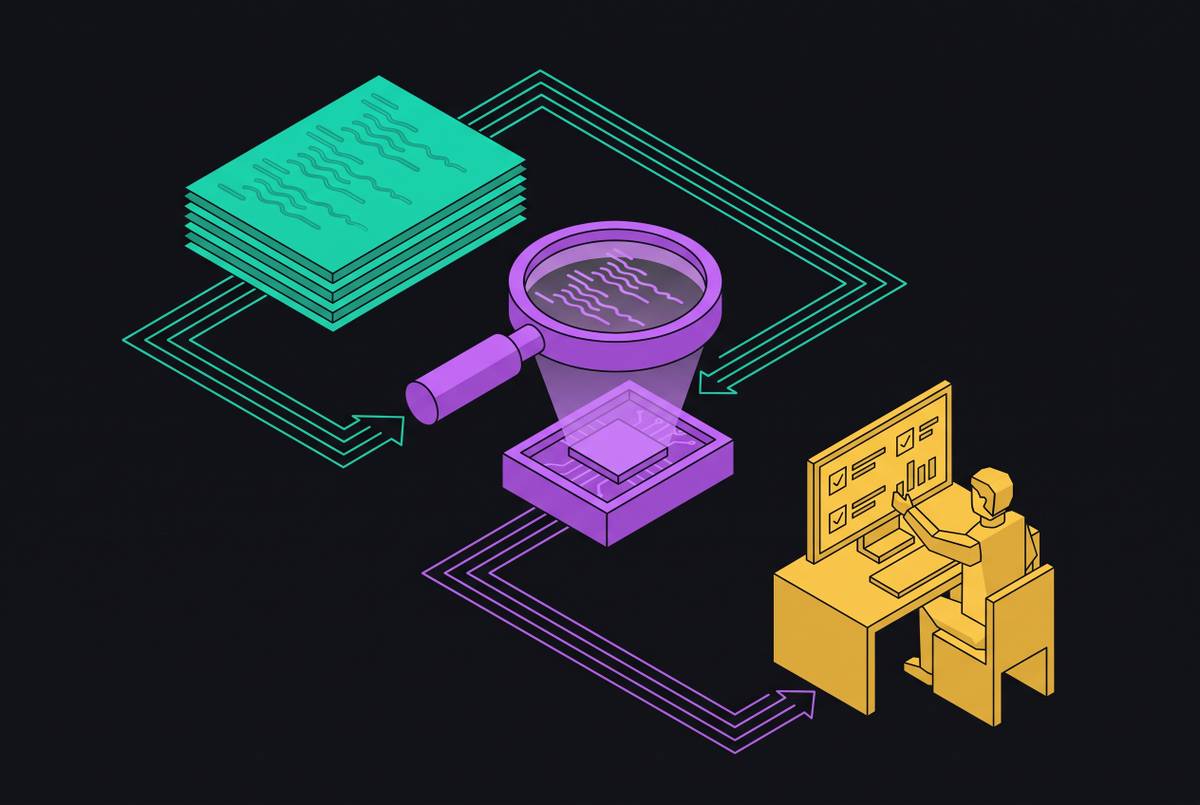
Taint analysis follows untrusted input from the moment it enters an application to the moment it might reach a dangerous operation. That's the mechanism that separates real whitebox static analysis (SAST) from a scanner that just checks code against a list of bad patterns. A pattern matcher can tell you a line of code looks risky. Taint analysis tells you whether a value an attacker controls can actually travel from the front door to a place where it does damage.
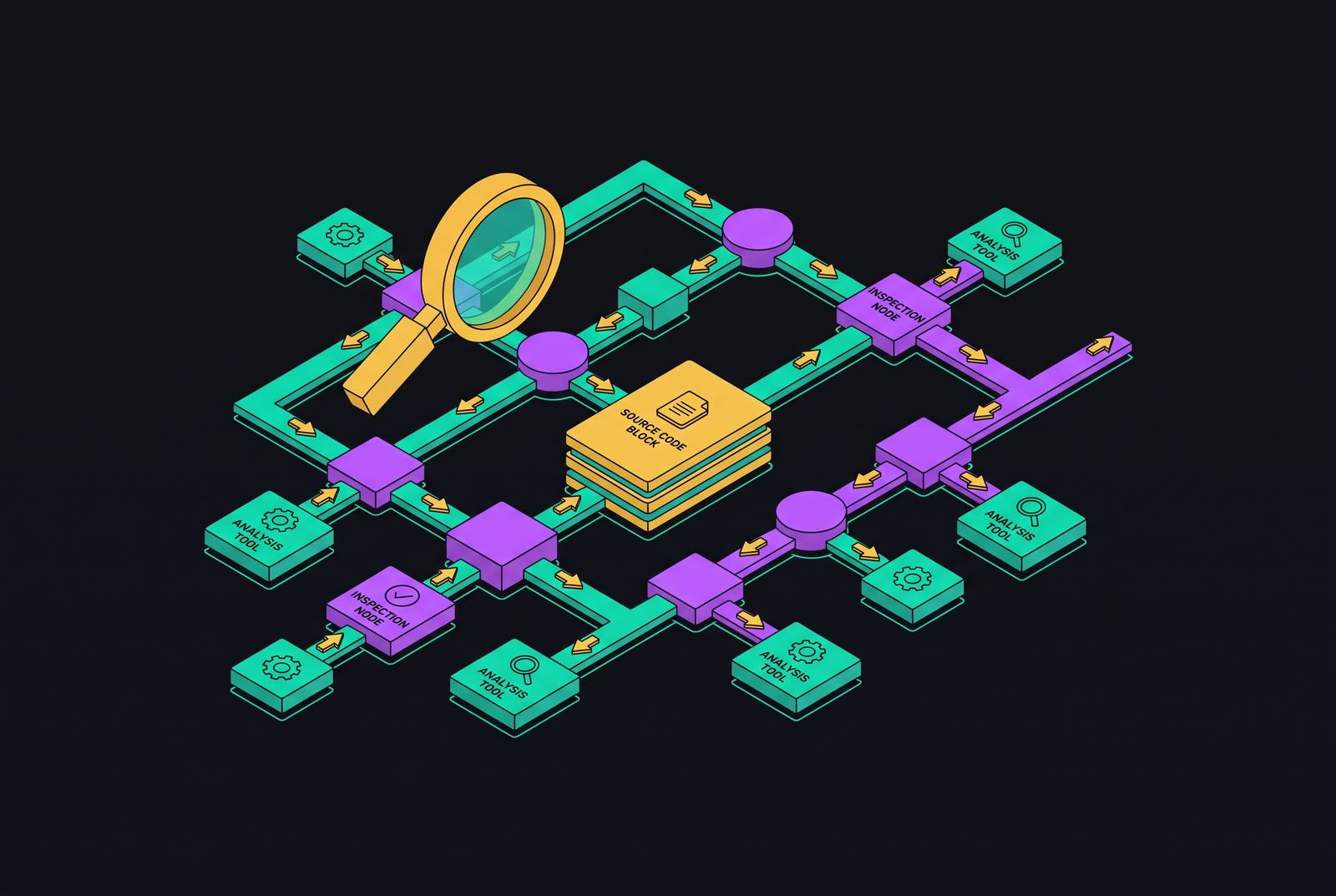
The process runs in three stages. First, the tool parses the source code into an Abstract Syntax Tree, or AST. Think of this as stripping away every bit of formatting, every comment, every stylistic choice a developer made, until only the structure is left: variable declarations, function calls, if-statements, loops. Each of these becomes a node the tool can inspect and connect to other nodes. Second comes taint marking. Anything that comes from outside the program's trust boundary, an HTTP request parameter, a file read, a row pulled from a database, gets labeled "tainted" right at the point it enters the code. That entry point is called the source. Third, the tool checks sinks. It walks the tainted value through every assignment, every function call, every transformation it passes through, and watches for the moment it lands in a dangerous operation, a SQL query, a shell command, a block of HTML rendered to a browser, without anything in between that cleans it up. That dangerous landing spot is the sink.
A SAST scanner never has to run the application to catch a SQL injection risk, which is what buys a tester in practice. It reads the source code, sees that a value pulled from a request parameter flows, unmodified, into a string that gets concatenated and passed to a cursor.execute() call, and flags it. No server has to be running. No database connection has to exist. The vulnerability gets caught on paper, before a single request is ever sent.
That's also what separates taint analysis from the other layers of static analysis it usually gets grouped with. Lexical scanning, the fastest and shallowest layer, just tokenizes raw source text to find things like hardcoded secrets or calls to banned functions. It tracks flow within a single file and so cannot see a flow that spans two files. Pattern matching is a step up: it walks the AST looking for known vulnerability signatures, like a query built without parameters. That catches well-documented, single-location problems but goes blind the moment a vulnerability requires three or four steps to materialize. Dataflow, or taint analysis, is the layer built for exactly that case: it tracks a value as it moves between variables and functions across the whole program, which is how it catches something like tainted input reaching an eval() call three function calls downstream of where it entered. Above that sits semantic analysis, which checks whether the code is logically consistent rather than just structurally valid, catching things like type mismatches or an API used the wrong way.
AST-based tools read one file at a time. A question like "does a permission check exist somewhere earlier in this call chain" often can't be answered from a single file's tree. That makes flaws that cross files, services, or authorization boundaries a recurring blind spot, and it's a thread this piece comes back to.
What the leading SAST tools bring to taint tracking
The tools that do taint-based dataflow analysis for whitebox testing today differ in scope, language coverage, and how far they reach across file and service boundaries. Picking the wrong one for a given codebase means leaving real attack surface unchecked, so it helps to know what each one actually does.
Semgrep runs custom static analysis rules across more than 30 programming languages, and plugs directly into GitHub Actions and GitLab CI. Its Community tier ships over 3,000 rules covering the OWASP Top 10, CWE categories, and patterns specific to individual languages. Its Pro engine adds cross-file taint analysis, tracing data flows across function boundaries and across multiple files in a repository, which is the feature that lifts it above simple pattern matching. Semgrep Assistant adds an AI layer on top to triage findings and cut down false positives, and results come out in SARIF format so they drop cleanly into CI/CD pipelines.
Snyk Code runs its own dataflow engine to track tainted input across function boundaries, covering SQL injection, cross-site scripting, command injection, path traversal, SSRF, and hardcoded credentials.
SonarQube performs static analysis across more than 30 languages and flags injection flaws, cross-site scripting, and authentication issues directly inside pull requests.
Brakeman takes the opposite approach: instead of covering many languages, it covers one framework, Ruby on Rails, in depth. It runs without needing a live application or a database connection, and it catches SQL injection, cross-site scripting, command injection, mass assignment, and unsafe redirects. That narrow focus is what makes it strong for Rails projects and what limits it to them.
Bearer takes a third approach, built around data rather than code paths. It specializes in tracing personally identifiable information, health data, and payment card data from the point it enters an application, through the application's logic, to wherever it exits. It flags sensitive data that gets logged, sent over an unencrypted connection, stored without protection, or handed to a third-party service without the right consent controls in place. That makes it especially relevant for fintech and health-tech codebases, where mishandled data carries regulatory consequences on top of the security risk.
Secrets detection deserves a place in this same conversation, even though it looks different on the surface. TruffleHog scans Git repositories and CI/CD pipelines for exposed secrets, and it goes a step further than most tools by actually checking, through API calls, whether a found credential is still active. That verification step is what separates it from simple lexical scanning. GitGuardian watches GitHub organizations for exposed credentials across repositories and pull requests, and sends real-time alerts to repository administrators when it finds one. Secrets detection belongs in a taint discussion because a hardcoded credential is a dataflow problem in disguise: a secret value that starts in source code and ends up in a call to an external API is structurally the same risk as tainted user input reaching a dangerous sink.
One more tool rounds out the practical toolkit, not for detection but for confirmation. sqlmap automates the detection and exploitation of SQL injection vulnerabilities, and its real value in a whitebox engagement appears after a SAST tool has already flagged a possible injection path. It's the step that turns a static finding into a confirmed, working exploit.
Vulnerability classes SAST taint analysis reliably catches
Taint analysis's value concentrates in a specific family of injection-class bugs, where the underlying mechanism, untrusted input traveling unchecked to a dangerous operation, maps cleanly onto a code pattern a tool can recognize.
SQL injection is the clearest case. The taint path runs from an HTTP parameter, through string concatenation, into a cursor.execute() call. SAST catches it by tracing the value at that final sink back to its source and confirming nothing sanitized or parameterized it along the way. OWASP catalogues 38 distinct CWEs that map to injection vulnerabilities, and injection holds the second-most-frequently related CVEs of any category OWASP tracks.
Cross-site scripting follows a similar shape: user input flows into a template or a DOM operation without being escaped first. In the first half of 2025, XSS and SQL injection together accounted for a substantial share of all catalogued weaknesses. SAST tools catch this by identifying the gap between where the input enters and the point where escaping should have happened but didn't.
Command injection works the same way, with user input landing as a concatenated argument inside a subprocess or shell call. SAST flags subprocess or exec patterns where the argument includes a value that traces back to tainted input.
Path traversal occurs when user input gets used directly in a file system operation, without the path being normalized or checked against an allowlist first.
Server-side request forgery, SSRF, involves a user-controlled URL passed to an HTTP client that then makes an outbound request on the application's behalf. The current OWASP Top 10 folds SSRF into Broken Access Control at position one, which reframes it correctly: SSRF is an authorization failure that forces an application into making requests it was never supposed to make.
Insecure deserialization happens when an application deserializes data supplied by a user without validating it first, which can open the door to arbitrary code execution. SAST can flag a deserialization call that receives tainted input, though confirming it's actually exploitable often takes a runtime test on top. The safest fix skips deserialization of untrusted data entirely and uses a structured format like JSON for exchanging data instead.
Hardcoded secrets round out the list, and the scale of the problem has grown fast. GitGuardian's State of Secrets Sprawl 2026 report found a large and fast-growing volume of new hardcoded secrets appearing in public GitHub commits during 2025, marking the largest single-year jump the report has recorded, with AI-generated code a significant driver. The exposure window for these secrets runs long: nearly 70% of credentials identified as legitimate in 2022 were still valid as of January 2025, and a substantial share remained unrevoked as of January 2026. A leaked secret is a long-duration exposure rather than a one-time event. SAST detects that a secret exists in source code; confirming whether it's still live is a separate step, the kind TruffleHog's active verification provides. The fix works best placed at commit time, catching the secret before it ever enters the repository's history, rather than at push or inside a CI/CD pipeline after the fact.
Where SAST taint analysis reaches its structural limits
The properties that make taint analysis fast and able to scale across a large codebase, chiefly that it reads code without ever running it, create limits that no amount of new rules will fix. These limits come from how the analysis is built, rooted in its design rather than its configuration.
Start with runtime blindness. A SAST tool has no way to confirm that a flagged code path is actually reachable when the application runs. A tainted variable that technically reaches a sink, but only through a branch of code that never executes in production, still generates a finding. A large majority of SAST alerts turn out to be false positives, and without a triage process sitting on top of the tool, that volume buries the small number of findings that matter. Interactive Application Security Testing, IAST, was built to close this gap: it embeds sensors inside the running application, pairing the code visibility of a whitebox tool with confirmation from live execution, which brings the false-positive rate down. IAST works best as a complement sitting alongside SAST, not a replacement for it.
Cross-file and cross-service flows present a second limit. Because AST-based tools read one file at a time, authorization checks that live in a different file, multi-step exploit chains, and flaws that only exist in the relationship between two components can all slip through unflagged. Semgrep's Pro-tier cross-file taint analysis narrows this gap for function calls happening inside a single process, but it still has nothing to say about authorization questions that span two separate services.
Business logic flaws sit outside what taint rules can see. Broken Access Control, the current OWASP Top 10's number one entry, is a semantic problem rather than a data-flow problem: the code can be syntactically correct, and the taint path from input to output can be clean, while the security model behind it is simply wrong. Whether a given user should be allowed to request a particular resource is a business rule, and no ruleset can encode what an application is supposed to do when all it can read is what the application actually does. IDOR vulnerabilities, privilege escalation chains, and workflow bypass all live in this category. The syntax is valid, the code compiles, and SAST has nothing to flag.
AI-generated code is widening this gap rather than closing it. A substantial share of AI-generated code carries security vulnerabilities, and the sheer volume of new code reaching production is growing faster than rule libraries can be updated to match it. The hardcoded-secrets surge in GitGuardian's report is partly a symptom of this same shift: code generators trained on large volumes of existing code reproduce the same credential patterns found in their training data.
None of this makes SAST less valuable inside the vulnerability classes it's built for. It means the tool is blind by design to an entire category of risk that sits one layer above syntax, in the logic of what the application is supposed to allow.
Why whitebox access to source code is the precondition for making SAST findings actionable
Taint analysis can only ever cover the attack surface it's given access to see. The quality of a whitebox penetration test scales directly with how complete that access is: full source code across every service, cloud configuration and infrastructure-as-code, architecture documentation and data-flow diagrams, and API specifications and design documents.
Each piece of access does different work. Full source code across all services makes cross-file taint tracing and a genuine logic review possible. Cloud configuration and infrastructure-as-code expose misconfigurations and trust-boundary violations that live outside the application's own code, in the infrastructure around it. Architecture documentation and data-flow diagrams let a tester check that the security model an application was designed around actually matches what got built, rather than just confirming the code is internally consistent with itself. API specifications and design documents make it possible to judge whether the authorization logic in the code lines up with what access control was supposed to look like.
Greybox testing, by comparison, works with partial access, often limited to an application's running behavior and some but not all of its source. That gap matters most exactly where SAST is weakest to begin with: cross-service authorization logic and business rules that only reveal themselves by reading the code's full structure, not by poking at it from outside. A tester working without complete source access can confirm that a sink exists. Confirming that every path reaching that sink has been accounted for takes the full picture.
That's the throughline across every section here.