Platforms That Combine Automated Source Code Analysis With Human Researcher Validation
Automation finds vulnerabilities at scale, but only human validation proves they actually matter.
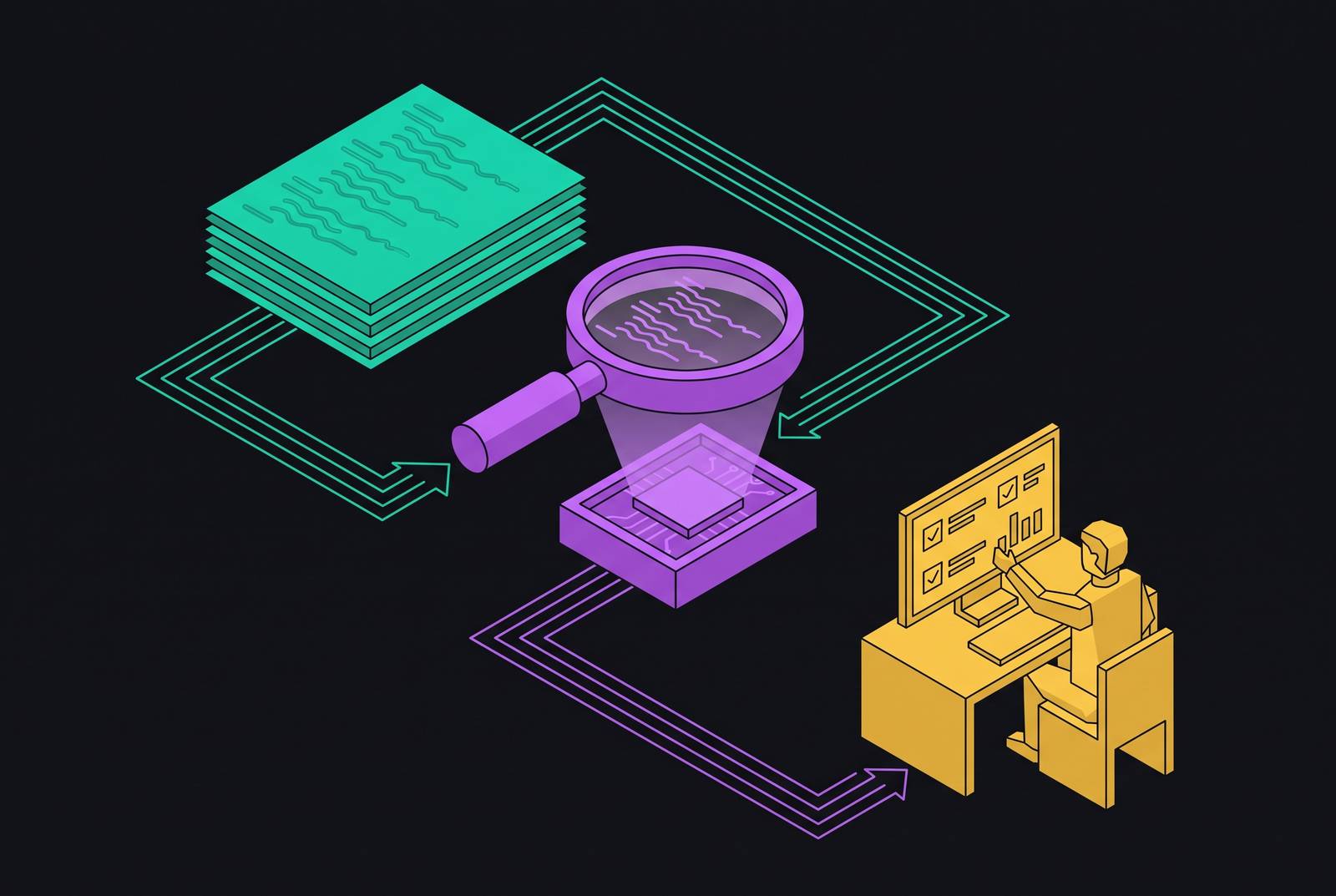
Automated source code analysis and human researcher validation are not two ways of doing the same job. They cover different failure modes on the same attack surface, and a security program only works when both are present. Automation operates at scale: it traces every user-controlled input through HTTP entry points, application logic, function call chains, and dangerous sinks, a kind of coverage no human team could match at that speed or breadth. Humans do the opposite kind of work. They reason about what a business is trying to do, chain small findings into attack paths that matter, and confirm whether a flaw can actually be used against a real target.
The April 2026 SoK study of LLM-based AutoPT frameworks puts hard numbers behind this split. It found that retrieval results can easily send an automated agent down the wrong exploration path, that adding more tools to an agent's toolkit does not reliably improve its ability to carry out a penetration test, and that AI coding agents can perform remarkably well using only general tools and simple prompts. That last finding cuts both ways: it shows how far automation has come, and it shows the ceiling just as clearly. Automation can get further on less than people expect, but it still hits a wall that requires a different kind of reasoning to get past.
A platform built only on automation produces findings nobody has confirmed. Hybrid platforms exist because neither approach alone can close the gap between finding something and proving it. The rest of this piece works through how that division plays out in practice: what the machine actually does, where the person takes over, and why that handoff is what makes a finding worth acting on.
Automated source code analysis inside a hybrid platform
Inside a hybrid platform, the automated layer usually takes the form of a white-box agent that reads source code directly. It traces user-controlled input starting at HTTP entry points, follows it through the application's logic and function call chains, and watches for where it lands in a dangerous sink. This kind of tracing catches things an outside scanner would never see: injection flaws buried in background tasks, authentication bypasses hidden in middleware configuration, business logic flaws that never produce an odd response for an external tool to notice.
That last category matters because of how dynamic application security testing (DAST) works. A DAST scanner probes an application from the outside and can only flag a visible behavioral difference in that application. Code-informed testing does not have that limit. Because it reads the actual source, it can find problems that never surface in any response a user or an attacker would see from outside.
Intruder's white-box agents work this way in practice: they connect directly to a GitHub or GitLab repository, so every test runs with full knowledge of the real source code. There is no schema to upload. The agent maps endpoints and APIs on its own and reports findings down to the exact file and line number. On top of that, gray-box agents add authenticated access, so they can test whether a logged-in user can reach resources meant for someone else, manipulate identifiers to surface IDOR vulnerabilities, or exploit weak points in how sessions are handled. None of that is visible to a black-box scanner working from outside with no account access.
The same SoK study that showed automation's strengths also marks where it runs out of road. It found that stable exploitation of public CVEs depends on knowledge that has to be kept current, not knowledge baked into a model at training time, and that when an agent's tools are restricted, the workarounds it tries have limited effect on hard penetration testing tasks. Automation reasons well most of the time, but its reasoning can be steered wrong by bad retrieval or outdated assumptions.
Secrets buried in git history show this ceiling clearly. A SAST tool that only checks the current state of a repository, its HEAD, will miss a credential that someone deleted from a config file two years ago but that still sits in every commit before the deletion. That secret is invisible to a scan that only looks at HEAD, and it is fully retrievable by anyone with access to the repository's history. Finding it takes a person who knows to go looking there first.
Where human researchers take over
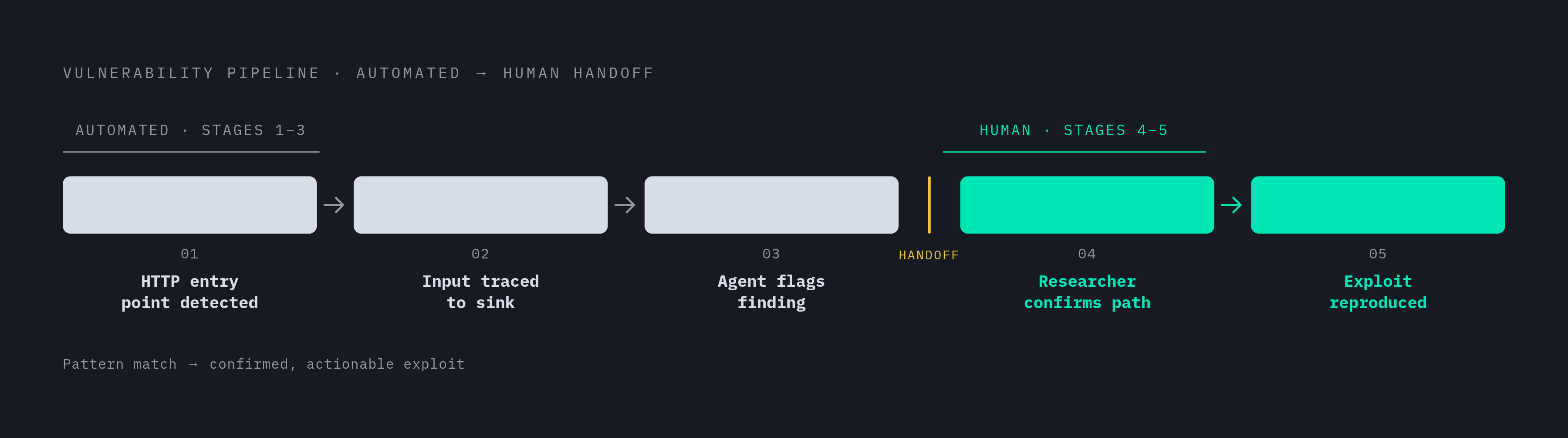
The human researcher's job in a hybrid platform is to do the things automation structurally cannot: confirm that a flaw is really exploitable, chain separate findings into a full attack path, and apply the kind of instinct that comes from having attacked real systems before. An automated scanner detects a pattern. An automated scanner flags a pattern; a person confirms whether it is reachable, exploitable, and actually dangerous in the context of the live application, and that confirmation is what separates a usable finding from a pile of scanner noise nobody can act on.
Chaining is where this matters most. A handful of low-severity findings, each one minor on its own, can combine into something critical, and spotting that combination takes someone thinking about the application as a whole rather than checking findings off a list one at a time. Business logic flaws make the same point from a different angle. No automated tool can encode what an application is supposed to do. Finding a business logic flaw means understanding the intended behavior first and then noticing exactly where the real implementation drifts from it, a task that depends on context no static rule can capture.
The mechanism that makes this handoff work, rather than just sound good, is a requirement for proof. XBOW requires every finding it reports to come with a working, reproducible exploit before it goes into a report, specifically to cut down false positives and prove that a flaw is real rather than theoretical. That requirement is the gate. A pattern match from an automated tool does not pass through it. A confirmed, working exploit does.
The strongest pushback on this setup is a fair one: if the automated layer is already producing working exploits, what is left for a person to add? Judgment about scope, judgment about blast radius, and a narrative that ties separate findings into a picture an engineering team can actually act on: that is what a person adds. Those are the parts of a penetration test report that decide whether the findings in it get fixed or get ignored.
Why auditors and compliance frameworks require human validation
Compliance frameworks only accept penetration testing as real security evidence when a human researcher has validated the findings in it. A raw vulnerability scan, no matter how thorough, does not meet the same bar. SOC 2, HIPAA, and ISO 27001 each include audit-related criteria that a penetration test can help satisfy, even though none of the three formally requires one. Auditors reviewing these engagements can tell automated scan output apart from a test that proves an application's defenses hold up against someone actually trying to break in.
The risk runs in one direction. A test that looks like a checkbox exercise, an automated scan with no exploitation confirmation behind it, can get rejected outright, and the organization ends up paying for a retest and losing the time it needed to close out its compliance work on schedule. A test that proves its findings with working exploits, reviewed and signed off by a certified researcher, satisfies the compliance requirement and the actual security question at the same time. There is no tension between the two.
A rigorous pen test's letter of attestation carries weight with enterprise customers and auditors for the same reason. Its credibility comes from the named person who reviewed it. When the methodology is sound, audit-readiness and real security reinforce each other: the same findings, proven with working exploits, are what an auditor wants to see and what an engineering team needs in order to know what to fix first.
The vulnerability classes where the hybrid model's two layers each pull their weight
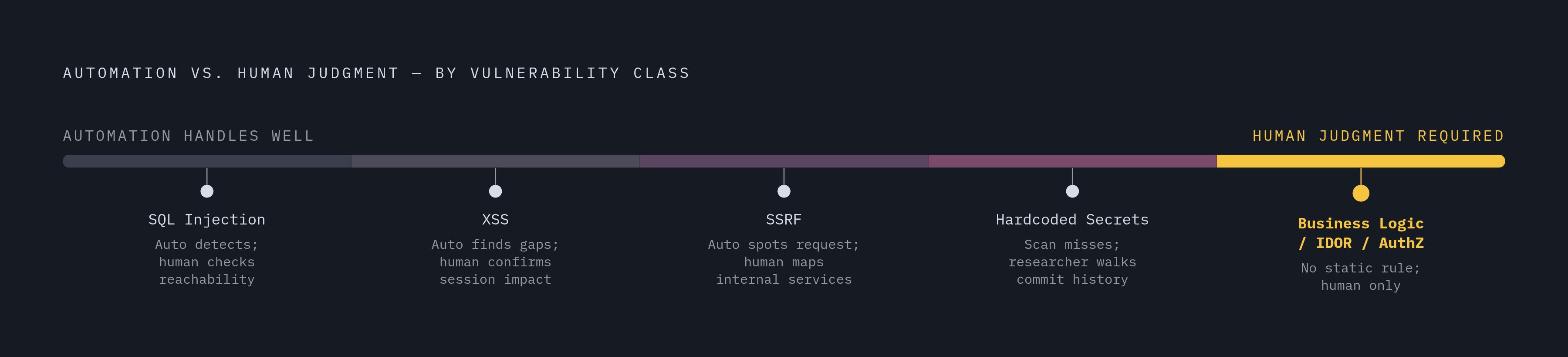
Different vulnerability classes show this division of labor in different proportions, and walking through them in order, from the ones automation handles well to the ones it cannot touch, makes the shape of the argument concrete.
SQL injection sits closest to the automation end. Static analysis reliably catches cases where untrusted user input reaches a SQL query without parameterization, a pattern-matching task automation handles at real scale. A human still has to determine reachability of the vulnerable code path and what data an attacker could pull out through it.
Cross-site scripting works similarly. Automated tools find where user-controlled input gets rendered without proper output encoding. Confirming whether that gap turns into session theft or stolen credentials in the live application is where a person's judgment comes in.
Server-side request forgery (SSRF) sits a step further along. Automated tracing can spot a server-side request being built from a user-supplied URL. What that request can actually reach, whether an internal service or a cloud metadata endpoint holds credentials worth stealing, depends on the permission structure of the specific cloud environment, and working that out takes a person who understands how that environment is set up.
Hardcoded secrets in git history sit near the human end of the spectrum. A scan scoped only to the current state of a repository misses them by design. Finding them takes a researcher who deliberately walks back through the commit history and pulls out credentials that were deleted from a config file but remain visible in every commit before that deletion, fully retrievable by anyone with access to the repository.
Business logic and authorization bypass sit furthest from anything automation can encode. No static rule captures what an application is supposed to do for its users. IDOR vulnerabilities, broken object-level authorization, and workflow bypasses all require an attacker who understands the intended behavior of the system and goes looking for the place where the real implementation diverges from it. This is the category where a human researcher adds the most value that nothing else can replace.
How a hybrid platform changes the CI/CD remediation workflow
Folding hybrid testing into a CI/CD pipeline turns security from a once-a-year audit event into an ongoing feedback loop, but only if the remediation process is rebuilt to keep pace with it. The technical stack behind continuous hybrid testing usually runs three layers together: SAST for code-level issues like injection flaws and weak cryptography, DAST for runtime issues like broken access control and authentication bypass, and software composition analysis (SCA) for vulnerable dependencies. Manual expert review still sits on top of all three, because business logic flaws keep slipping past automated tools no matter how those tools improve.
Once a researcher proves a finding and the team fixes it, that finding can turn into an automated regression check that runs on every future release. The team does not have to rediscover the same issue twice, and the effort spent finding it the first time keeps paying off on every build after.
The hard part is what happens to remediation once testing goes continuous. Continuous testing produces a steady stream of findings, and that stream needs a remediation process built to match it. Organizations that built their remediation workflow around one annual batch of findings often discover that simply running tests more often does not improve security. It just builds a backlog. Testing cadence and remediation cadence have to change at the same time, or the extra testing becomes extra noise.
Scanning at the pull-request level closes the loop at the earliest point possible. A vulnerability caught before code merges costs a fraction of what the same bug costs once it ships, and the developer who wrote it is still thinking about that code when the finding comes back. A direct channel between the engineering team and the researchers doing the testing is required: not a static PDF report but a live line where findings get triaged, questioned, and retested inside the workflow the team already uses every day.
Evaluating a platform that claims to combine automation with human validation
A buyer can find the gap between a genuine hybrid platform and an automated scanner dressed up as a penetration test before signing a contract by asking a short list of direct questions. Start by asking whether the vendor can provide a working proof-of-exploit for every finding in a report. A vendor who cannot answer yes without hedging is running a scanner and calling the output a pen test. Ask who actually does the testing and what their credentials are. The statement of work should name the lead tester and list their certifications before a contract is signed.
Ask how the vendor handles business logic and authorization bypass testing specifically, since the answer reveals whether a real person is doing real reasoning or whether the entire engagement is pattern-matching dressed up in a report template. Ask whether the platform uses source code access, and press on how. Not every platform that claims white-box testing reads code the same way, and understanding what evidence the platform actually produces from that access is part of any serious evaluation. Ask about the retesting policy after remediation. A vendor that charges full price to retest findings it already identified once is not built for the continuous model that hybrid testing is supposed to deliver.
A few signals should end the conversation. Per-IP or per-page pricing is one of them: real manual testing does not scale in a straight line per IP address, so pricing structured that way usually means the vendor is running an automated scanner and billing by volume of output. A report full of words like "potential" or "possible" attached to vulnerabilities, with no exploitation confirmation behind them, means the provider never actually validated those findings by hand. A quoted timeline that is too short for the stated scope is another: real manual testing on a mid-sized SaaS application and its API cannot happen in a few business days, and a vendor willing to quote that timeline is planning a shallow engagement dressed up as a full one.
The sourcing of a platform is a methodology choice. XBOW routes each task to whichever model handles it best and adopts new frontier models as they ship, which is a concrete picture of what "model-agnostic" means in practice and why it matters to a buyer who wants testing that keeps improving as the underlying technology does. A platform worth buying combines direct access to source code repositories, cloud configurations, and product documentation with human expert review and sign-off on every finding, and produces a report built to hold up in front of auditors working against SOC 2, HIPAA, or ISO 27001. That combination, automated reach paired with human proof, is what separates a hybrid platform from a scanner wearing a pen test's name.