AI-Assisted Pen Testing vs Traditional Manual Testing Compared
AI agents handle continuous testing where annual pen tests leave months of code untested.
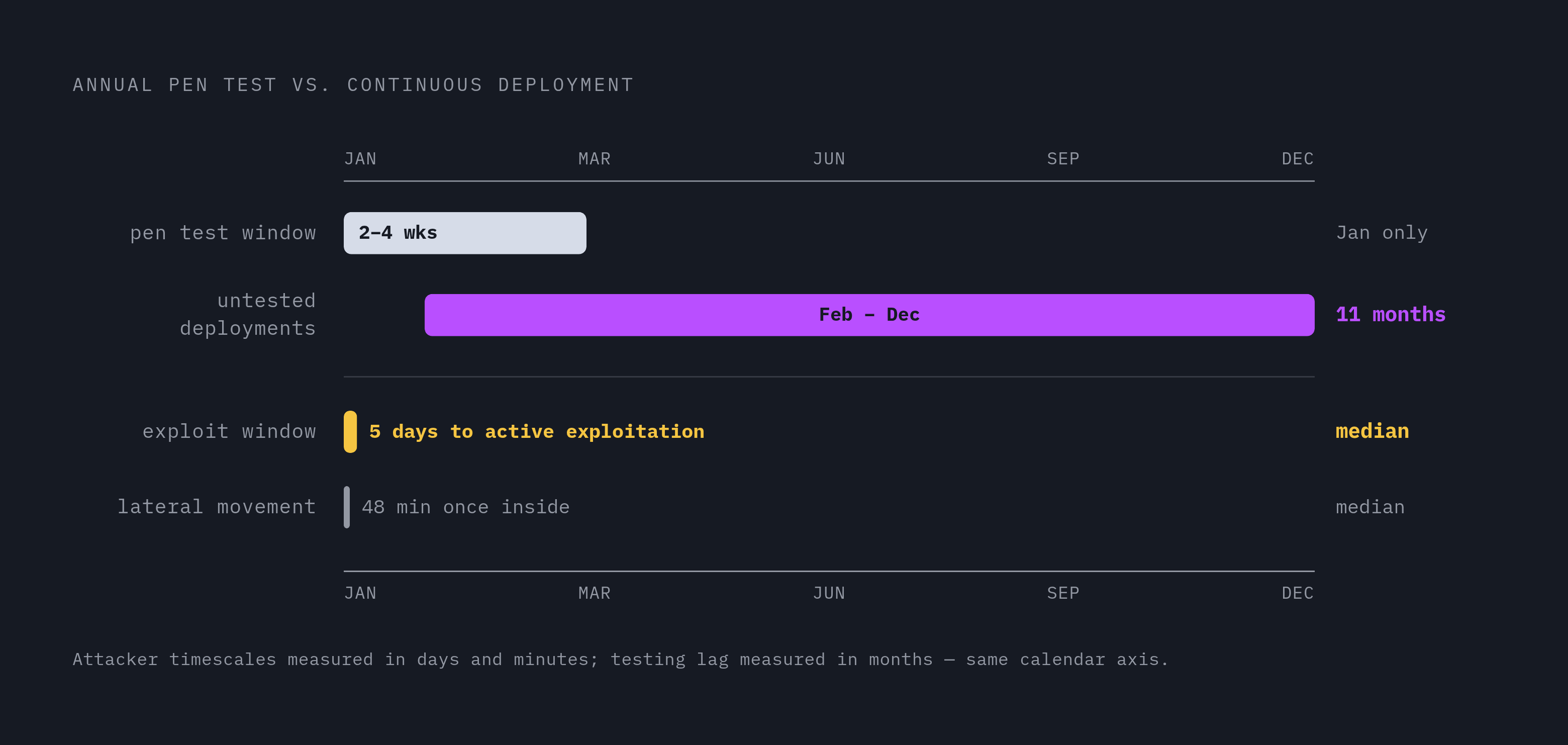
The annual pen test model broke because software stopped shipping on an annual schedule. Teams push code weekly, sometimes daily, and the gap between a flaw shipping and someone exploiting it has shrunk to almost nothing. Vulnerability discovery now turns into active exploitation in about five days, and once an attacker gets a foothold, the median time to move laterally inside a network is 48 minutes. Neither number leaves any room for a testing process that takes two to four weeks to schedule, run, and write up.
Think about what that timeline actually does to coverage. A pen test run in January checks the code as it existed in January. Everything shipped from February through December ships untested, a consequence of a point-in-time check meeting a continuous deployment pipeline, not a scheduling slip or a lazy vendor. It's what happens when a point-in-time check meets a continuous deployment pipeline.
The cost structure locks this in further. A standard enterprise web-app engagement runs into the tens of thousands of dollars, and a full-stack, enterprise-grade or red-team engagement costs a good deal more than that. At that price, no growth-stage company tests every release. Annual becomes the ceiling on frequency, not the floor, and human testers physically cannot keep pace with a modern DevOps pipeline pushing out changes several times a week.
That's the opening AI-assisted testing was built to fill. Figuring out what it actually fills, and what it leaves open, means looking closely at what these tools do differently from the scanners that came before them.
What AI pentesting agents do differently from earlier scanners
A vulnerability scanner asks one kind of question: does this specific, known-bad thing exist in this system? An AI pentesting agent asks a different one: what happens if these three minor findings get chained together into something serious? Reasoning versus lookup changes what the tool is capable of finding.
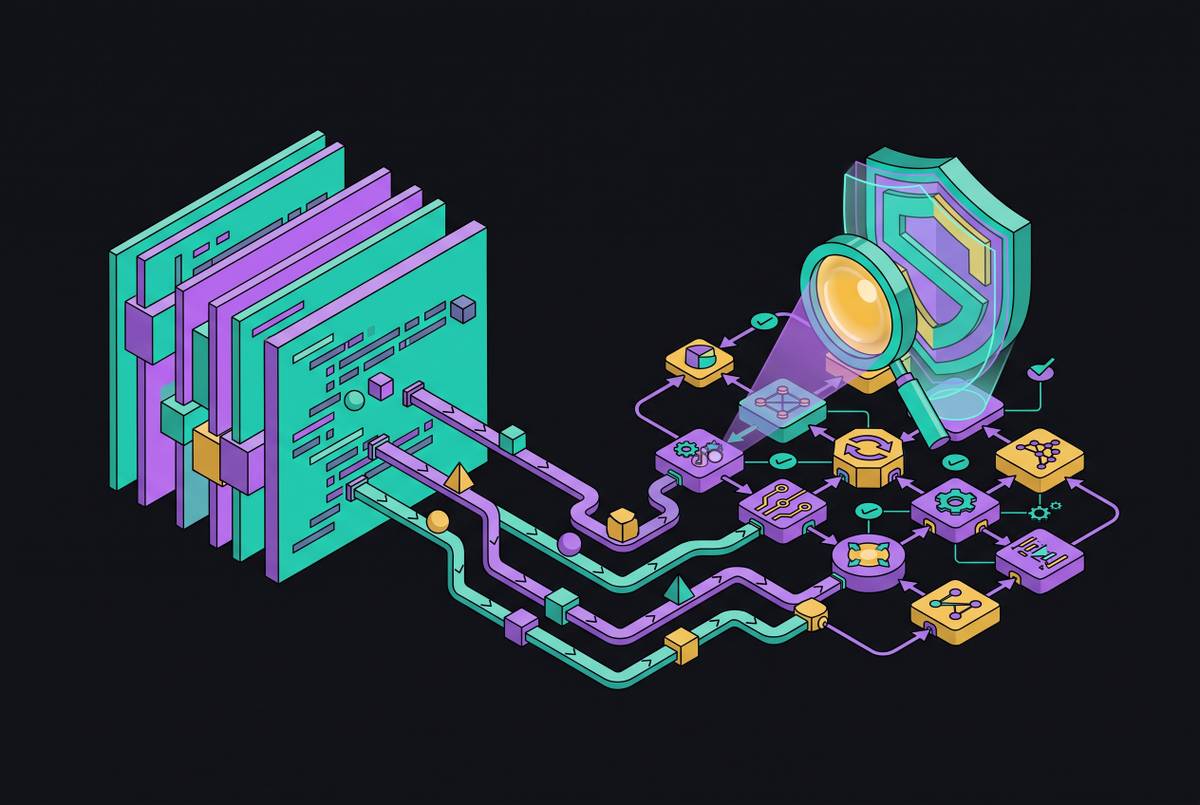
Most of these agents run on what's called a ReAct loop. The agent looks at the current state of the target, picks an action, runs it, reads what came back, updates its working theory of the system, and does it again. As of April 2026, at least 39 open-source projects follow this basic pattern, ranging from a single lightweight agent bolted onto a language model up to multi-agent swarms with dedicated roles for planning, reconnaissance, exploitation, and reporting.
The multi-agent setups tend to win when the task gets complicated: HPTSA's hierarchical teams achieved a 4.3× improvement over monolithic agents on zero-day exploitation, and D-CIPHER solved substantially more MITRE ATT&CK techniques. Splitting the work across specialized roles, in other words, produces better outcomes than asking one model to do everything.
None of this happens in a vacuum. The agents still rely on the same professional toolkit human testers use, tools like Nmap, Metasploit, Burp Suite, and Nuclei. What changes is who decides which tool to run and when. A traditional automated scan follows a fixed script from start to finish. An agent picks its next move based on what the last move revealed, closer to how a human tester actually works through a target.
That distinction carries through to how findings get reported. A well-built agent doesn't file a finding on suspicion. If it can't get a working proof of exploitation, it doesn't report the issue at all, and that discipline is what keeps false-positive rates down compared to older scanning tools that flag anything that looks suspicious on paper.
What the benchmarks show about AI agent capability
The published benchmarks tell a more complicated story than the marketing decks do, and the gap between lab performance and real-world exploitation is the whole story here. GPT-4 exploited 87% of one-day CVEs when it was handed the advisory description ahead of time. Strip away that scaffolding and the numbers fall off a cliff: agents solved only a small fraction of real CVEs in CVE-Bench, and almost none of the harder HackTheBox challenges.
That collapse happens for a specific reason. Benchmarks usually hand the agent a pre-scoped target and tell it what to look for. Real engagements don't come with that kind of structure. An agent working a live system has to figure out what's worth testing in the first place, not just execute a known attack against a known target, and that reconnaissance and scoping judgment is still where human testers hold the edge.
None of this means the capability is fake. An autonomous agent reached the top of a major bug bounty platform's US leaderboard on the strength of a large volume of validated submissions, and a separate system outperformed 9 of the 10 human testers it competed against on a live enterprise network. The ceiling on what these agents can do keeps climbing, and it's climbing fast.
Anthropic's Mythos Preview model, released in April 2026, found thousands of zero-day vulnerabilities across every major operating system and browser, many of them critical. Anthropic decided the model was too capable to release broadly. That decision cuts two ways at once. The capability is genuinely there. So is the risk of turning something that powerful loose without controls around it.
A #1 ranking on a bug bounty leaderboard doesn't settle the argument for full autonomy. Bug bounty platforms hand an agent a known scope with clear rules of engagement, basically a fenced-off sandbox built for exactly this kind of testing. A production enterprise application offers none of that structure. Scope is ambiguous, business logic varies by company, and someone needs to be accountable for the audit trail when a regulator asks who signed off on a finding. No agent on the market handles that combination reliably yet.
Where AI-assisted testing genuinely outperforms manual work
None of the gaps above erase the places where AI-assisted testing beats manual work outright, and those places aren't marginal. Speed, raw surface coverage, and the ability to validate continuously rather than once a year are structural advantages that no amount of skilled human labor can replicate on the same budget.
Reconnaissance is the clearest case. An AI tool can sweep over 100,000 IP addresses in a single autonomous run and, in controlled test environments, reach full Domain Admin access in a matter of seconds. A human tester working the same scope would need days to cover that ground manually.
Chaining delivers value in a less obvious way: it finds combinations of low-severity flaws that individually look harmless but together open a serious path for attackers. Two low-severity flaws, on their own, might each get a shrug from a reviewer. Chained together, they can hand an attacker full domain admin access. Finding those chains requires pattern-matching across a large attack surface at a scale a time-boxed manual engagement simply can't cover in the hours allotted.
Continuous, pull-request-level scanning closes the exposure window that point-in-time testing leaves wide open. Instead of waiting for next year's scheduled engagement, every code change gets evaluated as it lands. Jyoti Raval, Director of Cyber Security Engineering at Baker Hughes, has pointed to exactly these categories as where AI already performs well: automated reconnaissance, low-hanging-fruit discovery, threat intelligence correlation, fuzzing, exploit generation, and documentation. These are volume tasks. They eat hours out of a skilled tester's week without needing much judgment to execute, which makes them a natural place to hand off to a machine.
Where human expert judgment cannot be substituted
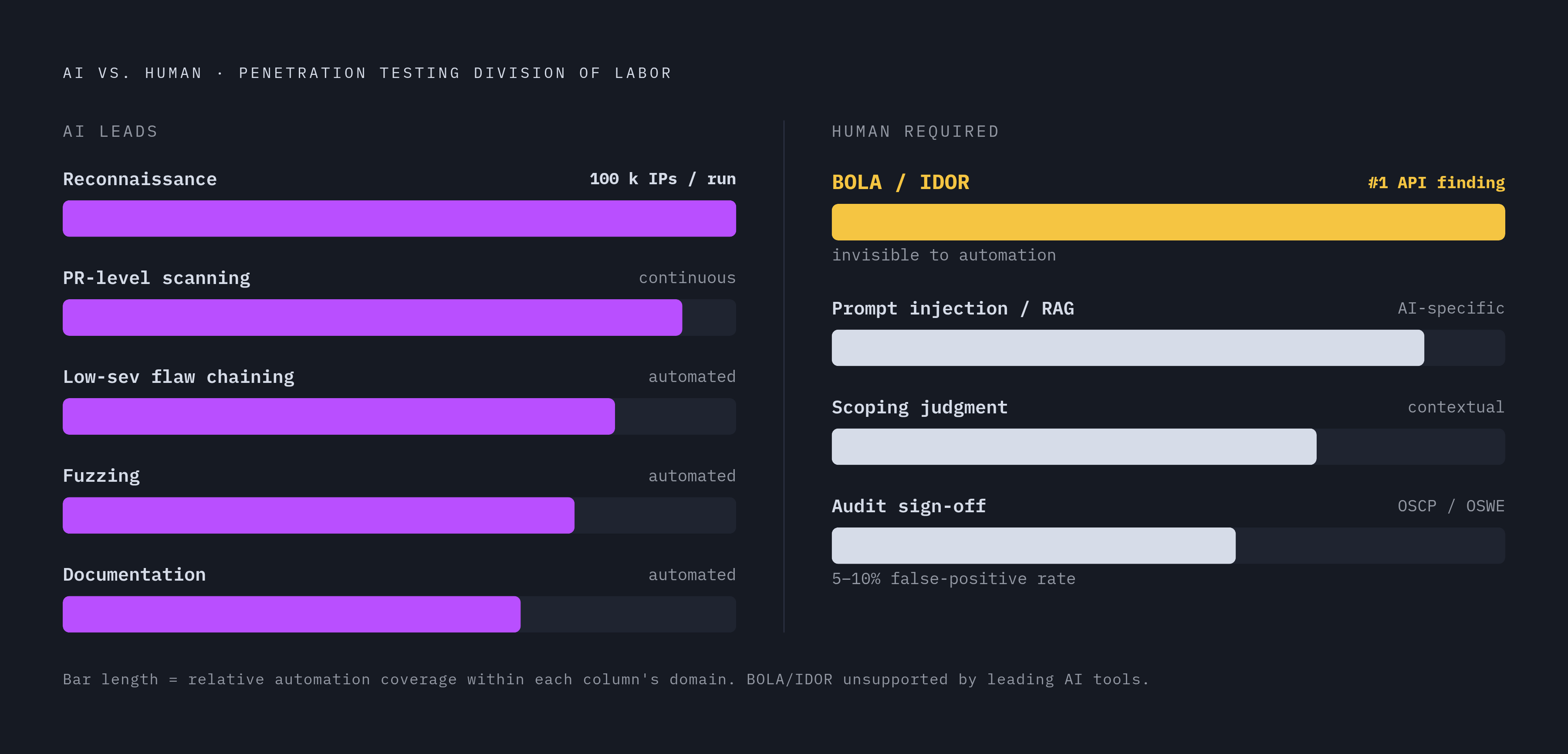
Four areas separate what AI agents handle well from what still needs a trained person in the loop: business logic, the new attack surfaces AI systems themselves introduce, scoping judgment, and accountability to auditors.
Business logic flaws are the clearest example. Broken Object Level Authorization, authentication bypass, and authorization logic errors are invisible to technical anomaly detection. They occur when the application does what it was coded to do, but that behavior violates what it was supposed to do for a specific business context. Several leading tools explicitly note no business logic vulnerability detection, including BOLA and IDOR, as a current limitation, and BOLA is the most common and impactful API finding in modern applications. Spotting it requires understanding the business the application serves.
Judgment problems appear elsewhere in similar form. DOM-based XSS in single-page applications and the newer XSS-to-prompt-injection chains showing up in AI-integrated products both slip past automated scanners, because catching them means tracing how the application renders dynamic content and how it wires into a language model's instruction handling. That's judgment work built on understanding a specific system's architecture, not pattern matching against a signature list.
AI systems have also created an entirely new category of risk that doesn't map onto the older penetration testing playbook at all: prompt injection, indirect prompt injection, instruction hierarchy bypass, agentic tool misuse, model privilege escalation, and RAG pipeline manipulation. A tool trained to spot broken authentication has no frame of reference for spotting a cleverly poisoned document that hijacks an LLM's behavior three steps downstream.
Scoping carries its own kind of risk. Underscope an engagement and critical assets never get touched. Overscope it and testing can knock over a production system that customers depend on. No agent currently on the market reliably negotiates scope boundaries, sets its own stop controls, or carries the professional liability insurance that matters once testing starts deliberately breaking live systems.
Accountability closes the loop. SOC 2 auditors, HIPAA reviewers, and ISO certifiers want findings signed by a credentialed human, typically someone holding an OSCP or OSWE certification, who personally reviewed and attests to each one. Manual penetration testing holds false-positive rates to roughly 5 to 10% under 2026 industry benchmarks, and that low rate gives an expert's signature on a report evidentiary weight that raw agent output can't match on its own.
How the strongest modern approach divides work between AI and human testers
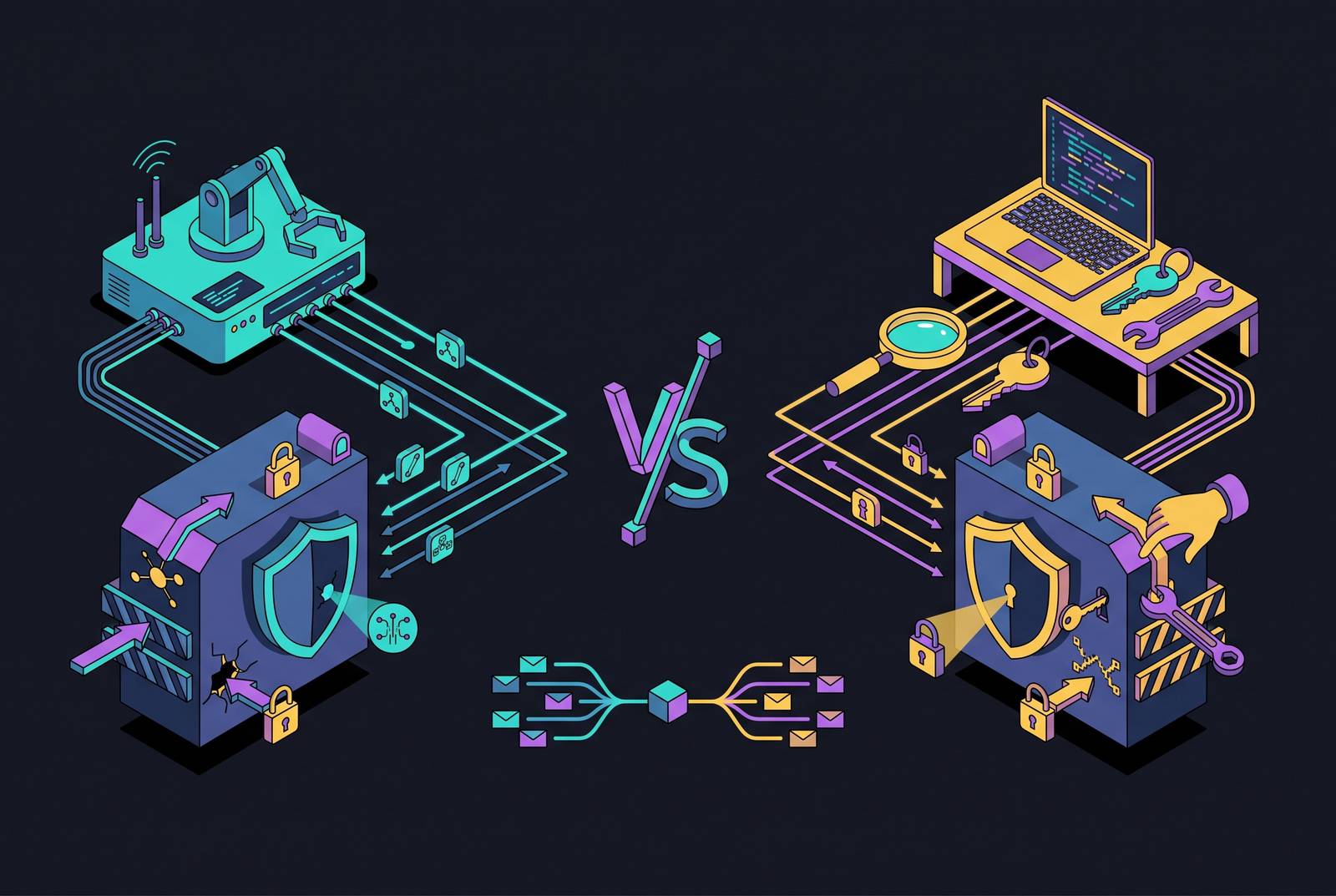
The framing that holds up in practice is a defined division of labor. It's a defined division of labor, with AI carrying volume, coverage, and continuous checking, and human experts carrying judgment, business context, and the sign-off that auditors accept.
In the strongest security programs, AI pentesting runs the continuous validation layer, standard web application checks, and API testing, closing the exposure window between scheduled audits, while manual testing gets reserved for business logic review, adversarial scenario design, and any report headed for external scrutiny.
Access level changes what the agent can actually see. Pointed only at a live, running application, an AI agent behaves like a sophisticated blackbox tester, working from the outside with no more visibility than an attacker would have. That's where the speed advantage really compounds.
The cadences complement each other rather than compete. Continuous, PR-level scanning by an AI agent catches regressions the moment they're introduced. A scheduled whitebox engagement by a certified human tester covers the business logic, authorization architecture, and multi-stage chained paths the agent doesn't catch. Run side by side, they cover ground the other one leaves open.
No single approach wins across every dimension that matters. AI wins on turnaround time and false-positive rate. Business context and exploit validation get shared between both. Audit-ready accountability still requires a human signature. Any finding bound for a compliance report or a customer-facing attestation still needs a person to confirm it's exploitable, judge its business impact, and put a name on the letter. The working exploit is the proof. The expert's signature is what makes that proof count for something in front of an auditor.
Evaluating whether a vendor delivers combined testing or sells one as the other
The real purchasing risk in 2026 is paying for raw automated output dressed up as expert-reviewed findings, or paying premium manual rates for work that AI could handle faster and cheaper.
A few direct questions expose the gap fast. Ask what percentage of the engagement is manual testing versus automated scanning, and ask which specific certified testers will actually be assigned to the work. Vendors doing this right name their testers and list credentials. A vague reference to "our certified team" with no names attached is a sign the human layer is thinner than the sales pitch suggests.
Watch for one specific red flag: raw automated output handed over without any human review behind it. Anything destined for a compliance report needs a person to confirm the proof of concept and weigh the business impact. Agent output on its own, no matter how clean it looks, doesn't clear that bar.
Scoping conversations reveal operational maturity on both sides of the table. A thorough scoping process covers target IP ranges, application URLs, user roles, testing windows, systems explicitly excluded from testing, and for AI agents, enforced scope boundaries and a stop control that halts the agent before it damages something in production. A vendor that quotes a flat fee without asking detailed questions about the environment first is very likely underscoping the work before it even starts.
Ask for a redacted sample report next. A report built on genuine human-AI collaboration should show which findings came from automated agent runs, which ones a human confirmed by hand, and what the resulting attestation actually covers, so it's possible to see the division of labor rather than take a vendor's word for it.