Communicating Pen Test Findings to Non-Technical Stakeholders
Security findings stay unfixed because executives can't understand what they mean for the business.

A critical finding sits unpatched for months. Nobody disagreed with the severity rating. The security team flagged it, the engineers acknowledged it, and still nothing moved, because the person who controls the budget never understood what the finding meant or what fixing it would actually prevent. That's the real failure behind most stalled remediation efforts: not bad findings, but findings nobody outside the security team can act on.
A finding rated "Critical" in a CVSS table tells a CFO nothing about whether to delay a product launch. A recommendation to "remediate insecure deserialization" tells a compliance officer nothing useful while she's preparing a SOC 2 Type II response. These are precise, technically correct statements written in a language that doesn't reach the people who hold the budget or the compliance deadline. These findings are deprioritized when that happens, remediation stalls, and the same vulnerabilities turn up again in next year's test.
There's a second cost beyond the technical debt. When non-technical stakeholders can't connect a finding to something that affects the business, they stop treating the report as a plan and start treating it as paperwork, something produced to satisfy an auditor once a year. That shift in how the report gets perceived does real damage to how seriously security gets taken inside the company. Fixing it starts with understanding who actually reads the report and what each of them needs from it.
Who is in the room and what each person needs from you
A pen test report usually travels to at least three different audiences, and each one has a different job to do with it and a different appetite for technical depth.
Executives and board members, including CEOs, CFOs, and board audit committees, are making resource decisions: how much budget to approve, what level of risk the company is willing to carry, whether to move forward on an enterprise deal or a compliance certification. They don't need CVSS scores, CVE identifiers, or a walkthrough of an exploit chain. They need to know what the findings mean for the business.
Compliance officers and legal counsel have a narrower, more specific job: deciding whether findings create a reportable gap under SOC 2, HIPAA, ISO 27001, or whatever framework applies, and whether the evidence of remediation will satisfy an auditor. For this audience, findings need to map directly onto the controls they touch, with remediation status and verification spelled out clearly.
The mistake most security teams make is writing one report for all three groups, usually pitched at the engineering level, and then bolting on a short summary at the top that strips out the jargon without adding back any of the context that made the finding matter. That's the gap the rest of this article is built to close.
What the Executive Summary Must Accomplish
For most non-technical readers, the executive summary is the whole report. Nobody beyond engineering and compliance is going to read the findings section in full, so the summary has to carry the complete business argument on its own, without assuming anyone will dig deeper for context.
A strong executive summary looks different. It opens with a tight paragraph on scope: what was tested, when, by whom, and under what methodology, written so a compliance officer can confirm it matches what the auditor expects without reading further. It states the company's overall risk posture in plain language, not a tally of findings, but a clear picture of whether an attacker could reach a critical system as an authenticated user, as an outsider with no credentials, or only through a chain of several exploits. It names the two or three findings that carry the most business risk, described by what an attacker could do and what the company stands to lose, not by vulnerability class or CVSS vector. It gives a compliance snapshot: which frameworks are touched by the findings, and whether the remediation plan restores or maintains the company's standing. And it ends with a specific ask: the budget decision, the timeline adjustment, or the disclosure call the executive needs to make, and by when.
Translating individual findings from vulnerability descriptions into business risk statements
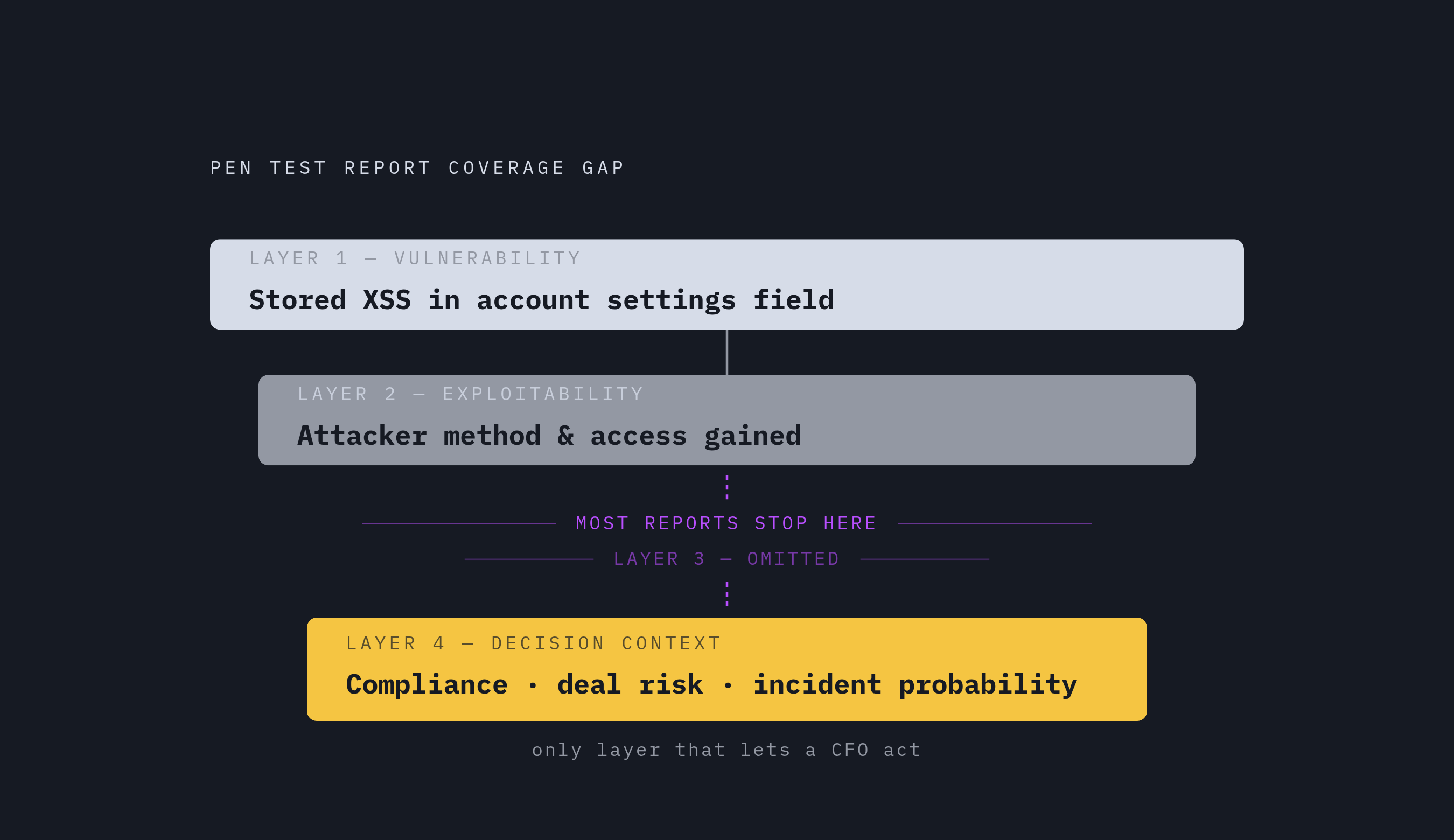
Every finding carries four layers, and most reports only write down the first two.
The vulnerability itself is layer one, for example a stored cross-site scripting flaw in the account settings field. Layer two is exploitability: how an attacker would actually use it and what access they'd gain by doing so. Layer four is decision context: what fixing or ignoring the finding means for compliance standing, customer trust, deal risk, and the odds of an incident. That fourth layer is what lets a non-technical reader actually decide something, and it's almost always the layer missing from the report.
A few worked examples show how the translation runs in practice. A SQL injection flaw starts as unsanitized input passed to a database query, but at layer four it means an unauthenticated attacker could pull the entire customer database, and if that happens before SOC 2 certification closes, the breach notification alone would end the audit cycle and put every customer contract under review. An SSRF flaw in a cloud environment starts as a server fetching a user-controlled URL without checking it, but at layer four it means an attacker could reach the cloud provider's metadata endpoint, grab IAM credentials, and take over the cloud account entirely, the exact pattern behind several major cloud breaches. Business logic flaws, like an authorization bypass or a manipulated workflow, start as behavior that deviates from the intended design under adversarial use, but at layer four they're the findings most likely to get exploited by an attacker who actually understands the product, since automated scanners miss them entirely, and they're the findings most likely to create contractual liability if customer data is involved.
Across all five, the same formula holds: an attacker who exploits this can do X; for the business, that means Y; the compliance implication is Z; fixing it takes this much effort and prevents this specific loss.
How severity ratings mislead non-technical audiences
CVSS scores measure technical exploitability and scope. They don't measure business impact in a specific company's environment. A Critical score on an internal tool with no outside exposure doesn't carry the same risk as a Critical score on a customer-facing login page, but to a non-technical reader, both labels say the exact same word: Critical.
That mismatch produces two opposite failures. Another executive looking at a report full of Medium findings may conclude nothing urgent needs attention, when one of those Medium findings sits on a system handling customer payment data. Both conclusions can be wrong, because CVSS was never built to answer the question that actually matters: what do we fix first, given what this company does and what it has to lose?
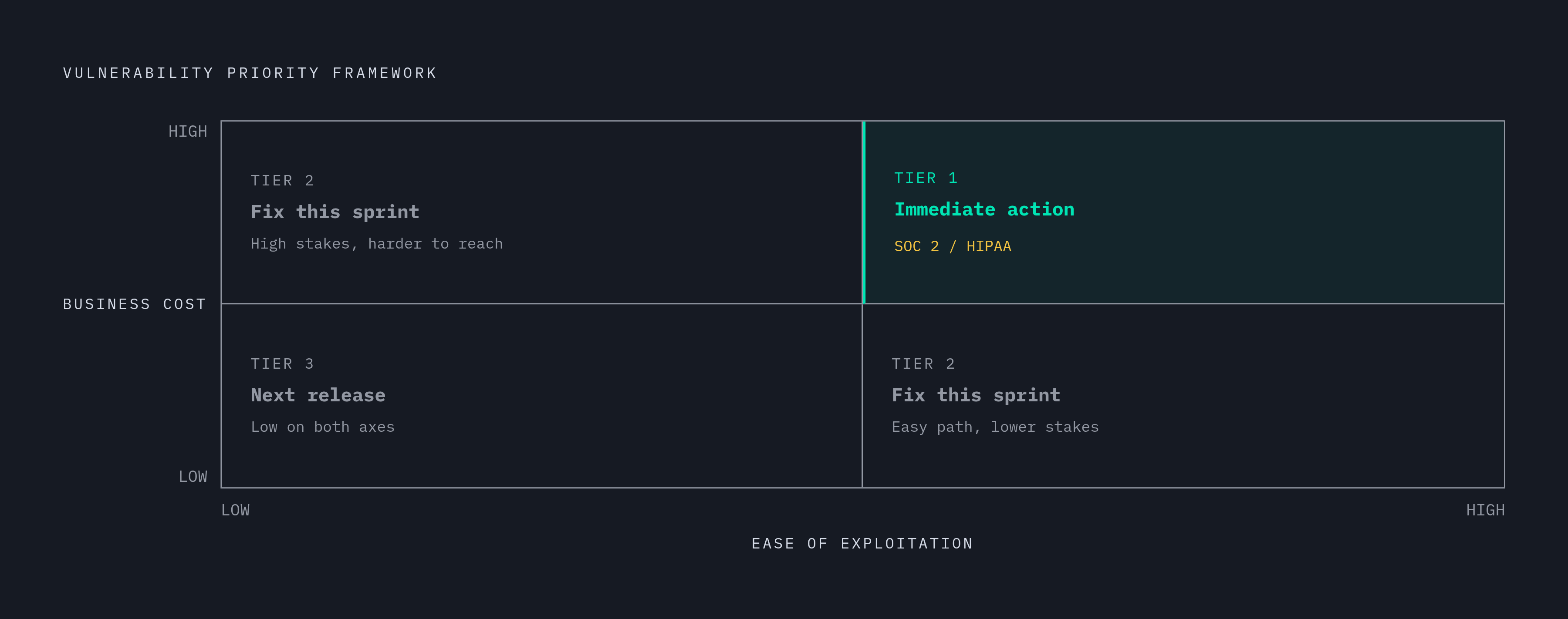
The fix is to present severity along two dimensions a non-technical reader can actually use: how easy the flaw is to reach and use, and what it costs the business if someone does. From there, a simple three-tier system does the real work: immediate action required, for findings that are exploitable now and carry high business consequence; fix within the current sprint, for findings that are either less severe in consequence or harder to reach; and fix in the next release cycle, for findings low on both counts. Each tier should also say when it touches a SOC 2 or HIPAA control, because that one line turns a security recommendation into a compliance obligation, and compliance obligations get budget approved faster than security recommendations do.
None of this means dropping CVSS scores from the report. They still belong in the full findings section, for the engineering team and for auditors who expect to see them. Stripping them out entirely would hurt the report's credibility with exactly the readers who rely on that detail.
Structuring the remediation section so stakeholders can track progress without reading technical tickets
A remediation section written only for engineers gets tracked only by engineers, and everyone else loses visibility into whether the risk identified three months ago has actually gone down.
Each finding also needs a one-sentence remediation description written in plain language next to the technical steps, something like "Rotate the exposed API key and implement secrets scanning in the CI/CD pipeline," so a non-engineer can follow what's happening without translating the ticket themselves.
The section also needs to say clearly what retesting will cover: which findings get verified with a follow-up test, on what timeline, and what evidence that retest will produce. No finding should count as closed until a retest verifies the fix, and every ticket should carry proof-of-concept payloads and asset metadata so the person doing the fix isn't stuck chasing the security team for basic context.
This matters for more than internal tracking. A remediation section built this way is part of what makes a report acceptable to a SOC 2 Type II auditor, who is reviewing a period of time, not a single snapshot, and wants to see that findings got fixed and verified across that window. An auditor who finds the same finding with a signed risk acceptance reads it as a decision.
Running the readout meeting when the audience is mixed
The readout meeting is the highest-leverage moment in the entire pen test process, and most security teams run it as a straight technical walkthrough that loses the executives in the room within the first ten minutes.
A better structure opens with the business posture statement first: five minutes, no CVE tables on the screen, just the overall exposure level, the two or three findings that carry the most business consequence, and where the company stands on compliance. Only after that business summary wraps up should the conversation move into technical depth, and the shift should be announced out loud, something like, "For the engineering team, I want to walk through the exploitation chain on the two critical findings." Executives who've gotten what they came for can step out at that point, and the people who stay have chosen to be in a technical conversation.
Mixed audiences tend to ask the same handful of questions, and each one deserves a direct answer. And "Is our vendor or partner responsible for any of this?" comes up often in SaaS environments with third-party integrations, and deserves an answer scoped to the facts.
What breaks a mixed readout is reading the findings list top to bottom, reciting straight from the report, or pushing business-impact questions off to a follow-up call. Each of those moves signals that the translation work never got done, and it puts that work back on the audience least equipped to do it.
The Underlying Test's Quality
None of the translation work in this article means anything if the underlying finding can't be proven. A finding that can't be demonstrated with a working exploit can only be described as a theoretical possibility, and non-technical stakeholders are right to discount theoretical possibilities when they're deciding what to spend money on.
Every technique described here depends on findings that meet a basic bar. They need to be verified as exploitable, not inferred from a scanner flagging a known CVE, because "this CVE is present" and "an attacker can use this to reach your customer data" are two different claims, and only the second one gives a reader something to act on. They need to come from a tester with access to the full attack surface, including source code, cloud configuration, and API documentation, because testing limited to the outside perimeter misses the business logic flaws, authorization bypasses, and hardcoded secrets that tend to carry the most business consequence and that automated tools can't find on their own. And they need review and sign-off from a qualified expert before they ever reach a stakeholder, because a compliance officer or enterprise customer who later learns a finding was a false positive loses trust in the whole report, and that trust doesn't come back with a better-designed slide.
A report built on unverified scan results can't be turned into credible business risk statements no matter how carefully it's written. The translation work amplifies whatever signal exists in the underlying test; it can't manufacture signal that was never there. Whitebox testing in SaaS environments follows the same pattern: a test run with access to source code and cloud configuration produces findings a writer can turn into specific, provable business consequences, while a blackbox scan of the external perimeter produces a list of possibilities the writer can only describe as such.
For a technical founder or CTO evaluating a testing provider, the questions worth asking are the same questions that decide whether the eventual report will hold up in front of a board or an auditor: Was every finding confirmed with a working exploit? Did the tester have access to source code and cloud configuration, not just an external IP range? Is retesting built into the engagement to confirm remediation actually worked? And is a certified expert standing behind the findings with their name on it? A pen test that answers yes to all four produces a report someone can act on. One that doesn't produces paperwork.