Tools That Test Tenant Boundary Enforcement Across Request Pipelines
Three testing techniques reveal cross-tenant data leaks application scanners miss.
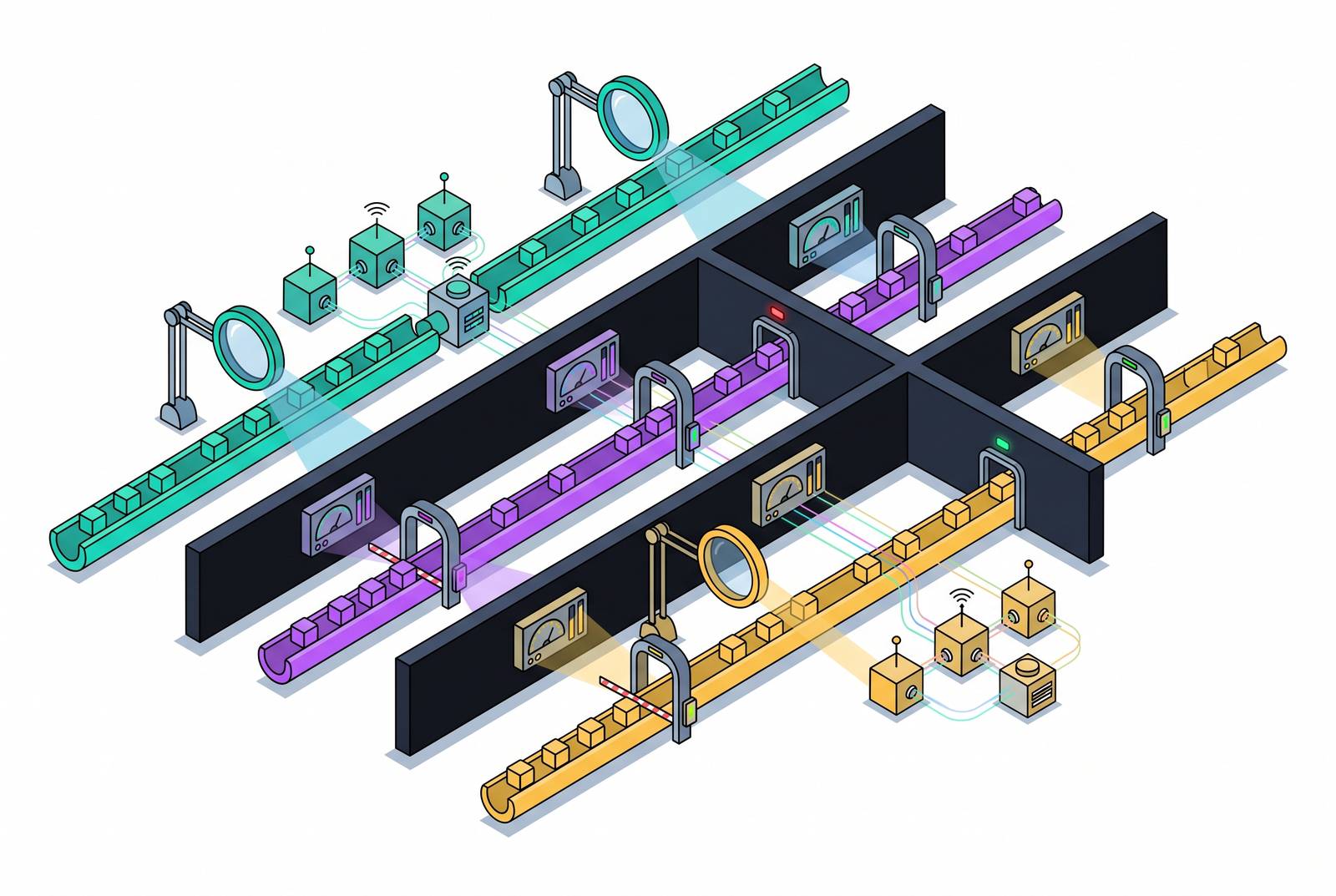
Testing how tenant boundaries hold across request pipelines takes three techniques that work together, proxy-based session manipulation, authorization fuzzing, and source-aware analysis. A generic scanner cannot expose a cross-tenant flaw if it never brings two tenant contexts into the same request flow. The right testing pipeline creates that interaction, scales it across the application, and reads the logic that responses alone cannot reveal.
Why generic scanners cannot see cross-tenant failures
A single-session scanner is limited to sending requests as one customer, leaving untested the two-tenant request pair that makes a tenant boundary failure visible by establishing whether another customer's credentials would unlock the same records. Running that scan continuously does not change its architecture. More repetitions of a one-tenant test do not produce a two-tenant test.
The boundary itself lives in application logic, including a tenant_id check, a JWT claim, or a row-level security policy. Separate servers and network segmentation are not substitutes for those checks in a shared application. A signature-based scanner looks for known patterns, while a cross-tenant test asks whether the authenticated tenant has a right to the requested data. That distinction matters because a broken boundary can expose customers' records, credentials, and billing data across the platform, extending the damage beyond one session.
Where in the request pipeline tenant boundaries actually break
The first chokepoint is the API layer, where object IDs and tenant-identifying parameters meet the authenticated session. Single-record routes are only part of that surface. Bulk exports and reporting endpoints can reach the same data through handlers with weaker tenant scoping. The database layer then controls access to the requested data within the caller's boundary. In a shared database with row-level security, a SQL injection or ORM misconfiguration that bypasses tenant-scoping filters can turn one broken path into a platform-wide breach.
Schema-per-tenant designs rely on privileges between schemas, and dedicated instances still need IAM and storage controls even though they have a smaller blast radius. Shared infrastructure adds further handoffs, including caches that need tenant-specific keys and background workers that must preserve and revalidate tenant context. At the container layer, Kubernetes namespaces alone do not provide sufficient separation without network policies and pod security controls. In the admin plane, support tools cross tenant boundaries by design, so the test must tell allowed access from access that goes too far.
Proxy-based session manipulation as the foundational technique
An HTTP proxy gives the tester control over the interaction that a single-session scanner cannot create. The core operation is simple. Capture a legitimate request from Tenant A, then replay it authenticated as Tenant B while retaining the reference to Tenant A's resource. If that replay returns Tenant A's private data, it demonstrates a boundary failure. The test targets the relationship between identity and resource.
Burp's “Match and Replace” and session-handling rules allow credential substitution across a request sequence. A tester can follow Tenant A's API workflow while inserting Tenant B's credentials mid-stream. ZAP's authenticated scanning and session-switching features support this approach for an open-source stack. These operations expose targets such as object IDs in URLs or bodies, tenant IDs in headers, and manipulated JWT claims. Each target requires a deliberately constructed request that challenges the application's authorization decision.
Wiz Research's 2021 ChaosDB disclosure concerned unauthorized access to other customers' Azure Cosmos DB instances. ExtraReplica exposed another isolation failure in Azure Database for PostgreSQL Flexible Server. These cases illustrate why normal-path behavior is not enough to establish isolation, although they are not evidence that a proxy alone covers database-service exploitation. Proxy replay creates the adversarial two-context condition at the HTTP layer. Its limit is scale, because repeating that work across hundreds of endpoints requires scripting and automation.
Authorization fuzzing across tenant-parameterized endpoints
Authorization fuzzing takes a controlled replay and runs it across the application. It changes tenant-identifying parameters while keeping two authenticated tenant sessions on hand to compare the results. Those parameters include object IDs, workspace IDs, account tokens, and header values. Their positions matter as much as their names because tenant context can appear in path segments, query strings, request bodies, and custom headers. A fuzzer that changes only URL paths leaves the other positions untouched.
Burp Suite Pro's Intruder supports repeated requests with varied inputs. The Autorize extension automatically replays requests with a second session's cookies and flags responses that appear to succeed when authorization should fail. Scripted tools such as ffuf can iterate over enumerated object IDs with two credential sets, which is useful for REST APIs with predictable or sequential identifiers. The same approach can test role boundaries by sending a viewer-role token to an admin endpoint or a member-role token from one tenant to another tenant's admin route.
These tools expand the reach of tests for IDOR and BOLA, where access to an object is not properly tied to the caller's authority. Response codes and body differences cannot show whether the returned resource is private or shared on purpose. A tester still has to interpret the result against the application's data model. That judgment becomes much stronger when the authorization logic is available to read.
Source-aware analysis and why whitebox access changes what is findable
The single-record handler may use a tenant filter while an export handler queries the same table without it. Behavioral testing can miss that difference if it never exercises the export path or cannot distinguish the contents of a large response. Source review can reveal the missing WHERE tenant_id =? directly. The missing check exists whether or not the test window produces a visible leak.
An ORM abstraction can strip a filter applied earlier in query construction. A cache key without a tenant identifier can let Tenant B receive Tenant A's cached response. A background job can carry tenant context when enqueued but reach a worker that does not revalidate it. Reading those handoffs traces response changes to where the boundary is lost.
Semgrep with custom rules and CodeQL can flag database access without tenant-scoping predicates or object access without an authenticated-tenant check. Those rules must fit the application's data model, since an off-the-shelf definition of tenant isolation is not enough. Cloud configuration review extends that work to IAM policies, S3 bucket ACLs, and database privileges between schemas. Prowler and ScoutSuite can find cloud permission errors and cross-account access paths that HTTP testing does not show.
Secret scanning built into the repository can find hardcoded credentials and long-lived API keys that give direct data-store access and bypass application checks. Key management also needs a check because encryption at rest does not keep tenants in separate boundaries. Source and configuration access can show whether those boundaries exist or whether the platform relies on one shared key. Whitebox analysis therefore reaches beyond the behavior of the requests that happened to run.
How the three techniques combine into a coherent testing pipeline
The sequence starts with proxy work because automation needs a meaningful baseline. Manual session manipulation establishes how tenant context flows and what legitimate access looks like. Fuzzing then extends that model beyond a small sample to documented and undocumented endpoints. Source-aware analysis follows the authorization logic into paths that the requests did not exercise and checks whether cloud configuration supports the application's claimed boundary. These are complementary stages.
Without the proxy baseline, it is harder to tell whether response differences come from shared resources that the caller is allowed to use. Without fuzzing, manual sampling can miss an export handler or an undocumented partner API. Without source access, successful behavioral tests say nothing about dormant paths with missing checks. The combined pipeline turns isolated request results into an account of how tenant isolation is enforced, which is also the narrative an auditor needs.
Applying this to the hardest cases, including admin tooling, bulk endpoints, and Kubernetes boundaries
Admin and support tooling needs a different baseline because it may allow cross-tenant reading. The test must check whether that access extends to prohibited writes, bulk extraction, or tenants outside the account's allowed reach. Burp can replay a support token against tenant-scoped endpoints that should reject a non-admin session, while fuzzing extends those attempts across routes and roles. Source review then checks whether access controls hold across the admin codebase, including on routes that behavioral testing did not reach. Treating every cross-tenant response as a defect would miss the purpose of the test.
Bulk endpoints can break the common assumption that record-level authorization also applies to an export. An export or reporting query may have been built separately and lack the filter used by the original API. Fuzzing can return a 200 response with a large payload in both tenant contexts, so the result may still be unclear. Reading the export query's WHERE clause resolves whether tenant scoping is present. Each export, reporting, and bulk-action endpoint needs to be tested as its own isolation boundary.
Kubernetes requires a further change to cluster-testing tools. kube-bench audits cluster configuration against CIS benchmarks, while manual network policy review examines whether ingress and egress rules restrict cross-namespace traffic. Pod security controls address privilege escalation, and Falco or similar runtime tools can detect unexpected cross-tenant syscall patterns. Namespace separation without the required controls is not a complete boundary. Container escape paths need exploitation techniques built for the cluster and fall outside a general web application test, even when the same engagement covers both layers.
Why a point-in-time test cannot hold tenant isolation over a release cadence
A point-in-time test covers only the isolation model that existed during the test. A new endpoint can omit the established tenant-scoping pattern. An ORM refactor can drop a filter, or a cache change can remove the tenant identifier from a key. Continuous releases therefore create a structural gap in annual testing.
Astra's State of Continuous Pentesting Report 2026 frames APIs, cloud misconfiguration, CI/CD, and tenant isolation as attack surfaces that move faster than an annual cadence can follow. CI/CD also sits upstream of the controls being tested. Secrets in runner environments, over-privileged build steps, and poisoned dependencies can expose deployment authority, including the ability to alter isolation logic. Continuous pull-request scanning can flag changes to authorization on shared data paths as they enter the codebase. That catches regressions earlier, but it does not replace adversarial testing with two live sessions and the full three-stage method.
What a credible cross-tenant test report looks like, and why it satisfies auditors
A report that can be trusted starts by laying out the isolation model being tested, whether it uses a shared database with row-level security, separate schemas, or dedicated instances. It then records the attempted cross-tenant interactions, including the endpoints, varied parameters, sessions, and compared responses. Each finding needs a working exploit to substantiate its warning. Together, these details show what the test challenged and what the evidence proves. A single-session OWASP pass/fail summary cannot provide that account.
ISO 27001 Annex A 8.8 and 8.29 call for documented, risk-driven evidence of vulnerability management and security testing. The isolation model and the record of interactions do more to meet those requirements than a result on its own. PCI DSS 4.0.1, which became fully mandatory on March 31, 2025, calls for penetration testing at least once a year and after major changes to infrastructure. Service providers must validate segmentation every six months, and isolation-model documentation supports that evidence. The report must connect the tested boundary to the relevant compliance requirement.
At the scale of hundreds of endpoints and multiple tenant contexts, Trace is one option that combines direct repository access with multi-session testing to map tenant-boundary parameters across the codebase and automate the cross-tenant requests built manually in a proxy. Its working-exploit evidence and OSCP-certified expert sign-off carry that method into the report. The business payoff is a clear isolation narrative for both auditors and enterprise buyers in fintech, healthcare, and regulated B2B segments. When the report answers how customer data was tested for separation, procurement has evidence to assess instead of another questionnaire that delays the deal.